
What a yuru-kyara is
A yuru-kyara (ゆるキャラ) is a mascot character with a relaxed, unpolished look, usually created by a prefecture, city, tourist board or public body. The illustrator Jun Miura, who coined the term, has described the ideal as a character that carries a message of love for its home region, moves in an unsteady and distinctive way, and has a lovable looseness about it.
A closely related term is gotōchi kyara (ご当地キャラ), local character. Gotōchi is a polite word for this area or that locality, and you will see it on regional snacks, stamps and souvenirs as well.
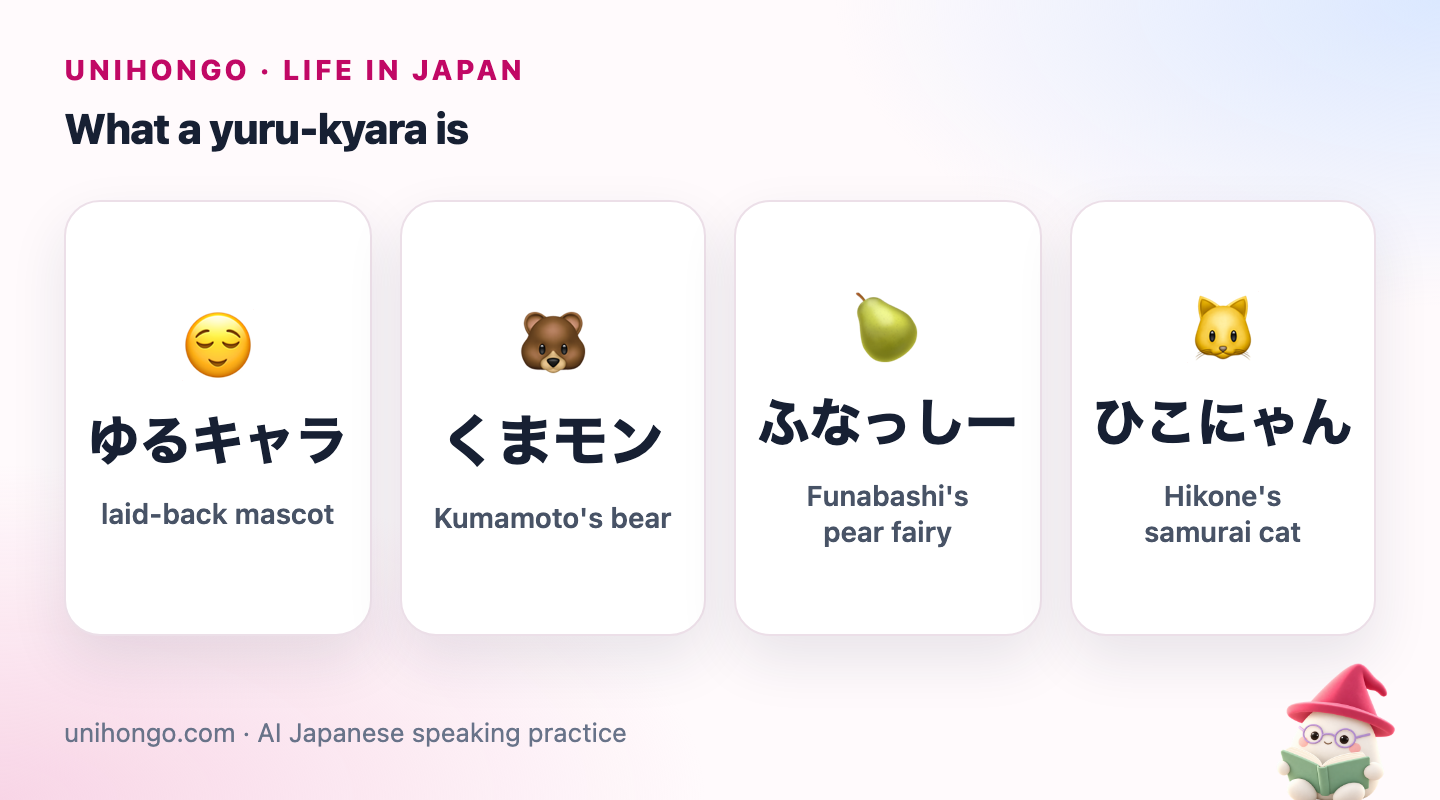
| Japanese | Romaji | Meaning |
|---|---|---|
| ゆるキャラ | yuru-kyara | laid-back mascot |
| くまモン | Kumamon | Kumamoto's bear |
| ふなっしー | Funasshī | Funabashi's pear fairy |
| ひこにゃん | Hikonyan | Hikone's samurai cat |
| ご当地キャラ | gotōchi kyara | local character |
Yurui: the word behind the name
Yurui (ゆるい) is an everyday adjective meaning loose or slack. Trousers that are too big are yurui, a screw that wobbles is yurui, and rules that nobody enforces are yurui. Applied to a mood or a person, it means relaxed and unhurried, often with approval. A yurui café is one where nobody minds how long you stay.
That positive sense is the one in yuru-kyara. The character is not sharp, cool or perfectly drawn, and that is the appeal.
| Japanese | Romaji | Meaning |
|---|---|---|
| このズボンはゆるい。 | Kono zubon wa yurui. | These trousers are loose. |
| ルールがゆるい。 | Rūru ga yurui. | The rules are lax. |
| ゆるい雰囲気 | yurui fun'iki | a relaxed atmosphere |
Kumamon: Kumamoto's bear
Kumamon is a black bear with round red cheeks, created by Kumamoto Prefecture ahead of the opening of the full Kyushu Shinkansen line. He won the national Yuru-kyara Grand Prix in 2011 and became one of the most recognised characters in Japan, appearing on everything from sweets to stationery.
The name is a three-layer pun. Kuma (熊) is bear, and it is also the first half of Kumamoto (熊本). Mon is the local way of saying mono (者), person, so Kumamoto-mon means someone from Kumamoto. The prefecture has even given him job titles, including sales manager.
Funassyi and Hikonyan: a pear and a samurai cat
Funassyi (ふなっしー) calls itself a pear fairy from Funabashi (船橋) in Chiba. The name blends Funabashi with nashi (梨), the Japanese pear the area is known for, and the character ends its sentences with nasshī to match. Funassyi was created by a private citizen and is not an official city mascot, which is part of the legend: it jumps, shrieks and chats on TV in a way official characters rarely do. The usual spelling in Latin letters is Funassyi.
Hikonyan (ひこにゃん) is the white cat of Hikone (彦根) in Shiga, created for the 400th anniversary of Hikone Castle in 2007. Nyan is the Japanese cat sound. He wears a red horned kabuto (兜), the helmet of the Ii clan who ruled Hikone, and his design recalls a legend in which a cat beckoned a lord of that clan into a temple just before a thunderstorm.
| Japanese | Romaji | Meaning |
|---|---|---|
| 梨 | nashi | Japanese pear |
| 船橋 | Funabashi | Funabashi, a city in Chiba |
| 彦根 | Hikone | Hikone, a city in Shiga |
| にゃん | nyan | meow |
| 兜 | kabuto | samurai helmet |
Why towns, police and companies want a mascot
A mascot gives a place a face. It can appear at events, on local products and on social media, and visitors remember a bear more easily than a slogan. A popular character also sells goods, and some regions let businesses use their character on packaging to spread it further.
Public bodies use characters to soften their image. The Tokyo Metropolitan Police Department's Pīpo-kun, whose name joins people and police, appears on police boxes and safety leaflets. Fire departments, railway companies and city halls do the same. In Japan a cute character on an official notice is not seen as childish; it is a way of saying please read this.
Mascot vocabulary
| Japanese | Romaji | Meaning |
|---|---|---|
| 着ぐるみ | kigurumi | full-body character costume |
| マスコット | masukotto | mascot |
| ご当地 | gotōchi | this locality, local |
| グッズ | guzzu | merchandise, goods |
| 公式 | kōshiki | official |
| 非公認 | hikōnin | not officially recognised |
| 限定 | gentei | limited, exclusive |
Kōshiki appears constantly online: kōshiki saito is an official site and kōshiki guzzu are official goods. Gentei is the word that sells souvenirs: Kumamoto gentei means available only in Kumamoto.
What to say when you meet one
Mascots turn up at stations, festivals and shop openings, usually with a human attendant. The attendant is the one to speak to, and polite forms are right.
| Japanese | Romaji | Meaning |
|---|---|---|
| かわいい! | Kawaii! | So cute! |
| ゆるくていいですね。 | Yurukute ii desu ne. | Nice and laid-back, isn't it? |
| 癒されます。 | Iyasaremasu. | It's so soothing. |
| 一緒に写真を撮ってもいいですか。 | Issho ni shashin o totte mo ii desu ka. | May I take a photo together? |
| このキャラクターの名前は何ですか。 | Kono kyarakutā no namae wa nan desu ka. | What is this character's name? |
| グッズはどこで買えますか。 | Guzzu wa doko de kaemasu ka. | Where can I buy the goods? |
| ここの限定ですか。 | Koko no gentei desu ka. | Is this sold only here? |
Iyasareru (癒される) is the passive of iyasu, to heal or soothe. People say it about pets, hot springs, quiet music and mascots: anything that takes the tension out of the day.
Mascot manners
- Ask before taking a photo together, and wait your turn in the line.
- Do not pull, hit or hang on the costume; the person inside can see very little.
- Most mascots do not speak. Wave, bow or offer a high five instead.
- Do not ask about the person inside in front of children. Fans treat the character as real, and playing along is part of the fun.