
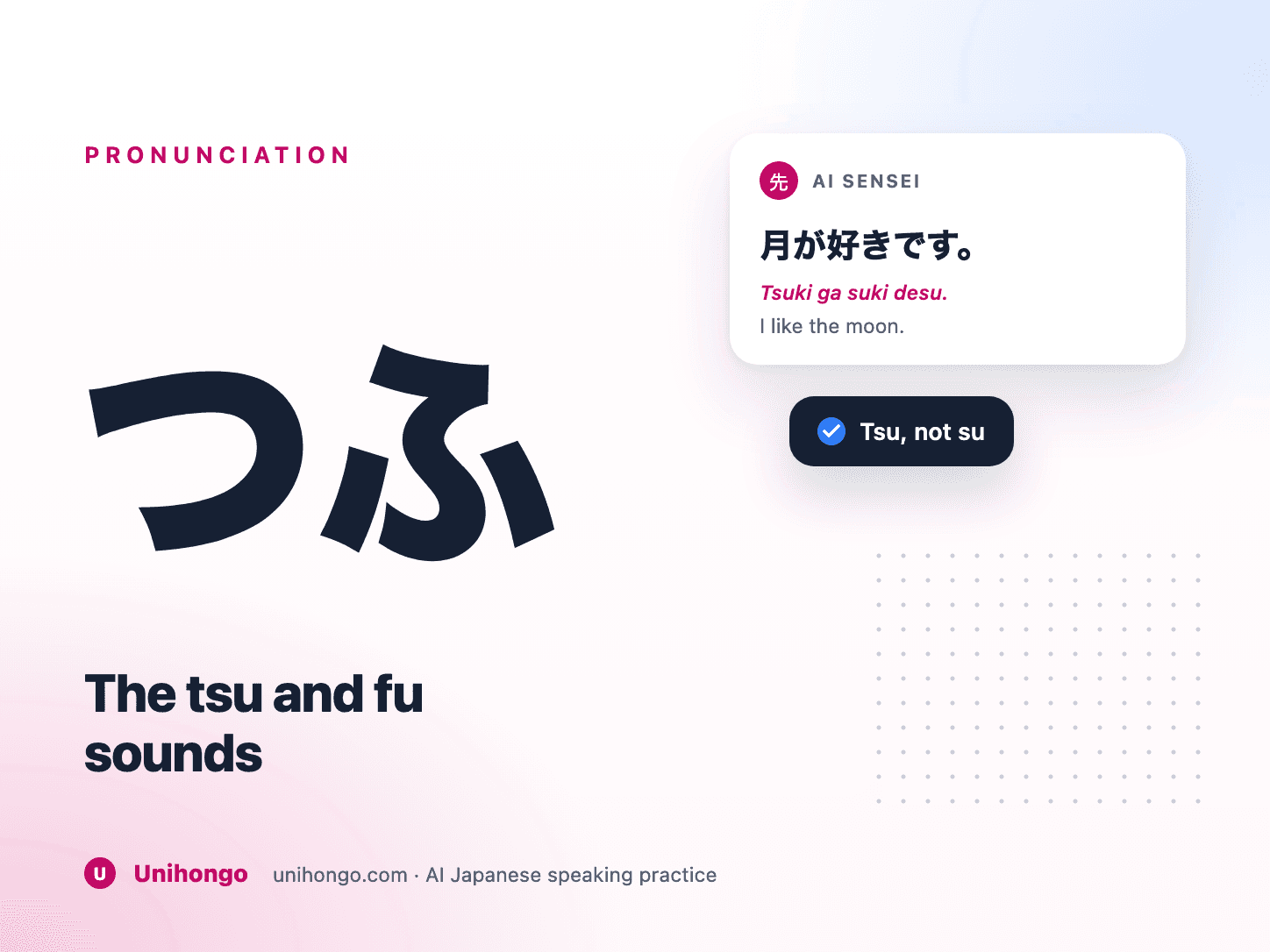
Two sounds English only half has
Neither sound is exotic. English speakers produce ts constantly in words like cats and bits, and an f-like breath through the lips when blowing on hot food. The problem is that Japanese places these sounds where English never does, so the mouth reaches for the nearest familiar sound instead.
That is why these errors survive long after grammar has improved: they are habits of position, not of knowledge.
Tsu at the start of a word
Make tsu by touching the tip of your tongue just behind your top teeth, as for t, then releasing into s without a gap. The t and the s happen as one sound.
Start from a position you already have. Say cats, hold the final sound, then add u. Then move the sound to the start of a word.
| Japanese | Romaji | Meaning |
|---|---|---|
| いつ | itsu | When |
| なつ | natsu | Summer |
| くつ | kutsu | Shoes |
| つき | tsuki | Moon |
| つくえ | tsukue | Desk |
| つかれました。 | Tsukaremashita. | I am tired. |
The substitutions that change words
| Intended sound | Common substitution | Why it matters |
|---|---|---|
| Tsu | Su | Moon can become the word for liking; next can become too much |
| Tsu | Chu | Commuting to school can sound like middle school |
| Tsu | A plain t with a vowel | The word can sound clipped or unfamiliar |
| Fu | An English f with the teeth | Understood, but sounds noticeably foreign |
| Fu | A strong h | Can sound like a different syllable in fast speech |
Minimal pairs to drill
Minimal pairs train both your ear and your mouth. Say each pair slowly, then quickly, and ask whether a listener could tell them apart.
| Japanese | Romaji | Meaning |
|---|---|---|
| 月 | tsuki | Moon |
| 好き | suki | Liking, to like |
| 次 | tsugi | Next |
| 過ぎ | sugi | Past, too much |
| 鶴 | tsuru | Crane (the bird) |
| する | suru | To do |
| 通学 | tsūgaku | Commuting to school |
| 中学 | chūgaku | Middle school |
Record yourself saying the list in a random order and play it back a day later. If you cannot tell which word you said, the listener cannot either.
Fu: lips, not teeth
Make fu by rounding your lips gently and blowing air through the narrow gap, with your teeth out of the way. It is softer than an English f and has no buzz of the teeth against the lip.
A good image is blowing out a candle without much force. The vowel after it is a relaxed Japanese u, not a rounded English oo.
| Japanese | Romaji | Meaning |
|---|---|---|
| ふたつ | futatsu | Two things |
| ふゆ | fuyu | Winter |
| ふく | fuku | Clothes |
| ふじさん | Fujisan | Mount Fuji |
| ふとん | futon | Futon |
| ふつうです。 | Futsū desu. | It is normal. |
Fu and tsu in loanwords
Katakana uses fu with small vowels to write foreign f sounds, and the same lip sound applies. Tsu with a small vowel writes sounds like ts in foreign words.
| Japanese | Romaji | Meaning |
|---|---|---|
| ファイル | fairu | File |
| フォーク | fōku | Fork |
| フィルム | firumu | Film |
| カフェ | kafe | Café |
| ツアー | tsuā | Tour |
| ツナ | tsuna | Tuna |
Putting the sounds into sentences
Individual words improve fastest; sentences are where old habits return. Once pairs feel steady, practise short sentences at normal speed, then have a conversation where you are not thinking about pronunciation at all.
Unihongo's pronunciation lab generates drill lines for your level and scores the sounds and mora timing of each recording, showing which mora slipped. Follow it with a conversation with your AI Sensei, and check the session report's corrections for any word that was misunderstood.
| Japanese | Romaji | Meaning |
|---|---|---|
| 次の月曜日は都合がいいです。 | Tsugi no getsuyōbi wa tsugō ga ii desu. | Next Monday suits me. |
| 冬は服を二枚重ねて着ます。 | Fuyu wa fuku o nimai kasanete kimasu. | In winter I wear two layers of clothes. |