
What the phrase is actually doing
Broken into pieces, nihongo jōzu desu ne is simply Japanese, skilful, is, isn't it. Jōzu means skilled at something, and the ne invites agreement. Grammatically it is a compliment. Socially, in the situation where learners meet it most, it works more like an opening move: it acknowledges that you are speaking Japanese, signals goodwill, and gives the other person something friendly to say to a stranger.
That explains the timing. The phrase very often arrives after konnichiwa or a single order in a cafe, long before anyone could evaluate anything. It also explains why it does not stop as you improve. It is not a rung on a ladder that you climb past; it is a piece of small talk attached to the fact that you are a foreigner speaking Japanese.
| Japanese | Romaji | Meaning |
|---|---|---|
| 日本語お上手ですね。 | Nihongo ojōzu desu ne. | Your Japanese is good, isn't it. |
| 日本語がお上手ですね。どこで勉強しましたか? | Nihongo ga ojōzu desu ne. Doko de benkyō shimashita ka? | Your Japanese is good. Where did you study? |
| 発音がきれいですね。 | Hatsuon ga kirei desu ne. | Your pronunciation is beautiful. |
| よく勉強していますね。 | Yoku benkyō shite imasu ne. | You have studied a lot, haven't you. |
Why it starts to sting around the intermediate stage
At the beginning the phrase is pleasant. Around the point where you can hold a real conversation, many learners start to find it deflating, and the reason is worth naming. Praise that arrives regardless of what you said carries no information, so the better your Japanese gets, the more the compliment feels like a marker that you are still being treated as a guest rather than a participant.
It is worth separating the feeling from the intent. Almost nobody says it to remind you that you are an outsider. But the effect can still be tiring, and the practical answer is not to explain that to the speaker. It is to answer briefly and steer the conversation onto content, at which point the interaction becomes an ordinary one.
- The compliment is usually about effort, so it does not scale with your level
- Answering at length keeps the attention on your foreignness
- Answering briefly and adding a fact moves the conversation to normal ground
- With people you will see again, the phrase disappears on its own after a few conversations
Replies that always work
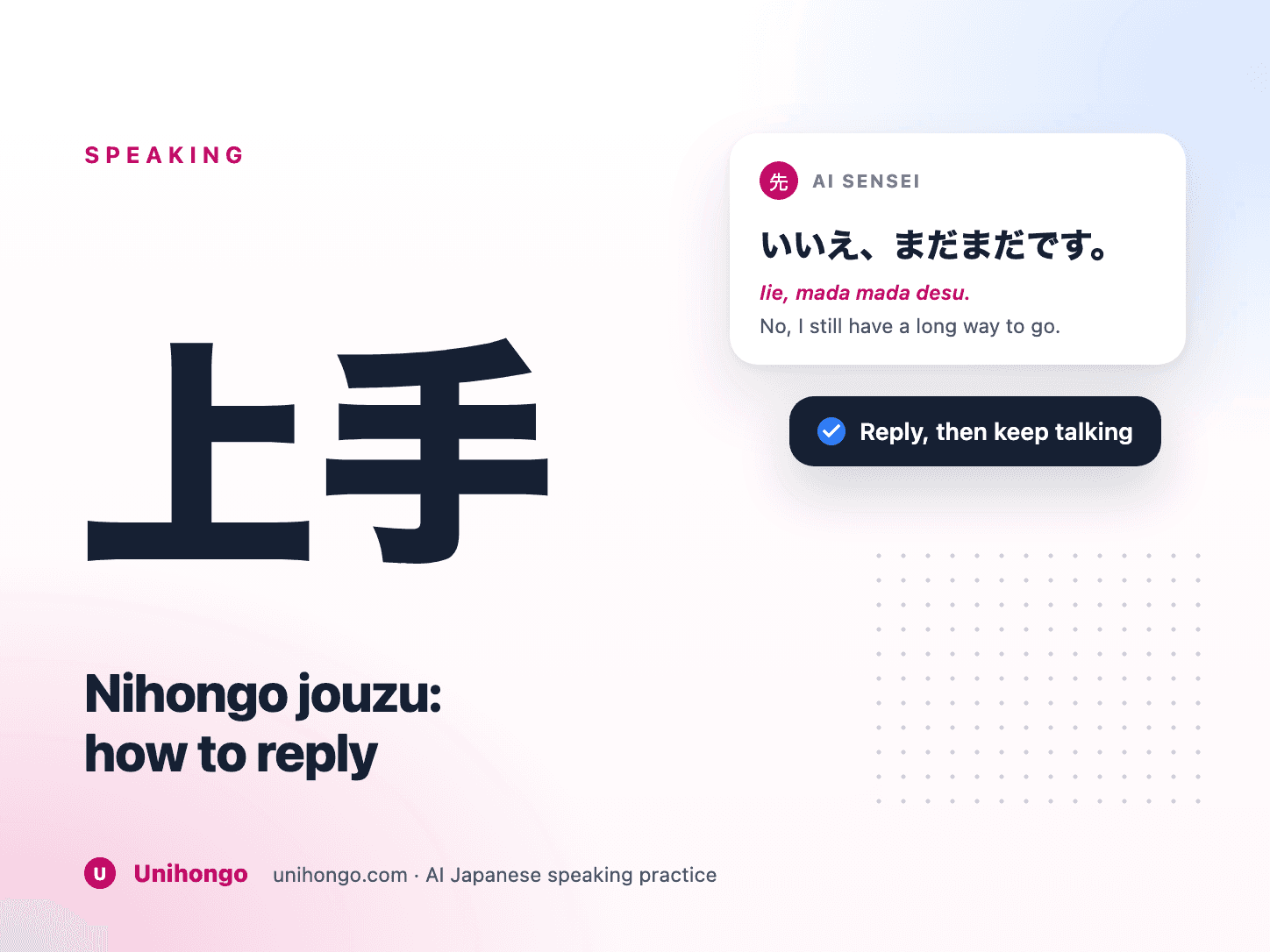
Japanese compliment responses lean modest, so the safest replies deflect a little. Mada mada desu, meaning I still have a long way to go, is the classic and never sounds wrong. Sonna koto nai desu is the same move in softer words. If you would rather be warm than modest, arigatō gozaimasu is completely acceptable and increasingly common, particularly among younger speakers.
The one to avoid is a long protest. Insisting several times that your Japanese is terrible obliges the other person to keep contradicting you, and the exchange stalls. One short deflection is the whole of the ritual.
| Japanese | Romaji | Meaning |
|---|---|---|
| いいえ、まだまだです。 | Iie, mada mada desu. | No, I still have a long way to go. |
| ありがとうございます。うれしいです。 | Arigatō gozaimasu. Ureshii desu. | Thank you. That makes me happy. |
| そんなことないですよ。 | Sonna koto nai desu yo. | That is not true at all. |
| 少しだけ話せます。 | Sukoshi dake hanasemasu. | I can only speak a little. |
| まだ勉強中です。 | Mada benkyō-chū desu. | I am still in the middle of studying. |
| ありがとうございます。毎日練習しています。 | Arigatō gozaimasu. Mainichi renshū shite imasu. | Thank you. I practise every day. |
| いやいや、聞き取るのが難しくて。 | Iya iya, kikitoru no ga muzukashikute. | Not at all, I find listening difficult. |
| 恐れ入ります。 | Osoreirimasu. | You are too kind. (formal, for work situations) |
Add a fact so the conversation has somewhere to go
The difference between a good reply and a great one is a single extra clause. A bare denial closes the exchange and leaves both people looking for a new topic. A denial plus one piece of information gives the other person an obvious next question, which is exactly what small talk is for.
Useful facts are how long you have studied, why you started, where you learned, or what you find hard. Each one invites a follow-up, and none of them requires advanced grammar.
| Add this | Japanese | What it invites |
|---|---|---|
| How long | 二年ぐらい勉強しています Ni-nen gurai benkyō shite imasu | So you started before you came here? |
| Why you started | アニメがきっかけでした Anime ga kikkake deshita | Which anime? What do you watch now? |
| Where | オンラインで練習しています Onrain de renshū shite imasu | How does that work? Who do you practise with? |
| What is hard | 敬語がまだ難しいです Keigo ga mada muzukashii desu | Advice, sympathy, a workplace story |
| A question back | 日本語の勉強、何かおすすめありますか Nihongo no benkyō, nani ka osusume arimasu ka | Their recommendations, which is a long topic |
Handing a question back is the strongest option, because it moves you from being the subject of the conversation to being a participant in it.
Reading who is saying it
The right reply depends on the speaker. A shop assistant is being friendly at the counter and expects a one-second answer. A colleague who says it after a meeting may be giving genuine feedback and deserves a real response. A teacher who says it is almost certainly assessing something specific and it is worth asking what.
The register changes too. Osoreirimasu is right in front of a client and far too heavy with a taxi driver. Mada mada desu fits almost everywhere. Sonna koto nai yo is for friends only.
| Who | Likely meaning | Reply that fits |
|---|---|---|
| Shop or restaurant staff | Friendly acknowledgement | ありがとうございます Arigatō gozaimasu |
| Someone you just met socially | Small talk opener | まだまだです。二年勉強しています Mada mada desu. Ni-nen benkyō shite imasu |
| A colleague after a meeting | Possibly real feedback | ありがとうございます。まだ敬語が難しいです Arigatō gozaimasu. Mada keigo ga muzukashii desu |
| Your teacher | Assessment of something specific | どこがよかったですか Doko ga yokatta desu ka |
| A client or senior person | Politeness | 恐れ入ります Osoreirimasu |
| A close friend | Teasing or genuine | そんなことないよ Sonna koto nai yo |
The other compliments in the same family
Nihongo jōzu has relatives, and they behave the same way. Hashi no tsukaikata ga jōzu desu ne, praise for using chopsticks, and kanji ga yomeru n desu ne, surprise that you can read kanji, are the two most common. Some learners find these more grating because the bar is lower still.
The same strategy works: answer lightly, then move. If you would like to shift the frame without any friction, replying with something you find genuinely difficult puts you and the speaker on the same side of a problem, which changes the shape of the conversation immediately.
| Japanese | Romaji | Meaning |
|---|---|---|
| お箸の使い方が上手ですね。 — 慣れました。 | Ohashi no tsukaikata ga jōzu desu ne. — Naremashita. | You use chopsticks well. — I got used to it. |
| 漢字が読めるんですね。 — 読むのは少しだけです。 | Kanji ga yomeru n desu ne. — Yomu no wa sukoshi dake desu. | So you can read kanji. — Only a little. |
| 納豆が食べられるんですか。 — 好きですよ。 | Nattō ga taberareru n desu ka. — Suki desu yo. | You can eat natto? — I like it. |
| 日本に長いんですか。 — 三年になります。 | Nihon ni nagai n desu ka. — San-nen ni narimasu. | Have you been in Japan long? — It will be three years. |
When you want it to stop
With people you meet once, you cannot change the phrase and it is not worth trying. With people you see repeatedly, it fades on its own as soon as they have had a few real conversations with you, because it belongs to the first meeting rather than to your level.
You can speed that up. Keep your answers short, keep speaking Japanese without switching to English, and ask questions about the other person. The compliment is a way of handling an unfamiliar situation, so the fastest route out of it is making the situation familiar.
- Answer in one short sentence and continue in Japanese
- Ask a question straight afterwards so the topic moves
- Do not explain that the phrase bothers you; it puts the other person on the back foot
- Expect it to disappear with regular contacts after two or three conversations