
The three hands: gū, choki, pā
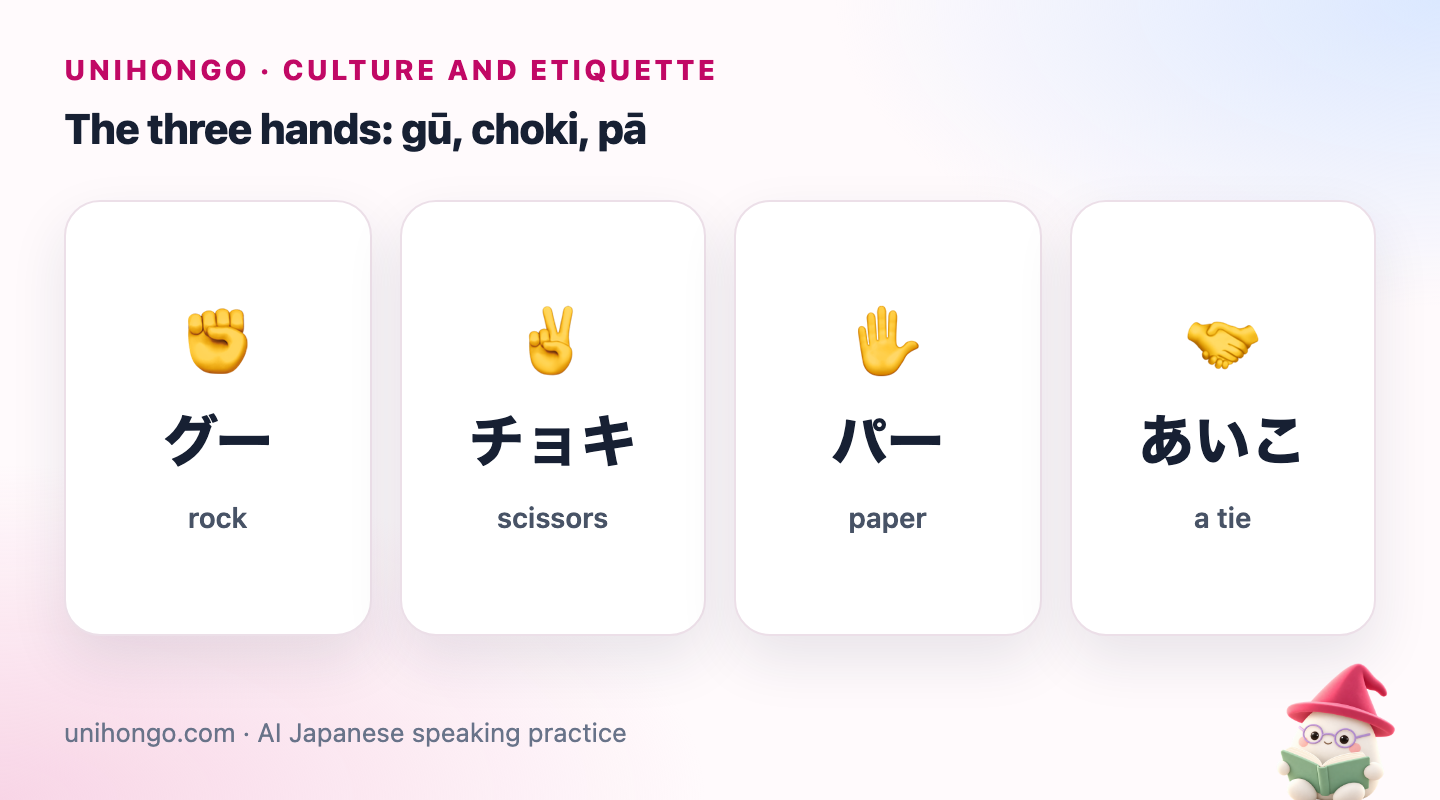
Janken uses the same three shapes as rock paper scissors anywhere. A fist is gū (グー), two fingers are choki (チョキ) and an open hand is pā (パー). Rock beats scissors, scissors beat paper, paper beats rock. When both players show the same hand, the round is aiko (あいこ), a tie, and you throw again.
These are game words, usually written in katakana. A real stone is ishi (石), real scissors are hasami (はさみ) and real paper is kami (紙), but you will not hear those in the game. Children also say the three together as gū choki pā, and there is a well-known hand-play song built on those words.
| Japanese | Romaji | Meaning |
|---|---|---|
| グー | gū | rock |
| チョキ | choki | scissors |
| パー | pā | paper |
| あいこ | aiko | a tie |
| 勝ち | kachi | a win |
| 負け | make | a loss |
The chant, beat by beat
The standard chant has two parts. First everyone says saisho wa gū (最初はグー), first comes rock, and holds out a fist on gū. This warm-up beat puts all the players in the same rhythm. Then comes janken pon (じゃんけんぽん), and on pon each player shows a hand. The opening line is widely said to have spread across Japan from a TV comedy show featuring the comedian Ken Shimura; before that, people simply started from janken pon, and many still do.
If the hands match, do not stop. Say aiko de sho (あいこでしょ) and throw again on sho. Tie again and you repeat only sho, sho, sho, faster and faster, until someone wins. You will also hear janken poi or janken hoi instead of pon, depending on the region and the family.
| Japanese | Romaji | Meaning |
|---|---|---|
| 最初はグー | Saisho wa gū | First comes rock |
| じゃんけんぽん | Janken pon | Janken, go! |
| あいこでしょ | Aiko de sho | A tie, so again! |
How adults really use janken
Among adults, janken is a quick and fair way to decide small things without anyone having to insist or give way. Who takes the last gyoza, who sits in the middle seat, who phones the restaurant, which team serves first: one round and it is settled. Because the result is pure luck, nobody loses face, which suits a culture where people often hesitate to push their own preference.
The casual way to propose it is janken de kimeyō. With people you speak politely to, janken de kimemashō ka is friendly and still polite. Skip it in formal settings: you would not suggest janken to a client or in a job interview.
| Japanese | Romaji | Meaning |
|---|---|---|
| じゃんけんで決めよう。 | Janken de kimeyō. | Let's decide by janken. (casual) |
| じゃんけんで決めましょうか。 | Janken de kimemashō ka. | Shall we decide by janken? (polite) |
| 最後の一個、じゃんけんしよう。 | Saigo no ikko, janken shiyō. | Last one: let's janken for it. |
| 勝った人から選んでね。 | Katta hito kara erande ne. | Winners choose first, okay? |
| 負けた人が皿洗いね。 | Maketa hito ga saraarai ne. | The loser does the dishes, okay? |
| 誰が行くか、じゃんけんね。 | Dare ga iku ka, janken ne. | Janken to see who goes. |
Calling the result
The verbs are katsu (勝つ), to win, and makeru (負ける), to lose. In the moment people use the short past forms katta and maketa. The nouns kachi and make are handy for announcing a result politely or for setting the stakes before you start.
| Japanese | Romaji | Meaning |
|---|---|---|
| 勝った! | Katta! | I won! |
| 負けた。 | Maketa. | I lost. |
| あいこだ。 | Aiko da. | It's a tie. |
| 私の勝ちです。 | Watashi no kachi desu. | I win. (polite) |
| 後出しはずるいよ。 | Atodashi wa zurui yo. | Throwing late isn't fair. |
| もう一回! | Mō ikkai! | One more time! |
| 三回勝負にしよう。 | Sankai shōbu ni shiyō. | Let's play three rounds. |
Zurui (ずるい) means sneaky or unfair, and it is the natural, light complaint when someone throws late. Said with a laugh it is teasing, not a serious accusation.
Atchi muite hoi: the round after the round
Once janken has a winner, the game can continue with atchi muite hoi (あっち向いてホイ), roughly look that way, hoi. The winner chants the phrase and, on hoi, points a finger up, down, left or right. At the same instant the loser turns their head in one of the four directions. If the face follows the finger, the pointer wins the whole game. If the face goes another way, nobody wins and you go back to janken.
Atchi is a casual form of achira, that way, and muite is the te-form of muku, to face. The game is fast, silly and popular on TV variety shows as well as in playgrounds.
| Japanese | Romaji | Meaning |
|---|---|---|
| あっち向いてホイ | Atchi muite hoi | Look that way, hoi! |
| 上 | ue | up |
| 下 | shita | down |
| 右 | migi | right |
| 左 | hidari | left |
Regional names and group versions
Janken has many local chants. In Osaka and nearby areas people often call the game injan (いんじゃん), and other regions have their own versions of the call. The details vary by town and by generation, so treat any list as a rough guide; saisho wa gū, janken pon is understood everywhere.
With a big group a full game takes too long, so there are shortcuts. To split into two teams, children throw only gū or pā and group themselves by hand; the chant for this differs a lot from region to region. At parties, a host may also play against the whole room at once: everyone who loses sits down, and the last person standing wins the prize.
Historians generally trace janken to older hand games that reached Japan from China, with the modern three shapes settling in Japan before the game spread abroad.
Mistakes learners make with janken
- Saying ishi, hasami, kami for the hands. The game words are gū, choki, pā.
- Showing the hand on jan or ken. The hand appears only on pon.
- Stopping at a tie. Keep the rhythm going with aiko de sho.
- Calling the game by a word-for-word translation of rock paper scissors. Its name is simply janken.
- Using the casual kimeyō with someone senior. Say kimemashō ka instead.
Get these right and janken becomes one of the first pieces of Japanese you can perform at full native speed, which is a good feeling early in your studies.