

The ichi, shichi, hachi problem
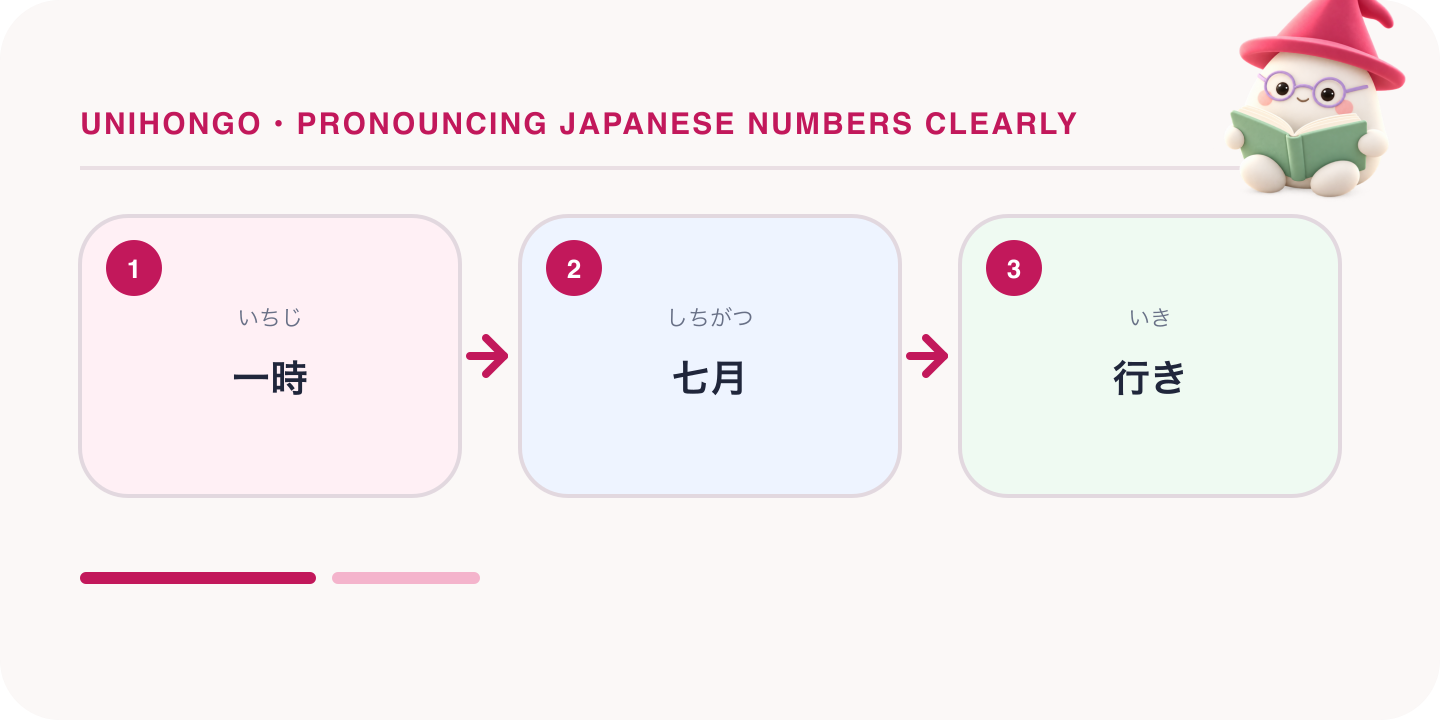
Ask a Japanese friend to say one, seven and eight quickly and you will hear why learners struggle: ichi, shichi, hachi. The second mora is identical in all three, so the whole contrast lives in the first one. Ichi begins with a bare vowel and a slight tightening of the throat before it. Shichi begins with a light, smiling sh, and its first vowel is often whispered, so the word can sound almost like a single sh-chi. Hachi begins with a breathy h and the open vowel a, which is the clearest of the three.
In the mouth, the fix is to give the first mora its full length. Learners rush it because they are thinking ahead to chi. Say i, pause, chi; shi, pause, chi; ha, pause, chi. Then close the gap gradually while keeping the first mora as long as the second. Japanese morae are roughly equal in length, so a squeezed first mora is not just unclear, it is wrong.
Ichi has one more quirk. In counting and in compounds it often loses its final vowel and doubles the next consonant: ikko, ippon, ippun, issai. The i stays. Shichi does not do this, which is one reason native speakers hear the two words as quite different even when learners do not.
| Japanese | Romaji | Meaning |
|---|---|---|
| 一、七、八。 | Ichi, shichi, hachi. | One, seven, eight. |
| 一時、七時、八時。 | Ichi-ji, shichi-ji, hachi-ji. | One o'clock, seven o'clock, eight o'clock. |
| 一階です。 | Ikkai desu. | It's the first floor. |
| 八階です。 | Hakkai desu. | It's the eighth floor. |
| 七月に行きます。 | Shichi-gatsu ni ikimasu. | I'm going in July. |
| 一人です。 | Hitori desu. | Just one person. |
Nana or shichi, yon or shi
Seven and four each have two readings. Shichi and shi come from Chinese; nana and yon are native Japanese. Shi is avoided in many contexts because it sounds like the word for death, and shichi is avoided because it collides with ichi and hachi. As a result, the native readings dominate in speech: yon-nin, four people; nana-hon, seven bottles; yon-hyaku, four hundred; nana-sen, seven thousand.
The Chinese readings survive where custom has fixed them. Shichi-ji is seven o'clock and shichi-gatsu is July; shi-gatsu is April and yo-ji, a special form, is four o'clock. In counting aloud from one to ten, many people say shi and shichi going up and yon and nana coming down, but either is understood. When reading a string of digits, such as a phone number or a room number, always use yon and nana; that is what a Japanese speaker would do.
If you are ever unsure which reading a counter takes, choose nana and yon. A native speaker may quietly correct you once, but they will never mishear you.
| Japanese | Romaji | Meaning |
|---|---|---|
| 四人でお願いします。 | Yo-nin de onegai shimasu. | A table for four, please. |
| 七本ください。 | Nana-hon kudasai. | Seven bottles, please. |
| 四月と七月。 | Shi-gatsu to shichi-gatsu. | April and July. |
| 四時に来ます。 | Yo-ji ni kimasu. | I'll come at four. |
| 七時に来ます。 | Shichi-ji ni kimasu. | I'll come at seven. |
| 四百七十円です。 | Yonhyaku nanajū en desu. | That's 470 yen. |
Counters that change their sound
The counters that begin with h, k, s and t change shape after certain numbers, and the changes are regular once you know the pattern. After ichi, roku, hachi and jū, the number loses its final vowel and the counter's first consonant doubles: ippun, roppun, happun, juppun for minutes; ikko, rokko, hakko, jukko for small objects; issai, hassai, jussai for years of age. After san, an h-starting counter becomes voiced: sanbyaku, three hundred; sanbon, three long objects; sanzen, three thousand. Hachi and roku also turn h into p: roppyaku, happyaku, roppon, happon.
The mouth work here is the doubled consonant. In ippun the pp is a silent beat where the lips stay closed for one full mora before releasing. Learners who say i-pun, with no held beat, are heard as saying something else or nothing recognisable. Hold the closure, count one in your head, then release. The same applies to the doubled k in ikko and the doubled s in issai, where the s is simply held longer.
| Number and counter | Reading | Notes |
|---|---|---|
| 一分 | ippun | Not ichi-fun; hold the pp for a full beat |
| 三分 | sanpun | Fun becomes pun after san |
| 六分 | roppun | Roku loses ku, fun becomes pun |
| 八分 | happun | Hachi loses chi; also heard as hachifun |
| 十分 | juppun | Jū loses its length; also jippun |
| 三百 | sanbyaku | Hyaku voiced after san |
| 六百 | roppyaku | Doubled p |
| 八百 | happyaku | Doubled p |
| 三千 | sanzen | Sen voiced after san |
| 八千 | hassen | Doubled s |
| 一本 | ippon | Hon becomes pon after 1, 6, 8, 10 |
| 三本 | sanbon | Hon voiced after san |
Notice that the changes cluster on the same five numbers: 1, 3, 6, 8 and 10. If you drill only those five with each new counter, you have covered nearly every irregularity.
Saying phone numbers so they are written down correctly
Japanese phone numbers are read digit by digit, never as pairs or hundreds. Zero is zero or maru, four is yon, seven is nana and nine is kyū. The hyphens are spoken as no, and each group is separated by a small pause. The digits two and five are often lengthened, nii and goo, so they do not get lost between their neighbours, and this lengthening is normal, not an error.
Speed is the main enemy. A number said at conversational speed will be asked for again, so read it at the pace someone can write, which is slower than feels natural. After the last group, wait for the listener to repeat it back; Japanese speakers usually do, and you should confirm with hai, sō desu, or correct the one digit that was wrong rather than repeating the whole number.
| Japanese | Romaji | Meaning |
|---|---|---|
| 電話番号は〇九〇の一二三四の五六七八です。 | Denwa bangō wa zero kyū zero no ichi nii san yon no goo roku nana hachi desu. | The phone number is 090-1234-5678. |
| もう一度お願いします。 | Mō ichido onegai shimasu. | Once more, please. |
| 復唱します。 | Fukushō shimasu. | I'll repeat it back. |
| 七ではなく、一です。 | Nana de wa naku, ichi desu. | Not seven, one. |
| 最後は八です。 | Saigo wa hachi desu. | The last one is eight. |
| 部屋番号は四〇七です。 | Heya bangō wa yon zero nana desu. | The room number is 407. |
Saying and hearing prices
Prices are built in blocks. Read from the largest block down: man for ten thousands, sen for thousands, hyaku for hundreds, jū for tens, then the units and en. So 12,800 yen is ichi-man nisen happyaku en. The blocks that change sound are the ones from the table above: sanbyaku, roppyaku, happyaku, sanzen, hassen. Add ichi before man but not before sen, hyaku or jū when they stand alone: sen en is one thousand yen, hyaku en is one hundred yen, but ichi-man en is ten thousand yen.
When a cashier says the total, they will usually say it once at full speed and then it appears on the register display, so you do not need to catch every mora. What you do need is to say amounts clearly when asking whether something is within budget, or when giving a budget to a florist or a taxi driver. Say the block words slowly and the digits sharply, and do not swallow en at the end, since it tells the listener the number is finished.
| Japanese | Romaji | Meaning |
|---|---|---|
| 三百円です。 | Sanbyaku en desu. | That's 300 yen. |
| 八百八十円です。 | Happyaku hachijū en desu. | That's 880 yen. |
| 千二百八十円になります。 | Sen nihyaku hachijū en ni narimasu. | That comes to 1,280 yen. |
| 一万二千円です。 | Ichi-man nisen en desu. | That's 12,000 yen. |
| 三千円くらいでお願いします。 | Sanzen en kurai de onegai shimasu. | About 3,000 yen, please. |
| 六百円ですか、八百円ですか。 | Roppyaku en desu ka, happyaku en desu ka. | Is it 600 yen or 800 yen? |
Common mistakes by first language
The number system is the same for everyone, but the errors are not. Here are the ones that come up most often.
- English speakers: rushing the first mora of ichi, shichi and hachi, and reading phone numbers in pairs, as in twelve thirty-four. Fix: equal-length morae and single digits.
- English speakers again: dropping the held beat in ippun, ikko and hassen. Fix: close the mouth, count one, release.
- Mandarin speakers: using the Chinese readings shi and shichi everywhere because they resemble Chinese sì and qī. Fix: default to yon and nana in speech.
- Korean speakers: the Sino-Korean numbers are close to Japanese, so sam and san, or pal and hachi, blend. Fix: hold the Japanese vowel lengths, especially in jū.
- Vietnamese speakers: final consonants are often cut short, so en, sen and man lose their n. Fix: finish every n with the tongue on the ridge.
- Spanish speakers: the doubled consonants have no Spanish equivalent and are dropped, and hachi loses its h. Fix: practise happun and happyaku with a clear breathy h.
- Hindi speakers: strong aspiration on ch and k makes ichi and ikko sound like chhi and kkho. Fix: reduce the puff of air on chi and ko.
Every one of these fixes is mechanical. None requires learning anything new about the numbers themselves; they are about giving each mora its full time and shape.
A self-check routine with the AI Sensei
Numbers respond well to short, frequent drills. Try this loop three times a week. First, count from one to ten and back, then say only one, seven and eight in random order five times, recording yourself and checking that each first mora is distinct. Second, ask your AI Sensei to dictate three phone numbers and three prices, write them down, and check them against what the Sensei meant. Third, reverse it: read the Sensei three phone numbers and three prices from your own notes and ask it to repeat them back. Finally, run a role-play with the Ramen Ticket Machine or Reserve a Restaurant by Phone mission and read the corrections afterwards.
If the Sensei writes ichi where you said shichi, your sh is too quiet; make it a real smiling hiss. If it hears hachi as ichi, your h is missing; breathe out before the a. If ippun is heard as ichi-fun, you are not holding the doubled consonant. Adjust one thing per session.
| Japanese | Romaji | Meaning |
|---|---|---|
| 数字を言いますので、書いてください。 | Sūji o iimasu node, kaite kudasai. | I'll say some numbers, so please write them down. |
| 今のは一ですか、七ですか。 | Ima no wa ichi desu ka, nana desu ka. | Was that a one or a seven? |
| もう少しゆっくり言います。 | Mō sukoshi yukkuri iimasu. | I'll say it a little more slowly. |
| 合っていますか。 | Atte imasu ka. | Is that right? |
| 値段を聞き取れませんでした。 | Nedan o kikitoremasen deshita. | I couldn't catch the price. |