

Booking an appointment
Most nail salons in Japan take reservations, yoyaku, through their website, beauty booking apps or social media, and many also accept phone calls. Walk-ins are possible at some salons but not guaranteed. When you book, you usually choose a menu, which sets the time and approximate price, so it helps to know the menu words before you start.
Two things are worth mentioning when you book: whether you already have gel or acrylic on your nails, because removal takes time, and whether it is your first visit, hajimete, since some salons offer a first-visit price. Cancellation policies, kyanseru ryō, vary, so read them before booking.
| Japanese | Romaji | Meaning |
|---|---|---|
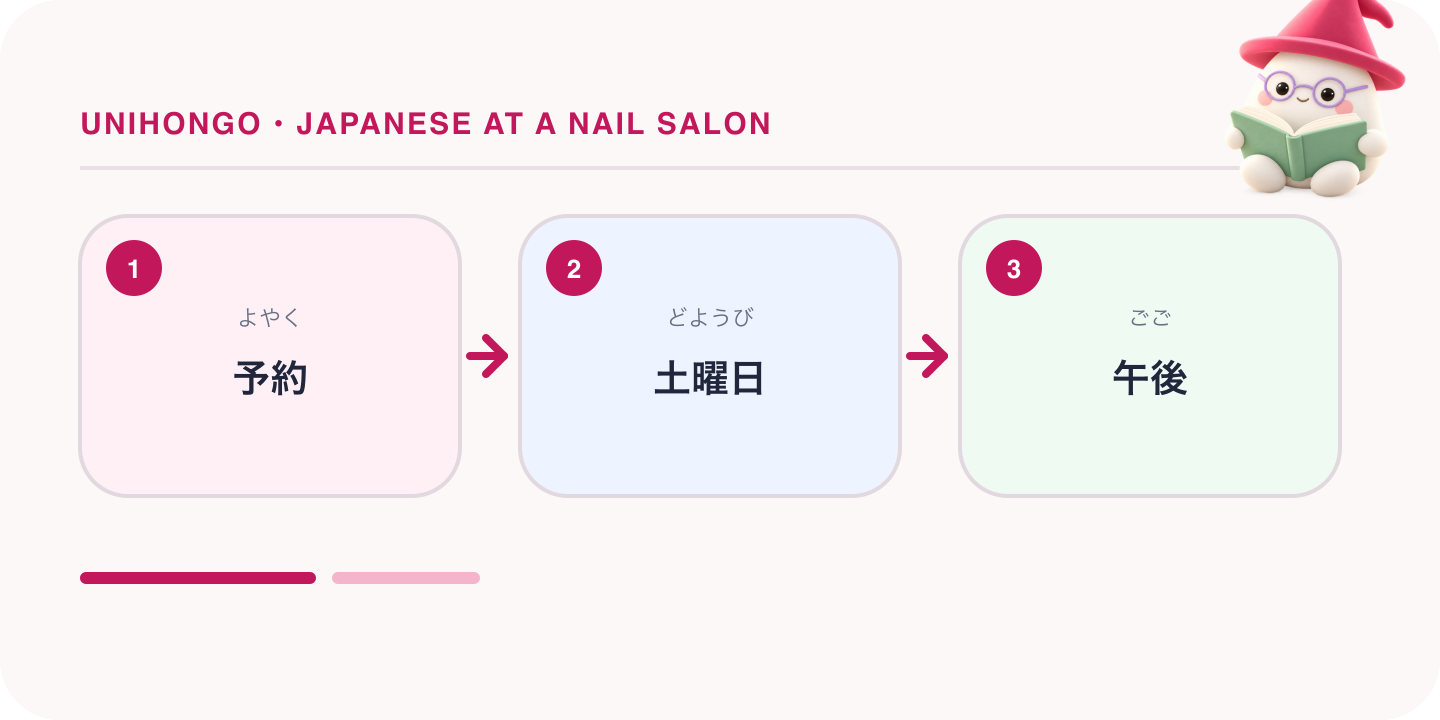
| 予約をしたいんですが。 | Yoyaku o shitai n desu ga. | I'd like to make a reservation. |
| 土曜日の午後は空いていますか。 | Doyōbi no gogo wa aite imasu ka. | Do you have any time on Saturday afternoon? |
| ジェルのワンカラーでお願いします。 | Jeru no wan-karā de onegai shimasu. | A one-colour gel, please. |
| 他店のジェルが付いています。 | Taten no jeru ga tsuite imasu. | I have gel on from another salon. |
| 初めてです。 | Hajimete desu. | It's my first visit. |
| どのくらい時間がかかりますか。 | Dono kurai jikan ga kakarimasu ka. | How long does it take? |
| キャンセル料はかかりますか。 | Kyanseru ryō wa kakarimasu ka. | Is there a cancellation fee? |
Reading the menu
Salon menus are organised by hand, hando, and foot, futto, then by style. The basic choice is between a single colour and some kind of design. Many salons offer teigaku dezain, fixed-price designs grouped by price level, which you pick from a sample book or the salon's social media. Fully custom art is usually priced separately.
You will also see items for care and extras: amakawa kea, cuticle care; nagasa-dashi, lengthening with extensions; and pātsu, decorations such as stones and studs. The exact names vary, so ask if a menu item is not clear.
| Menu word | Reading | Meaning |
|---|---|---|
| ワンカラー | wan-karā | One colour |
| グラデーション | guradēshon | Gradation, ombre |
| フレンチ | furenchi | French tips |
| 定額デザイン | teigaku dezain | Fixed-price design |
| 持ち込みデザイン | mochikomi dezain | Design you bring (e.g. a photo) |
| ジェルネイル | jeru neiru | Gel nails |
| 長さ出し | nagasa-dashi | Nail extensions |
| パーツ | pātsu | Decorations, stones |
| ハンド | hando | Hands |
| フット | futto | Feet |
Consultation: choosing colour, length and shape
Before starting, the nail artist, neirisuto, usually asks what you would like and looks at your nails. This short talk is often called kaunseringu, consultation. Expect questions about the design, the colour, the length, nagasa, and the shape of the nail tip, katachi.
Common shapes are sukuea, square, sukuea ofu, square with rounded corners, raundo, round, and ōbaru, oval. For colours, useful words are koime, a bit darker, usume, a bit lighter, and the finish: tsuya, glossy, or matto, matte.
| Japanese | Romaji | Meaning |
|---|---|---|
| このデザインにしたいです。 | Kono dezain ni shitai desu. | I'd like this design. |
| 色だけ変えたいです。 | Iro dake kaetai desu. | I'd only like to change the colour. |
| 長さはこのままでお願いします。 | Nagasa wa kono mama de onegai shimasu. | Please keep the length as it is. |
| 少し短くしてください。 | Sukoshi mijikaku shite kudasai. | Please make them a little shorter. |
| 形はラウンドがいいです。 | Katachi wa raundo ga ii desu. | I'd like a round shape. |
| 仕事で目立たない色がいいです。 | Shigoto de medatanai iro ga ii desu. | I'd like a colour that isn't too noticeable at work. |
| マットにできますか。 | Matto ni dekimasu ka. | Can you do a matte finish? |
Removal: ofu
If you have existing gel, it has to come off first. This is called ofu, from the English off. Menus often separate jiten ofu, removal of gel done at the same salon, from taten ofu, removal of another salon's gel, which may cost more or take longer. Some salons include removal when you book a new design.
Removal usually involves filing the surface and soaking the nails, and it can take some time. If anything stings or feels too hot, say so straight away; the artist can adjust.
| Japanese | Romaji | Meaning |
|---|---|---|
| オフもお願いします。 | Ofu mo onegai shimasu. | Removal as well, please. |
| オフだけできますか。 | Ofu dake dekimasu ka. | Can I have just the removal? |
| 自店オフ | jiten ofu | Removal of this salon's gel |
| 他店オフ | taten ofu | Removal of another salon's gel |
| 少ししみます。 | Sukoshi shimimasu. | It stings a little. |
| ちょっと痛いです。 | Chotto itai desu. | It hurts a bit. |
During the treatment
After removal and shaping comes care: the artist pushes back or trims the cuticle, amakawa, and may buff the surface. Then comes the base gel, bēsu, the colour, karā, and the top coat, toppu, each cured under a lamp, raito. You will be asked to put your hand under the lamp many times, so learn the phrase for it.
Staff may ask you to relax your hand, change position or check a colour sample on one nail before doing the rest. This is a good moment to say if something looks different from what you expected, because changing a colour before the top coat is much easier.
| Japanese | Romaji | Meaning |
|---|---|---|
| ライトに手を入れてください。 | Raito ni te o irete kudasai. | Please put your hand under the lamp. |
| 力を抜いてください。 | Chikara o nuite kudasai. | Please relax your hand. |
| 甘皮の処理をしますね。 | Amakawa no shori o shimasu ne. | I'll take care of your cuticles now. |
| この色でいかがですか。 | Kono iro de ikaga desu ka. | How about this colour? |
| ライトが熱いです。 | Raito ga atsui desu. | The lamp feels hot. |
| いい感じです。 | Ii kanji desu. | That looks good. |
Asking for changes politely
Nail artists expect small requests, and a clear one is kinder than staying quiet and being unhappy with the result. The polite pattern is sumimasen, then what you would like, softened with moshi dekireba, if possible, or mō sukoshi, a little more. Describe the change rather than criticising the work.
If you are unsure how something will look, ask the artist for advice with dotchi ga ii to omoimasu ka, which do you think is better. Artists often have a strong eye for what suits a hand.
| Japanese | Romaji | Meaning |
|---|---|---|
| すみません、もう少し薄い色にできますか。 | Sumimasen, mō sukoshi usui iro ni dekimasu ka. | Excuse me, could it be a little lighter? |
| もしできれば、ラメを少なめにしてください。 | Moshi dekireba, rame o sukuname ni shite kudasai. | If possible, a little less glitter, please. |
| この指だけストーンをつけたいです。 | Kono yubi dake sutōn o tsuketai desu. | I'd like stones on this finger only. |
| 左右で同じ長さにしてもらえますか。 | Sayū de onaji nagasa ni shite moraemasu ka. | Could you make both hands the same length? |
| どっちがいいと思いますか。 | Dotchi ga ii to omoimasu ka. | Which do you think is better? |
| イメージと少し違います。 | Imēji to sukoshi chigaimasu. | It's a little different from what I had in mind. |
Paying and aftercare
At the end the artist may apply cuticle oil, kyūtikuru oiru, and show you the finished nails. At the counter you pay and may be offered a point card or the next booking, jikai no yoyaku. Many people book their next visit a few weeks ahead, when the nails have grown out.
Staff often mention aftercare: avoid very hot water or pressing hard on the nails for a while, use oil on the cuticles, and do not peel off lifting gel yourself. Many salons have a repair guarantee, onaoshi hoshō, for chips or lifting within a set number of days. The period and what it covers depend on the salon.
| Japanese | Romaji | Meaning |
|---|---|---|
| お直しの期間はありますか。 | Onaoshi no kikan wa arimasu ka. | Is there a repair period? |
| 次回の予約もお願いします。 | Jikai no yoyaku mo onegai shimasu. | I'd like to book the next visit too. |
| キューティクルオイルを塗ってくださいね。 | Kyūtikuru oiru o nutte kudasai ne. | Please apply cuticle oil. |
| カードで払えますか。 | Kādo de haraemasu ka. | Can I pay by card? |
| ありがとうございました。とても気に入りました。 | Arigatō gozaimashita. Totemo ki ni irimashita. | Thank you. I really like them. |
When a nail chips or lifts
If a nail chips, kakeru, lifts at the edge, uku, or comes off, toreru, contact the salon rather than picking at it. Explain which finger and when it happened, and ask whether it falls within the repair period. Knowing the finger names in Japanese helps, although pointing to a photo works too.
Fingers are oyayubi, thumb, hitosashiyubi, index finger, nakayubi, middle finger, kusuriyubi, ring finger, and koyubi, little finger. Migi is right and hidari is left.
| Word | Reading | Meaning |
|---|---|---|
| 欠ける | kakeru | To chip |
| 浮く | uku | To lift |
| 取れる | toreru | To come off |
| お直し | onaoshi | Repair |
| 親指 | oyayubi | Thumb |
| 人差し指 | hitosashiyubi | Index finger |
| 中指 | nakayubi | Middle finger |
| 薬指 | kusuriyubi | Ring finger |
| 小指 | koyubi | Little finger |
A complete message could be: senjitsu ukagatta Smith desu. Migi no kusuriyubi ga uite kimashita. Onaoshi wa dekimasu ka? I'm Smith, who visited the other day. The ring finger on my right hand has started lifting. Could you repair it?