

Guai, chōshi and taichō: the three words for feeling unwell
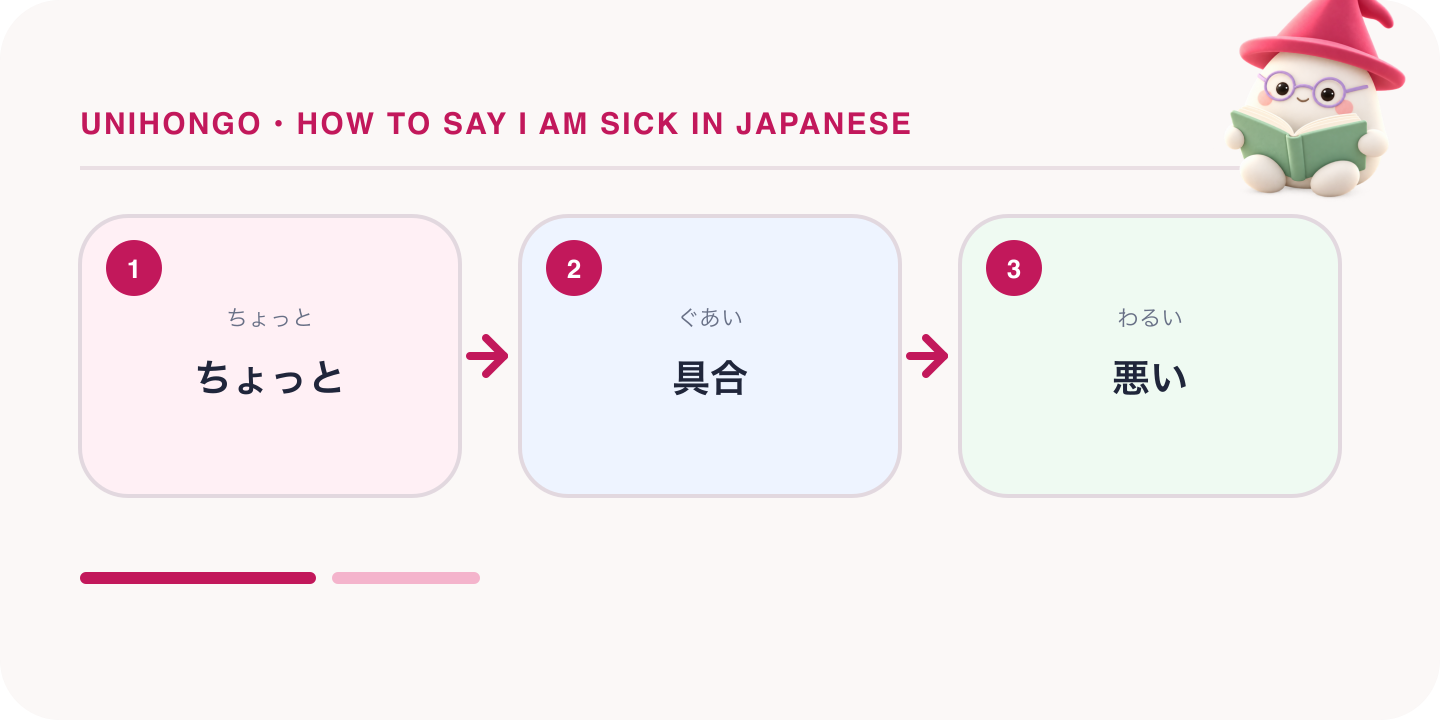
Japanese has no single everyday verb for being sick. Instead, people describe their condition as bad using one of three nouns plus warui. Guai ga warui is the most common and flexible: it covers everything from a hangover to a bad back, and it is what you say when you cannot pin down what is wrong. Chōshi ga warui is close, but chōshi is also used for the state of a car or a sports performance, so with your body it suggests a slightly off day rather than real illness. Taichō ga warui uses the word for physical condition, so it is unambiguous and sounds right in polite conversation and at work.
All three take desu for politeness, and all three can be softened with chotto: chotto guai ga warui, I feel a bit unwell. This chotto is the normal way to raise the subject without making the listener anxious. Kibun ga warui is also fine, and often means nauseous.
| Japanese | Romaji | Meaning |
|---|---|---|
| ちょっと具合が悪いです。 | Chotto guai ga warui desu. | I feel a bit unwell. |
| 今日は体調が悪いので、早めに帰ります。 | Kyō wa taichō ga warui node, hayame ni kaerimasu. | I'm not well today, so I'll head home early. |
| 最近、調子が悪くて。 | Saikin, chōshi ga warukute. | I've been feeling off lately. |
| 朝から気分が悪いです。 | Asa kara kibun ga warui desu. | I've felt sick since this morning. |
| なんだか体がだるいです。 | Nandaka karada ga darui desu. | My body feels heavy and sluggish somehow. |
| 昨日から具合がよくないんです。 | Kinō kara guai ga yokunai n desu. | I haven't been well since yesterday. |
Colds, fever and the set phrases everyone uses
A cold is kaze, and you catch it with the verb hiku, so kaze o hiita or, politely, kaze o hikimashita. The past tense is normal even if you still have the cold, because the catching happened earlier; kaze o hiite imasu stresses that it is ongoing. A fever is netsu, and you have it with aru: netsu ga arimasu. Japanese people usually give the temperature, because a number tells the listener how serious things are.
Influenza is infuruenza, usually shortened to infuru: infuru ni kakarimashita, I have come down with flu. Stomach trouble is onaka o kowashita, literally I broke my stomach, which covers an upset stomach without going into detail. Hay fever is kafunshō, a national conversation topic every spring.
| Japanese | Romaji | Meaning |
|---|---|---|
| 風邪を引きました。 | Kaze o hikimashita. | I've caught a cold. |
| 熱があります。三十八度です。 | Netsu ga arimasu. Sanjū-hachi-do desu. | I have a fever. It's thirty-eight degrees. |
| 熱っぽいです。 | Netsuppoi desu. | I feel feverish. |
| インフルにかかりました。 | Infuru ni kakarimashita. | I've come down with the flu. |
| お腹を壊しました。 | Onaka o kowashimashita. | I have an upset stomach. |
| 花粉症で、鼻が止まりません。 | Kafunshō de, hana ga tomarimasen. | It's hay fever, and my nose won't stop running. |
| まだ本調子じゃないです。 | Mada honchōshi ja nai desu. | I'm still not back to normal. |
Why byōki desu sounds heavy, and when it is right
Textbooks often list byōki as the word for sick, but its centre of gravity is different from the English word. Byōki is an illness or a disease: something diagnosed, something with a name, something that might be serious. Saying watashi wa byōki desu sounds like the opening of a serious conversation, and a Japanese friend may go quiet and wait for you to explain what you have. For a cold, a headache or a rough morning, it is simply too much.
Byōki is the right word in other situations. If you have a chronic condition, byōki ga arimasu is natural and clear. If a family member has been ill for a long time, haha ga byōki de, my mother is unwell, is how people explain absences. Byōki de yasunde imasu, off sick, uses it naturally because it refers to a state rather than a passing feeling. With a diagnosed illness, people say byōki ni naru, become ill, or byōki ni kakaru, contract an illness, rather than byōki desu on its own.
| Japanese | Romaji | Meaning |
|---|---|---|
| 持病があります。 | Jibyō ga arimasu. | I have a chronic condition. |
| 母が病気で、今週は実家に帰ります。 | Haha ga byōki de, konshū wa jikka ni kaerimasu. | My mother is ill, so I'm going home this week. |
| 病気で一週間休んでいました。 | Byōki de isshūkan yasunde imashita. | I was off sick for a week. |
| 病気というほどではないです。 | Byōki to iu hodo de wa nai desu. | It's not what you'd call an illness. |
Naming the symptom: what hurts and how
Once you have said you feel unwell, the next question is almost always dō shita no? or dō shimashita ka? what's wrong. The answer is a body part plus itai, painful, or a specific verb. Japanese pairs each symptom with a fixed expression: a cough is seki ga deru, a cough comes out; a runny nose is hanamizu ga deru; nausea is hakike ga suru. Intensity is described with sugoku, very, or chotto, a bit, and duration with kara, since: kinō no yoru kara, since last night. This small formula of symptom plus duration does most of the work.
| Symptom | Reading | How to say it |
|---|---|---|
| 頭が痛い | atama ga itai | I have a headache |
| 喉が痛い | nodo ga itai | My throat hurts |
| お腹が痛い | onaka ga itai | My stomach hurts |
| 咳が出る | seki ga deru | I have a cough |
| 鼻水が出る | hanamizu ga deru | I have a runny nose |
| 寒気がする | samuke ga suru | I have chills |
| 吐き気がする | hakike ga suru | I feel nauseous |
| めまいがする | memai ga suru | I feel dizzy |
| 体がだるい | karada ga darui | My body feels heavy |
| 食欲がない | shokuyoku ga nai | I have no appetite |
| 眠れない | nemurenai | I can't sleep |
Put them into a sentence with kara and desu: kinō kara nodo ga itakute, seki mo demasu, since yesterday my throat hurts and I have a cough too. The te-form links symptoms in the same way and connects to a request or an explanation.
Telling a friend versus telling work
With a friend, the news is casual and the sentence short. Guai warui, with the particle dropped, or kaze hiita, is enough, and the friend will ask what is wrong. If you are cancelling plans, apologise once, give the reason, and suggest another time.
At work the same news becomes polite. Use taichō rather than guai, add node to give the reason, and frame what you need as a request for permission: kaerasete itadakemasu ka, may I be allowed to go home. Give the symptom in one phrase, add a short apology for the inconvenience, and say when you expect to be back. Managers do not want detail; they want to know whether you are leaving and what needs covering. If you are calling in before the day starts, the guide on calling in sick covers the full phone call.
| Japanese | Romaji | Meaning |
|---|---|---|
| ごめん、今日ちょっと具合悪くて。また今度でいい? | Gomen, kyō chotto guai warukute. Mata kondo de ii? | Sorry, I'm not feeling great today. Can we do another time? |
| 風邪ひいたみたい。うつすと悪いから。 | Kaze hiita mitai. Utsusu to warui kara. | I think I've caught a cold. I don't want to pass it on. |
| すみません、体調が悪いので、早退させていただけますか。 | Sumimasen, taichō ga warui node, sōtai sasete itadakemasu ka. | I'm sorry, I'm unwell. May I leave early? |
| 朝から熱があって、今日はお休みをいただきたいのですが。 | Asa kara netsu ga atte, kyō wa o-yasumi o itadakitai no desu ga. | I've had a fever since this morning and would like to take the day off. |
| ご迷惑をおかけしてすみません。 | Go-meiwaku o okake shite sumimasen. | I'm sorry for the trouble. |
| 明日は出られると思います。 | Ashita wa derareru to omoimasu. | I think I'll be able to come in tomorrow. |
Replies and words of sympathy
When someone tells you they are unwell, the first reply is daijōbu? or daijōbu desu ka? are you all right. Then comes o-daiji ni, the standard wish for someone's recovery, literally please treat yourself as important. It works at every level of politeness; o-daiji ni nasatte kudasai is the very polite version.
Among friends, yukkuri yasunde ne, rest properly, and muri shinaide, don't overdo it, are warm and common. Offering help is nanika iru? or nanika hitsuyō na mono wa arimasu ka? Do not say ganbatte to a sick person; it tells them to push through. The sick person answers with arigatō or, at work, sumimasen, often adding daijōbu desu to reassure.
| Japanese | Romaji | Meaning |
|---|---|---|
| 大丈夫?無理しないでね。 | Daijōbu? Muri shinaide ne. | Are you okay? Don't push yourself. |
| お大事に。 | O-daiji ni. | Take care of yourself. |
| お大事になさってください。 | O-daiji ni nasatte kudasai. | Please take good care of yourself. (very polite) |
| ゆっくり休んでね。 | Yukkuri yasunde ne. | Rest well. |
| 何か必要なものはありますか。 | Nanika hitsuyō na mono wa arimasu ka. | Is there anything you need? |
| 早く良くなりますように。 | Hayaku yoku narimasu yō ni. | I hope you get better soon. |
| ありがとう。もう大丈夫。 | Arigatō. Mō daijōbu. | Thanks. I'm fine now. |
Useful patterns for feeling better and being asked how you are
The conversation does not end when the cold does. Colleagues and friends will ask taichō wa dō desu ka? how is your health, when you come back, and there are set phrases for each stage of recovery.
- Daibu yoku narimashita: I'm much better
- Mō sukkari naorimashita: I've completely recovered
- Mada chotto darui desu: I'm still a bit sluggish
- Okage-sama de, genki ni narimashita: thanks to you, I'm well again
- Go-shinpai o okake shimashita: sorry to have worried you
- Byōin ni ikimashita: I went to the clinic
- Kusuri o nonde imasu: I'm taking medicine
- Yasunde ita bun, ganbarimasu: I'll make up for the time I was off
Okage-sama de is a fixed courtesy that thanks the listener for their concern, even if they did nothing concrete. It is the expected reply when a colleague asks how you are after a few days off.
Mistakes to avoid when saying you are sick
The first mistake is byōki desu for a cold. The second is translating I feel sick literally as kimochi warui. Kimochi warui does mean feeling bad, but it also means creepy or disgusting, so said out loud in a room it can be heard as a comment on something or someone. Kibun ga warui or hakike ga suru are the safe words for nausea.
A third mistake is over-explaining at work; one phrase plus an apology and a plan is the norm. Fourth, learners say ganbatte to a sick colleague because it feels encouraging. It is not; use o-daiji ni. Finally, be careful with itai. It means painful, so karada ga itai means my body aches, not I feel sick generally. For general malaise, darui is the word you want.
| Japanese | Romaji | Meaning |
|---|---|---|
| 気分が悪いので、少し座ってもいいですか。 | Kibun ga warui node, sukoshi suwatte mo ii desu ka. | I feel sick. May I sit down for a moment? |
| 大したことはないです。ただの風邪です。 | Taishita koto wa nai desu. Tada no kaze desu. | It's nothing serious. Just a cold. |
| 体が痛いというより、だるい感じです。 | Karada ga itai to iu yori, darui kanji desu. | It's not so much pain as a heavy, sluggish feeling. |
| 薬を飲んだので、少し楽になりました。 | Kusuri o nonda node, sukoshi raku ni narimashita. | I took some medicine, so I feel a bit better. |