
What varies, and the stages of a resignation
Almost every concrete number in a resignation depends on your own paperwork. How much notice you owe, whether the company wants a taishokunegai or a taishokutodoke or its own printed form, how remaining paid leave is handled, what happens to your insurance and pension records, and who has to sign what are all governed by your employment contract and your company's work rules. Read your contract and the shūgyō kisoku, and ask HR directly where anything is unclear.
If your right to stay in Japan is tied to your employment, there are separate procedures with the immigration authority and there are deadlines, so confirm what applies to your status with the relevant office or with a qualified adviser rather than with colleagues. Nothing in this guide is advice about your entitlements. What it gives you is the language for each conversation, which is the part you can actually rehearse in advance.
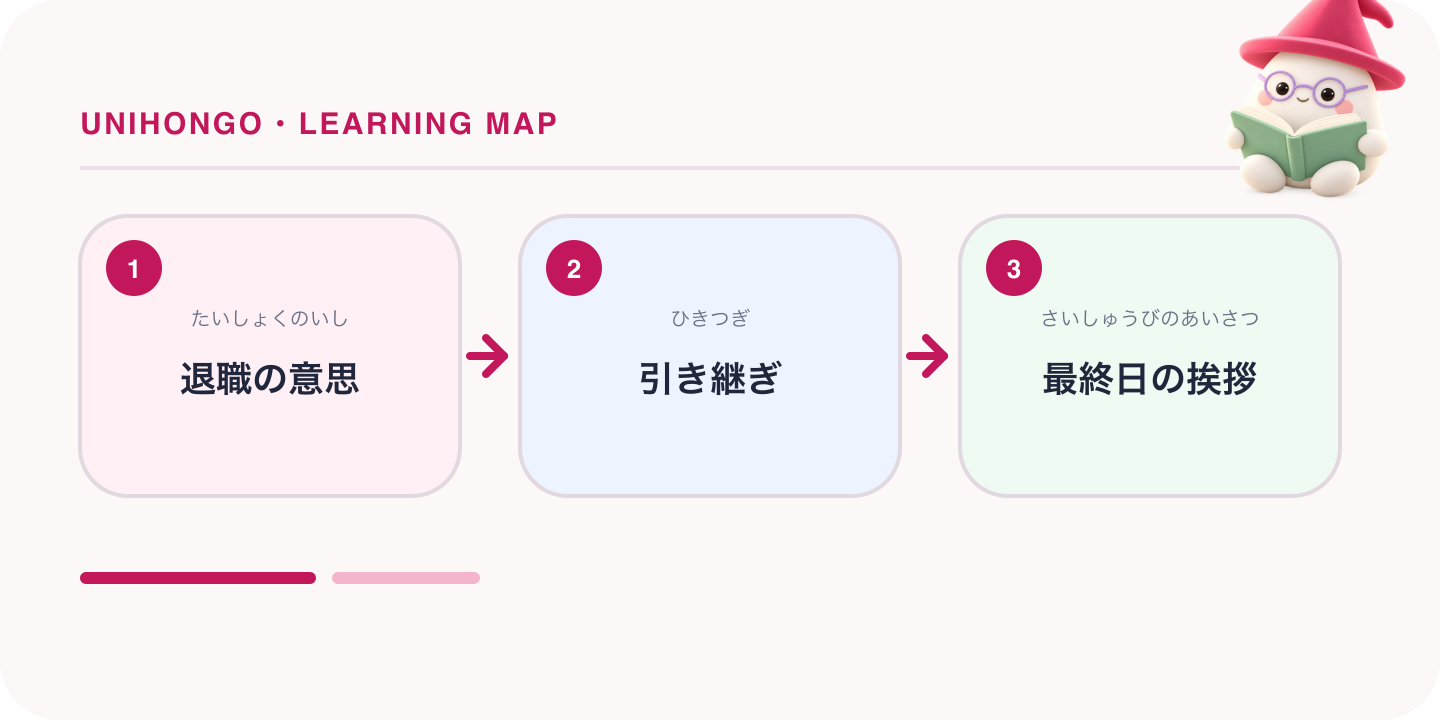
| Japanese | Romaji | Meaning |
|---|---|---|
| 就業規則を確認したいのですが、どちらで見られますか。 | Shūgyō kisoku o kakunin shitai no desu ga, dochira de miraremasu ka? | I would like to check the work rules; where can I see them? |
| 退職の手続きについて教えていただけますか。 | Taishoku no tetsuzuki ni tsuite oshiete itadakemasu ka? | Could you tell me about the resignation procedure? |
| 提出する書類は何になりますでしょうか。 | Teishutsu suru shorui wa nani ni narimasu deshō ka? | Which documents will I need to submit? |
| 会社所定の様式はありますか。 | Kaisha shotei no yōshiki wa arimasu ka? | Is there a company form for this? |
| 有給休暇の残りについて伺いたいのですが。 | Yūkyū kyūka no nokori ni tsuite ukagaitai no desu ga. | I would like to ask about my remaining paid leave. |
| いつまでにお伝えすればよろしいでしょうか。 | Itsu made ni otsutae sureba yoroshii deshō ka? | By when should I let you know? |
| Stage | Opening phrase | Note |
|---|---|---|
| Asking for time | ご相談したいことがあります。Gosōdan shitai koto ga arimasu. | Ask privately, not in front of the team |
| Stating the intention | 退職させていただきたく存じます。Taishoku sasete itadakitaku zonjimasu. | Humble form; say it clearly once |
| Giving a reason | 一身上の都合により…Isshinjō no tsugō ni yori... | Forward-looking, never a complaint |
| Submitting the notice | 退職願を提出させていただきます。Taishokunegai o teishutsu sasete itadakimasu. | Only after the conversation, and in the form your company asks for |
| Agreeing the date | 最終出社日はいつになりますでしょうか。Saishū shussha-bi wa itsu ni narimasu deshō ka? | Depends on contract, handover and leave |
| Handing over | 引き継ぎ資料を作成しました。Hikitsugi shiryō o sakusei shimashita. | Written document plus spoken walkthroughs |
| Telling clients | 私事で恐縮ですが…Shiji de kyōshuku desu ga... | Introduce your successor in the same message |
| Last day | 本日をもちまして退職いたします。Honjitsu o mochimashite taishoku itashimasu. | Short greeting to the team, under a minute |
The order matters more than any individual phrase. Submitting paperwork before speaking to your manager, or telling colleagues before your manager knows, is the thing most likely to cause lasting friction, because it removes their ability to manage the news. Speak first, privately, to the person you report to, and let them decide how and when it is announced more widely.
Asking your manager for a private moment
This first request should be deliberately vague. You are not announcing anything yet, only asking for time somewhere private, and the standard phrasing does that without hinting at the topic. Asking for a meeting room or a quiet corner signals seriousness on its own, and most managers will read it correctly.
Timing is a real courtesy here. Avoid the busiest hour, avoid the day before a deadline, and give them a slot long enough that the conversation does not have to be rushed. Thirty minutes is a reasonable ask. If they suggest doing it on the spot at a desk, it is fine to ask for somewhere private instead.
| Japanese | Romaji | Meaning |
|---|---|---|
| ご相談したいことがあるのですが、お時間をいただけますでしょうか。 | Gosōdan shitai koto ga aru no desu ga, ojikan o itadakemasu deshō ka? | There is something I would like to consult you about; could I have some of your time? |
| 三十分ほどお時間をいただけますか。 | Sanjuppun hodo ojikan o itadakemasu ka? | Could I have about thirty minutes? |
| 少しお時間よろしいでしょうか。 | Sukoshi ojikan yoroshii deshō ka? | Do you have a little time? |
| できれば二人でお話しできればと思います。 | Dekireba futari de ohanashi dekireba to omoimasu. | If possible, I would like to speak with you privately. |
| 会議室をお借りしてもよろしいでしょうか。 | Kaigishitsu o okari shite mo yoroshii deshō ka? | Would it be all right to use a meeting room? |
| 今日の午後はいかがでしょうか。 | Kyō no gogo wa ikaga deshō ka? | Would this afternoon suit you? |
| いいよ、どうしたの? | Ii yo, dōshita no? | Sure, what is it? (manager's reply, casual) |
The conversation where you state your intention
Say the sentence early and once. Taishoku sasete itadakitaku zonjimasu is the humble register that this moment conventionally uses: literally, I humbly wish to be permitted to resign. It sounds heavy in translation, and that weight is appropriate. Do not soften it into something that could be mistaken for thinking about it, because a manager who hears ambiguity will treat the conversation as negotiable.
Open by acknowledging the suddenness, deliver the sentence, then stop and let them respond. The silence that follows is normal. Most managers will ask why, some will ask you to reconsider, and some will move straight to dates. Have your reason ready in two clauses and resist expanding it under pressure.
| Japanese | Romaji | Meaning |
|---|---|---|
| 突然のことで申し訳ありません。 | Totsuzen no koto de mōshiwake arimasen. | I am sorry that this is sudden. |
| 退職させていただきたく存じます。 | Taishoku sasete itadakitaku zonjimasu. | I would like to resign. |
| 三月末での退職を考えております。 | San-gatsu-sue de no taishoku o kangaete orimasu. | I am thinking of leaving at the end of March. |
| いろいろ考えた結果の決断です。 | Iroiro kangaeta kekka no ketsudan desu. | This is a decision I reached after a lot of thought. |
| これまで大変お世話になりました。 | Kore made taihen osewa ni narimashita. | You have looked after me a great deal until now. |
| ご迷惑をおかけすることになり、申し訳ありません。 | Gomeiwaku o okake suru koto ni nari, mōshiwake arimasen. | I am sorry for the trouble this will cause. |
| 理由を聞いてもいいかな。 | Riyū o kiite mo ii kana? | May I ask why? (manager's reply, casual) |
| 考え直してもらえないでしょうか。 | Kangaenaoshite moraenai deshō ka? | Could you not reconsider? (manager's reply) |
Giving a reason without making it a complaint
The convention is to explain what you are moving towards rather than what you are leaving behind. Even where your reasons are genuine grievances, saying them at this moment rarely improves anything and often makes the remaining weeks harder. Family circumstances, a return to your home country, study, or a change of field are all reasons that are accepted without much probing.
If your manager presses for detail or offers you something to stay, thank them warmly and repeat that your decision is settled. Arigatai ohanashi desu ga is a set phrase for declining a kind offer, and ketsui wa katai desu, my resolve is firm, closes the point politely. Repeat rather than argue, and stay consistent across every retelling.
| Japanese | Romaji | Meaning |
|---|---|---|
| 一身上の都合により、退職を決めました。 | Isshinjō no tsugō ni yori, taishoku o kimemashita. | I have decided to resign for personal reasons. |
| 家庭の事情で帰国することになりました。 | Katei no jijō de kikoku suru koto ni narimashita. | Family circumstances mean I will be returning to my country. |
| 新しい分野に挑戦したいと考えております。 | Atarashii bun'ya ni chōsen shitai to kangaete orimasu. | I want to take on a challenge in a new field. |
| 学び直したいことがあります。 | Manabinaoshitai koto ga arimasu. | There is something I want to go back and study. |
| この会社で学んだことは大きかったです。 | Kono kaisha de mananda koto wa ōkikatta desu. | What I learned at this company was substantial. |
| ありがたいお話ですが、決意は固いです。 | Arigatai ohanashi desu ga, ketsui wa katai desu. | That is a kind offer, but my mind is made up. |
| 引き止めていただき、ありがとうございます。 | Hikitomete itadaki, arigatō gozaimasu. | Thank you for asking me to stay. |
| 申し訳ありませんが、変わりません。 | Mōshiwake arimasen ga, kawarimasen. | I am sorry, but it will not change. |
The written notice and its fixed wording
The written notice is short, formal and almost entirely fixed. It is typically a single sheet naming the reason as isshinjō no tsugō, the intended leaving date, your department and name, and the addressee, usually the company president by title. Many companies supply their own form, and some accept it electronically; ask before you write anything by hand.
The document goes to your manager after the conversation, not before it. Two closing verbs are conventionally used: onegai mōshiagemasu in a request-style taishokunegai, and itashimasu in a notification-style taishokutodoke. Since companies differ over which they want and over how dates are written, confirm the expected format rather than copying a template you found elsewhere.
| Japanese | Romaji | Meaning |
|---|---|---|
| 退職願 | Taishokunegai | Letter of resignation (request form, written line) |
| 退職届 | Taishokutodoke | Notice of resignation (notification form, written line) |
| 私事、一身上の都合により | Shiji, isshinjō no tsugō ni yori | In a personal matter, owing to personal circumstances (written line) |
| 来る三月三十一日をもって退職いたしたく、ここにお願い申し上げます。 | Kitaru san-gatsu sanjūichi-nichi o motte taishoku itashitaku, koko ni onegai mōshiagemasu. | I hereby request to resign as of the coming 31 March. (written line) |
| 三月三十一日をもって退職いたします。 | San-gatsu sanjūichi-nichi o motte taishoku itashimasu. | I will resign as of 31 March. (written line) |
| 営業部 山田太郎 | Eigyō-bu Yamada Tarō | Sales Department, Taro Yamada (written line) |
| 退職願を提出させていただきます。 | Taishokunegai o teishutsu sasete itadakimasu. | I would like to submit my letter of resignation. |
| こちらの書式で問題ないでしょうか。 | Kochira no shoshiki de mondai nai deshō ka? | Is this format acceptable? |
| 確かに受け取りました。 | Tashika ni uketorimashita. | Received, thank you. (manager's reply) |
Agreeing a leaving date
Two dates matter and they are often different: saishū shussha-bi, your last day physically at work, and taishoku-bi, the date your employment formally ends. Remaining paid leave is frequently taken between the two, which is why people say their last day at the office is earlier than their leaving date. What you are entitled to here depends on your contract and company rules, so ask rather than assume.
Come to the conversation with a proposed date and a reason for it, and stay flexible about the handover. Offering to complete a specific piece of work before you go is usually received well and costs little. If the company asks you to stay longer than you can, say so plainly and early rather than agreeing and renegotiating later.
| Japanese | Romaji | Meaning |
|---|---|---|
| 最終出社日はいつになりますでしょうか。 | Saishū shussha-bi wa itsu ni narimasu deshō ka? | When will my last day at the office be? |
| 退職日は三月三十一日を希望しております。 | Taishoku-bi wa san-gatsu sanjūichi-nichi o kibō shite orimasu. | I would like my leaving date to be 31 March. |
| 引き継ぎの期間はどのくらい必要でしょうか。 | Hikitsugi no kikan wa dono kurai hitsuyō deshō ka? | How long will be needed for the handover? |
| プロジェクトが終わるまでは在籍したいと思っています。 | Purojekuto ga owaru made wa zaiseki shitai to omotte imasu. | I would like to stay until the project finishes. |
| それ以降は難しい状況です。 | Sore ikō wa muzukashii jōkyō desu. | Staying beyond that would be difficult for me. |
| 日程はご相談させてください。 | Nittei wa gosōdan sasete kudasai. | Let me discuss the schedule with you. |
| 残りの有給はどのように扱われますか。 | Nokori no yūkyū wa dono yō ni atsukawaremasu ka? | How is the remaining paid leave handled? |
| では、その日程で調整しましょう。 | Dewa, sono nittei de chōsei shimashō. | Then let us arrange it for those dates. (manager's reply) |
The handover document and the handover conversations
The handover is where most of your remaining reputation is decided. A hikitsugi shiryō is a written document listing your recurring tasks, the contacts attached to each, where the files live, the deadlines in the calendar, and the things that are only in your head. Write it before you start talking people through it, so the conversations can be about the exceptions rather than the basics.
Then walk your successor through it in person, in short sessions rather than one long one, and let them do the task once while you watch. Offer a way to reach you for questions if that is acceptable to your company. Ending with a genuine offer to be asked is the thing colleagues remember most kindly.
| Japanese | Romaji | Meaning |
|---|---|---|
| 引き継ぎ資料を作成しました。 | Hikitsugi shiryō o sakusei shimashita. | I have prepared the handover document. |
| 後任の方はどなたになりますか。 | Kōnin no kata wa donata ni narimasu ka? | Who will be taking over from me? |
| 来週から引き継ぎを始めさせていただきます。 | Raishū kara hikitsugi o hajimesasete itadakimasu. | I will start the handover from next week. |
| 担当している業務は三つあります。 | Tantō shite iru gyōmu wa mittsu arimasu. | There are three tasks I am responsible for. |
| まずは一度、私が説明します。 | Mazu wa ichido, watashi ga setsumei shimasu. | First let me talk you through it once. |
| 次は実際にやってみてください。 | Tsugi wa jissai ni yatte mite kudasai. | Next, please try doing it yourself. |
| ファイルは共有フォルダに入れてあります。 | Fairu wa kyōyū forudā ni irete arimasu. | The files are in the shared folder. |
| 不明な点があれば、いつでも聞いてください。 | Fumei na ten ga areba, itsudemo kiite kudasai. | If anything is unclear, please ask me any time. |
| 責任を持って引き継ぎます。 | Sekinin o motte hikitsugimasu. | I will hand it over properly. |
| 丁寧にまとめてくれて助かります。 | Teinei ni matomete kurete tasukarimasu. | Thank you for putting it together so carefully. (colleague's reply) |
Telling clients and colleagues about the change
External announcements usually wait until your manager approves the timing and the wording, and they follow a set shape: a brief personal note, the date, the successor's name, and thanks. Shiji de kyōshuku desu ga, meaning it is a personal matter and I am obliged, is the conventional opening for announcing your own departure to someone outside the company.
Introduce your successor in the same breath rather than in a later message, so the client never feels dropped. Where possible, take them along to a meeting or a call before you go. Internally, follow whatever announcement your manager makes rather than getting ahead of it, and keep your own version consistent with theirs.
| Japanese | Romaji | Meaning |
|---|---|---|
| 私事で恐縮ですが、三月末で退職することになりました。 | Shiji de kyōshuku desu ga, san-gatsu-sue de taishoku suru koto ni narimashita. | It is a personal matter, but I will be leaving the company at the end of March. |
| 在職中は大変お世話になりました。 | Zaishoku-chū wa taihen osewa ni narimashita. | Thank you for everything during my time here. |
| 後任は田中が務めさせていただきます。 | Kōnin wa Tanaka ga tsutomesasete itadakimasu. | Tanaka will be taking over from me. |
| 改めてご挨拶に伺わせてください。 | Aratamete goaisatsu ni ukagawasete kudasai. | Please allow me to come and greet you properly. |
| 引き続き、変わらぬお付き合いをお願いいたします。 | Hikitsuzuki, kawaranu otsukiai o onegai itashimasu. | I hope you will continue to work with us as before. |
| 今後は田中にご連絡いただけますでしょうか。 | Kongo wa Tanaka ni gorenraku itadakemasu deshō ka? | Could you contact Tanaka from now on? |
| 急なご連絡で申し訳ございません。 | Kyū na gorenraku de mōshiwake gozaimasen. | I apologise for the short notice. |
| それは寂しくなりますね。 | Sore wa sabishiku narimasu ne. | That is a shame, we will miss you. (client's reply) |
The last-day greeting and the replies
On your final day it is customary to give a short greeting to the team, often at the end of the day, standing where everyone can hear. Keep it under a minute. Say the date, thank people for their support, name one specific thing you learned or one memory, wish the team well, and finish. Criticism has no place in it, and neither does an apology beyond a light acknowledgement of the trouble caused.
Colleagues will reply with encouragement, and you should answer rather than only bowing. Ganbatte kudasai, karada ni ki o tsukete and osewa ni narimashita all get short, warm answers. Small gifts are common in some workplaces and unusual in others, so follow what people around you have done rather than assuming a rule.
| Japanese | Romaji | Meaning |
|---|---|---|
| 本日をもちまして退職いたします。 | Honjitsu o mochimashite taishoku itashimasu. | Today is my last day with the company. |
| 皆様には大変お世話になりました。 | Minasama ni wa taihen osewa ni narimashita. | You have all been so good to me. |
| 至らない点も多かったと思いますが、温かくご指導いただきました。 | Itaranai ten mo ōkatta to omoimasu ga, atatakaku goshidō itadakimashita. | I know I fell short in many ways, but you guided me warmly. |
| ここで学んだことを、次の職場でも活かします。 | Koko de mananda koto o, tsugi no shokuba demo ikashimasu. | I will make use of what I learned here in my next workplace. |
| 短い間でしたが、ありがとうございました。 | Mijikai aida deshita ga, arigatō gozaimashita. | It was a short time, but thank you. |
| 皆様のご健康とご活躍をお祈り申し上げます。 | Minasama no gokenkō to gokatsuyaku o oinori mōshiagemasu. | I wish you all good health and every success. |
| 最後になりますが、本当にありがとうございました。 | Saigo ni narimasu ga, hontō ni arigatō gozaimashita. | Lastly, thank you very much indeed. |
| お世話になりました。 | Osewa ni narimashita. | Thank you for everything. (said to each colleague) |
| 新しい職場でも頑張ってください。 | Atarashii shokuba demo ganbatte kudasai. | Do your best at the new place too. (colleague's reply) |
| 体に気をつけてね。 | Karada ni ki o tsukete ne. | Take care of yourself. (colleague's reply, casual) |
| ありがとうございます。皆さんもお元気で。 | Arigatō gozaimasu. Minasan mo ogenki de. | Thank you. Keep well, all of you. |
| 寂しくなります。 | Sabishiku narimasu. | We will miss you. (colleague's reply) |
Staying in touch afterwards
Japanese working life keeps former colleagues in view, and a good exit is worth maintaining. Ask before your last day whether you may exchange personal contact details, since company policy sometimes restricts this, and send one short message a week or two after you leave rather than a long one on the day. A brief note when you have settled into the new role is the conventional follow-up.
Keep the tone the same as when you worked together. Osewa ni narimashita remains the standard opening to a former colleague for a long time, and it is normal to hear from people again years later when a project or an introduction brings you back into contact.
| Japanese | Romaji | Meaning |
|---|---|---|
| 個人の連絡先をお伝えしてもよろしいでしょうか。 | Kojin no renrakusaki o otsutae shite mo yoroshii deshō ka? | Would it be all right to give you my personal contact details? |
| これからも連絡を取らせてください。 | Korekara mo renraku o torasete kudasai. | Please let me stay in touch. |
| 落ち着いたら、またご連絡します。 | Ochitsuitara, mata gorenraku shimasu. | I will be in touch once I have settled in. |
| 新しい職場にも慣れてきました。 | Atarashii shokuba ni mo narete kimashita. | I am getting used to the new workplace. |
| また機会があれば、ご一緒したいです。 | Mata kikai ga areba, goissho shitai desu. | If there is another chance, I would like to work together again. |
| 近くに来たときはお声がけください。 | Chikaku ni kita toki wa okoegake kudasai. | Do let me know when you are nearby. |
| その節はお世話になりました。 | Sono setsu wa osewa ni narimashita. | Thank you for your help back then. |
Mistakes that make the last weeks harder
- Telling colleagues before your direct manager, which removes their ability to manage the announcement.
- Submitting the written notice first and treating the conversation as a formality afterwards.
- Using the conversation to list everything that was wrong with the job.
- Phrasing the intention as a question, so the manager hears it as an opening position to negotiate.
- Assuming a notice period from something you read rather than from your own contract and work rules.
- Leaving the handover document unwritten and relying on spoken explanations alone.
- Disappearing on the last day without a greeting, which is remembered far longer than any of the work.
The pattern behind all of these is order and privacy. Speak to your manager first, in a room with the door closed, with the sentence rehearsed and the decision already made. Everything after that is procedure, and procedure is much easier to handle once the difficult ninety seconds are behind you.