

Taking the word apart: bu, shi and dō
Bushidō is a three-kanji compound, and each character is worth knowing on its own. 武 (bu) means military or martial and appears in budō, the martial arts, and buki, a weapon. 士 (shi) originally meant a gentleman or a man of standing and came to mean a warrior; you will see it in bengoshi, a lawyer, and in hakushi, a doctor of philosophy, where it marks a qualified person. 道 (dō) is a road or way and, by extension, a path of discipline, which is why it ends jūdō, kendō, shodō and sadō, the tea ceremony.
Put together, bushi is a warrior of the military class and bushidō is the way that such a person is supposed to walk. The reading is straightforward on-yomi throughout: bu-shi-dō, with a long final vowel that learners often clip. Say it with a clear, held ō at the end, or a Japanese listener may hear budō instead.
| Japanese | Romaji | Meaning |
|---|---|---|
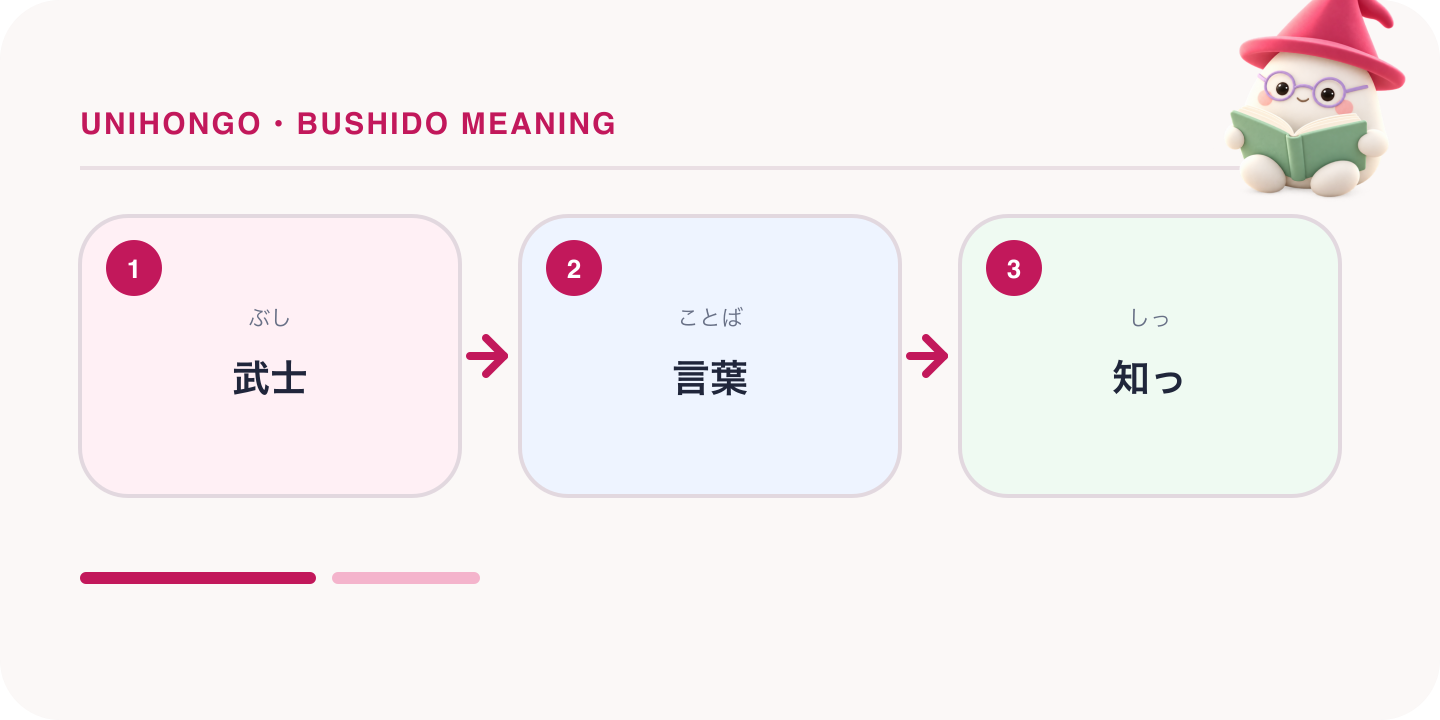
| 武士道という言葉を知っていますか。 | Bushidō to iu kotoba o shitte imasu ka. | Do you know the word bushidō? |
| 武士道は「武士の道」という意味です。 | Bushidō wa bushi no michi to iu imi desu. | Bushidō means the way of the warrior. |
| 「道」は柔道や書道の「道」と同じです。 | Dō wa jūdō ya shodō no dō to onaji desu. | The dō is the same as in jūdō and shodō. |
| 武士は昔の日本の戦士です。 | Bushi wa mukashi no Nihon no senshi desu. | Bushi were the warriors of old Japan. |
| この漢字はどう読みますか。 | Kono kanji wa dō yomimasu ka. | How do you read this kanji? |
The seven virtue words and where you will meet them
The virtues usually attached to bushidō are a vocabulary list in disguise. Every one of them is a living word or a component of living words, and several are on the JLPT lists. Learn them as characters first, then as parts of compounds you will actually hear.
| Virtue | Reading | Meaning and a modern word that uses it |
|---|---|---|
| 義 | gi | Rectitude, justice; seigi (justice), giri (duty, obligation) |
| 勇 | yū | Courage; yūki (courage), yūkan (brave) |
| 仁 | jin | Benevolence, humanity; jinjutsu (the healing art), jin'ai (compassion) |
| 礼 | rei | Courtesy, respect; reigi (manners), shitsurei (rudeness, excuse me) |
| 誠 | makoto | Sincerity; seijitsu (sincere), seii (good faith) |
| 名誉 | meiyo | Honour; meiyo kison (defamation), meiyo kyōju (professor emeritus) |
| 忠義 | chūgi | Loyalty; chūjitsu (faithful), chūkoku (candid advice) |
| 恥 | haji | Shame, often discussed alongside the seven; hazukashii (embarrassed) |
| 武士 | bushi | Warrior of the military class; the neutral historical term |
| 侍 | samurai | Warrior who serves a lord; the romantic word used in names |
| 刀 | katana | The curved single-edged sword; nihontō is the formal term |
Notice how many of these are things you already say. Shitsurei shimasu, excuse me, is literally I commit a discourtesy, so every time you leave a room politely you are using rei. Giri chokorēto, the obligation chocolate given to colleagues on Valentine's Day, is gi with a suffix. The virtues are not exotic; they are the same characters doing ordinary work.
Using the virtue words in real sentences
You will rarely announce that you follow bushidō, but you will constantly describe people with the words behind it. Reigi tadashii, well mannered, is one of the most common compliments for a young person. Seijitsu, sincere and honest, is a word that turns up in job references and dating profiles alike. Giri-gatai describes someone who takes obligations seriously and always returns a favour.
The tone of each word varies. Yūki ga aru, to have courage, is warm and everyday; chūjitsu, faithful, is a little formal; meiyo is grand and lives in fixed phrases. Learn the collocations, not only the dictionary meanings.
| Japanese | Romaji | Meaning |
|---|---|---|
| 彼はとても礼儀正しい人です。 | Kare wa totemo reigi tadashii hito desu. | He is a very well mannered person. |
| 誠実な対応に感謝しています。 | Seijitsu na taiō ni kansha shite imasu. | I am grateful for your sincere handling of this. |
| 彼女は義理堅いので、必ずお返しをします。 | Kanojo wa girigatai node, kanarazu okaeshi o shimasu. | She takes obligations seriously, so she always returns a favour. |
| 勇気を出して聞いてみました。 | Yūki o dashite kiite mimashita. | I plucked up the courage and asked. |
| 社長は忠実な部下を大切にします。 | Shachō wa chūjitsu na buka o taisetsu ni shimasu. | The president values loyal subordinates. |
| それは名誉なことだと思います。 | Sore wa meiyo na koto da to omoimasu. | I think that is an honour. |
| 恥をかきたくないので、練習します。 | Haji o kakitakunai node, renshū shimasu. | I don't want to embarrass myself, so I'll practise. |
Bushidō in sport: Samurai Japan and the fighting spirit
The place a learner is most likely to hear bushidō today is sport. Japan's national baseball team is officially nicknamed Samurai Japan, the football team is often called Samurai Blue, and commentators reach for bushidō seishin, the bushidō spirit, when a team keeps fighting after going behind. The word carries the idea of disciplined effort, respect for the opponent and not giving up, and it is used with a certain fondness rather than as a strict claim about history.
Traditional martial arts are where the vocabulary is still used literally. Kendō and jūdō classes begin and end with rei, the bow, and the phrase rei ni hajimari rei ni owaru, it begins with a bow and ends with a bow, is repeated in almost every dōjō. Sports commentators borrow the same idea when praising a player's manners after a match.
| Japanese | Romaji | Meaning |
|---|---|---|
| 侍ジャパンの試合を見ましたか。 | Samurai Japan no shiai o mimashita ka. | Did you watch the Samurai Japan game? |
| 最後まで諦めない、武士道精神ですね。 | Saigo made akiramenai, bushidō seishin desu ne. | Never giving up until the end, that's the bushidō spirit. |
| 剣道は礼に始まり、礼に終わります。 | Kendō wa rei ni hajimari, rei ni owarimasu. | Kendō begins with a bow and ends with a bow. |
| 相手を尊重する気持ちが大切です。 | Aite o sonchō suru kimochi ga taisetsu desu. | Respect for your opponent is what matters. |
| 武道を習ったことがありますか。 | Budō o naratta koto ga arimasu ka. | Have you ever learnt a martial art? |
Bushidō in business and everyday speech
In business Japanese, bushidō is mostly a rhetorical flourish. A manager giving a speech might praise sacrifice for the team as bushidō no seishin, and business books have long borrowed samurai imagery for leadership and perseverance. Used lightly, it signals seriousness and old-fashioned dedication; used heavily, it can sound pompous, and younger colleagues may quietly smile.
You will also hear the word in casual, half-joking comments. Someone who insists on finishing a task properly might say sore ga watashi no bushidō desu, that is my code, with a grin. The related word giri, obligation, does far more real work in daily life: it covers the duty to return favours, attend a colleague's wedding or send a year-end gift, and it is the word to reach for when explaining social obligations.
| Japanese | Romaji | Meaning |
|---|---|---|
| それが私の武士道です。 | Sore ga watashi no bushidō desu. | That's my code (said half jokingly). |
| 彼のやり方はまるで侍みたいだ。 | Kare no yarikata wa marude samurai mitai da. | The way he does things is just like a samurai. |
| 義理で結婚式に出席しました。 | Giri de kekkonshiki ni shusseki shimashita. | I attended the wedding out of obligation. |
| 最後まで責任を持ってやります。 | Saigo made sekinin o motte yarimasu. | I'll see it through responsibly to the end. |
| 武士に二言はない、と言いますね。 | Bushi ni nigon wa nai, to iimasu ne. | They say a warrior never goes back on his word. |
Nitobe's book and where the modern idea comes from
The tidy version of bushidō that most people know comes largely from one book. Nitobe Inazō, a Japanese scholar and diplomat, published Bushido: The Soul of Japan in English in 1900, aiming to explain Japanese morality to Western readers. He organised traditional ideals into chapters on justice, courage, benevolence, politeness, sincerity, honour and loyalty, drawing comparisons with European chivalry and Christian ethics. The book became widely read, was translated back into Japanese, and shaped how the word is understood both abroad and in Japan.
Historians point out that Nitobe was writing an interpretation, not recording a code samurai had actually carried around. Warrior ethics existed for centuries in house precepts, in Confucian teaching and in works such as the Hagakure, but they varied by period and domain, and the word bushidō itself was not common until the Edo period and was rare before the Meiji era. It was the Meiji state and its writers who turned scattered ideals into a national ethic, and later militarist propaganda that pushed it further.
For a learner, the practical lesson is simple: talk about bushidō with interest, but do not frame it as an ancient unbroken tradition, which sounds naive to an educated Japanese listener.
| Japanese | Romaji | Meaning |
|---|---|---|
| 新渡戸稲造の「武士道」を読んだことがあります。 | Nitobe Inazō no Bushidō o yonda koto ga arimasu. | I have read Nitobe Inazō's Bushidō. |
| この本は英語で書かれました。 | Kono hon wa eigo de kakaremashita. | This book was written in English. |
| 武士道の考え方は明治時代に広まりました。 | Bushidō no kangaekata wa Meiji jidai ni hiromarimashita. | The idea of bushidō spread in the Meiji period. |
| 歴史的には、いろいろな解釈があります。 | Rekishiteki ni wa, iroiro na kaishaku ga arimasu. | Historically, there are various interpretations. |
Myths to avoid when you talk about it
Because bushidō is popular abroad, a lot of what circulates about it is wrong, and repeating it in Japanese is an easy way to lose credibility. The following points are safe ground.
- It was never one written rulebook; the seven-virtue list is a modern summary
- Not every samurai was noble or loyal, and history records plenty of betrayals
- Seppuku was real but rare, and it is not something to bring up lightly
- The katana was a symbol of status; many warriors fought mainly with bows and spears
- Modern Japanese people are not bound by bushidō and may find the idea amusing
- Ninja are a separate topic and mostly a matter of later storytelling
If you are unsure, ask rather than assert. Nihon no kata wa bushidō o dō omotte imasu ka, what do Japanese people think of bushidō, is a good question that invites an honest, often nuanced answer.
When the conversation goes wrong
The most common mishap is tone. A learner who earnestly says they admire bushidō may get a polite but uncomfortable reaction, especially from older people who associate the word with wartime slogans. Adding a light touch, or narrowing the claim to something specific such as reigi, courtesy, fixes this quickly.
The second mishap is pronunciation. Budō, bushidō and bushi no michi are all close, and dropping the long vowel turns dō into do. If someone looks puzzled, spell it out with the kanji meanings: bushi no bu, samurai no shi, michi no dō.
| Japanese | Romaji | Meaning |
|---|---|---|
| 武士道というより、礼儀の文化に興味があります。 | Bushidō to iu yori, reigi no bunka ni kyōmi ga arimasu. | Rather than bushidō, I'm interested in the culture of courtesy. |
| すみません、ちょっと大げさでしたね。 | Sumimasen, chotto ōgesa deshita ne. | Sorry, that was a bit over the top, wasn't it. |
| 武道じゃなくて、武士道です。 | Budō ja nakute, bushidō desu. | Not budō, bushidō. |
| 日本の方は武士道をどう思っていますか。 | Nihon no kata wa bushidō o dō omotte imasu ka. | What do Japanese people think of bushidō? |
| 面白い話をありがとうございました。 | Omoshiroi hanashi o arigatō gozaimashita. | Thank you for the interesting conversation. |