
Why borrowed words come back wrong
When English adopts a word, it fits the word into English sound habits. Three habits matter most for Japanese words. First, English picks one syllable and stresses it hard, while the other vowels shrink into a quick uh. Second, English turns vowels into glides: an e at the end of a word tends to become ay or ee. Third, English ignores vowel length, so the long vowels in rāmen or tōfu disappear.
Japanese works the other way. It has five short, clear vowels, a as in father, i as in machine, u with relaxed lips, e as in bet and o as in a short version of law, and each beat takes about the same time. If you can say the five vowels cleanly and keep the beats even, most of these words fix themselves.
| Japanese | Romaji | Meaning |
|---|---|---|
| カラオケに行こう! | Karaoke ni ikō! | Let's go to karaoke! (casual) |
| あ・い・う・え・お | a i u e o | The five Japanese vowels, short and pure |
| ラーメン | rāmen | ramen: ra-a-me-n, four beats |
Four words you probably say the English way
These four are the most common offenders. Each looks simple, and each has one specific spot where English changes it.
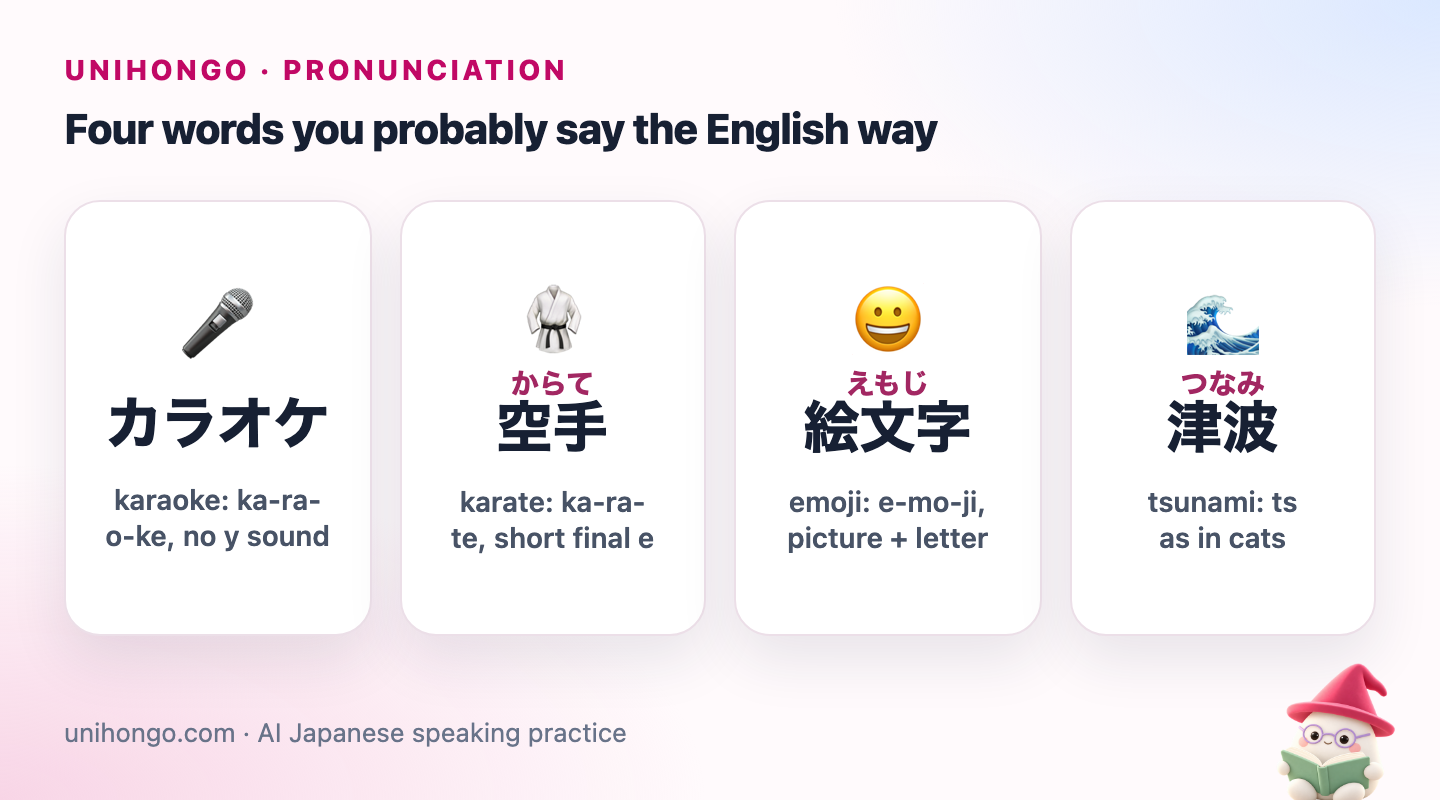
| Japanese | Romaji | Meaning |
|---|---|---|
| カラオケ | karaoke | karaoke: ka-ra-o-ke, no y sound |
| 空手 | karate | karate: ka-ra-te, short final e |
| 絵文字 | emoji | emoji: e-mo-ji, picture + letter |
| 津波 | tsunami | tsunami: ts as in cats |
Karaoke is the clearest example. English inserts a y and stresses the third syllable, carry-OH-key. Japanese says four flat beats: ka-ra-o-ke. Karate has the same opening; it is ka-ra-te, from kara, empty, and te, hand, so empty hand. The final te is short, like the te in ten.
Emoji is three beats with a short e at the start, e-mo-ji. Tsunami starts with ts, a sound English has only at the ends of words. The literal meaning, harbour wave, comes from tsu (津), harbour, and nami (波), wave.
Food words with hidden long vowels
Food is where most learners meet Japanese words first, and it is also where long vowels most often vanish. In Japanese a long vowel counts as two beats, and it can be the only thing that separates two words. When you order food in Japan, saying the long vowel helps the staff understand you straight away.
| Japanese | Romaji | Meaning |
|---|---|---|
| 豆腐 | tōfu | tōfu: to-o-fu, long o |
| 枝豆 | edamame | edamame: e-da-ma-me, four even beats |
| 天ぷら | tenpura | tempura: te-n-pu-ra |
| 抹茶 | matcha | matcha: a pause before cha |
| 刺身 | sashimi | sashimi: sa-shi-mi, three even beats |
| 旨味 | umami | umami: u-ma-mi, savoury taste |
Tempura is written tenpura in strict Hepburn romaji, because the n before p sounds like m. Either spelling is fine in English text, but in your mouth it is four beats: te-n-pu-ra. Matcha has a small tsu in kana, まっちゃ, so there is a short pause before the cha. Edamame, which English speakers often stress on the third syllable, is simply four equal beats.
Words whose meaning changed in English
Pronunciation is not the only thing that shifted. Some words picked up a narrower or different meaning in English, and using the English sense in Japanese can confuse people.
| Japanese | Romaji | Meaning |
|---|---|---|
| 日本酒をください。 | Nihonshu o kudasai. | Some sake, please. (rice drink) |
| 布団を敷きます。 | Futon o shikimasu. | I'll lay out the futon. |
| アニメが好きです。 | Anime ga suki desu. | I like anime. |
| 着物を着てみたいです。 | Kimono o kite mitai desu. | I'd like to try wearing a kimono. |
| Word | In English it often means | In Japanese it means | Say this in Japan |
|---|---|---|---|
| sake | Japanese rice wine | alcohol in general | nihonshu for the rice drink |
| futon | a sofa bed or thick mattress | folded bedding laid on the floor | futon, with the Japanese meaning |
| anime | Japanese animation only | any animation, from any country | anime, but expect the broad sense |
| manga | Japanese comics | comics or cartoons in general | manga, usually fine |
| kimono | a dressing gown or wrap | traditional Japanese clothing | kimono, or wafuku for Japanese clothing |
Anime in English is often said AN-i-may, with a long ay at the end. In Japanese it is three short beats, a-ni-me, and the last vowel is a short e. The word itself is a shortening of animēshon, the Japanese pronunciation of animation.
Using them in real sentences
A word said correctly on its own often slips back into English inside a sentence, because your mouth speeds up and old habits return. The fix is to practise each word inside a short, everyday sentence until the Japanese rhythm comes along with it. Here is a short exchange you might have after work.
| Japanese | Romaji | Meaning |
|---|---|---|
| 今日、カラオケ行かない? | Kyō, karaoke ikanai? | Coworker: Want to go to karaoke today? (casual) |
| いいね!その前にラーメン食べたい。 | Ii ne! Sono mae ni rāmen tabetai. | You: Sounds good! I want ramen before that. |
| 枝豆も頼もうか。 | Edamame mo tanomō ka. | Coworker: Shall we order edamame too? |
| うん。あと日本酒も少し。 | Un. Ato nihonshu mo sukoshi. | You: Yeah. And a little sake too. |
| 空手やってたって本当? | Karate yatteta tte hontō? | Coworker: Is it true you used to do karate? |
| 昔ね。今は全然。 | Mukashi ne. Ima wa zenzen. | You: Long ago. Not at all now. |
More borrowed words to check
Once you start listening for them, you will notice Japanese words all over English: in restaurants, gardening shops, puzzle books and films. Most of them follow the same rules, so the fixes are the same: five pure vowels, even beats, and long vowels kept long. Here are some more you will probably use.
| Japanese | Romaji | Meaning |
|---|---|---|
| 俳句 | haiku | haiku: ha-i-ku, three beats |
| 数独 | sūdoku | sudoku: su-u-do-ku, long u |
| 漫画 | manga | manga: ma-n-ga, three beats |
| 忍者 | ninja | ninja: ni-n-ja, three beats |
| 盆栽 | bonsai | bonsai: bo-n-sa-i, four beats |
| 寿司 | sushi | sushi: su-shi, short and even |
| 照り焼き | teriyaki | teriyaki: te-ri-ya-ki, light r |
| 侍 | samurai | samurai: sa-mu-ra-i, four beats |
Notice how often the n is its own beat. Manga, ninja and bonsai each have a beat for n, which English speakers tend to squeeze. And in haiku, bonsai and samurai, ai is two beats, a then i, not the English eye sound said quickly.
Sushi is a good test of the quiet vowel. In everyday speech the u after s is often very soft, so sushi can sound close to s-shi. You do not need to copy this, but if you hear it, it is not a mistake. What you should avoid is the English stress SOO-shee, with a long ee at the end.
Common learner mistakes
- Ending words with an English ee or ay sound: karatee, sah-key, AN-i-may. Japanese e is short and flat, like the e in bet.
- Stressing one syllable: ka-RAH-te, eda-MAH-me. Keep the beats even and let pitch, not volume, do the work.
- Dropping long vowels: ramen, tofu and sudoku are rāmen, tōfu and sūdoku in Japanese.
- Turning tsu into su. Tsunami and tsuyu (rainy season) need the ts sound from the end of cats.
- Using the English meaning: asking for sake when you mean rice sake, or calling a Western sofa bed a futon.
Retrain your ear with Mocchi
Type /pronounce in the Mocchi chat on the web and ask for a short practice with words like rāmen, tōfu and karaoke. Mocchi notes which words still come out the English way, so the next quiz and review can start with those instead of the easy ones.
To train your ear as well as your mouth, ask Mocchi to make flashcards of these words with /create-flashcards, picking a photo for each, then play Kotoba Tank with your own deck. You hear the Japanese word and hit the right one, which is a quick way to replace the English version in your head.