
Joining the call and the first thirty seconds
The opening of a Japanese video call is compressed. You greet, you name yourself, and you confirm that the audio works, usually inside two sentences. Colleagues get otsukaresama desu; anyone outside your company gets osewa ni natte orimasu. Say your company and name even if your tile shows them, because half the participants are still joining and nobody is reading name labels yet.
If you are the host, you also mark the start out loud. Waiting silently for people to notice that everyone has arrived wastes the first minute of every call. A short line that says the members are here and you will begin is enough, and it gives the latecomers a clear point to apologise at.
| Japanese | Romaji | Meaning |
|---|---|---|
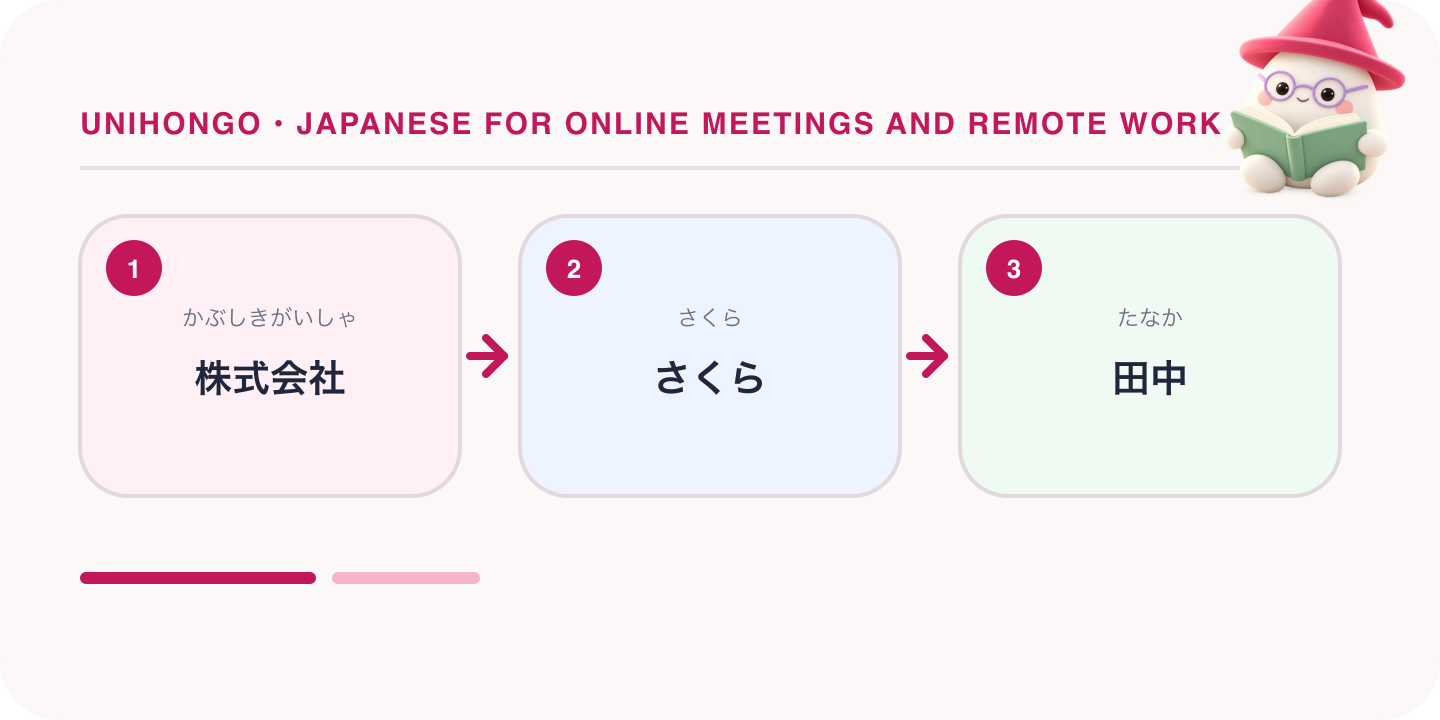
| お疲れ様です。株式会社さくらの田中です。 | Otsukaresama desu. Kabushiki-gaisha Sakura no Tanaka desu. | Hello everyone. This is Tanaka from Sakura Inc. |
| お世話になっております。よろしくお願いいたします。 | Osewa ni natte orimasu. Yoroshiku onegai itashimasu. | Thank you for your continued business. I look forward to speaking with you. |
| 音声、聞こえていますでしょうか。 | Onsei, kikoete imasu deshō ka. | Can you hear me all right? |
| はい、問題なく聞こえております。 | Hai, mondai naku kikoete orimasu. | Yes, we can hear you perfectly. |
| 皆さんお揃いのようですので、始めさせていただきます。 | Minasan osoroi no yō desu node, hajimesasete itadakimasu. | It looks like everyone is here, so let us begin. |
| 遅れて申し訳ございません。 | Okurete mōshiwake gozaimasen. | I am sorry for joining late. |
One phrase for each thing that goes wrong
Connection problems are the one part of a remote meeting where you cannot afford to compose a sentence from scratch. Something breaks, ten seconds of silence follow, and everyone waits. The fix is to learn one fixed line per failure so that the reaction is automatic. Each of these is neutral in politeness and works with colleagues and clients alike.
| What went wrong | Japanese | Romaji |
|---|---|---|
| They may not be able to hear you | 聞こえていますでしょうか。 | Kikoete imasu deshō ka. |
| You cannot hear them | お声が聞こえておりません。 | Okoe ga kikoete orimasen. |
| Their voice is breaking up | お声が途切れているようです。 | Okoe ga togirete iru yō desu. |
| Echo or feedback | ハウリングしているようです。 | Hauringu shite iru yō desu. |
| They are still muted | マイクがミュートになっているようです。 | Maiku ga myūto ni natte iru yō desu. |
| Their video has frozen | 画面が止まっているようです。 | Gamen ga tomatte iru yō desu. |
| You will leave and rejoin | 一度退出して、入り直します。 | Ichido taishutsu shite, hairinaoshimasu. |
| You dropped out and came back | 回線が切れてしまい、失礼いたしました。 | Kaisen ga kirete shimai, shitsurei itashimashita. |
| You missed what was said | 恐れ入ります、もう一度お願いできますでしょうか。 | Osore irimasu, mō ichido onegai dekimasu deshō ka. |
| Your line is unstable | 電波が不安定なので、カメラをオフにいたします。 | Denpa ga fuantei na node, kamera o ofu ni itashimasu. |
| Two of you spoke at once | 失礼しました、お先にどうぞ。 | Shitsurei shimashita, osaki ni dōzo. |
Notice how often yō desu appears. Saying that something seems to be happening, rather than stating it flatly, keeps the remark away from blame, which matters when the problem might be at either end of the line. It is the same softening you would use to point out any inconvenient fact at work.
Audio trouble in full sentences
Beyond the one-line reactions, you need a few longer sentences: one to check whether the problem is yours or theirs, one to say what you are about to do about it, and one to fall back to a phone call. Say what you are doing before you do it, because a participant who suddenly disappears without a word leaves the meeting stalled while everyone guesses.
| Japanese | Romaji | Meaning |
|---|---|---|
| 音声が少し聞こえづらいのですが、いかがでしょうか。 | Onsei ga sukoshi kikoezurai no desu ga, ikaga deshō ka. | Your audio is a little hard to hear. How is it on your end? |
| こちらの声は届いていますでしょうか。 | Kochira no koe wa todoite imasu deshō ka. | Is my voice coming through? |
| はい、こちらは問題ございません。 | Hai, kochira wa mondai gozaimasen. | Yes, everything is fine on our side. |
| 少し音が遅れているようです。 | Sukoshi oto ga okurete iru yō desu. | There seems to be a slight delay on the audio. |
| 有線に切り替えますので、少々お待ちください。 | Yūsen ni kirikaemasu node, shōshō omachi kudasai. | I will switch to a wired connection, so please give me a moment. |
| 電話でおかけ直ししてもよろしいでしょうか。 | Denwa de okakenaoshi shite mo yoroshii deshō ka. | May I call you back by phone instead? |
The reply you should expect to your check is a short one: hai, kikoete orimasu or sukoshi togiremashita. If you hear the second, do not repeat the whole paragraph. Repeat the last sentence only, slightly slower, and then ask whether that part came through.
Sharing your screen
Screen sharing has a small fixed script: announce it, check that it is visible, narrate your movement through the document, and announce the end. The verb kyōyū suru covers sharing, and sasete itadakimasu is the polite way to say that you are about to do something in front of people. Confirming visibility once is not fussy; a shared window that failed to appear can waste several minutes.
| Japanese | Romaji | Meaning |
|---|---|---|
| 画面を共有させていただきます。 | Gamen o kyōyū sasete itadakimasu. | I will share my screen. |
| 画面は見えていますでしょうか。 | Gamen wa miete imasu deshō ka. | Can you see my screen? |
| はい、見えております。 | Hai, miete orimasu. | Yes, we can see it. |
| 少し文字が小さいので、拡大していただけますか。 | Sukoshi moji ga chiisai node, kakudai shite itadakemasu ka. | The text is a little small. Could you zoom in? |
| 次のページに進みます。 | Tsugi no pēji ni susumimasu. | I will move to the next page. |
| 共有を止めます。 | Kyōyū o tomemasu. | I will stop sharing now. |
| 資料は後ほどお送りいたします。 | Shiryō wa nochihodo o-okuri itashimasu. | I will send the materials afterwards. |
Asking someone to unmute
There are two registers for this. The request form, myūto o kaijo shite itadakemasu deshō ka, is polite and direct. The observation form, maiku ga myūto ni natte iru yō desu, points at the situation instead of at the person and is the softer choice with a client or a senior colleague. Both are used constantly, and neither carries any irritation unless your tone supplies it.
When it is you who has been talking on mute, keep the recovery short. One shitsurei shimashita, then repeat the point, then carry on. Learners tend to over-apologise here, which turns a two-second stumble into a thirty-second interruption for everyone else on the call.
| Japanese | Romaji | Meaning |
|---|---|---|
| ミュートを解除していただけますでしょうか。 | Myūto o kaijo shite itadakemasu deshō ka. | Could you unmute yourself, please? |
| 田中さん、マイクがミュートのようです。 | Tanaka-san, maiku ga myūto no yō desu. | Tanaka, your microphone seems to be muted. |
| 失礼しました、ミュートのままでした。 | Shitsurei shimashita, myūto no mama deshita. | Sorry, I was still on mute. |
| 発言される際はミュートを解除してください。 | Hatsugen sareru sai wa myūto o kaijo shite kudasai. | Please unmute when you would like to speak. |
Taking turns without the cues of a room
In a meeting room you claim a turn with your body: you sit forward, draw breath, catch the chair's eye. None of that survives a grid of small tiles and a delayed picture, so the signals have to move into words. Japanese has neat ready-made ones. Itten, yoroshii deshō ka asks for a single point and promises to be brief, which makes it easy to grant.
Closing your turn matters just as much. Ijō desu is a clear full stop that tells the room the microphone is free, and without it two people will start at once. When that happens, do not negotiate: one of you says osaki ni dōzo immediately and the other simply continues. Naming the next speaker is the fastest way to fix an awkward silence.
| Japanese | Romaji | Meaning |
|---|---|---|
| 一点、よろしいでしょうか。 | Itten, yoroshii deshō ka. | May I raise one point? |
| 恐れ入ります、途中で失礼します。 | Osore irimasu, tochū de shitsurei shimasu. | Excuse me for cutting in. |
| 以上です。 | Ijō desu. | That is all from me. |
| 佐藤さん、いかがでしょうか。 | Satō-san, ikaga deshō ka. | Satō, what are your thoughts? |
| どうぞお続けください。 | Dōzo otsuzuke kudasai. | Please carry on. |
| 補足してもよろしいでしょうか。 | Hosoku shite mo yoroshii deshō ka. | May I add something to that? |
| ご意見のある方はいらっしゃいますか。 | Goiken no aru kata wa irasshaimasu ka. | Does anyone have a comment? |
Why the aizuchi rhythm breaks down on a laggy line
Japanese conversation runs on frequent back-channel signals. In person you produce hai, ee, and naruhodo every few seconds, and the speaker uses them to know that you are still with them. This is one of the habits a learner works hardest to acquire, and on a video call it can quietly turn against you. Your hai leaves your mouth in a gap, travels down a delayed line, and arrives on top of the speaker's next word.
The result is a call where the speaker keeps stopping because it sounds as though you are interrupting, or where both of you freeze in the same half second and then apologise. It is not a language problem and it is not rudeness. It is timing, and the fix is to change where the signals go rather than to drop them, because a completely silent listener reads as disengaged or unhappy to a Japanese speaker.
- Keep the camera on and nod visibly. On video, the nod carries the load that hai carries in a room.
- Save spoken aizuchi for clause boundaries and for the end of a turn, not for every phrase.
- Use one longer confirmation instead of several short ones, so it survives a delay without landing mid-word.
- If you and the speaker collide, stop completely and let them continue rather than trading apologies.
- As the speaker, pause deliberately every few sentences to give the delayed signals somewhere to arrive.
What to say instead of constant back-channelling
Replace quantity with weight. One clear confirmation at the end of a section shows you followed it far better than a scattering of hai that arrive at random points. These lines also give the speaker a natural place to check in, which is why hosts use them at the end of every agenda item.
| Japanese | Romaji | Meaning |
|---|---|---|
| はい、承知いたしました。 | Hai, shōchi itashimashita. | Yes, understood. |
| なるほど、そういうことですね。 | Naruhodo, sō iu koto desu ne. | I see, so that is how it works. |
| ここまでで、ご不明な点はございますか。 | Koko made de, gofumei na ten wa gozaimasu ka. | Is anything unclear so far? |
| 今の点、もう少し詳しく伺ってもよろしいでしょうか。 | Ima no ten, mō sukoshi kuwashiku ukagatte mo yoroshii deshō ka. | Could I hear a little more about that last point? |
| 大丈夫です、続けてください。 | Daijōbu desu, tsuzukete kudasai. | It is fine, please go on. |
Using the chat box
The chat panel carries real conventions in Japanese meetings. Links, spellings, numbers, and company names go there rather than into the audio, because they survive a bad connection and can be copied. Announce anything you post, since not everyone has the panel open, and say when you will answer a question that arrived in writing rather than answering it silently.
| Japanese | Romaji | Meaning |
|---|---|---|
| リンクをチャットに貼っておきます。 | Rinku o chatto ni hatte okimasu. | I will put the link in the chat. |
| 詳細はチャットに記載しました。ご確認ください。 | Shōsai wa chatto ni kisai shimashita. Gokakunin kudasai. | I have written the details in the chat. Please take a look. |
| チャットでご質問をいただければ、後ほどお答えします。 | Chatto de goshitsumon o itadakereba, nochihodo okotae shimasu. | If you post questions in the chat, I will answer them later. |
| 先ほどチャットに送った資料をご覧ください。 | Sakihodo chatto ni okutta shiryō o goran kudasai. | Please look at the document I sent in the chat a moment ago. |
Recording and minutes
Ask before you record, every time, and ask in a form that makes refusal easy. Sashitsukae nakereba, meaning if it causes no inconvenience, is the standard opener. Minutes are gijiroku, and saying out loud who is taking them is normal practice, partly so that person can ask for a pause when the discussion outruns their typing.
| Japanese | Romaji | Meaning |
|---|---|---|
| 本日の会議を録画してもよろしいでしょうか。 | Honjitsu no kaigi o rokuga shite mo yoroshii deshō ka. | May I record today's meeting? |
| 差し支えなければ、録音させていただきます。 | Sashitsukae nakereba, rokuon sasete itadakimasu. | If you have no objection, I will record the audio. |
| 録画を開始いたします。 | Rokuga o kaishi itashimasu. | I am starting the recording now. |
| 議事録は私が取ります。 | Gijiroku wa watashi ga torimasu. | I will take the minutes. |
| 議事録は後ほど共有いたします。 | Gijiroku wa nochihodo kyōyū itashimasu. | I will share the minutes afterwards. |
Closing the call
Endings on video are abrupt, because there is no walk to the door and no small talk while people gather their papers. That makes the closing sequence more important, not less: signal that time is nearly up, summarise what happens next, thank everyone, and then leave. Say the next action out loud even if it is already in the minutes, since it is the last thing anyone will remember.
| Japanese | Romaji | Meaning |
|---|---|---|
| そろそろお時間ですので、このあたりで。 | Sorosoro ojikan desu node, kono atari de. | We are nearly out of time, so let us stop here. |
| 本日の内容をまとめますと、次回までに見積もりをお送りします。 | Honjitsu no naiyō o matomemasu to, jikai made ni mitsumori o o-okuri shimasu. | To sum up today, we will send the quotation before the next meeting. |
| ありがとうございました。次回もよろしくお願いいたします。 | Arigatō gozaimashita. Jikai mo yoroshiku onegai itashimasu. | Thank you very much. I look forward to the next meeting. |
| それでは、本日はこれで失礼いたします。 | Sore de wa, honjitsu wa kore de shitsurei itashimasu. | Well then, I will say goodbye for today. |
| お疲れ様でした。失礼いたします。 | Otsukaresama deshita. Shitsurei itashimasu. | Thank you for your work today. Goodbye. |
| お先に失礼いたします。 | Osaki ni shitsurei itashimasu. | Please excuse me for leaving first. |
Do not close the window on the last syllable. Leave a second of silence after shitsurei itashimasu so that the delayed replies from the other participants can land, and so that nobody is cut off halfway through their own goodbye.