
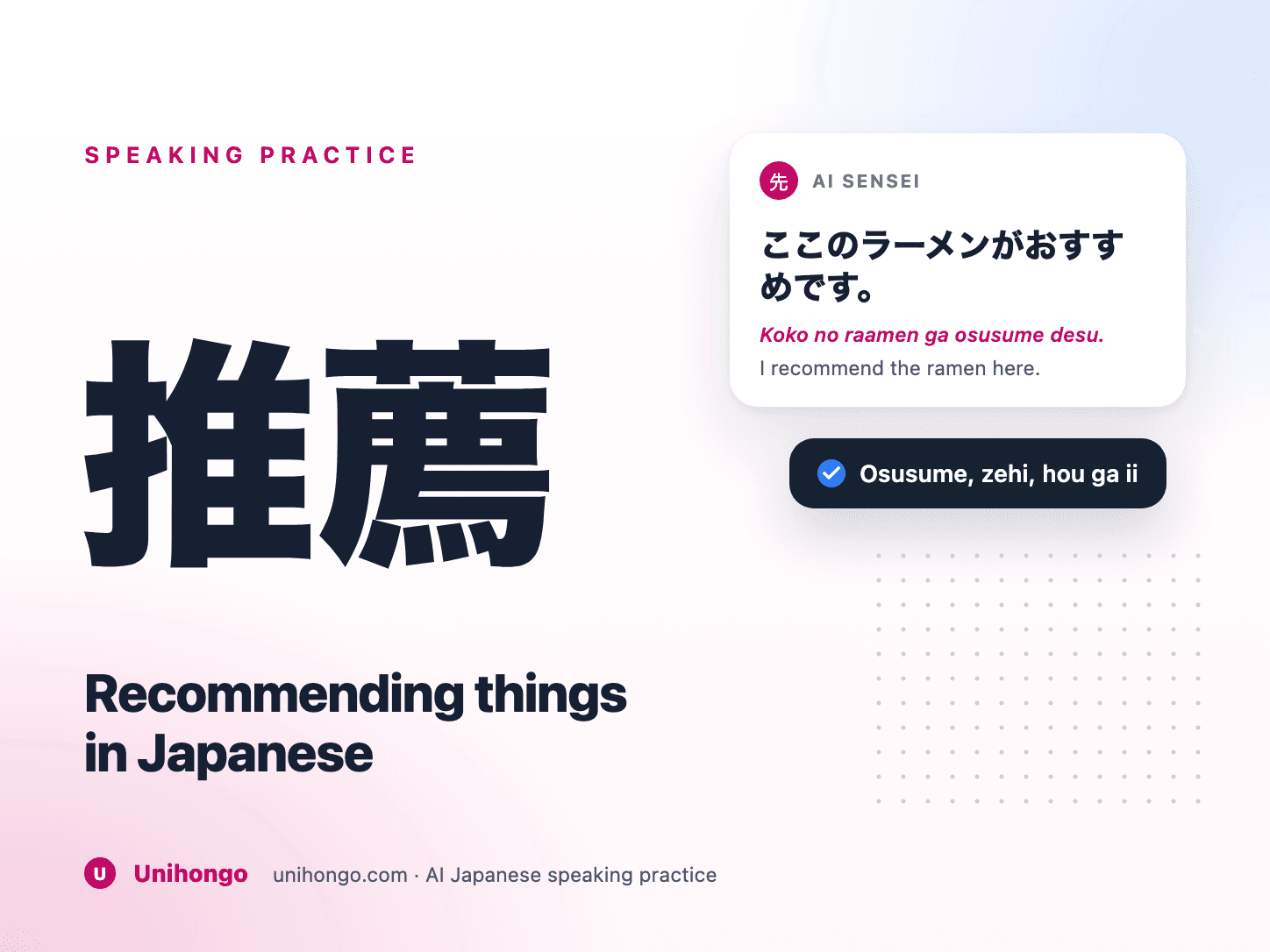
The recommendation scale
Recommendations differ in how much they push, and Japanese marks that difference clearly. At the light end you are simply mentioning something. In the middle you are saying it is good and worth trying. At the strong end you are telling somebody they should do it, which is advice rather than a recommendation and carries a corresponding social weight.
Matching the strength to the relationship matters. Ta hō ga ii to a friend is normal; the same phrase to a client sounds like you are directing them. The middle of the scale is where most conversation lives.
| Form | Strength | Feel |
|---|---|---|
| …もいいですよ ...mo ii desu yo | Light | One option among several |
| …がおすすめです ...ga osusume desu | Standard | This is my recommendation |
| …はおいしいですよ ...wa oishii desu yo | Standard, indirect | Stating a fact that implies a recommendation |
| …てみてください ...te mite kudasai | Warm | Please give it a try |
| ぜひ…てください zehi ...te kudasai | Enthusiastic | You really should |
| …た方がいいです ...ta hō ga ii desu | Advice | You should, with a should in it |
Te mite kudasai, please try it and see, is the most useful of these. It recommends without asserting that the listener will like it.
Asking for a recommendation
Asking is often more useful than telling, particularly for a learner, because it hands the conversation to someone with more to say and gives you listening time. Osusume wa arimasu ka is the universal form and works in a restaurant, a shop, or a conversation about films.
Narrowing the question makes it easier to answer. Adding a constraint, such as a budget, a time, or a preference, turns a broad question into one that can be answered in a sentence.
| Japanese | Romaji | Meaning |
|---|---|---|
| おすすめは何ですか。 | Osusume wa nan desu ka. | What do you recommend? |
| この店のおすすめはありますか。 | Kono mise no osusume wa arimasu ka. | Is there anything you recommend here? |
| 初めてなんですが、何がいいですか。 | Hajimete na n desu ga, nani ga ii desu ka. | It is my first time. What would be good? |
| 辛くないものでおすすめはありますか。 | Karakunai mono de osusume wa arimasu ka. | Do you have a recommendation that is not spicy? |
| 一日しかないので、どこがいいですか。 | Ichinichi shika nai node, doko ga ii desu ka. | I only have one day, so where would be good? |
| 何か面白い本、知りませんか。 | Nani ka omoshiroi hon, shirimasen ka. | Do you know any interesting books? |
Giving one with a reason
A recommendation with a reason is more useful and more polite than one without, because it lets the listener judge whether the reason applies to them. It also gives them a graceful way to decline: they can disagree with the reason rather than with you.
The reason usually comes second, attached with node or kara, or as a separate short sentence. Keep it concrete. Saying a restaurant is good says nothing; saying it is quiet and the fish is fresh gives someone a basis for a decision.
| Japanese | Romaji | Meaning |
|---|---|---|
| ここのラーメンがおすすめです。あっさりしていて食べやすいです。 | Koko no rāmen ga osusume desu. Assari shite ite tabeyasui desu. | I recommend the ramen here. It is light and easy to eat. |
| 静かなので、話すのにいいですよ。 | Shizuka na node, hanasu no ni ii desu yo. | It is quiet, so it is good for talking. |
| 朝早く行くと空いています。 | Asa hayaku iku to suite imasu. | If you go early in the morning it is empty. |
| 値段の割においしいと思います。 | Nedan no wari ni oishii to omoimasu. | I think it is good for the price. |
| 観光地の割に人が少ないです。 | Kankōchi no wari ni hito ga sukunai desu. | For a tourist spot, there are few people. |
| 好みが分かれるかもしれませんが、私は好きです。 | Konomi ga wakareru kamo shiremasen ga, watashi wa suki desu. | Opinions may differ, but I like it. |
No wari ni, for a, is a compact and very natural way to frame value: nedan no wari ni, for the price; kankōchi no wari ni, for a tourist spot.
Zehi, and how enthusiasm works
Zehi adds warmth and a sense of by all means, and it is the word that turns a recommendation into an invitation. It works best on experiences: visiting, trying, coming, seeing. It fits less well on purchases, where the enthusiasm can read as pressure.
It is also the standard word for accepting an invitation enthusiastically. Zehi on its own is a complete and warm yes, which is why it is worth learning both directions.
| Japanese | Romaji | Meaning |
|---|---|---|
| ぜひ食べてみてください。 | Zehi tabete mite kudasai. | You really should try it. |
| 京都に行くなら、ぜひ朝に行ってください。 | Kyōto ni iku nara, zehi asa ni itte kudasai. | If you go to Kyoto, do go in the morning. |
| ぜひ遊びに来てください。 | Zehi asobi ni kite kudasai. | Please do come and visit. |
| ぜひ、お願いします。 | Zehi, onegaishimasu. | Yes, please do. |
| ぜひ一度は見てほしいです。 | Zehi ichido wa mite hoshii desu. | I would love you to see it at least once. |
Recommending at work
At work a recommendation is closer to a proposal, and the wording shifts accordingly. Ta hō ga ii is too directive for anyone senior, and the safe frames present the option and hand back the decision.
The useful pattern is to give the recommendation as your own view, supported by a reason, and end with a question. Kojinteki ni wa, personally, lowers the pressure while still committing to a position, which is usually what a colleague actually wants from you.
| Japanese | Romaji | Meaning |
|---|---|---|
| 個人的には、こちらの方がいいと思います。 | Kojinteki ni wa, kochira no hō ga ii to omoimasu. | Personally, I think this one is better. |
| 経験上、この方法が早いです。 | Keiken-jō, kono hōhō ga hayai desu. | In my experience this method is faster. |
| A の方が安全かと思いますが、いかがでしょうか。 | A no hō ga anzen ka to omoimasu ga, ikaga deshō ka. | I think A may be safer. How would that be? |
| どちらでも対応できますが、おすすめは B です。 | Dochira demo taiō dekimasu ga, osusume wa B desu. | We can do either, but my recommendation is B. |
| よろしければ、資料をお送りします。 | Yoroshikereba, shiryō o ookuri shimasu. | If you like, I will send you the materials. |
Responding to a recommendation
When someone recommends something, the conventional response has two parts: a reaction and an indication of what you will do. A reaction alone leaves the recommender unsure whether their suggestion landed.
Both acceptance and deferral are easy. Ittemimasu, I will go and try it, accepts. Kondo tameshite mimasu, I will try it sometime, defers politely, and everyone understands that sometime may never arrive.
| Japanese | Romaji | Meaning |
|---|---|---|
| いいですね。行ってみます。 | Ii desu ne. Ittemimasu. | That sounds good. I will give it a try. |
| ありがとうございます。今度試してみます。 | Arigatō gozaimasu. Kondo tameshite mimasu. | Thank you. I will try it sometime. |
| メモしておきます。 | Memo shite okimasu. | I will make a note of it. |
| 前から気になっていたんです。 | Mae kara ki ni natte ita n desu. | I had been curious about it for a while. |
| 実は、辛いものが苦手なんです。 | Jitsu wa, karai mono ga nigate na n desu. | Actually, I am not good with spicy food. |
| また教えてください。 | Mata oshiete kudasai. | Please tell me about others sometime. |
Recommending against something
Warning someone off is harder than recommending, because it contradicts a choice they may already have made. The soft version raises a consideration rather than a verdict, and the strong version, nai hō ga ii, should be reserved for genuine problems.
Framing the warning around conditions rather than the thing itself is usually better. Saying that a place is very crowded at weekends is more useful and less confrontational than saying it is not good.
| Japanese | Romaji | Meaning |
|---|---|---|
| 週末はすごく混みますよ。 | Shūmatsu wa sugoku komimasu yo. | It gets very crowded at weekends. |
| 予約しないと入れないかもしれません。 | Yoyaku shinai to hairenai kamo shiremasen. | You might not get in without a reservation. |
| あまりおすすめしません。 | Amari osusume shimasen. | I would not really recommend it. |
| 行くなら、平日の方がいいと思います。 | Iku nara, heijitsu no hō ga ii to omoimasu. | If you go, I think a weekday is better. |
| 好みによると思いますが、私はちょっと。 | Konomi ni yoru to omoimasu ga, watashi wa chotto. | I think it depends on taste, but personally, not so much. |
Watashi wa chotto, trailing off, is a complete and polite way to say it was not for you without saying it is bad.