
Four names from the sky
These four names come from the sky by day and by night: the open sky, a famous star cluster, a group of stars and the universe itself.
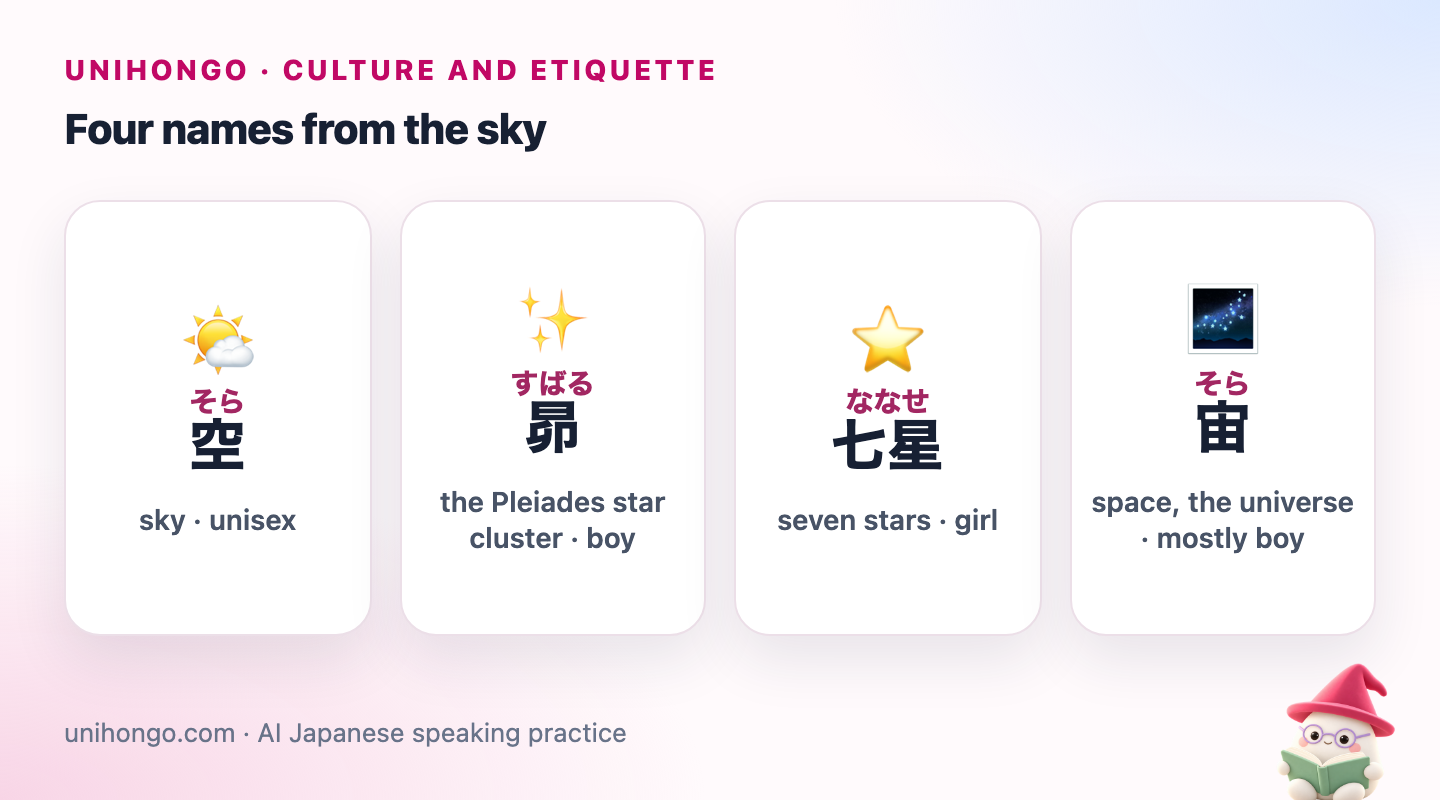
| Japanese | Romaji | Meaning |
|---|---|---|
| 空 | Sora | sky · unisex |
| 昴 | Subaru | the Pleiades star cluster · boy |
| 七星 | Nanase | seven stars · girl |
| 宙 | Sora | space, the universe · mostly boy |
Subaru is the Japanese name for the Pleiades, the small bright cluster you can see in winter; it appears in classical Japanese literature. 宙 is read chū in words like 宇宙 (uchū, the universe), and Sora is a name reading for it. Nanase uses 七, seven, and 星, star, read se here.
Star kanji and how they are read
The kanji 星 is read hoshi in everyday Japanese and sei in words like 星座 (seiza, constellation). In names you meet both, and in some modern names a shortened se, as in Nanase. Because readings vary, star names are a common reason for the question nan to oyomi sureba ii desu ka, how should I read it.
| Japanese | Romaji | Meaning |
|---|---|---|
| 流星 | Ryūsei | shooting star · boy |
| 北斗 | Hokuto | the Big Dipper · boy |
| 星也 | Seiya | star + a classical ending · boy |
| 星来 | Seira | star + come · girl |
| 銀河 | Ginga | the galaxy, Milky Way · boy (rare) |
Hokuto is the Big Dipper, the seven stars used to find the north, which is why 斗, the dipper, is so common in boys' names ending in -to. Seira and Ginga feel modern and a little bold; they are names you will meet, but not in every class.
Sky and heaven kanji
Sky names use a few different kanji, each with its own feel. 空 is the everyday sky; 天 is heaven, grander and more poetic; 宙 is space beyond the sky. Blue kanji such as 蒼 and 碧 often join them.
| Japanese | Romaji | Meaning |
|---|---|---|
| 美空 | Misora | beautiful sky · girl |
| 天音 | Amane | heaven + sound · girl |
| 蒼空 | Sora | blue + sky · boy |
| 晴 | Haru | clear weather, a fine sky · boy |
| Kanji | Everyday reading and word | Feel in names |
|---|---|---|
| 空 | sora: 青空 (aozora, blue sky) | Open, free, simple |
| 天 | ten: 天気 (tenki, weather) | Heavenly, grand |
| 宙 | chū: 宇宙 (uchū, the universe) | Vast, modern |
| 蒼 | ao: deep blue | Cool, calm, often boys |
空 also means empty in words like 空港 (kūkō, airport) and 空席 (kūseki, vacant seat). In a name, nobody thinks of emptiness; they think of a wide blue sky. Amane shows 天 read ama, as in 天の川, the Milky Way.
Star and sky words to know
| Japanese | Romaji | Meaning |
|---|---|---|
| 星空 | hoshizora | starry sky |
| 流れ星 | nagareboshi | shooting star |
| 星座 | seiza | constellation; star sign |
| 天の川 | Amanogawa | the Milky Way |
| 青空 | aozora | blue sky |
| 夜空 | yozora | night sky |
Seiza means both a constellation and a star sign. Nanza desu ka, what is your sign, is common small talk in Japan, along with blood type. Nagareboshi is the everyday word for shooting star; Ryūsei, the same kanji read in on'yomi, sounds more literary and is the name.
Tanabata: the night of two stars
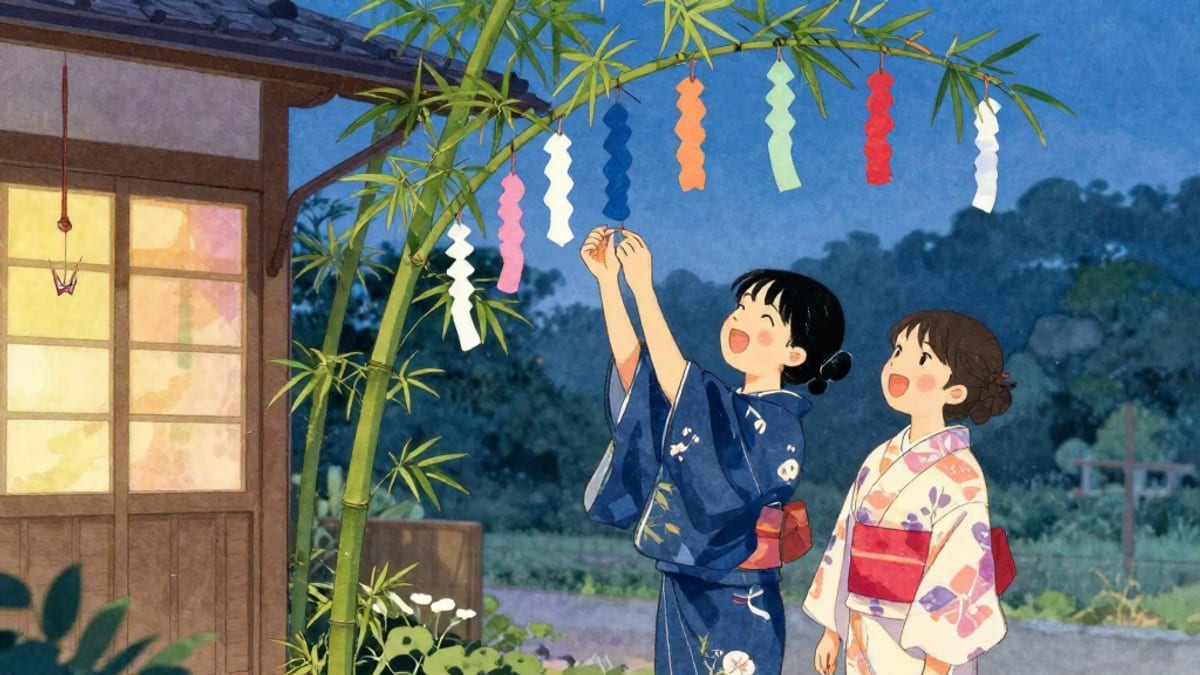
Tanabata, 七夕, is held on 7 July in most of Japan, and a month later in some regions. It retells an old story of two stars, the weaver Orihime (Vega) and the cowherd Hikoboshi (Altair), who are separated by the Milky Way and allowed to meet once a year. People write wishes on colourful paper strips called tanzaku and hang them on bamboo branches.
Tanabata is a natural time to talk about star names, and a lovely time to practise wishes in Japanese: the pattern ~ yō ni, may it be that, is how many wishes end.
| Japanese | Romaji | Meaning |
|---|---|---|
| 七夕 | Tanabata | the star festival, 7 July |
| 短冊に願い事を書きます。 | Tanzaku ni negaigoto o kakimasu. | We write wishes on paper strips. |
| 日本語が上手になりますように。 | Nihongo ga jōzu ni narimasu yō ni. | May my Japanese get better. |
| 今夜は星がよく見えますね。 | Kon'ya wa hoshi ga yoku miemasu ne. | You can see the stars well tonight. |
Mini dialogue: a boy called Hokuto
| Japanese | Romaji | Meaning |
|---|---|---|
| ほくとくんって、星の名前? | Hokuto kun tte, hoshi no namae? | You: Hokuto, is that a star name? |
| うん、北斗七星の北斗。 | Un, Hokuto shichisei no Hokuto. | Hokuto: Yeah, the Hokuto of the Big Dipper. |
| 道に迷わないように、だって。 | Michi ni mayowanai yō ni, datte. | Hokuto: So I'd never lose my way, they said. |
| すてきな理由だね。 | Suteki na riyū da ne. | You: What a lovely reason. |
The sky through the day
Sky names are not only about stars. Japanese has beautiful words for the sky at different times of day, and some of them sit behind names or make good conversation when you talk about one. A child born at dawn, on a clear morning or under a red evening sky may hear that story every birthday.
| Japanese | Romaji | Meaning |
|---|---|---|
| 朝焼け | asayake | red morning sky |
| 夕焼け | yūyake | sunset glow |
| 晴れ | hare | clear, sunny weather |
| 虹 | niji | rainbow |
| 雲 | kumo | cloud |
Hare, sunny weather, is written 晴, the kanji in Haru and in many names such as 晴翔 (Haruto). Yūyake is one of the most loved sky words in Japanese, from children's songs to evening chats on the way home. When someone tells you their name comes from the sky, ask Donna sora desu ka, what kind of sky? It often leads to a memory of the day they were born, or of a parent who loved the sea or the mountains.
Look up, then speak: Mocchi and Ibuki-sensei
Start with Mocchi: ask it to explain the difference between 空, 天 and 宙 in names, then say Quiz me on star words tomorrow. Mocchi remembers the request and the words you stumble on, so the quiz comes back to Amanogawa if that is the one you miss.
When you feel ready to talk, open AI Sensei, choose Ibuki-sensei and ask for a Tanabata evening: the Sensei plays a friend at the festival, you explain a star name, talk about your wish and ask about theirs. If it is too fast, ask Ibuki-sensei to speak more slowly.
Mistakes to avoid with star and sky names
- Reading 星 as hoshi in every name. Seiya, Seira and Nanase use sei or se.
- Dropping the long vowel in Ryūsei. Ryusei with a short u sounds clumsy to Japanese ears.
- Treating 宙 or 宇宙 read Sora as a standard reading. It is a name reading; some people will need to be told.
- Thinking Tanabata is the same date everywhere. Most places use 7 July, some celebrate in August.
- Calling 昴 by its English name in Japanese. Say Subaru; the Pleiades is not a word most Japanese people use.