
Four flower names to start with
Flower names range from the flower itself to the act of blooming. These four show the range, and one of them is a boy's name.
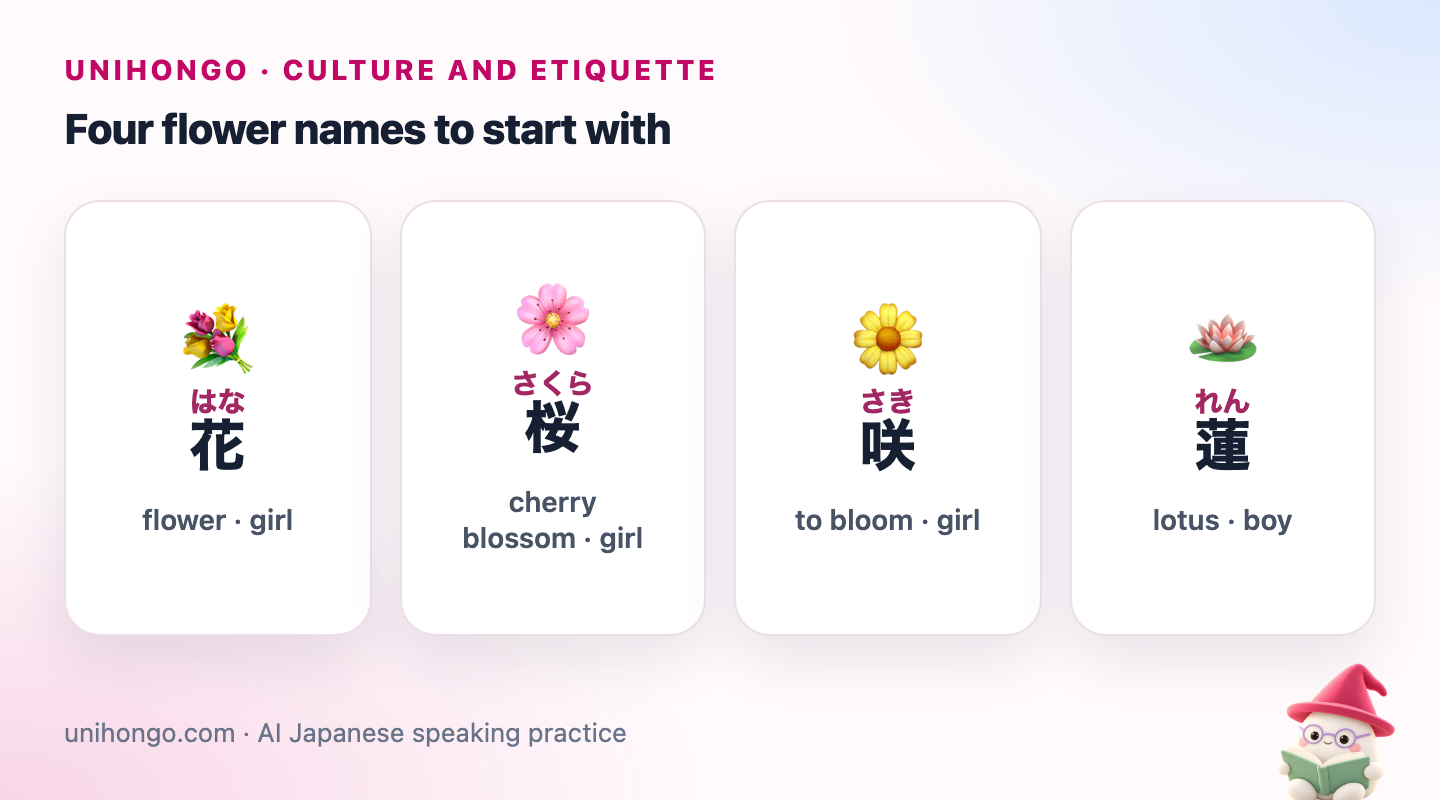
| Japanese | Romaji | Meaning |
|---|---|---|
| 花 | Hana | flower · girl |
| 桜 | Sakura | cherry blossom · girl |
| 咲 | Saki | to bloom · girl |
| 蓮 | Ren | lotus · boy |
Saki, 咲, uses the verb 咲く (saku), to bloom. It suggests a child who will flourish, and the same kanji appears in many names: 美咲 (Misaki), 咲良 (Sakura), 咲希 (Saki). Ren, the lotus, has been one of the most popular boys' names in recent years.
The flower kanji in names
A handful of kanji carry the idea of flowers and blooming. Recognise them and you can read the meaning of hundreds of names.
| Japanese | Romaji | Meaning |
|---|---|---|
| 花音 | Kanon | flower + sound · girl |
| 優花 | Yūka | gentle + flower · girl |
| 華 | Hana | flower, splendour · girl |
| 茉莉 | Mari | jasmine · girl |
| Kanji | Meaning | Example names |
|---|---|---|
| 花 | Flower | Hana, Kanon (花音), Yūka (優花) |
| 華 | Flower, splendour, glamour | Hana, Haruka (春華) |
| 咲 | To bloom | Saki, Misaki, Sakura (咲良) |
| 桜 | Cherry blossom | Sakura, Sakurako (桜子) |
| 芽 | Sprout, bud | Mei (芽依, 芽衣) |
| 莉 | Jasmine (in 茉莉) | Riko, Mari, Akari (朱莉) |
In names, 花 is often read ka at the end (Yūka, Haruka) and hana or ka at the start. 華 feels more gorgeous and formal than 花; parents choose between them for the feel as much as the meaning.
Flower names for girls
| Japanese | Romaji | Meaning |
|---|---|---|
| 百合 | Yuri | lily · girl |
| 椿 | Tsubaki | camellia · girl |
| 菫 | Sumire | violet · girl |
| 杏 | An | apricot blossom and fruit · girl |
| 小梅 | Koume | little plum blossom · girl |
| 花梨 | Karin | Chinese quince · girl |
| 撫子 | Nadeshiko | fringed pink · girl (rare) |
Sumire is often written in hiragana, すみれ, because 菫 is not an everyday kanji. Nadeshiko is the flower in the old phrase 大和撫子 (Yamato nadeshiko), an ideal of graceful Japanese womanhood; the phrase now sounds old-fashioned to many people, and Nadeshiko itself is a rare name. Koume, little plum, has a gentle retro charm.
Yuri, the lily, is an elegant, familiar name, and it can also be written ゆり or 由里. Tsubaki is a strong, distinctive name: the camellia is a tough evergreen with glossy leaves that blooms in the cold, and parents who choose it often mention that resilience. An, apricot, is one of the shortest girl names in Japanese, a single syllable plus the final n.
Flower and plant names for boys
Boys' names use flowers less often, but plants, trees and leaves are common, and a few flower names are clearly popular for boys.
| Japanese | Romaji | Meaning |
|---|---|---|
| 蓮 | Ren | lotus · boy |
| 葵 | Aoi | hollyhock · unisex |
| 草太 | Sōta | grass + big · boy |
| 樹 | Itsuki | tree · boy |
| 楓 | Kaede | maple · mostly girl, some boys |
The lotus has a strong image in Japanese culture: it grows out of mud and blooms clean, and it is closely associated with Buddhism. Aoi, the hollyhock, appears on a famous family crest and is also the name of a historic Kyoto festival, the Aoi Matsuri, which gives it a dignified feel for boys and girls alike.
What flowers suggest in Japan
Flowers in Japan carry seasonal and cultural associations, and flower language, hanakotoba (花言葉), adds a meaning to many of them. Hanakotoba meanings vary between sources, so treat them as a pleasant extra rather than a fixed code. Season matters more: a Sakura is often imagined as a spring child, a Tsubaki as a winter one.
A few associations are worth knowing. 菊, the chrysanthemum, is on the imperial crest and is widely used at funerals, so it feels formal and is uncommon in modern baby names. Camellias drop their whole flower at once, and some older people avoid them as get-well flowers for that reason; Tsubaki as a name is still well liked.
| Japanese | Romaji | Meaning |
|---|---|---|
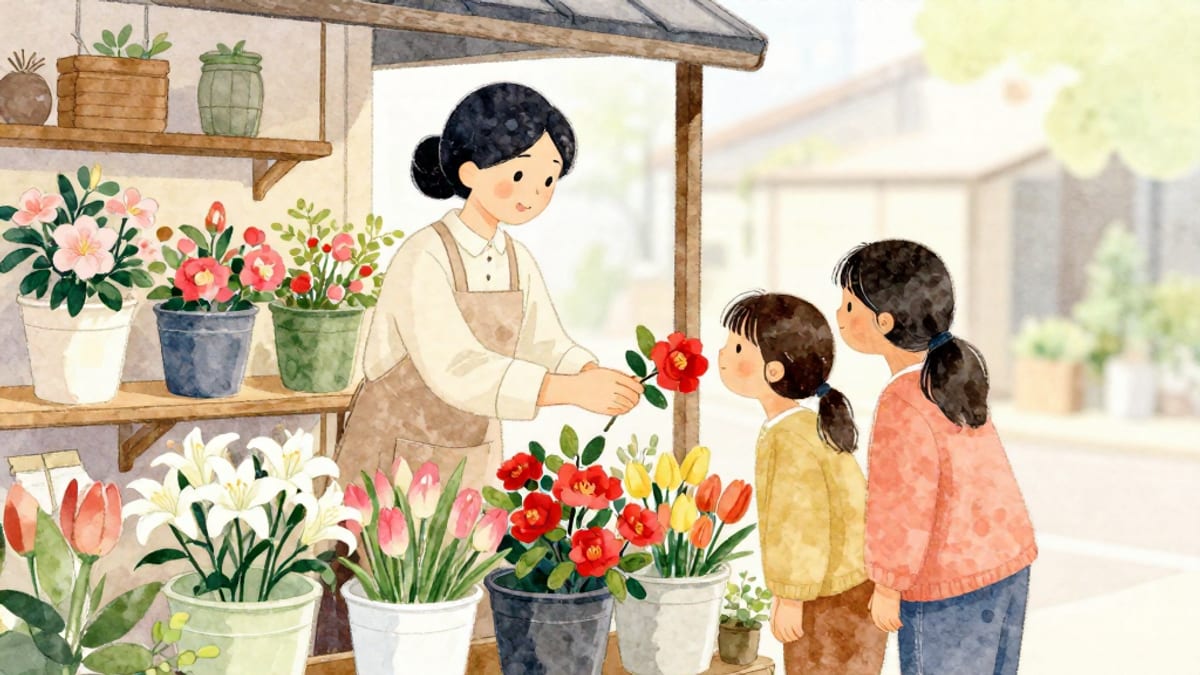
| この花は何という名前ですか。 | Kono hana wa nan to iu namae desu ka. | What is this flower called? |
| 椿は冬の花です。 | Tsubaki wa fuyu no hana desu. | The camellia is a winter flower. |
| 花言葉は何ですか。 | Hanakotoba wa nan desu ka. | What does it mean in flower language? |
| 娘の名前と同じ花です。 | Musume no namae to onaji hana desu. | It's the same flower as my daughter's name. |
Mini dialogue: a classmate called Yuri
| Japanese | Romaji | Meaning |
|---|---|---|
| ゆりちゃんって、花の百合? | Yuri chan tte, hana no yuri? | You: Yuri, like the lily? |
| そう。でも、ひらがなで書くの。 | Sō. Demo, hiragana de kaku no. | Yuri: Yes. But I write it in hiragana. |
| へえ、どうして? | Hē, dōshite? | You: Oh, why? |
| やわらかい感じにしたかったんだって。 | Yawarakai kanji ni shitakatta n da tte. | Yuri: My parents wanted it to look soft, they say. |
Flower names through the seasons
Many Japanese flowers are tied to a season, and flower names often carry that season with them. Parents sometimes choose the flower that blooms around the birth, so knowing the seasons helps you guess the story behind a name. Blooming times vary from south to north, so treat these as rough guides.
| Japanese | Romaji | Meaning |
|---|---|---|
| 春に咲く花です。 | Haru ni saku hana desu. | It's a flower that blooms in spring. |
| 娘は桜の季節に生まれました。 | Musume wa sakura no kisetsu ni umaremashita. | My daughter was born in cherry blossom season. |
| 季節の花から名前をつけました。 | Kisetsu no hana kara namae o tsukemashita. | We named her after a seasonal flower. |
- Late winter and early spring: 梅 (ume, plum) blooms first, then 桜 (sakura). Names: Koume, Sakura, Haruka (春華).
- Late spring and early summer: 菖蒲 (ayame, iris) and 藤 (fuji, wisteria). Ayame and Fuji appear in older names.
- Summer: 蓮 (hasu, lotus), 百合 (yuri, lily) and 向日葵 (himawari, sunflower), whose 葵 appears in Himari and Aoi.
- Autumn: 菊 (kiku, chrysanthemum) and 萩 (hagi, bush clover), both more common in old poetry than in modern baby names.
- Winter: 椿 (tsubaki, camellia) and 水仙 (suisen, narcissus). Tsubaki is the best-known winter flower name.
Notice that the lotus is hasu as a plant word but Ren as a name: names often use a different reading from the everyday word. The same is true of 葵, aoi as a plant, and part of Himari.
Build a flower-name photo deck
This is the post where photo flashcards shine. Ask Mocchi: /create-flashcards Japanese flower names Hana, Sakura, Yuri, Tsubaki, Sumire, Ren and Aoi, with the flower's name and the kanji. For each card you pick a photo of the real flower, so a camellia or a lotus becomes the cue instead of English.
Review the deck with /review-flashcards; the flowers you keep confusing come back sooner. Then play Vocabulary Dash with your own deck and run through the right name at speed. Next time you chat, Mocchi knows which flowers you have learned and can add the next set to your plan.
Mistakes to avoid with flower names
- Assuming flower names are only for girls. Ren and Aoi are popular for boys.
- Using 華 and 花 as if they were identical. Both are hana, but 華 feels more glamorous.
- Relying on one hanakotoba website. Flower meanings differ between sources.
- Calling the chrysanthemum a cheerful birthday flower in Japan. It is beautiful, but it is closely linked with formal and funeral use.
- Writing Sumire as 菫 for a friend who uses すみれ. Always copy the person's own spelling.