
Inemuri and its words, in four cards
These four expressions tell the whole story of a sleepy commute: you doze off, you nod, you sleep past your stop, and finally someone tells you it is the end of the line.
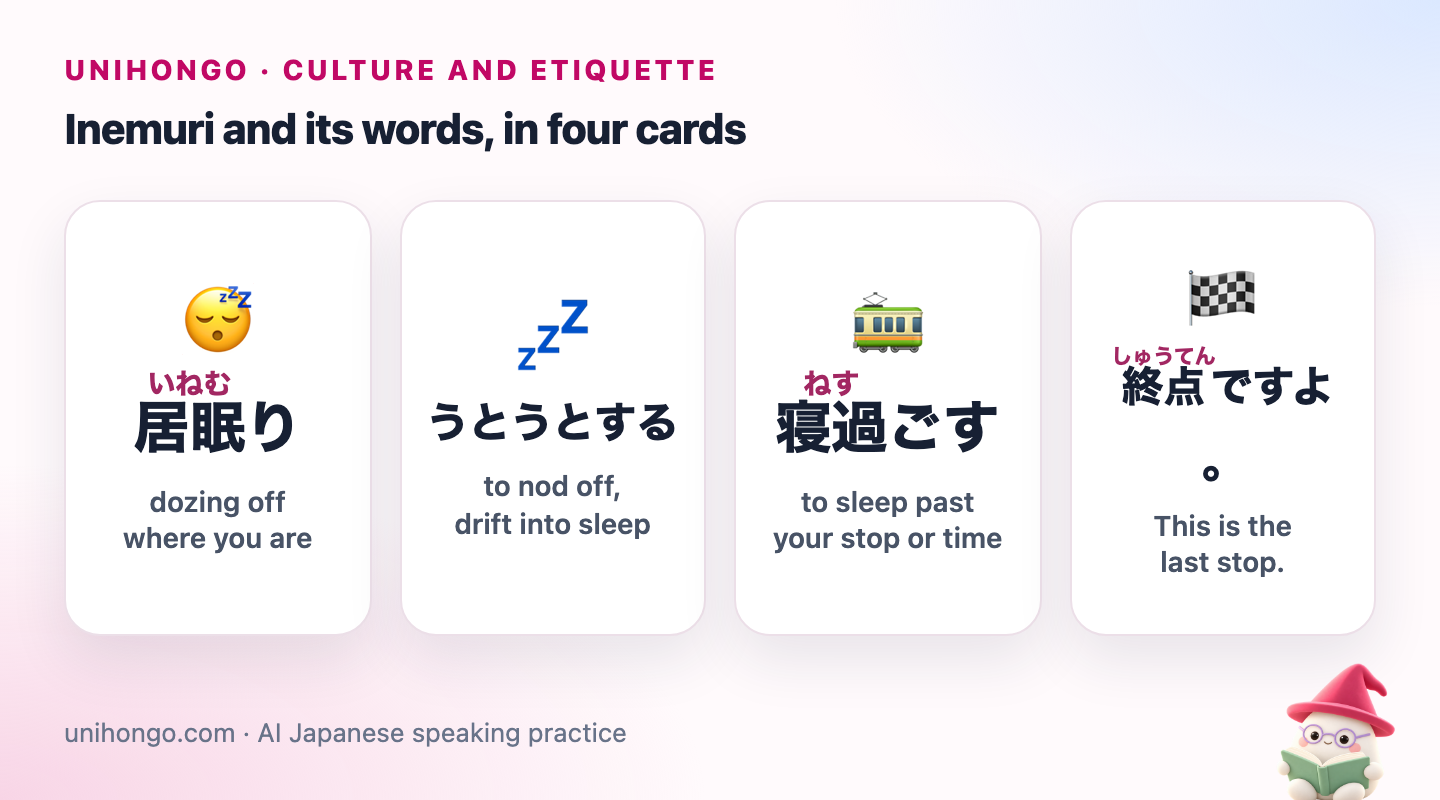
| Japanese | Romaji | Meaning |
|---|---|---|
| 居眠り | inemuri | dozing off where you are |
| うとうとする | utouto suru | to nod off, drift into sleep |
| 寝過ごす | nesugosu | to sleep past your stop or time |
| 終点ですよ。 | Shūten desu yo. | This is the last stop. |
Inemuri combines 居 (to be present, to stay) and 眠り (sleep). The idea is sleeping while you are supposed to be somewhere doing something else, which is why it covers trains, classrooms and desks, but not your bed. Utouto describes the light, drifting stage before real sleep.
Why so many people doze on trains
There is no single explanation, but several reasons come up again and again when Japanese people talk about it.
| Japanese | Romaji | Meaning |
|---|---|---|
| 通勤に一時間かかります。 | Tsūkin ni ichijikan kakarimasu. | My commute takes an hour. |
| 電車ではいつも寝ています。 | Densha de wa itsumo nete imasu. | I always sleep on the train. |
| 昨日はあまり寝られなかったんです。 | Kinō wa amari nerarenakatta n desu. | I couldn't sleep much last night. |
| 座るとすぐ眠くなります。 | Suwaru to sugu nemuku narimasu. | As soon as I sit down, I get sleepy. |
- Long commutes. In the Tokyo and Osaka areas, many people travel an hour or more each way, and a seat is a rare chance to rest.
- Short nights. Early starts, overtime, cram school and long club activities leave many workers and students tired.
- Quiet carriages. Phone calls are discouraged and most people speak softly, so the train is calm.
- A sense of safety. Many people feel comfortable closing their eyes in public, though sensible people still hold on to their bags.
- Acceptance. Dozing on a train is rarely judged. Others simply let you sleep.
These reasons overlap, and individual habits vary. Many people never sleep on trains, and some cannot. What is striking for visitors is how ordinary it is: nobody stares, and sleepers often wake up, almost by instinct, just before their station.
On a train versus at work
Some books and articles say that in Japan, falling asleep in a meeting shows that you have been working very hard. This idea is popular abroad, but it is risky to rely on. In most Japanese offices, dozing at your desk or in a meeting is seen as a lack of focus, and a manager may quietly mention it. A short nap during the lunch break is another matter: some companies accept it, and a few even encourage a brief rest after lunch.
In classrooms, students do fall asleep, and teachers react in different ways, from ignoring it to calling out the student's name. As a learner or visitor, the safe rule is simple: dozing on the train is fine; dozing in front of a teacher, client or boss is not.
| Japanese | Romaji | Meaning |
|---|---|---|
| 会議中に居眠りしてしまいました。 | Kaigichū ni inemuri shite shimaimashita. | I dozed off in the meeting, unfortunately. |
| 昼休みに少し昼寝します。 | Hiruyasumi ni sukoshi hirune shimasu. | I take a short nap in the lunch break. |
| 眠そうだね。大丈夫? | Nemusō da ne. Daijōbu? | You look sleepy. Are you OK? (casual) |
| Place | How it is usually seen | Safer choice |
|---|---|---|
| Commuter train | Normal and accepted | Hold your bag and set an alarm |
| Office desk or meeting | Usually frowned upon | Take a short break or a walk |
| Lunch break at work | Accepted in some companies | Check what coworkers do |
| Class or lecture | Varies; teachers often mind | Sit near the front if you are tired |
Missing your stop and the last train
Every commuter in Japan has a story about sleeping past their station. Nesugosu, to oversleep or sleep past something, puts the focus on the sleep. Norisugosu, to ride past your stop, focuses on the train, and you can miss your stop that way while reading or daydreaming too.
Late at night, the danger is the last train, shūden (終電). Fall asleep on it, wake up at the end of the line, and you may need a taxi, a capsule hotel or a long wait for the first train, shihatsu (始発). Many people set a vibration alarm on their phone for this reason.
| Japanese | Romaji | Meaning |
|---|---|---|
| 寝過ごして、終点まで行っちゃった。 | Nesugoshite, shūten made itchatta. | I slept and ended up at the last stop. (casual) |
| 一駅乗り過ごしました。 | Hitoeki norisugoshimashita. | I went one stop too far. |
| 終電に乗り遅れました。 | Shūden ni noriokuremashita. | I missed the last train. |
| 始発まで待ちます。 | Shihatsu made machimasu. | I'll wait for the first train. |
| 着いたら起こして。 | Tsuitara okoshite. | Wake me up when we get there. (casual) |
When a sleeping neighbour leans on you
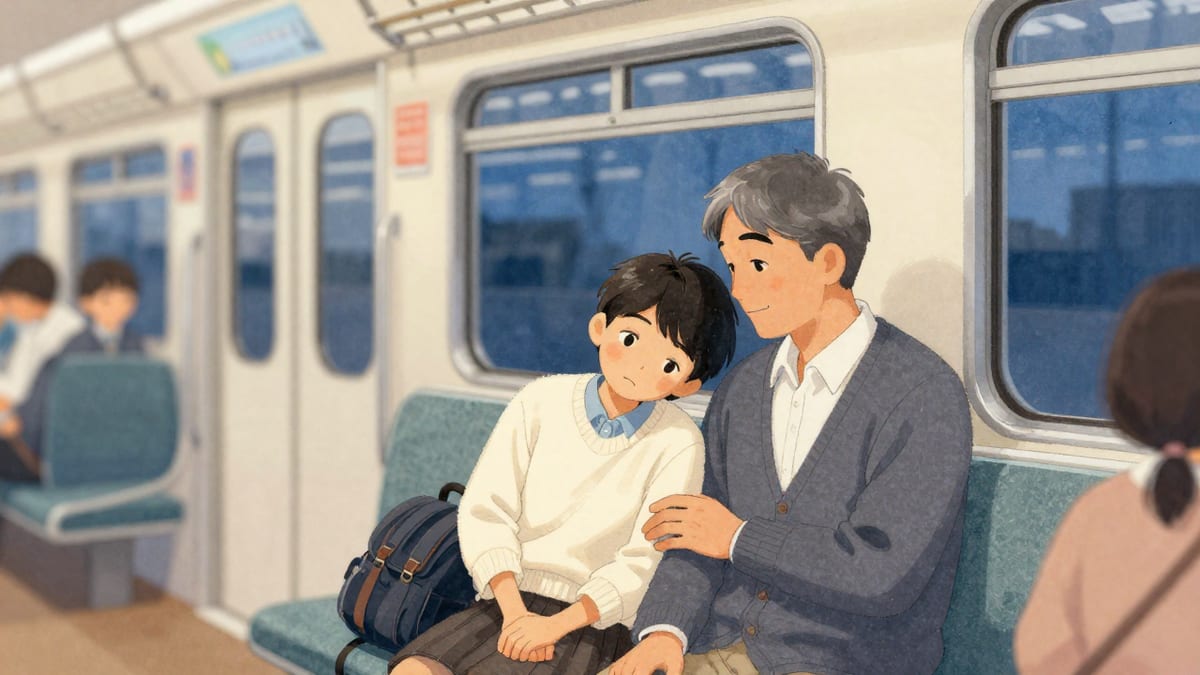
It happens to most regular train users: the person next to you falls asleep and slowly tips onto your shoulder. People handle it in different ways. Many simply shift a little so the sleeper's head moves back, or lean forward for a moment. If you need to get off and they are blocking the way, a soft sumimasen, orimasu, excuse me, I'm getting off, is usually enough to wake them politely.
If you are the sleepy one, a small apology when you wake up is kind: sumimasen, or shitsurei shimashita if it feels more serious. Most people will smile or nod and say nothing.
| Japanese | Romaji | Meaning |
|---|---|---|
| すみません、降ります。 | Sumimasen, orimasu. | Excuse me, I'm getting off. |
| あ、すみません。寝てしまって。 | A, sumimasen. Nete shimatte. | Oh, I'm sorry. I fell asleep. |
| いえいえ、大丈夫ですよ。 | Ieie, daijōbu desu yo. | Neighbour: No, no, it's fine. |
| 肩にもたれかかってきた。 | Kata ni moterekakatte kita. | They started leaning on my shoulder. |
Sleep words worth knowing
Japanese has a rich set of words for sleep, from the formal to the very casual. These are the ones you will hear around commuting and tiredness.
| Japanese | Romaji | Meaning |
|---|---|---|
| 眠い | nemui | sleepy |
| 昼寝 | hirune | a nap |
| 爆睡する | bakusui suru | to sleep like a log (casual) |
| 寝落ちする | neochi suru | to fall asleep mid-activity (casual) |
| こっくりこっくりする | kokkuri kokkuri suru | to nod, head bobbing |
| 睡眠不足 | suimin busoku | lack of sleep |
Neochi is a modern, casual word, often used for falling asleep during a phone call, a game or a video. Bakusui, literally explosive sleep, means you slept deeply; densha de bakusui shite ita, I was dead asleep on the train, is a classic line to a friend.
Make these sleep words stick with Mocchi
Ask Mocchi something specific, for example: explain the difference between nesugosu, norisugosu and noriokureru, with one example each. Mocchi gives you the difference and a sentence for each, and keeps track of the pair you hesitate over, so it shows up again in a /quiz a few days later instead of being forgotten.
Then turn the words into flashcards with /create-flashcards and play Kotoba Tank with your own deck: you hear a word and hit the right one, which is good practice for catching shūten or norikae in a real announcement.
Tips for visitors
- Doze if you like; nobody will mind. Keep your bag on your lap and your phone in a pocket.
- Set a vibrating alarm if your stop is near the end of a long ride.
- Do not put your feet on the seat or spread out across two seats, even if the train is empty.
- If someone leans on you, shifting gently is fine; you do not need to say anything.
- Late at night, check the time of the last train before you sit down and relax.