
Four names for any gender
Unisex names, sometimes called chūsei-teki na namae (中性的な名前), gender-neutral names, are usually short words from nature or virtues. These four are some of the most familiar.
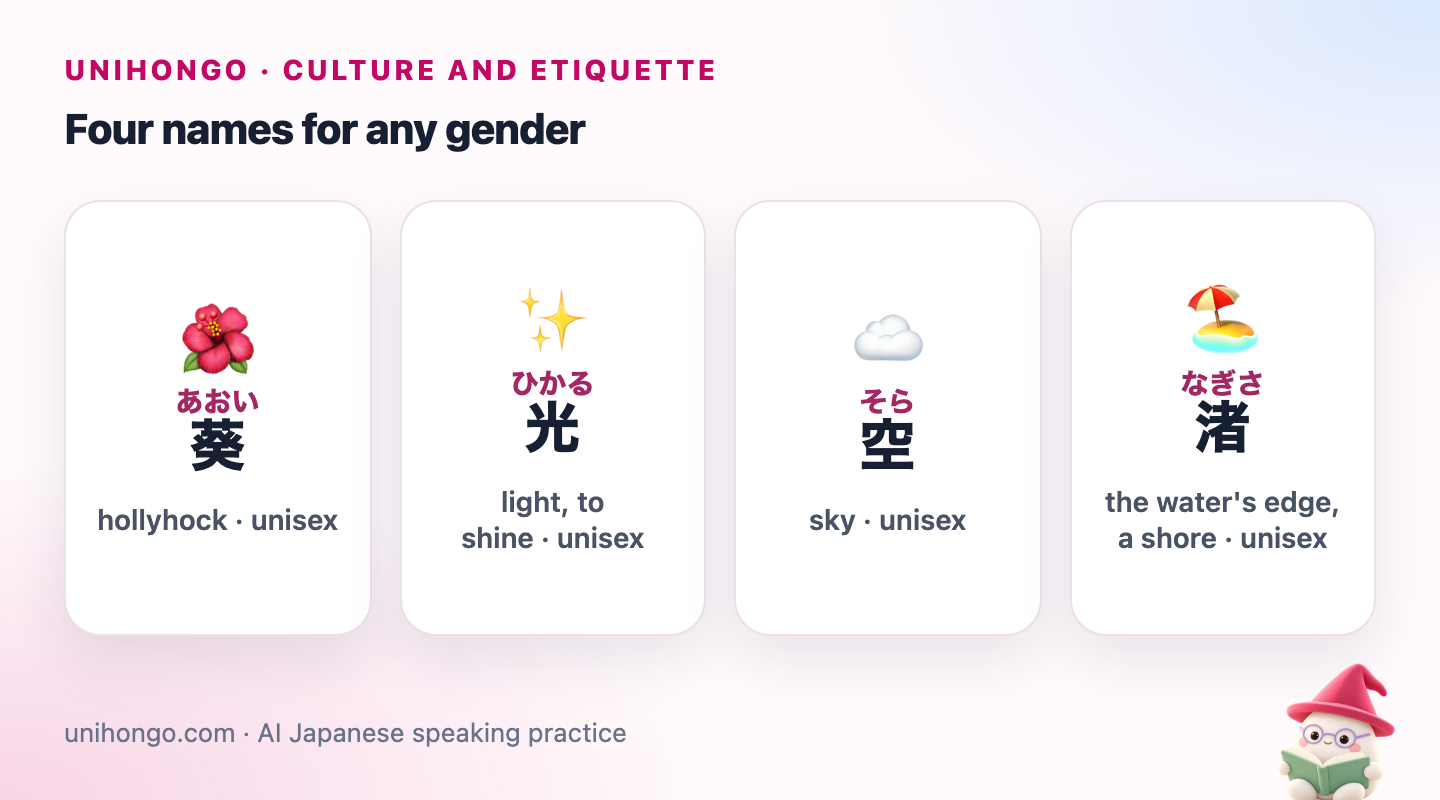
| Japanese | Romaji | Meaning |
|---|---|---|
| 葵 | Aoi | hollyhock · unisex |
| 光 | Hikaru | light, to shine · unisex |
| 空 | Sora | sky · unisex |
| 渚 | Nagisa | the water's edge, a shore · unisex |
Notice what these have in common: no -ko, no -tarō, no -suke. Without those endings, a name like Sora or Nagisa does not point in one direction, and parents of any child can choose it. 光 is often read Hikari for girls and Hikaru for any child.
Same sound, different kanji
Many shared names have spellings that lean one way. The sound is the same, but the kanji paint a different picture, and Japanese readers notice it immediately.
| Japanese | Romaji | Meaning |
|---|---|---|
| 誠 | Makoto | sincerity · mostly boy |
| 真琴 | Makoto | true + koto harp · mostly girl |
| 瑞樹 | Mizuki | auspicious + tree · mostly boy |
| 瑞希 | Mizuki | auspicious + hope · mostly girl |
| Name | Often for boys | Often for girls |
|---|---|---|
| Makoto | 誠: sincerity | 真琴: true + koto harp |
| Haruka | 悠: calm, distant | 遥: far away |
| Aoi | 蒼, 碧: blue | 葵: hollyhock |
| Kaoru | 薫: fragrance | 薫 or かおる |
| Mizuki | 瑞樹: auspicious + tree | 瑞希: auspicious + hope |
These are tendencies, not rules. There are girls named 誠 and boys named 瑞希. The kanji give a hint, but only the person can tell you who they are.
More unisex names and their meanings
| Japanese | Romaji | Meaning |
|---|---|---|
| 凛 | Rin | dignified, crisp and clear · mostly girl |
| 翼 | Tsubasa | wings · mostly boy |
| 薫 | Kaoru | fragrance · unisex |
| 日向 | Hinata | a sunny spot · unisex |
| 千尋 | Chihiro | a thousand fathoms, deep · mostly girl |
| 純 | Jun | pure · unisex |
| 司 | Tsukasa | to direct, govern · unisex |
| 晶 | Akira | crystal, sparkling · mostly boy |
Hinata, 日向, is the word for a sunny place, like the warm patch on a veranda. Parents also write it 陽向 or ひなた. Jun, Tsukasa and Akira are older names that have long been used for both genders.
Hiragana names and the name rules
Parents in Japan can use hiragana and katakana in names, and kanji from two official lists: the jōyō kanji for daily use and the jinmeiyō kanji, an extra list for names. Rare or invented characters are not accepted. Some parents choose hiragana because it looks gentle and is easy to read, which also makes a name feel softer and sometimes less clearly gendered.
Since 2025, the family register has also recorded the reading of each person's name, and a reading is expected to be one generally accepted for those kanji. Names that are hard to read, sometimes called kirakira names, have been a topic of discussion for years. Most parents simply try to choose a name that people can read and that the child will be happy with as an adult.
| Japanese | Romaji | Meaning |
|---|---|---|
| ひなた | Hinata | Hinata in hiragana · unisex |
| かおる | Kaoru | Kaoru in hiragana · unisex |
| 読み方を教えてください。 | Yomikata o oshiete kudasai. | Please tell me how to read it. |
Asking about a name without guessing
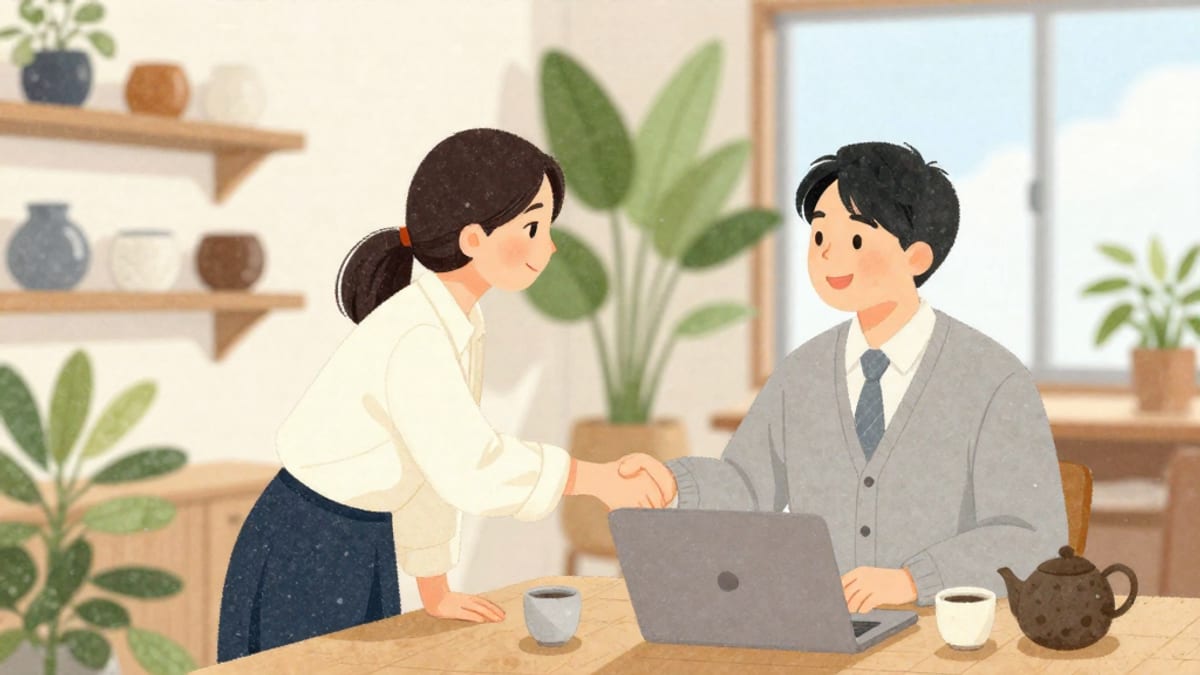
At work you will often see a name before you meet the person: on an email, a schedule or a class list. With a unisex name, do not guess. Use the family name with san, which is neutral, and let the person's introduction fill in the rest.
| Japanese | Romaji | Meaning |
|---|---|---|
| 佐藤さん、はじめまして。 | Satō san, hajimemashite. | Ms or Mr Satō, nice to meet you. |
| お名前は何とお読みすればいいですか。 | Onamae wa nan to oyomi sureba ii desu ka. | How should I read your name? (polite) |
| 「あおい」と読みます。 | "Aoi" to yomimasu. | Colleague: It's read Aoi. |
| 「そら」は青空の「空」です。 | "Sora" wa aozora no "sora" desu. | Sora is the sora of aozora, blue sky. |
| ひかるって呼んでください。 | Hikaru tte yonde kudasai. | Please call me Hikaru. (friendly) |
Being invited to use someone's given name is a sign of friendliness. Until then, the family name with san is the normal choice, whatever the name.
Mini dialogue: a mix-up in an email
| Japanese | Romaji | Meaning |
|---|---|---|
| メールでは女性の方だと思っていました。 | Mēru de wa josei no kata da to omotte imashita. | You: From the email I thought you were a woman. |
| よく言われます。かおるなので。 | Yoku iwaremasu. Kaoru na node. | Kaoru: I hear that a lot, since I'm Kaoru. |
| 失礼しました。 | Shitsurei shimashita. | You: I'm sorry about that. |
| いえいえ、気にしないでください。 | Ie ie, ki ni shinaide kudasai. | Kaoru: Not at all, don't worry about it. |
Nicknames and how friends use unisex names
Among friends and family, Japanese names are often shortened and given a friendly suffix. Shortening usually keeps the first two syllables: Makoto becomes Mako-chan, Tsubasa becomes Tsuba-san among some friends, Hinata becomes Hina-chan. Chan is warm and often used for children and girls, kun for boys and younger men, and san for anyone when you want to stay polite. With a unisex name, the suffix people choose is often the only hint of how they see the person, so follow the lead of the people around you.
If you are choosing a unisex Japanese name for a character, a pen name or yourself, pick a name that is common for both genders, such as Sora, Hikaru or Aoi, and a kanji that feels neutral, such as 空 or 光. Say it aloud with the family name, check that it is easy to read, and ask a native speaker how it sounds to them before you use it publicly.
| Japanese | Romaji | Meaning |
|---|---|---|
| まこちゃんって呼ばれています。 | Mako chan tte yobarete imasu. | People call me Mako-chan. |
| 何て呼べばいいですか。 | Nan te yobeba ii desu ka. | What should I call you? |
| 下の名前で呼んでもいいですか。 | Shita no namae de yonde mo ii desu ka. | May I call you by your first name? |
| どちらでも大丈夫ですよ。 | Dochira demo daijōbu desu yo. | Either is fine. |
Shita no namae, the lower name, means the given name, because it comes after the family name, and in vertical writing it sits below it. Asking before you switch to it is considerate, especially at work.
Say your own name out loud with AI Sensei
First ask Mocchi on the home page: Explain the kanji 光, 空 and 渚 as they are used in names, then quiz me on them tomorrow. Mocchi gives the meanings and readings, and because it remembers what you asked, the quiz shows up when you come back.
Then open AI Sensei, pick Hana-sensei and ask the Sensei to play a new classmate on the first day of a course. Introduce yourself, explain the kanji you would choose if you had a Japanese name, and ask about the classmate's name. The session report afterwards lists the corrections and new words.
Mistakes to avoid with unisex names
- Writing Mr or Ms in an English email to someone you have not met, based only on a name like Hikaru or Makoto. Use the full name or the family name with san.
- Assuming the kanji you know is the one they use. Ask Donna kanji desu ka.
- Telling someone their name sounds like the other gender. It may be meant as small talk, but it can sting.
- Thinking hiragana names are less serious. They are a deliberate, common choice.
- Inventing a reading for a kanji to make it unisex. Readings should be ones people can recognise.