
What mukashi asobi are
Mukashi (昔) means long ago and asobi (遊び) means play. The phrase covers the toys and playground games that Japanese grandparents grew up with. They have not disappeared: many elementary schools invite older neighbours in to teach them, and they come out in force at New Year.
For a learner they are a gift. The rules fit in one sentence, people of any age are happy to demonstrate, and each toy comes with one clear verb.
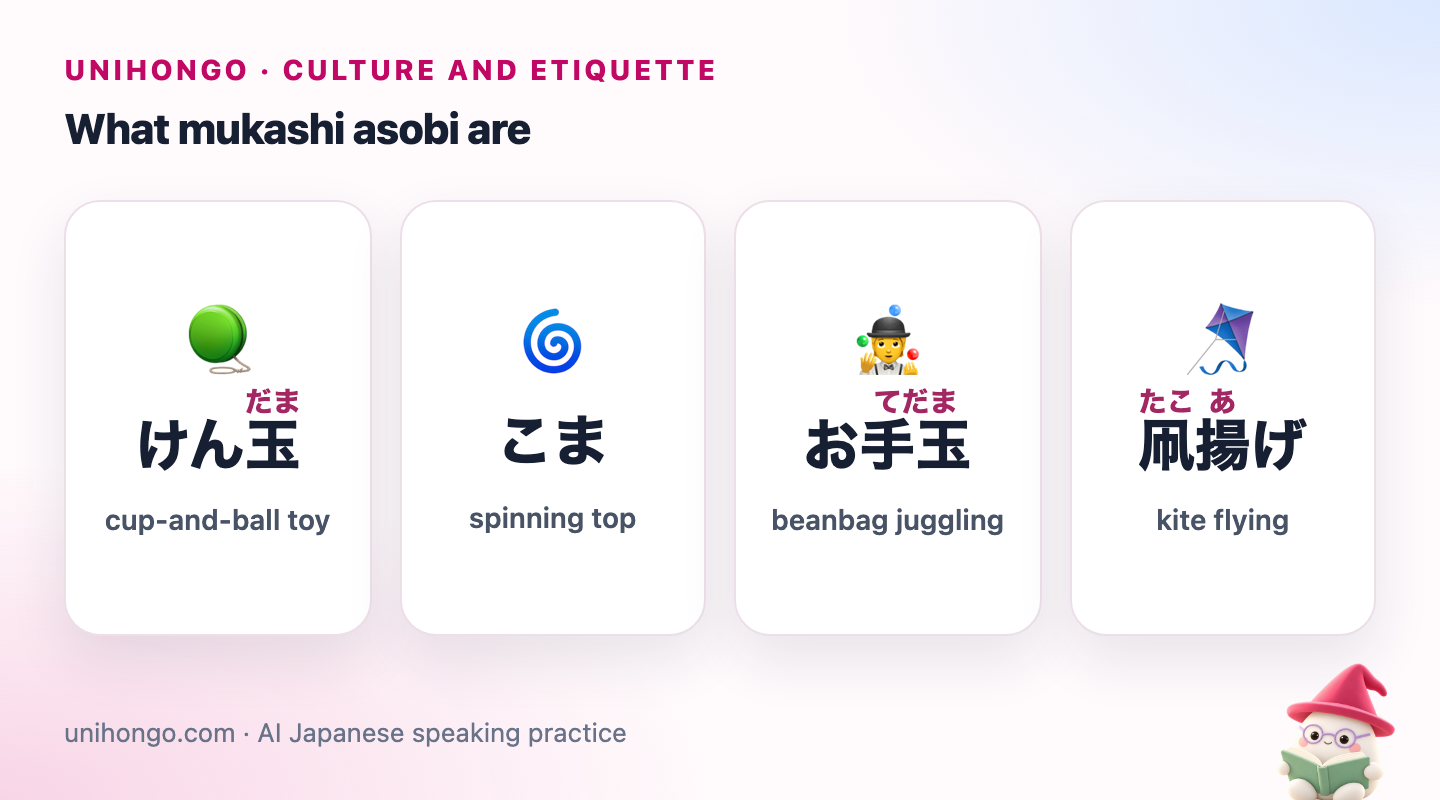
| Japanese | Romaji | Meaning |
|---|---|---|
| けん玉 | kendama | cup-and-ball toy |
| こま | koma | spinning top |
| お手玉 | otedama | beanbag juggling |
| 凧揚げ | takoage | kite flying |
| 昔遊び | mukashi asobi | old-time games |
| 一緒に遊びましょう。 | Issho ni asobimashō. | Let's play together. |
Kendama: the parts and your first trick
A kendama is a wooden handle with a spike and three cups, joined by a string to a ball with a hole in it. The handle is the ken (けん). The cups are called sara (皿), literally plates. The ball is the tama (玉).
The first trick everyone learns is ōzara: swing the ball straight up and catch it on the big cup, bending your knees as it lands. Then come the small cup, the base cup, and tomeken, catching the ball's hole on the spike. In the rhythm trick called moshikame, the ball hops back and forth between the big cup and the base cup, traditionally to a children's song about a hare and a tortoise.
| Japanese | Romaji | Meaning |
|---|---|---|
| 大皿 | ōzara | big cup; also the first trick |
| 小皿 | kozara | small cup |
| 中皿 | chūzara | base cup |
| けん先 | kensaki | the spike |
| とめけん | tomeken | catching the ball on the spike |
| 大皿に乗りました。 | Ōzara ni norimashita. | It landed on the big cup. |
Indoor classics: koma, otedama, ayatori, menko
A koma (こま) is a wooden top. You wind a cord around it, throw, and pull: koma o mawasu. Otedama (お手玉) are small cloth bags, traditionally filled with dried beans, that you toss and catch two or three at a time, often while singing. Ayatori (あやとり) is making string figures on your fingers, alone or by passing the string to a partner. Menko (めんこ) are thick cards: you slap yours onto the ground to flip your opponent's card over, and you keep the ones you flip.
| Japanese | Romaji | Meaning |
|---|---|---|
| こまを回します。 | Koma o mawashimasu. | I spin a top. |
| お手玉をします。 | Otedama o shimasu. | I play with beanbags. |
| あやとり | ayatori | string figures, cat's cradle |
| めんこ | menko | slap-down card game |
| おはじき | ohajiki | flicking small glass discs |
| 竹とんぼを飛ばします。 | Taketonbo o tobashimasu. | I fly a bamboo propeller. |
A taketonbo (竹とんぼ), literally bamboo dragonfly, is a propeller on a thin stick. Roll the stick fast between your palms, let go, and it climbs into the air.
New Year games: hanetsuki and takoage
New Year, oshōgatsu (お正月), is the high season for old games. Hanetsuki (羽根つき) is played with a wooden paddle, the hagoita (羽子板), and a feathered shuttle, the hane. There is no net; you simply keep the shuttle in the air. By tradition the player who drops it gets a mark of black ink on the face. Decorated hagoita are also sold as lucky ornaments at year-end markets.
Takoage (凧揚げ) is kite flying. The kite is a tako, and the verb is ageru (揚げる), to raise. Indoors, families bring out karuta cards, the board game sugoroku and fukuwarai, in which a blindfolded player places eyes, nose and mouth on a blank face and everyone laughs at the result.
| Japanese | Romaji | Meaning |
|---|---|---|
| 羽根つき | hanetsuki | paddle and shuttle game |
| 羽子板 | hagoita | wooden paddle |
| 凧を揚げます。 | Tako o agemasu. | I fly a kite. |
| 福笑い | fukuwarai | blindfold face-making game |
Daruma-san ga koronda: Japan's Red Light, Green Light
One player is the oni (鬼), the one who is it. The oni faces a wall or a tree, covers their eyes and calls out Daruma-san ga koronda, the daruma fell over. While the chant lasts, everyone else creeps forward. On the last syllable the oni spins around, and anyone caught moving is out or has to join hands with the oni.
The chant is not really about a doll. Written in kana, だるまさんがころんだ has exactly ten characters, so saying it is a quick way to count to ten, and the oni can stretch it or rattle it off to trick the others. Other regions have their own ten-beat chants. Koronda is the plain past form of korobu, to fall over.
| Japanese | Romaji | Meaning |
|---|---|---|
| だるまさんが転んだ | Daruma-san ga koronda | The daruma fell over. |
| 鬼 | oni | the player who is it |
| 動いた! | Ugoita! | You moved! |
| もう一回やりましょう。 | Mō ikkai yarimashō. | Let's play once more. |
One verb for each toy
| Japanese | Romaji | Meaning |
|---|---|---|
| 回す | mawasu | to spin, to turn |
| 飛ばす | tobasu | to send flying |
| 揚げる | ageru | to raise, to fly a kite |
| 取る | toru | to take, to catch |
| 投げる | nageru | to throw |
| つく | tsuku | to hit, to bounce |
Mawasu goes with tops. Tobasu goes with a taketonbo or a paper plane. Ageru is for kites. Toru is the verb of ayatori, where you take the string from your partner's hands, and of karuta, where you take the card. Nageru is for beanbags, and tsuku is for the shuttle in hanetsuki and for bouncing a ball.
When you do not know the special verb, two general patterns always work: the name plus o suru, as in kendama o suru, or the name plus de asobu, to play with it.
Where travellers can try them, and what to say
Look for a table of old toys at local history museums and open-air folk museums, in the lobbies of some inns, and at New Year events in shopping streets and parks. Toy shops and souvenir shops sell kendama and tops, which are light, sturdy presents. If someone is playing, it is fine to ask for a turn.
| Japanese | Romaji | Meaning |
|---|---|---|
| やってみてもいいですか。 | Yatte mite mo ii desu ka. | May I have a try? |
| やり方を教えてください。 | Yarikata o oshiete kudasai. | Please show me how to do it. |
| 難しいですね。 | Muzukashii desu ne. | It's hard, isn't it? |
| できました! | Dekimashita! | I did it! |
| 上手ですね。 | Jōzu desu ne. | You're good at it. |
| 子供のころ、何で遊びましたか。 | Kodomo no koro, nani de asobimashita ka. | What did you play with as a child? |
The last question is a reliable conversation starter with older people, who often answer by picking up the toy and showing you.