
Four names of love and hope
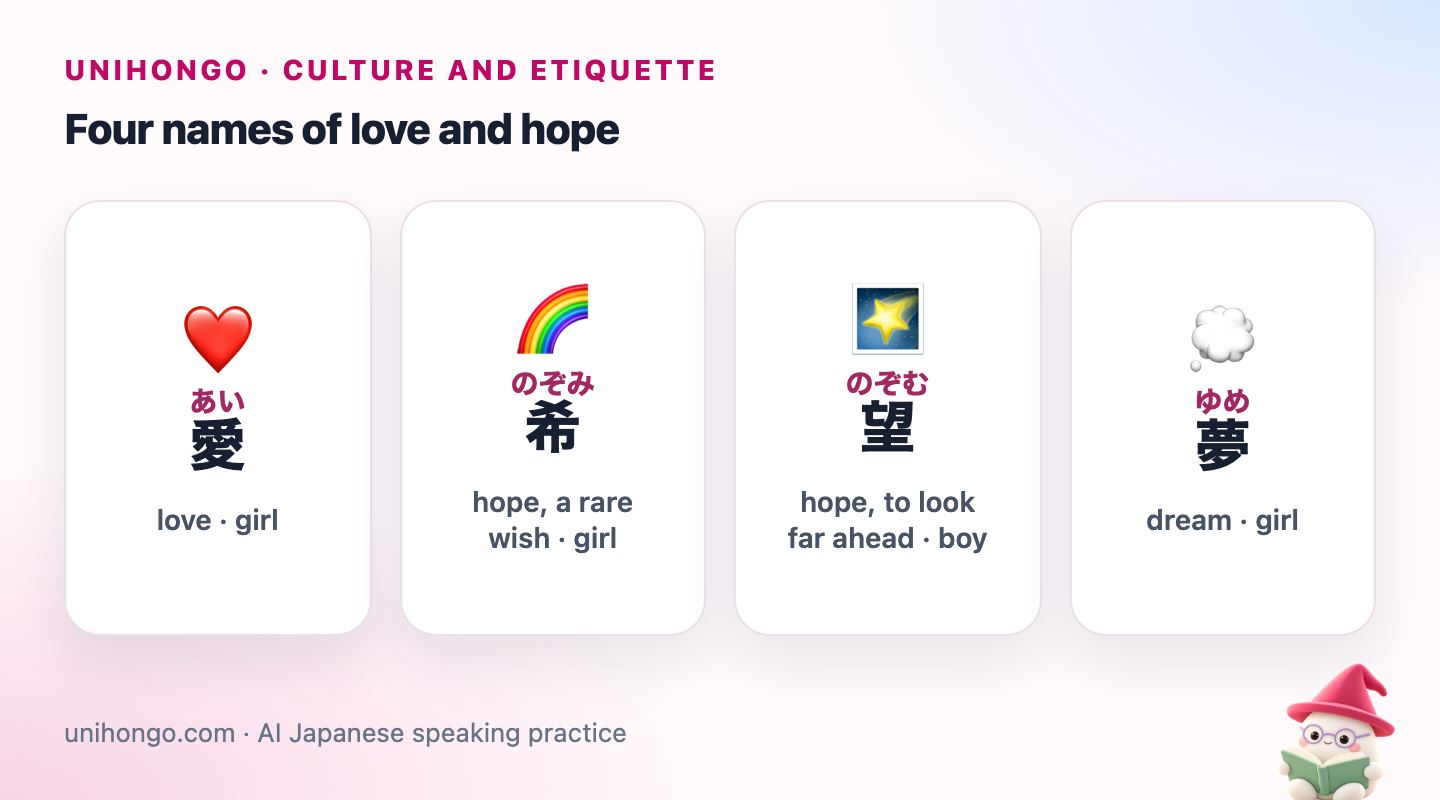
These four names show the main kanji of this theme: love, hope, hope that looks far ahead, and dream.
| Japanese | Romaji | Meaning |
|---|---|---|
| 愛 | Ai | love · girl |
| 希 | Nozomi | hope, a rare wish · girl |
| 望 | Nozomu | hope, to look far ahead · boy |
| 夢 | Yume | dream · girl |
希 originally carries a sense of something rare and precious, as in 希少 (kishō, rare), and in names it means hope, as in 希望 (kibō). 望 means to wish for or to gaze into the distance, as in 望遠鏡 (bōenkyō, telescope). Both are read nozomi in names; the gender usually shows in the ending: Nozomi for girls, Nozomu for boys.
愛 or 恋: which love?
Japanese has two main kanji for love, and in names they are not equal. 愛 is broad, deep love: the love of parents, family and people in general. 恋 is romantic love, falling for someone. Most love names use 愛.
| Japanese | Romaji | Meaning |
|---|---|---|
| 愛子 | Aiko | love + child · girl |
| 愛菜 | Mana | love + greens · girl |
| 愛美 | Manami | love + beauty · girl |
| 結愛 | Yua | tie + love · girl |
| Kanji | Kind of love | In names |
|---|---|---|
| 愛 | Deep, giving love; family, people | Very common: Ai, Aiko, Mana |
| 恋 | Romantic love, longing | Much rarer, mostly modern girls' names |
| 慈 | Compassion, tender care | Some names, often formal |
Notice the reading mana in Mana and Manami: it is a name reading for 愛 that you will not meet in everyday words. Boys' names with 愛 exist too, such as 愛斗 or 愛翔, read Manato, but they are less common and feel modern.
Hope, wishes and the future
| Japanese | Romaji | Meaning |
|---|---|---|
| 希美 | Nozomi | hope + beauty · girl |
| 叶 | Kanae | fulfilled, a wish come true · girl |
| 祈 | Inori | prayer · girl |
| 未来 | Mirai | the future · mostly girl |
| 未来 | Miku | the future · girl |
| 光希 | Kōki | light + hope · boy |
叶 is the kanji of 叶う (kanau), to come true. As Kanae it is a girl's name, and parents who choose it often say they want the child's dreams to come true. 未来 can be Mirai, the everyday reading, or Miku, a name reading; ask which.
Names of kindness and bonds
Close to love and hope are names of kindness, blessing and connection. They are some of the most familiar names in Japan.
| Japanese | Romaji | Meaning |
|---|---|---|
| 優 | Yū | gentle, kind · unisex |
| 恵 | Megumi | blessing, grace · mostly girl |
| 結 | Yui | to tie, bond · girl |
| 心 | Kokoro | heart, mind · girl |
| 和 | Nodoka | calm, peaceful · girl |
| 仁 | Jin | benevolence, humanity · boy |
優 means gentle in 優しい (yasashii) and excellent in 優秀 (yūshū); parents like both senses. 和 is the kanji of harmony and of Japan itself, as in 和食 (washoku, Japanese food); as Nodoka it means calm and peaceful.
Kokoro, 心, is a single-kanji name that means heart and mind together; in Japanese the heart is where feelings and thoughts live, so the name suggests a warm, thoughtful person. Megumi, blessing, is often explained by parents as gratitude: the child is a blessing they received.
Talking about the wish in a name
When Japanese people talk about a name, they often explain the parents' wish with ~ yō ni, so that. The verb comes in the dictionary or nai form before it.
| Japanese | Romaji | Meaning |
|---|---|---|
| みんなに愛されるようにと付けました。 | Minna ni aisareru yō ni to tsukemashita. | We named her so she'd be loved by all. |
| 夢が叶うように、叶にしました。 | Yume ga kanau yō ni, Kanae ni shimashita. | We chose Kanae, so her dreams come true. |
| どんな思いが込められているんですか。 | Donna omoi ga komerarete iru n desu ka. | What feelings are in the name? (polite) |
| 素敵な願いですね。 | Suteki na negai desu ne. | What a lovely wish. |
Omoi o komeru, to put your feelings into something, is the standard expression for the meaning parents give a name. It is also used for gifts and letters.
Kometa, put in, is the plain past of komeru, so the parent version is Kono namae ni wa ... to iu omoi o kometa, we put the feeling of ... into this name. You will hear this pattern at weddings, in speeches and whenever someone explains a gift. If you can use it in your own words, you sound much more natural than a learner who only says imi wa ... desu, the meaning is ....
Mini dialogue: a friend chooses a name
| Japanese | Romaji | Meaning |
|---|---|---|
| 名前、決まった? | Namae, kimatta? | You: Have you picked a name? |
| うん、「のぞみ」にしようと思って。 | Un, "Nozomi" ni shiyō to omotte. | Friend: Yes, I'm thinking Nozomi. |
| いいね。どの字? | Ii ne. Dono ji? | You: Nice. Which kanji? |
| 希望の「希」に、美しいという字。 | Kibō no "ki" ni, utsukushii to iu ji. | Friend: The ki of kibō, and the kanji for beautiful. |
| 希望がいっぱいの名前だね。 | Kibō ga ippai no namae da ne. | You: A name full of hope. |
Love and hope in boys' names
Boys' names express love and hope too, though they tend to use kanji of kindness, blessing and happiness rather than 愛. Many combine one of these with a common boy's ending such as -ta, -to or -ya.
| Japanese | Romaji | Meaning |
|---|---|---|
| 優斗 | Yūto | gentle + the Dipper stars · boy |
| 恵太 | Keita | blessing + big · boy |
| 幸太 | Kōta | happiness + big · boy |
| 和也 | Kazuya | harmony + a classical ending · boy |
| 誠 | Makoto | sincerity · mostly boy |
Kōta and Keita are familiar names across generations, and the wish inside them is simple: a happy, blessed child. 幸 is the kanji of 幸せ (shiawase, happiness), and in names it is read kō, yuki or sachi. Yūto is also often written 悠斗, with 悠, calm and distant, instead of 優, gentle; the sound is the same, the wish is different.
If you are naming a boy in a story or game and want a hopeful name, these are safer choices than an invented combination. They sound natural to Japanese ears and are easy to read.
Put your own wish into Japanese with Mocchi
Write one sentence about the wish behind a name you like, using ~ yō ni, and send it to Mocchi with /correct. Mocchi corrects it, explains the change, and remembers if yō ni is the part you keep getting wrong. Ask /grammar yō ni for a fuller explanation if you want one.
Then play Sentence Builder and put chunks like 夢が, 叶う, ように in order until the pattern feels automatic.
Mistakes to avoid with love and hope names
- Choosing 恋 because it means love. It suggests romance, and most parents prefer 愛 for a child.
- Reading 愛 always as ai. In Mana and Manami it is mana.
- Mixing Nozomi and Nozomu. The final vowel usually shows gender.
- Translating every 希 as hope. In 希少, rare, it means scarce.
- Writing 未来 as Mirai for someone named Miku. Copy the reading the person gives.