

Kore wa nan desu ka: the polite question
Kore wa nan desu ka is the safe, polite form. Kore is this thing near me, wa marks it as the topic, nan is the word for what before desu, and ka makes it a question. It works with shop staff, hosts, teachers, strangers and colleagues, and sumimasen at the front turns it into a request for attention as well.
Two small changes make it softer. Kore wa nan deshō ka uses the tentative deshō and sounds a touch more polite, which suits a formal shop or a host's home. Kore wa nan na n desu ka, with n desu, adds a sense of genuine curiosity, I'm wondering what this is, and invites a fuller explanation rather than a one-word answer.
When the thing is near the listener, use sore, and when it is far from both of you, are. The demonstratives guide on this site goes into the full system; for this question, remember that kore is in your hand, sore is in theirs, and are is across the room.
| Japanese | Romaji | Meaning |
|---|---|---|
| これは何ですか。 | Kore wa nan desu ka. | What is this? |
| すみません、これは何ですか。 | Sumimasen, kore wa nan desu ka. | Excuse me, what is this? |
| これは何でしょうか。 | Kore wa nan deshō ka. | What might this be? (softer) |
| これは何なんですか。 | Kore wa nan na n desu ka. | What is this exactly? (curious) |
| それは何ですか。 | Sore wa nan desu ka. | What is that (near you)? |
| あれは何ですか。 | Are wa nan desu ka. | What is that (over there)? |
Kore nani? and the casual forms
With friends, family and children, the question shrinks to kore nani? The particle wa disappears, desu disappears, and the rising intonation on nani does the work of ka. Kore nani? is warm and normal among people who are close, and you will hear it constantly at dinner tables and in shops when friends browse together.
Between casual and polite there is kore, nan darō, I wonder what this is, said half to yourself and half to the other person. It is a gentle way to ask without putting anyone on the spot, and it is the form to use when you are not sure the other person knows either. Kore nan da ke, what was this again, is for something you once knew.
| Japanese | Romaji | Meaning |
|---|---|---|
| これ、何? | Kore, nani? | What's this? (casual) |
| これ、何だろう。 | Kore, nan darō. | I wonder what this is. |
| これ、何だっけ? | Kore, nan da kke? | What was this again? |
| ねえ、それ何? | Nē, sore nani? | Hey, what's that? |
Nan to iimasu ka and nan te yomimasu ka: names and readings
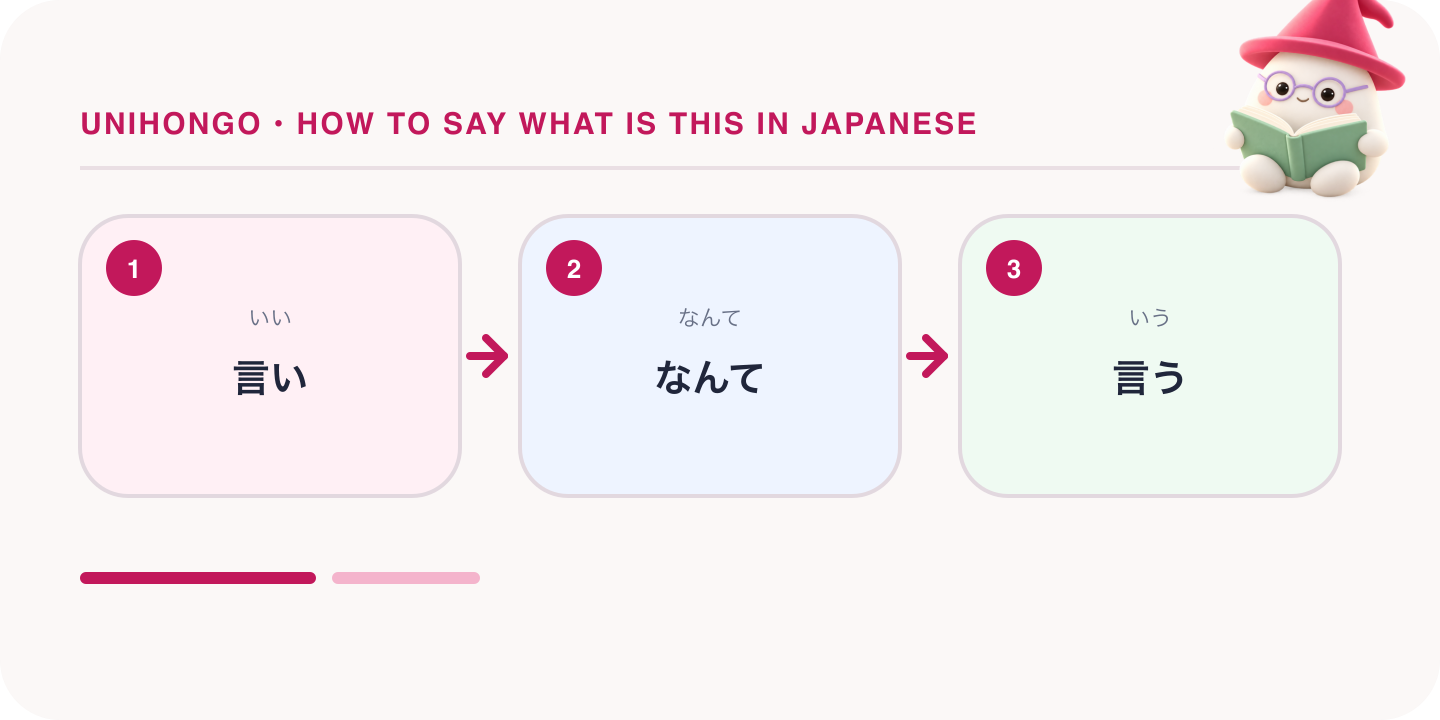
Sometimes you know what a thing is and what you want is the word for it. Then the question is kore wa nihongo de nan to iimasu ka, what is this called in Japanese. The verb iu, to say or to call, with the quoting particle to, asks for the name. Among friends, nante iu no? is the casual form, and nan to iu is also fine.
For written Japanese, especially kanji on signs, menus and name plates, ask kore wa nan te yomimasu ka, how do you read this. Yomu is to read, and the answer will be the pronunciation. If the reading alone does not help, follow with dō iu imi desu ka, what does it mean. Keep the two questions separate, because Japanese speakers will answer exactly what you ask: a reading question gets a reading, not a meaning.
Both patterns also work for people's names. O-namae wa nan to o-yomi suru n desu ka politely asks how to read a name on a business card, a question Japanese people ask each other all the time, since many names have several readings.
| Japanese | Romaji | Meaning |
|---|---|---|
| これは日本語で何と言いますか。 | Kore wa nihongo de nan to iimasu ka. | What is this called in Japanese? |
| これ、なんて言うの? | Kore, nante iu no? | What's this called? (casual) |
| この漢字は何と読みますか。 | Kono kanji wa nan to yomimasu ka. | How do you read this kanji? |
| これは何て読みますか。 | Kore wa nan te yomimasu ka. | How do you read this? |
| どういう意味ですか。 | Dō iu imi desu ka. | What does it mean? |
| お名前は何とお読みするんですか。 | O-namae wa nan to o-yomi suru n desu ka. | How should I read your name? (polite) |
Asking about food, objects and signs
Food is where the question gets the most use. At an izakaya or a market stall, kore wa nan desu ka will get a name and usually a short description. To learn more, ask nani ga haitte imasu ka, what is in it, which is also the question for allergies, or dō yatte tabemasu ka, how do you eat it. Kore wa nan no niku desu ka, what meat is this, and kore wa nan no sakana desu ka, what fish is this, are worth memorising.
For objects in shops, especially the unfamiliar gadgets in a home centre or a hundred-yen shop, kore wa nan ni tsukau n desu ka, what do you use this for, is more useful than the plain question, because the answer explains the purpose. Kore wa dō tsukaimasu ka, how do you use this, follows naturally.
For signs and notices, the reading question is the one to use, and kore wa nan no o-shirase desu ka, what is this notice about, works for the printed sheets in station corridors and apartment lobbies.
| Japanese | Romaji | Meaning |
|---|---|---|
| これは何が入っていますか。 | Kore wa nani ga haitte imasu ka. | What is in this? |
| これはどうやって食べますか。 | Kore wa dō yatte tabemasu ka. | How do you eat this? |
| これは何の魚ですか。 | Kore wa nan no sakana desu ka. | What fish is this? |
| これは何に使うんですか。 | Kore wa nan ni tsukau n desu ka. | What is this used for? |
| これはどう使いますか。 | Kore wa dō tsukaimasu ka. | How do you use this? |
| これは何のお知らせですか。 | Kore wa nan no o-shirase desu ka. | What is this notice about? |
| この看板は何て書いてありますか。 | Kono kanban wa nan te kaite arimasu ka. | What does this sign say? |
Pointing etiquette
The question almost always comes with a gesture, and the gesture has rules. Pointing at an object with a finger is acceptable, but an open hand, palm up and fingers together, is what shop and restaurant staff themselves use and it looks calmer. Pointing at a person with a finger is rude; use an open hand, a small nod in their direction, or say their name. Chopsticks are never used to point, and holding a menu or a package up towards the person you are asking is a polite way to make it clear which item you mean.
- Use an open hand, palm up, rather than a single finger for objects
- Never point at a person with a finger; nod or say their name
- Do not point with chopsticks, even at a dish on your own table
- Hold up the item or the menu line so the listener can see it
- Ask mite mo ii desu ka before handling goods behind a counter
- Stand back at a food stall and let the seller pick up the item
If you cannot point, describe: sono aoi hako, that blue box, or migi kara nibanme, second from the right. Position words with kore wa nan desu ka solve most of the awkward cases.
The answers you will get
The first part of the answer is usually just the name with desu: kore wa nasu desu, this is aubergine. Then comes an explanation, often of what it is made from or how it is eaten. If you do not catch the name, ask for it again with mō ichido onegai shimasu, once more please, or ask for it slowly, yukkuri onegai shimasu. To check spelling, ask nan te kakimasu ka, how is it written.
Below are answer patterns that come up often, so you can recognise the shape of what you hear even when the vocabulary is new.
| Answer pattern | Reading | What it means |
|---|---|---|
| 〜です | ... desu | It is ...; the name, e.g. nasu desu |
| 〜という料理です | ... to iu ryōri desu | It's a dish called ... |
| 〜のことです | ... no koto desu | It refers to ... (explaining a word) |
| 〜でできています | ... de dekite imasu | It's made from ... |
| 〜に使います | ... ni tsukaimasu | It's used for ... |
| 〜と読みます | ... to yomimasu | It's read as ... |
| 〜という意味です | ... to iu imi desu | It means ... |
| さあ、何でしょうね | Sā, nan deshō ne | Hmm, I wonder what it is (they don't know) |
| ちょっとわかりません | Chotto wakarimasen | I'm not sure |
| 食べてみますか | Tabete mimasu ka | Would you like to try it? |
Sā, nan deshō ne is a polite way of saying the person does not know. Do not keep asking; thank them and try someone else or a dictionary.
Follow-up questions that keep the conversation going
One question gets a name. Two or three get a conversation, and hosts, stallholders and colleagues are usually delighted to explain. At a food counter, ask oishii desu ka, is it tasty, doko no desu ka, where is it from, or tabete mite mo ii desu ka, may I try it. For objects, kore wa benri desu ka, is it handy, and hitotsu kudasai, one please, are natural next steps.
| Japanese | Romaji | Meaning |
|---|---|---|
| おいしいですか。 | Oishii desu ka. | Is it tasty? |
| 人気がありますか。 | Ninki ga arimasu ka. | Is it popular? |
| どこのですか。 | Doko no desu ka. | Where is it from? |
| 食べてみてもいいですか。 | Tabete mite mo ii desu ka. | May I try it? |
| もう一度お願いします。 | Mō ichido onegai shimasu. | Once more, please. |
| 何て書きますか。 | Nan te kakimasu ka. | How is it written? |
Common mistakes
The first mistake is kore wa nani desu ka. Nani becomes nan before desu, so the polite question is always nan desu ka. The reverse mistake, kore nan? in casual speech, is also wrong; on its own the word is nani.
The second is using nan desu ka when you want a name. If you ask a friend kore wa nan desu ka about a spoon, they may explain that it is a spoon rather than give you the Japanese word. Nan to iimasu ka asks for the word.
The third is the demonstrative. Sore wa nan desu ka while you are holding the object yourself sounds odd, since sore points to something near the listener. Use kore for what is in your hand.
The fourth is tone. Nani? on its own, said sharply, means what do you want. Keep the question light and add sumimasen with strangers.
| Japanese | Romaji | Meaning |
|---|---|---|
| これは何ですか。 | Kore wa nan desu ka. | Correct: what is this? |
| これはスプーンです。 | Kore wa supūn desu. | This is a spoon. (the answer to nan desu ka) |
| これは日本語で何と言いますか。 | Kore wa nihongo de nan to iimasu ka. | What is this called in Japanese? (asks for the word) |