
The listing shorthand that decides everything
Japanese listings are compressed, and almost every number on them is a cost or a constraint. Before you learn a single question, learn to read the terms in the table below, because an agent will read them aloud to you at speed and expect you to follow. The layout code and the four money words together tell you more about a property than the photographs do.
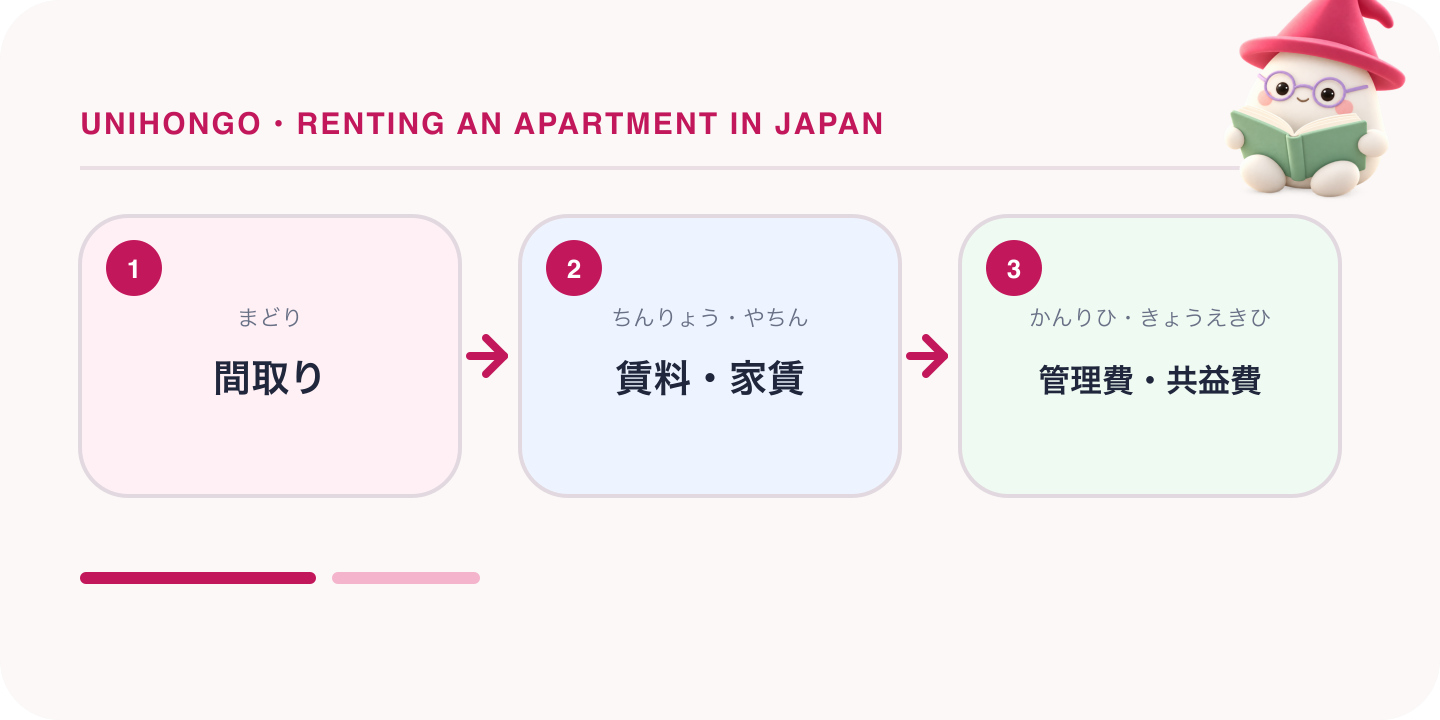
| Listing term | Reading | What it means |
|---|---|---|
| 間取り | madori | The layout, written as a code such as 1K or 2LDK |
| 1R | wan rūmu | One room with the kitchen inside it and no divider |
| 1K | wan kē | One room plus a small separate kitchen area |
| 1DK | wan dī kē | One room plus a kitchen big enough to eat in |
| 1LDK | wan eru dī kē | One room plus a combined living, dining and kitchen space |
| 賃料・家賃 | chinryō, yachin | The monthly rent itself |
| 管理費・共益費 | kanri-hi, kyōeki-hi | A monthly fee for shared areas, paid on top of rent |
| 敷金 | shikikin | A deposit held against damage and unpaid rent |
| 礼金 | reikin | A one-off payment to the owner that is not returned |
| 保証会社 | hoshō-gaisha | A guarantor company used in place of a personal guarantor |
| 更新料 | kōshin-ryō | A fee charged when the contract is renewed |
| 築 | chiku | The age of the building, counted in years |
| 駅徒歩 | eki toho | Walking minutes to the nearest station |
| 条件 | jōken | The conditions attached to the property |
| 即入居可 | soku nyūkyo ka | Available to move into straight away |
| 相談 | sōdan | Marked as open to discussion rather than fixed |
Two habits pay off immediately. Add the management fee to the rent whenever you compare properties, because a low headline rent with a high kyōeki-hi is not cheap. And treat the word sōdan as an invitation: where a listing says sōdan next to pets, instruments or move-in dates, the agent expects you to raise it.
Opening the conversation at the agency
Walk in, say what you want in one sentence, and let the agent lead. The no desu ga ending on your opening line is doing real work: it softens the statement into an approach rather than a demand, and it invites the other person to take over. Expect the agent to ask your desired area and move-in month before anything else, so have both ready in Japanese.
| Japanese | Romaji | Meaning |
|---|---|---|
| 部屋を探しているのですが。 | Heya o sagashite iru no desu ga. | I am looking for a flat. |
| 一人暮らしです。 | Hitori-gurashi desu. | I will be living alone. |
| 来月から住める部屋がいいです。 | Raigetsu kara sumeru heya ga ii desu. | I would like somewhere I can move into from next month. |
| 予算は管理費込みで考えています。 | Yosan wa kanri-hi komi de kangaete imasu. | My budget is inclusive of the management fee. |
| ネットで見た物件について聞きたいのですが。 | Netto de mita bukken ni tsuite kikitai no desu ga. | I would like to ask about a property I saw online. |
| 在留カードはこちらです。 | Zairyū kādo wa kochira desu. | Here is my residence card. |
The agent's first questions are almost always どのエリアをご希望ですか (Dono eria o go-kibō desu ka), meaning which area would you like, and ご予算はいくらぐらいですか (Go-yosan wa ikura gurai desu ka), meaning roughly what is your budget. Answer the budget question with a total figure and the words made de, up to, so the number is understood as a ceiling.
Stating your conditions clearly
Agents work from a list of jōken, conditions, and they will type them straight into a search. The most useful thing you can do is separate the requirements you insist on from the ones you would merely like, because that lets the agent widen the search sensibly instead of showing you nothing. The phrase yuzurenai jōken, the condition I cannot give up, is the exact word for this and agents respond well to it.
| Japanese | Romaji | Meaning |
|---|---|---|
| 駅から歩いて十分以内がいいです。 | Eki kara aruite juppun inai ga ii desu. | I would like it within a ten-minute walk of the station. |
| 二階以上の部屋を希望します。 | Ni-kai ijō no heya o kibō shimasu. | I would like a flat on the second floor or above. |
| 洗濯機置き場が室内にある部屋を探しています。 | Sentakuki okiba ga shitsunai ni aru heya o sagashite imasu. | I am looking for a flat with the washing machine space indoors. |
| ペット可の物件はありますか? | Petto ka no bukken wa arimasu ka? | Are there any properties that allow pets? |
| 外国人でも入居できる物件をお願いします。 | Gaikokujin demo nyūkyo dekiru bukken o onegai shimasu. | Please show me properties that accept foreign residents. |
| 譲れない条件は日当たりです。 | Yuzurenai jōken wa hiatari desu. | The condition I cannot compromise on is sunlight. |
Asking what you actually pay up front
Initial costs in Japan are assembled from several separate items, and the total surprises people who compared only the monthly rent. Ask for the whole figure in one question and then ask for the breakdown, rather than trying to add the pieces yourself while the agent talks. A written estimate is normal to request and gives you something to reread slowly at home.
| Japanese | Romaji | Meaning |
|---|---|---|
| 初期費用は全部でいくらになりますか? | Shoki hiyō wa zenbu de ikura ni narimasu ka? | How much are the initial costs in total? |
| 敷金と礼金はそれぞれ何か月分ですか? | Shikikin to reikin wa sorezore nan-kagetsu-bun desu ka? | How many months' rent are the deposit and the key money? |
| 管理費は家賃に含まれていますか? | Kanri-hi wa yachin ni fukumarete imasu ka? | Is the management fee included in the rent? |
| 火災保険はこちらで選べますか? | Kasai hoken wa kochira de erabemasu ka? | Can I choose the fire insurance myself? |
| 更新料はかかりますか? | Kōshin-ryō wa kakarimasu ka? | Is there a renewal fee? |
| 見積書をいただけますか? | Mitsumorisho o itadakemasu ka? | Could I have a written estimate? |
A common reply is 敷金一か月、礼金なしです (Shikikin ik-kagetsu, reikin nashi desu), one month's deposit and no key money. Nashi means there is none, and it is the word you most want to hear. If you are told a fee is 相談 (sōdan), it is being presented as discussable, which is your opening for the next section.
Guarantors, screening and paperwork
Almost every application goes through a screening step called shinsa, run either by the owner or by a guarantor company. Foreign residents are usually asked for a residence card, proof of income or employment, and an emergency contact who can be reached in Japan. None of this is unusual, and asking about it early prevents you from falling in love with a flat that will not accept your situation.
| Japanese | Romaji | Meaning |
|---|---|---|
| 保証人が必要ですか? | Hoshōnin ga hitsuyō desu ka? | Do I need a personal guarantor? |
| 保証会社を使うことはできますか? | Hoshō-gaisha o tsukau koto wa dekimasu ka? | Can I use a guarantor company instead? |
| 審査には何が必要ですか? | Shinsa ni wa nani ga hitsuyō desu ka? | What is needed for the screening? |
| 緊急連絡先は日本にいる友人でも大丈夫ですか? | Kinkyū renrakusaki wa Nihon ni iru yūjin demo daijōbu desu ka? | Is a friend living in Japan acceptable as the emergency contact? |
| 審査にはどのくらい時間がかかりますか? | Shinsa ni wa dono kurai jikan ga kakarimasu ka? | How long does the screening take? |
| 在職証明書は必要ですか? | Zaishoku shōmeisho wa hitsuyō desu ka? | Do you need a certificate of employment? |
Questions to ask inside the room
A viewing, naiken, is short, and the things that will annoy you daily are invisible in photographs. Work through a fixed list: which way the windows face, what you can hear, whether your phone works, where the rubbish goes, and what stays in the flat. Ask permission before photographing or measuring, then do both, because you will forget which room had the wider kitchen.
| Japanese | Romaji | Meaning |
|---|---|---|
| 内見をお願いできますか? | Naiken o onegai dekimasu ka? | Could I view the property? |
| 日当たりはどうですか? | Hiatari wa dō desu ka? | What is the sunlight like? |
| 隣の音は聞こえますか? | Tonari no oto wa kikoemasu ka? | Can you hear the neighbours? |
| 携帯の電波は入りますか? | Keitai no denpa wa hairimasu ka? | Is there mobile signal here? |
| ゴミ出しは何曜日ですか? | Gomi-dashi wa nan-yōbi desu ka? | Which days is the rubbish collected? |
| エアコンは付いていますか? | Eakon wa tsuite imasu ka? | Is an air conditioner included? |
| インターネットは無料で使えますか? | Intānetto wa muryō de tsukaemasu ka? | Is the internet free to use? |
| 洗濯機置き場を測ってもいいですか? | Sentakuki okiba o hakatte mo ii desu ka? | May I measure the washing machine space? |
| 写真を撮ってもいいですか? | Shashin o totte mo ii desu ka? | May I take photographs? |
Two answers are worth listening for. 前の方は長く住んでいました (Mae no kata wa nagaku sunde imashita), the previous tenant lived here a long time, is a quiet endorsement of the building. 上の階に小さいお子さんがいます (Ue no kai ni chiisai okosan ga imasu), there are small children upstairs, is honest information you should treat as a real data point rather than a warning to ignore.
Asking whether a condition is flexible
Direct bargaining is uncomfortable in this context and rarely works on rent. What does work is asking whether something can be discussed and letting the agent take it to the owner. Phrase it as a request for a check, not as an offer, and always leave the other person a graceful way to refuse. Accepting a no immediately keeps you in good standing for the flat you actually want.
| Japanese | Romaji | Meaning |
|---|---|---|
| 条件は少し相談できますか? | Jōken wa sukoshi sōdan dekimasu ka? | Are the conditions open to discussion at all? |
| 礼金について相談は可能でしょうか? | Reikin ni tsuite sōdan wa kanō deshō ka? | Would it be possible to discuss the key money? |
| 入居日を少し遅らせることはできますか? | Nyūkyo-bi o sukoshi okuraseru koto wa dekimasu ka? | Could the move-in date be pushed back slightly? |
| 大家さんに確認していただけますか? | Ōya-san ni kakunin shite itadakemasu ka? | Could you check with the owner? |
| 難しければ大丈夫です。 | Muzukashikereba daijōbu desu. | If it is difficult, that is fine. |
The reply you are hoping for is 大家さんに聞いてみます (Ōya-san ni kiite mimasu), I will ask the owner. A polite refusal usually arrives as ちょっと難しいですね (Chotto muzukashii desu ne), which means no. Answer that with わかりました、ありがとうございます (Wakarimashita, arigatō gozaimasu) and continue with the rest of your questions as if nothing happened.
The contract signing session
Before you sign, a licensed agent reads out the jūyō jikō setsumei, the explanation of important matters. It is long, fast and legally required, and nobody minds if you slow it down. Ask for the reading to be repeated, ask what a particular box is for, and ask for a copy to take home. This is also when you learn the payment date and the notice period, both of which matter for years.
| Japanese | Romaji | Meaning |
|---|---|---|
| ゆっくり話していただけますか? | Yukkuri hanashite itadakemasu ka? | Could you speak more slowly? |
| もう一度説明していただけますか? | Mō ichido setsumei shite itadakemasu ka? | Could you explain that once more? |
| ここは何のための欄ですか? | Koko wa nan no tame no ran desu ka? | What is this box for? |
| 印鑑はどこに押しますか? | Inkan wa doko ni oshimasu ka? | Where do I stamp my seal? |
| 家賃の引き落としは毎月何日ですか? | Yachin no hikiotoshi wa maitsuki nan-nichi desu ka? | Which day of the month is the rent debited? |
| 契約書のコピーをいただけますか? | Keiyakusho no kopī o itadakemasu ka? | Could I have a copy of the contract? |
Moving in and moving out
The cleaning charge at the end of a tenancy is the most common source of disputes, and the way to avoid one is to document the flat on the day you receive the keys. Photograph every mark, scuff and stain before you unpack anything. Then ask, in plain words, which costs will be taken from your deposit and what counts as normal wear rather than damage you must restore.
| Japanese | Romaji | Meaning |
|---|---|---|
| 鍵の受け取りはいつですか? | Kagi no uketori wa itsu desu ka? | When do I collect the keys? |
| 入居前に傷を写真で残しておきたいです。 | Nyūkyo mae ni kizu o shashin de nokoshite okitai desu. | I would like to photograph any damage before moving in. |
| クリーニング代は敷金から引かれますか? | Kurīningu-dai wa shikikin kara hikaremasu ka? | Will the cleaning fee be taken from the deposit? |
| 原状回復の範囲を教えてください。 | Genjō kaifuku no han'i o oshiete kudasai. | Please tell me what the restoration obligation covers. |
| 退去の連絡は一か月前でいいですか? | Taikyo no renraku wa ik-kagetsu mae de ii desu ka? | Is one month's notice enough when I move out? |
| 敷金はいつ返金されますか? | Shikikin wa itsu henkin saremasu ka? | When is the deposit refunded? |
Genjō kaifuku, restoration to the original state, does not mean making an old flat new. Ordinary fading and normal use are generally the owner's cost, while burns, large stains and holes are yours. Asking about the han'i, the scope, at the start signals that you know the distinction exists, which tends to keep the final invoice reasonable.
Rehearse these before you go
The agency conversation moves fast because the agent has had it a thousand times. Everything below is a line you will use in the first ten minutes, so practise them until they come out as one breath rather than as assembled grammar. Small talk is not required here, though the introductions and polite openings covered in the greetings guide will make the first thirty seconds easier.
- Your opening line: heya o sagashite iru no desu ga, delivered while still standing.
- Your budget as a total, with kanri-hi komi de and made de attached.
- Two areas and two stations, so the agent has somewhere to search.
- Your one non-negotiable condition, named with yuzurenai jōken wa.
- Shoki hiyō wa zenbu de ikura ni narimasu ka, asked before you get attached to a flat.
- Three viewing questions you will ask in every room, in the same order every time.
- Muzukashikereba daijōbu desu, so a refusal never becomes awkward.