

Why loanwords are harder than they look
When an English speaker sees スーパーマーケット, the brain recognises supermarket and the mouth produces English: a hard stress on su, a swallowed per, and market compressed into a rushed tail. A Japanese listener hears something with the wrong number of beats, an unfamiliar melody and vowels that do not exist in Japanese.
Japanese rebuilds every borrowed word to fit its own sound system. Consonant clusters are broken up with vowels, so strike becomes sutoraiku, and English vowels are mapped onto the five Japanese ones. The result is a new Japanese word that happens to have an English ancestor, and treating it as Japanese from the start is the whole secret.
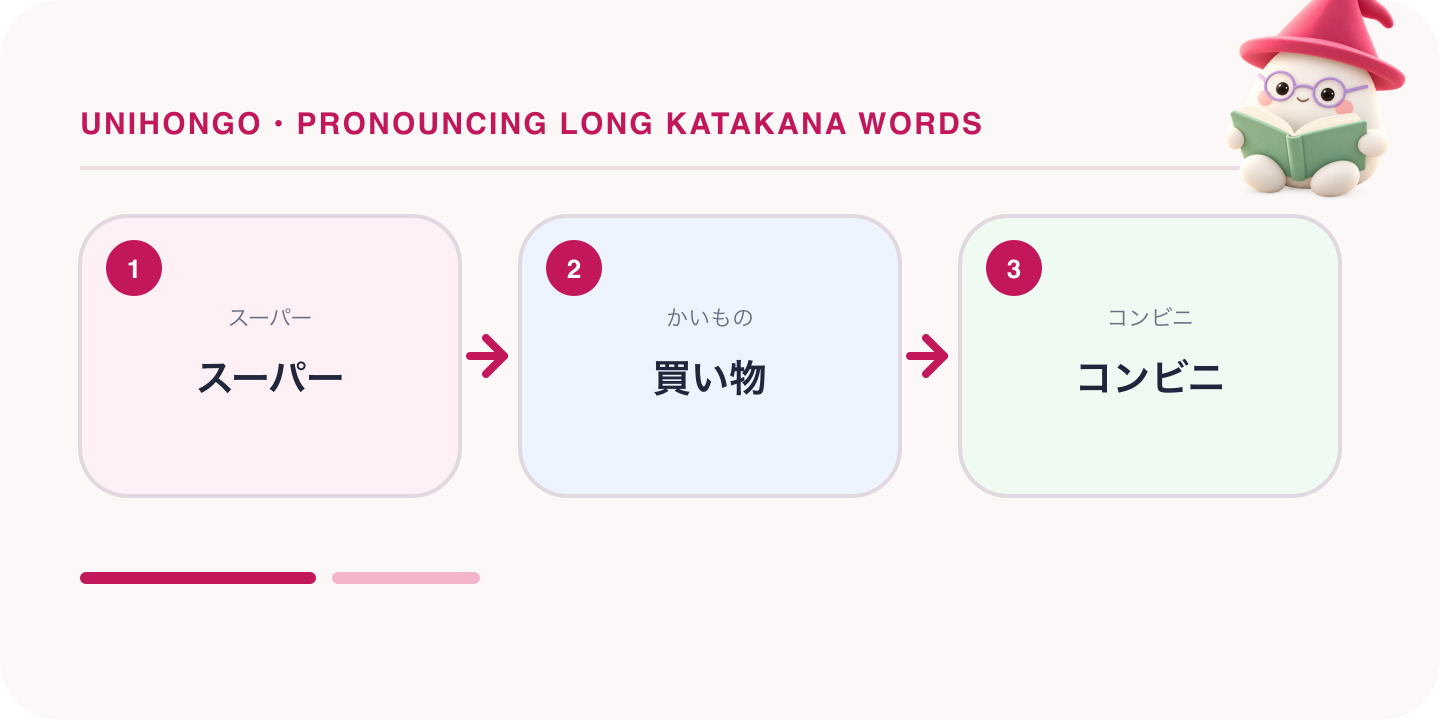
| Japanese | Romaji | Meaning |
|---|---|---|
| スーパーで買い物をします。 | Sūpā de kaimono o shimasu. | I do my shopping at the supermarket. |
| コンビニは二十四時間開いています。 | Konbini wa nijūyojikan aite imasu. | Convenience stores are open twenty-four hours. |
| アルバイトを探しています。 | Arubaito o sagashite imasu. | I'm looking for a part-time job. |
| レストランを予約しました。 | Resutoran o yoyaku shimashita. | I booked a restaurant. |
| エレベーターは右です。 | Erebētā wa migi desu. | The lift is on the right. |
Counting moras: ー, ッ and ン all take a beat
A mora is the timing unit of Japanese, and in katakana it is nearly one written character. Full-size characters are one mora each. A small ャ, ュ or ョ joins the character before it into a single mora, so キャ is one beat. The long vowel mark ー is a full mora, the small ッ is a full mora of silence before the following consonant, and ン is a full mora on its own. That gives you a simple counting rule for any loanword.
Apply it to the three title words. スーパーマーケット is su, u, pa, a, ma, a, ke, t, to: nine moras. コンビニエンスストア is ko, n, bi, ni, e, n, su, su, to, a: ten moras. アルバイト is a, ru, ba, i, to: five moras. Say each with a clap per mora, and notice how much longer the words are than their English sources.
Equal timing is the second rule. English lengthens stressed syllables and squashes the rest; Japanese gives each mora roughly the same duration, so in arubaito the ba is not louder or longer than the to. Clapping is the quickest way to hear where you are still stressing.
| Japanese | Romaji | Meaning |
|---|---|---|
| コーヒーをお願いします。 | Kōhī o onegai shimasu. | Coffee, please. |
| インターネットが遅いです。 | Intānetto ga osoi desu. | The internet is slow. |
| チョコレートを買いました。 | Chokorēto o kaimashita. | I bought some chocolate. |
| エスカレーターで二階へ行きます。 | Esukarētā de nikai e ikimasu. | I'll go to the second floor by escalator. |
| クレジットカードは使えますか。 | Kurejitto kādo wa tsukaemasu ka. | Can I use a credit card? |
Where the pitch falls in loanwords
Japanese words carry a pitch pattern rather than stress, and loanwords are unusually regular. Most have a single fall, and the default place for it is the third mora from the end. Arubaito is a, ru, ba, i, to, so the fall comes after ba: aruBAito with ba high and ito low. Konpyūtā is ko, n, pyu, u, ta, a, so the fall lands after pyu. Chokorēto falls after re. Once you know the rule you can predict most new loanwords before you ever hear them.
There is one adjustment. If the third mora from the end is a ー, a ッ, an ン or the second vowel of a pair like ai or ei, the fall cannot sit there and moves one mora earlier. Erebētā is e, re, be, e, ta, a; the third from the end is e, the second half of a long vowel, so the fall moves back to be: ereBĒtā. Kōhī is ko, o, hi, i; the third from the end is o, the second half of ō, so the accent moves to the first mora.
A second group of loanwords is unaccented: short, very frequent words such as konbini, pasokon, sumaho and eakon. They start low, rise on the second mora and stay high all the way through, including onto the following particle.
| Japanese | Romaji | Meaning |
|---|---|---|
| パソコンが壊れました。 | Pasokon ga kowaremashita. | My computer broke. |
| スマホを忘れました。 | Sumaho o wasuremashita. | I forgot my phone. |
| エアコンをつけてもいいですか。 | Eakon o tsukete mo ii desu ka. | May I turn on the air conditioning? |
| テレビを見ながらご飯を食べます。 | Terebi o minagara gohan o tabemasu. | I eat while watching television. |
| タクシーを呼んでください。 | Takushī o yonde kudasai. | Please call a taxi. |
Everyday loanwords with their readings and patterns
The table lists loanwords you will use within your first week in Japan. The reading column gives the romaji with long vowels marked; the last column shows the mora count and where the pitch falls, using a downward arrow after the accented mora, or the word unaccented when the pitch stays high. Read each word with a clap per mora, then say it with the melody.
| Word | Reading | Moras and pitch |
|---|---|---|
| スーパーマーケット | sūpāmāketto | 9 moras, sūpāma↓ketto |
| スーパー | sūpā | 4 moras, su↓pā |
| コンビニ | konbini | 4 moras, unaccented |
| アルバイト | arubaito | 5 moras, aruba↓ito |
| レストラン | resutoran | 5 moras, re↓sutoran |
| エレベーター | erebētā | 6 moras, erebe↓tā |
| コンピューター | konpyūtā | 6 moras, konpyu↓tā |
| インターネット | intānetto | 7 moras, intāne↓tto |
| アイスクリーム | aisukurīmu | 7 moras, aisukuri↓mu |
| ハンバーガー | hanbāgā | 6 moras, hanba↓gā |
| サラリーマン | sararīman | 6 moras, sarari↓man |
| パソコン | pasokon | 4 moras, unaccented |
| コーヒー | kōhī | 4 moras, ko↓hī |
Notice how often the fall lands right before a long vowel or doubled consonant at the end: erebe↓tā, intāne↓tto, hanba↓gā.
Splitting long words into chunks
Nobody learns a ten-mora word in one piece. Split it where the original English words join, drill each piece as a separate Japanese word with its own steady timing, then join the pieces without a pause. Konbiniensu sutoa becomes konbiniensu plus sutoa. Sūpāmāketto becomes sūpā plus māketto. Kurejitto kādo is already two words. The chunks are also the clipped forms Japanese people use in real speech, which is a bonus.
When you join the chunks, keep one pitch fall for the whole word. The first chunk usually loses its own accent and rides the rise, and the fall comes from the second chunk. That is why sūpā alone has a fall after su, but sūpāmāketto rises smoothly through sūpā and falls after ma.
Finally, say the word inside a sentence at natural speed. The sentences below combine two or more loanwords so that you have to hold the timing across the whole phrase.
| Japanese | Romaji | Meaning |
|---|---|---|
| コンビニエンスストアでアルバイトをしています。 | Konbiniensu sutoa de arubaito o shite imasu. | I work part-time at a convenience store. |
| スーパーマーケットの隣にレストランがあります。 | Sūpāmāketto no tonari ni resutoran ga arimasu. | There is a restaurant next to the supermarket. |
| アイスクリームとコーヒーを注文しました。 | Aisukurīmu to kōhī o chūmon shimashita. | I ordered ice cream and coffee. |
| インターネットでアルバイトを見つけました。 | Intānetto de arubaito o mitsukemashita. | I found a part-time job on the internet. |
Common mistakes by first language
Because loanwords come from many languages, the errors depend partly on which words are familiar. The list below groups the most frequent habits and how to correct each one.
- English speakers: stressing one syllable and squashing the rest, so arubaito becomes arBYto with three beats instead of five. Fix: clap every mora and keep the volume even.
- English speakers: pronouncing the English vowel, saying market with a schwa instead of māketto with a long a and a clear o. Fix: read the katakana, not the English spelling.
- Spanish and Italian speakers: shortening long vowels, because vowel length is not distinctive at home; kōhī becomes kohi. Fix: hold every ー for a full extra beat.
- French speakers: putting a final rise on every word, which masks the pitch fall in aruba↓ito. Fix: let the last moras drop and stay low.
- Chinese and Vietnamese speakers: treating ン as a full syllable with its own vowel, giving konbini four heavy beats plus an extra one. Fix: ン is a beat of nasal hum, not a syllable.
- Everyone: skipping the silent beat of ッ, so intānetto becomes intāneto. Fix: hold the mouth closed for one count before to.
If several of these apply to you, work on mora count first, long vowels second and pitch last. Timing errors cause the most misunderstandings; pitch errors usually just sound foreign.
A self-check routine with the AI Sensei
Because loanwords feel familiar, you are likely to believe you are saying them correctly when you are not, so external feedback matters more here than anywhere else in pronunciation. The routine below takes ten minutes. First, clap and say the words in the table, one clap per mora. Second, say the chunked pairs, short form then full form. Third, have a conversation with the AI Sensei about your part-time job, your shopping habits and your gadgets, which pulls in arubaito, sūpā, konbini, sumaho and pasokon naturally.
Then ask the Sensei to read five loanwords at natural speed and count the moras yourself before repeating each one. After the conversation, read the feedback, pick the three words that were flagged, and repeat only those with the claps.
| Japanese | Romaji | Meaning |
|---|---|---|
| アルバイトの話をしてもいいですか。 | Arubaito no hanashi o shite mo ii desu ka. | May I talk about my part-time job? |
| この言葉は何拍ですか。 | Kono kotoba wa nanpaku desu ka. | How many beats does this word have? |
| もっとゆっくり言ってください。 | Motto yukkuri itte kudasai. | Please say it more slowly. |
| 私の発音は英語っぽいですか。 | Watashi no hatsuon wa eigoppoi desu ka. | Does my pronunciation sound English? |
| もう一回言います。 | Mō ikkai iimasu. | I'll say it one more time. |
When a word still comes out wrong
If a loanword refuses to settle, write its moras out one per line and read them as a list before you read them as a word. Then check the usual culprits in order: is every ー held, is every ッ a silent beat, and is there a single fall rather than an English stress.
Clipped forms are not cheating. If the long form is beyond you today, use sūpā or konbini clearly and come back to the full form later.
| Japanese | Romaji | Meaning |
|---|---|---|
| 長い言葉は苦手です。 | Nagai kotoba wa nigate desu. | I'm not good at long words. |
| 短く言ってもいいですか。 | Mijikaku itte mo ii desu ka. | Is it all right to say it in the short form? |
| カタカナで書いてください。 | Katakana de kaite kudasai. | Please write it in katakana. |