
Which greeting for which person
All four phrases share the same root idea of a long interval, but they carry different levels of distance and different amounts of apology. Sorting them by relationship is faster than sorting them by dictionary meaning, because in the moment you are not thinking about formality theory. You are thinking, this is my old classmate, or this is a client I have neglected for eight months.
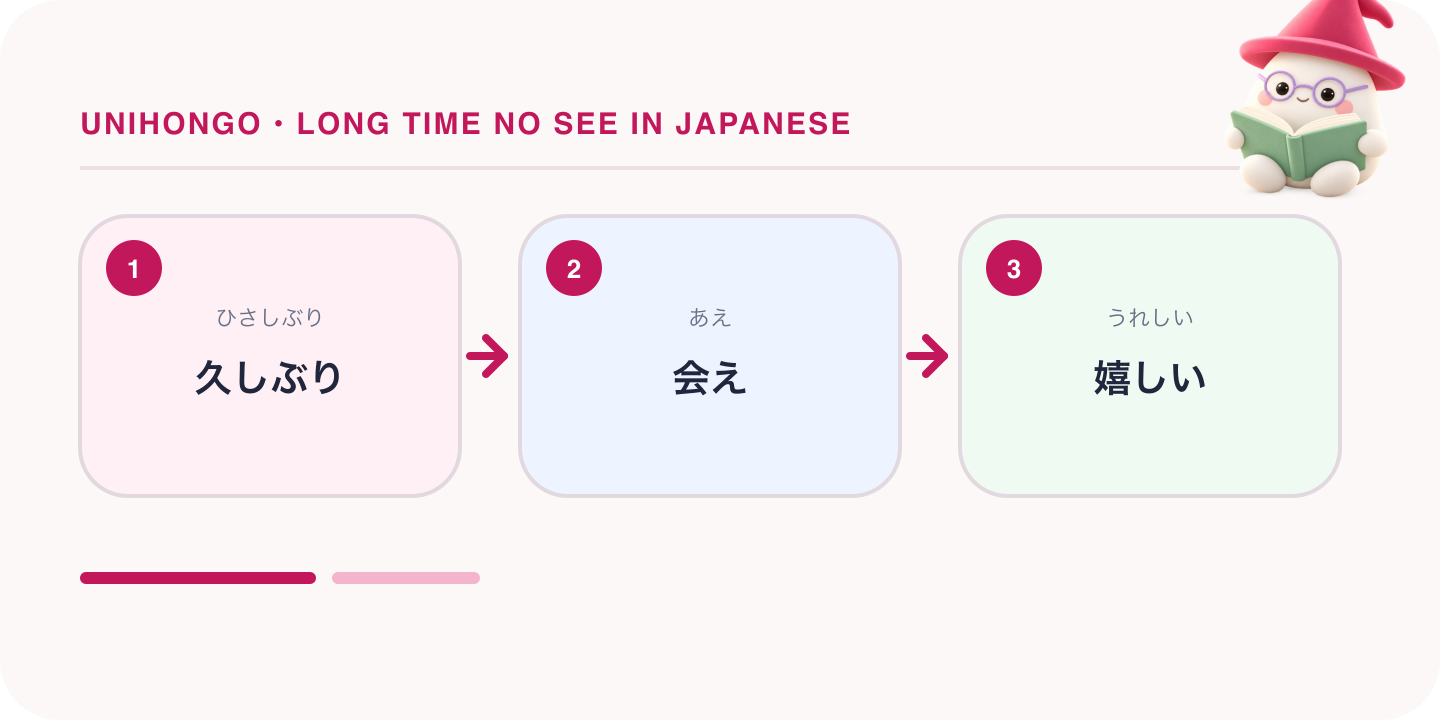
| Person | Greeting | Why it fits |
|---|---|---|
| Close friend | 久しぶり Hisashiburi | Plain form, no distance |
| Friend, warmer | 久しぶりだね Hisashiburi da ne | Ne invites agreement |
| Colleague, neighbour | お久しぶりです Ohisashiburi desu | The safe everyday default |
| Colleague, softer | お久しぶりですね Ohisashiburi desu ne | Sounds pleased rather than formal |
| Senior or a formal setting | しばらくです Shibaraku desu | A step above, slightly dated |
| Client or business contact | ご無沙汰しております Gobusata shite orimasu | Humble, includes an apology |
| Former teacher or mentor | ご無沙汰しております Gobusata shite orimasu | Acknowledges the neglected duty |
Ohisashiburi desu and its casual twin
Hisashiburi comes from hisashii, meaning a long time has passed, with the suffix buri marking an interval. The honorific o and desu turn it polite. In speech it usually arrives with ne, because ne asks the other person to share the feeling, and a reunion is precisely a shared feeling. Ohisashiburi desu ne sounds pleased; ohisashiburi desu on its own can sound like a form being filled in.
There is a small trap in the casual form. Hisashiburi is fine to say to someone your own age or younger, but shortening it for a manager sounds abrupt. If you know a colleague well and still want to keep it light, ohisashiburi desu with a smile does the job without dropping the register.
| Japanese | Romaji | Meaning |
|---|---|---|
| 久しぶり。 | Hisashiburi. | Long time no see. (casual) |
| 久しぶりだね。 | Hisashiburi da ne. | It has been ages, hasn't it. (casual) |
| お久しぶりです。 | Ohisashiburi desu. | Long time no see. (polite) |
| お久しぶりですね。 | Ohisashiburi desu ne. | It has been a while, hasn't it. |
| お久しぶりでございます。 | Ohisashiburi de gozaimasu. | It has been a long time. (very formal) |
| 会えて嬉しいです。 | Aete ureshii desu. | I am glad to see you. |
| 会いたかったよ。 | Aitakatta yo. | I have missed you. (casual) |
Shibaraku desu and the formal middle ground
Shibaraku means for a while, and shibaraku desu is a compact, slightly old-fashioned greeting you will hear from older speakers and in formal settings. Shibaraku buri desu ne is the fuller version. Learners rarely need to produce these, but recognising them matters, because if a senior colleague opens with shibaraku desu ne and you do not react, the exchange stumbles at the first line.
Note that shibaraku on its own has a separate everyday use meaning please wait a moment, as in shibaraku omachi kudasai, which staff say at a counter or on the phone. Context separates the two senses cleanly, since one is a greeting and the other a request, but the overlap does surprise learners who meet the waiting sense first.
| Japanese | Romaji | Meaning |
|---|---|---|
| しばらくです。 | Shibaraku desu. | It has been a while. (formal) |
| しばらくぶりですね。 | Shibaraku buri desu ne. | It has been quite some time. |
| ご無沙汰しています。 | Gobusata shite imasu. | I have not been in touch. (polite) |
| 長らくお会いしていませんでしたね。 | Nagaraku oai shite imasen deshita ne. | We have not met for a long time. |
| またお目にかかれて光栄です。 | Mata ome ni kakarete kōei desu. | It is an honour to see you again. (very formal) |
Gobusata shite orimasu, the business version that apologises
Busata means neglecting to make contact, so gobusata shite orimasu says I have been out of touch rather than simply it has been a while. That built-in apology is why it is the standard business opening after a gap, and why it works so well with a former teacher or a mentor. Orimasu is the humble equivalent of imasu, which is what places the speaker below the listener.
With a client, the greeting usually comes wrapped in a small package: the greeting, your company and name, and often a line thanking them for past help. Sono setsu wa osewa ni narimashita, thank you for your help on that occasion, is the phrase that names the shared history without going into detail. The guide to sonkeigo and kenjōgo covers the wider humble system.
| Japanese | Romaji | Meaning |
|---|---|---|
| ご無沙汰しております。 | Gobusata shite orimasu. | I have been out of touch. (humble, business) |
| 大変ご無沙汰しております。 | Taihen gobusata shite orimasu. | It has been far too long since I contacted you. |
| ご無沙汰しており、申し訳ございません。 | Gobusata shite ori, mōshiwake gozaimasen. | I apologise for not having been in touch. |
| 株式会社さくらの田中でございます。 | Kabushiki-gaisha Sakura no Tanaka de gozaimasu. | This is Tanaka from Sakura Corporation. |
| その節はお世話になりました。 | Sono setsu wa osewa ni narimashita. | Thank you for your help back then. |
| 先生、ご無沙汰しております。 | Sensei, gobusata shite orimasu. | Professor, it has been a long time. |
| 三年前にお世話になった田中です。 | San-nen mae ni osewa ni natta Tanaka desu. | I am Tanaka, whom you helped three years ago. |
The second move learners skip
Here is where most reunion conversations die. The learner says ohisashiburi desu, the other person says ohisashiburi desu, and then nothing. In Japanese the greeting is only the door; the room is the follow-up question, and there are four reliable ones: how have you been, what have you been up to, how is work, and is your family well. Ask one immediately, in the same breath as the greeting, and the conversation starts itself.
Choose the question by relationship. Ogenki deshita ka works with anyone. Saikin dō desu ka is for someone you know reasonably well. Okawari arimasen ka is the formal version, literally asking whether there have been any changes, and it is the natural partner for gobusata shite orimasu. The general small talk guide covers the topics that follow once the door is open.
| Japanese | Romaji | Meaning |
|---|---|---|
| お久しぶりです。お元気でしたか。 | Ohisashiburi desu. Ogenki deshita ka? | Long time no see. How have you been? |
| 久しぶり。元気だった? | Hisashiburi. Genki datta? | Hey, long time. How have you been? (casual) |
| 最近どうですか。 | Saikin dō desu ka? | How have things been lately? |
| 最近何をしていますか。 | Saikin nani o shite imasu ka? | What have you been up to? |
| お仕事はいかがですか。 | Oshigoto wa ikaga desu ka? | How is work going? (polite) |
| 仕事はどう? | Shigoto wa dō? | How is work? (casual) |
| ご家族はお元気ですか。 | Gokazoku wa ogenki desu ka? | Is your family well? |
| お変わりありませんか。 | Okawari arimasen ka? | Has everything been well with you? (formal) |
Answering when the question comes back
The reply has a shape too. Start with okagesama de, thanks to you, which is a set humble opener rather than a literal claim, then give your state, then add one concrete detail. The detail is what gives the other person something to ask about. Genki desu on its own is grammatically perfect and conversationally empty, and it hands the work straight back.
| Japanese | Romaji | Meaning |
|---|---|---|
| おかげさまで元気です。 | Okagesama de genki desu. | I have been well, thank you. |
| おかげさまで、変わりなく過ごしています。 | Okagesama de, kawarinaku sugoshite imasu. | Thank you, things have carried on as usual. |
| 相変わらずです。 | Aikawarazu desu. | Same as ever. |
| 最近はばたばたしています。 | Saikin wa batabata shite imasu. | Things have been hectic lately. |
| 去年、転職しました。 | Kyonen, tenshoku shimashita. | I changed jobs last year. |
| 今は大阪に住んでいます。 | Ima wa Ōsaka ni sunde imasu. | I live in Osaka now. |
| 子どもが生まれました。 | Kodomo ga umaremashita. | We had a baby. |
| そちらはいかがですか。 | Sochira wa ikaga desu ka? | And how about you? |
The last line matters as much as the rest. Sochira wa ikaga desu ka, or the casual sochira wa dō, returns the question and keeps the exchange balanced. Without it, one person interviews the other and the reunion feels like a form.
Naming the gap in years
Japanese has a neat construction for this: a time span plus buri, meaning for the first time in that span. Sannen buri desu ne says it has been three years. It is a natural second sentence after the greeting because it turns a vague feeling into a fact both of you can react to, and it often triggers a story about what happened in between.
| Japanese | Romaji | Meaning |
|---|---|---|
| 何年ぶりでしょうか。 | Nan-nen buri deshō ka? | How many years has it been? |
| 三年ぶりですね。 | San-nen buri desu ne. | It has been three years. |
| 十年ぶりに会いましたね。 | Jū-nen buri ni aimashita ne. | We have met for the first time in ten years. |
| 五年ぶりくらいかな。 | Go-nen buri kurai ka na. | About five years, I think. (casual) |
| 全然変わっていませんね。 | Zenzen kawatte imasen ne. | You have not changed at all. |
| 前に会ったのは大学の時ですね。 | Mae ni atta no wa daigaku no toki desu ne. | The last time we met was at university. |
A full reunion conversation
Read this straight through aloud, taking both parts. The rhythm is greeting, gap, question, answer with a detail, return question, reaction, and then the arrangement for a next meeting. Lines marked as the other person are the ones you listen for; everything else is yours to produce.
| Japanese | Romaji | Meaning |
|---|---|---|
| あ、田中さん。お久しぶりです。 | A, Tanaka-san. Ohisashiburi desu. | Oh, Tanaka. Long time no see. |
| お久しぶりです。お元気でしたか。 | Ohisashiburi desu. Ogenki deshita ka? | Long time no see. How have you been? (the other person) |
| おかげさまで元気です。三年ぶりですね。 | Okagesama de genki desu. San-nen buri desu ne. | I have been well, thank you. It has been three years. |
| そうですね。全然変わっていませんね。 | Sō desu ne. Zenzen kawatte imasen ne. | That is right. You have not changed at all. (the other person) |
| ありがとうございます。最近どうですか。 | Arigatō gozaimasu. Saikin dō desu ka? | Thank you. How have things been lately? |
| 去年、転職しました。今は横浜で働いています。 | Kyonen, tenshoku shimashita. Ima wa Yokohama de hataraite imasu. | I changed jobs last year. I work in Yokohama now. (the other person) |
| そうなんですか。お仕事はいかがですか。 | Sō nan desu ka. Oshigoto wa ikaga desu ka? | Is that so. How is the work? |
| 忙しいですが、楽しいです。そちらは? | Isogashii desu ga, tanoshii desu. Sochira wa? | Busy, but enjoyable. And you? (the other person) |
| 私は相変わらずです。家族も元気です。 | Watashi wa aikawarazu desu. Kazoku mo genki desu. | I am much the same. My family is well too. |
| それは何よりです。 | Sore wa nani yori desu. | That is the best news. (the other person) |
| 今度ゆっくり話しましょう。 | Kondo yukkuri hanashimashō. | Let us have a proper talk sometime. |
| ぜひ。連絡しますね。 | Zehi. Renraku shimasu ne. | Absolutely. I will be in touch. (the other person) |
Closing so there is a next time
A reunion that ends with mata ne and nothing else usually produces no next meeting. Japanese has a set of soft, non-binding closers that still create an opening, and they are deliberately vague: kondo, sometime, and zehi, by all means, do the diplomatic work. If you actually want the meeting, follow the soft closer with something concrete, such as exchanging contact details or naming a month.
| Japanese | Romaji | Meaning |
|---|---|---|
| また近いうちに会いましょう。 | Mata chikai uchi ni aimashō. | Let us meet again soon. |
| 今度ぜひお食事でもしましょう。 | Kondo zehi oshokuji demo shimashō. | Let us have a meal together sometime. |
| 連絡先を交換しませんか。 | Renrakusaki o kōkan shimasen ka? | Shall we exchange contact details? |
| また連絡しますね。 | Mata renraku shimasu ne. | I will be in touch again. |
| 今日は会えてよかったです。 | Kyō wa aete yokatta desu. | I am glad we met today. |
| お体に気をつけて。 | Okarada ni ki o tsukete. | Look after yourself. |
| また飲みに行こう。 | Mata nomi ni ikō. | Let us go for a drink again. (casual) |
The written opening after a gap
In writing, the same phrases open the message before you state your business. Business email conventionally starts with gobusata shite orimasu, then your company and name, then a bridge sentence into the reason for writing. In a personal message the tone is lighter, but the structure holds: greeting, brief apology or acknowledgement of the silence, then the reason you are writing now.
Two habits make written reunions land better. Give the shared context early so the reader does not have to search their memory, and say plainly why you are writing, since a message that opens warmly and then asks for a favour three paragraphs later reads as a preamble. Formats vary by company, so follow whatever your workplace already does.
| Japanese | Romaji | Meaning |
|---|---|---|
| ご無沙汰しております。 | Gobusata shite orimasu. | It has been a long time since I contacted you. (email opener) |
| 長らくご無沙汰しており、失礼いたしました。 | Nagaraku gobusata shite ori, shitsurei itashimashita. | My apologies for the long silence. |
| その後、お変わりございませんか。 | Sonogo, okawari gozaimasen ka? | I hope all has been well with you since. |
| 突然のご連絡、失礼いたします。 | Totsuzen no gorenraku, shitsurei itashimasu. | Forgive me for writing out of the blue. |
| 本日はお願いがあり、ご連絡いたしました。 | Honjitsu wa onegai ga ari, gorenraku itashimashita. | I am writing today because I have a request. |
| お久しぶりです。元気にしていますか。 | Ohisashiburi desu. Genki ni shite imasu ka? | Long time no see. Are you keeping well? (personal message) |
| また会えるのを楽しみにしています。 | Mata aeru no o tanoshimi ni shite imasu. | I look forward to seeing you again. |
Mistakes to fix before your next reunion
- Stopping at the greeting. Always attach a follow-up question in the same breath.
- Using hisashiburi with a manager or a client. Keep ohisashiburi desu or gobusata shite orimasu for anyone above you.
- Answering genki desu and stopping. Add one detail so the other person has something to ask about.
- Forgetting to return the question. Sochira wa ikaga desu ka keeps the exchange two-sided.
- Leaving without a next step. Kondo and zehi are soft, but they still open a door that silence does not.
- Assuming you will be recognised. Give your name and the shared context if there is any doubt.