
The mochitsuki in four words
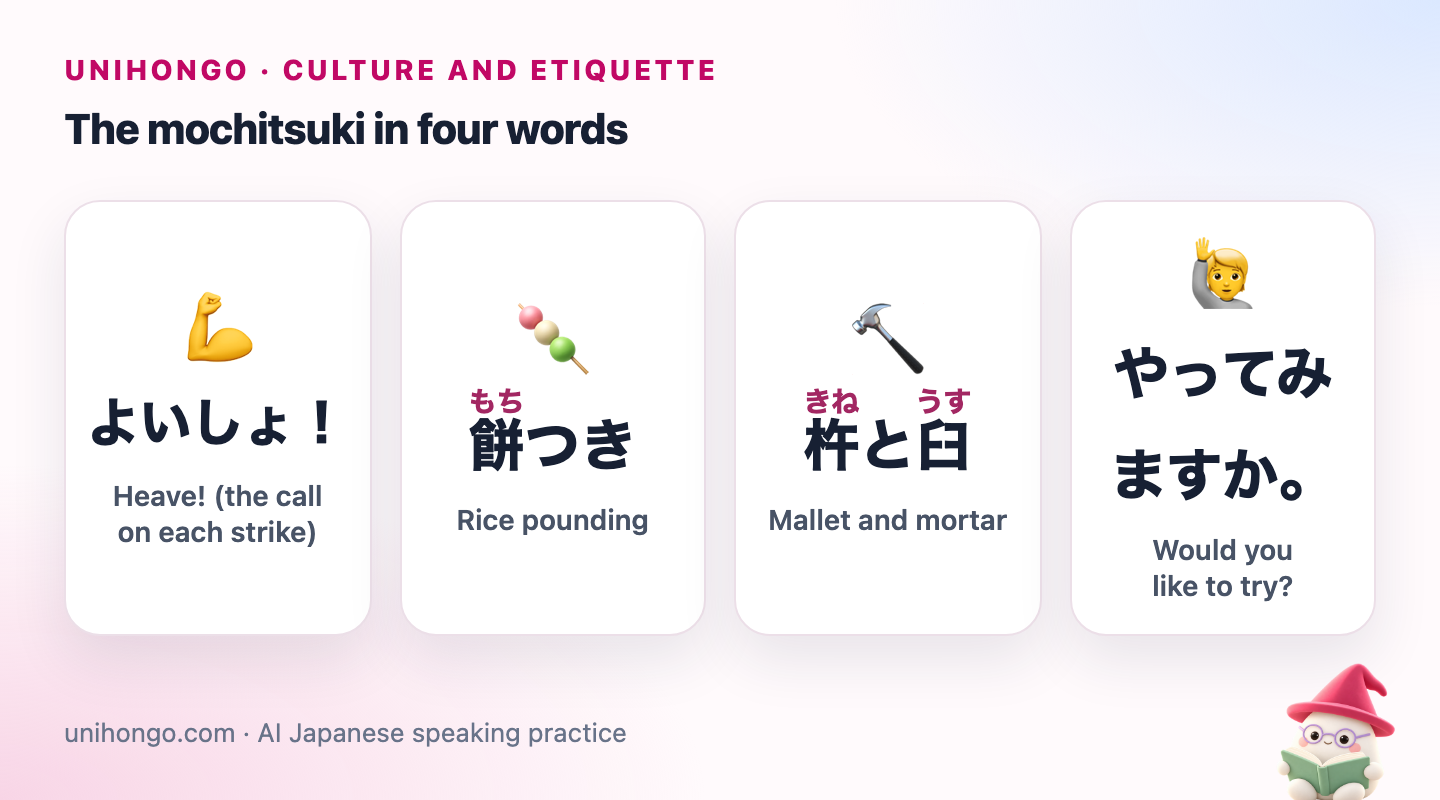
You only need a handful of words to follow a mochitsuki: the call that keeps the rhythm, the name of the event, the two tools, and the invitation that puts the mallet in your hands. Tsuku (搗く) means to pound, and mochi + tsuki becomes mochitsuki.
| Japanese | Romaji | Meaning |
|---|---|---|
| よいしょ! | Yoisho! | Heave! (the call on each strike) |
| 餅つき | mochitsuki | Rice pounding |
| 杵と臼 | kine to usu | Mallet and mortar |
| やってみますか。 | Yatte mimasu ka. | Would you like to try? |
Yoisho is not only for mochi. People say it when they lift a heavy box, stand up from the floor or sit down after a long day. Yatte mimasu ka uses the -te miru form, to try doing, and it is the standard friendly offer at any hands-on event.
What happens at a mochitsuki, step by step
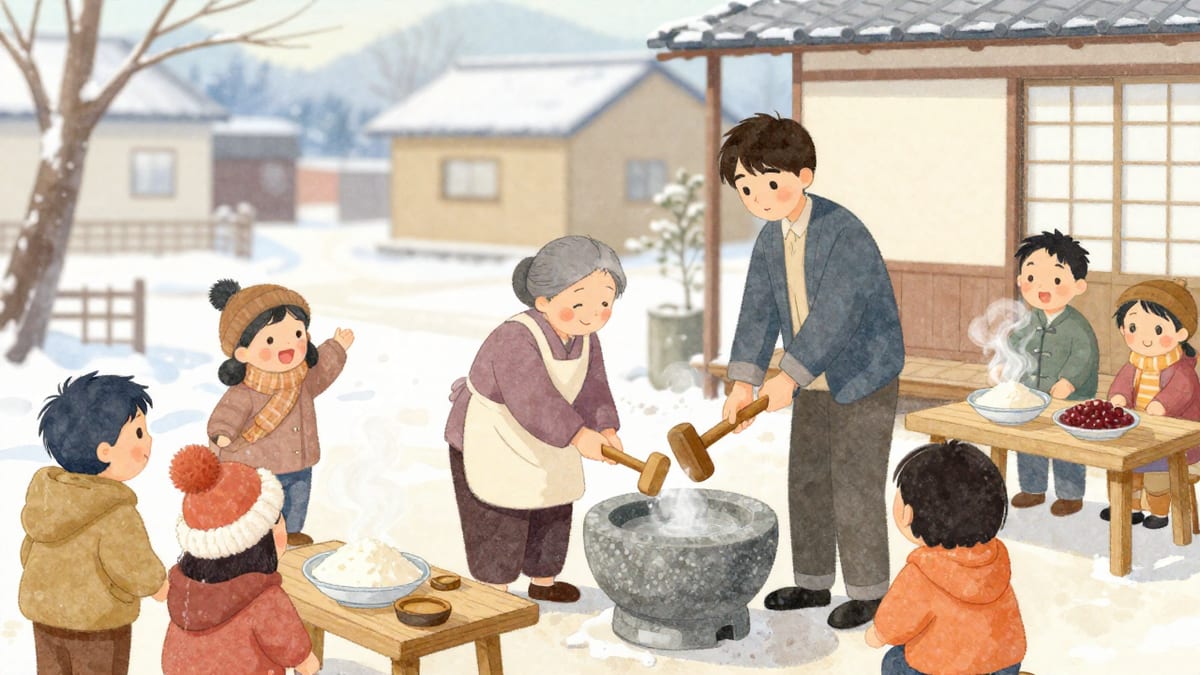
The day starts early. Glutinous rice, mochigome (もち米), is soaked overnight and steamed in stacked wooden trays called seiro (せいろ). The usu, usually a heavy wooden or stone mortar, is warmed with hot water so the rice does not cool and stick. Then the hot rice goes in, and the work begins.
First, the rice is not pounded at all. Experienced hands press and grind it with the kine, walking around the usu, until the grains break down. This step is called koneru (こねる), to knead. Only then does the pounding start, with one person striking and another, the kaeshite (返し手), turning and folding the mochi with wet hands between strikes. It takes a few minutes of steady work for one batch to become smooth.
To find an event, look for the words mochitsuki taikai (餅つき大会), literally a mochi-pounding gathering, on a neighbourhood notice, a school or kindergarten letter, or a shrine website. Children's associations, shopping streets and community centres often host one in December, and visitors are usually welcome, sometimes with a small contribution for the rice. If you are unsure, ask a neighbour: dare demo sanka dekimasu ka, can anyone join?
| Step | Word | What happens |
|---|---|---|
| 1 | 蒸す musu: to steam | Soaked rice is steamed until soft |
| 2 | こねる koneru: to knead | The rice is ground down with the mallet |
| 3 | つく tsuku: to pound | Strike, turn, strike, in a steady rhythm |
| 4 | 丸める marumeru: to roll | The mochi is torn and shaped into balls |
The rhythm: yoisho, hai and the person turning the mochi
Mochitsuki is a partnership. The pounder lifts and drops the kine; the kaeshite reaches into the usu between strikes to turn the mochi and wet it. Timing keeps fingers safe, so the pair settle into a rhythm, and the crowd helps by calling yoisho! on every strike. In many groups the kaeshite answers with hai, which also tells the pounder that the hand is out of the way.
As a beginner you will be the pounder, never the kaeshite. Turning the mochi takes practice and trust, and an experienced person will do it for you. Your job is to strike the same spot, at the same pace, and stop when they tell you.
| Japanese | Romaji | Meaning |
|---|---|---|
| よいしょ! | Yoisho! | Crowd: Heave! |
| はい! | Hai! | Turner: Now! |
| もう一回! | Mō ikkai! | Crowd: One more! |
| その調子! | Sono chōshi! | Crowd: That's it, keep going! |
| がんばれ! | Ganbare! | Crowd: Go for it! |
Mini dialogue: you are handed the mallet
A volunteer from the neighbourhood association sees you watching and offers you a turn. The coaching is short and practical, and a little teasing is part of the fun. Notice how the volunteer uses casual commands softened with ne, while you answer politely.
| Japanese | Romaji | Meaning |
|---|---|---|
| やってみますか。 | Yatte mimasu ka. | Volunteer: Would you like to try? |
| はい、やってみたいです。どうやればいいですか。 | Hai, yatte mitai desu. Dō yareba ii desu ka. | You: Yes, I'd love to. How do I do it? |
| 腰を落として、杵の重さで落とすだけでいいよ。 | Koshi o otoshite, kine no omosa de otosu dake de ii yo. | Volunteer: Bend your knees and just let the mallet's weight drop it. |
| 真ん中を狙ってね。 | Mannaka o neratte ne. | Volunteer: Aim for the middle. |
| わかりました。重いですね! | Wakarimashita. Omoi desu ne! | You: Got it. It's heavy! |
| 上手、上手!あと五回! | Jōzu, jōzu! Ato gokai! | Volunteer: Nice, nice! Five more! |
| ありがとうございました。腕が疲れました。 | Arigatō gozaimashita. Ude ga tsukaremashita. | You: Thank you. My arms are tired. |
Koshi o otosu, literally lower your hips, is the stance instruction you will hear in sport and martial arts too. Do not swing the kine high like an axe. A controlled drop from about waist or chest height is enough, and it is safer for the kaeshite.
Toppings and tasting
Once a batch is ready, the shaping team tears it into small pieces and the toppings come out. Which ones you find depends on the region and the organisers. Fresh, warm mochi is softer than the packaged blocks sold in shops, and many people say it is the best part of the day.
| Japanese | Romaji | Meaning |
|---|---|---|
| きなこにします。 | Kinako ni shimasu. | I'll have kinako, please. |
| つきたてはおいしいですね。 | Tsukitate wa oishii desu ne. | Freshly pounded mochi is delicious. |
| 小さく切ってもらえますか。 | Chiisaku kitte moraemasu ka. | Could you cut it small for me? |
| Topping | What it is | Taste |
|---|---|---|
| きなこ kinako | Roasted soybean flour, often with sugar | Sweet and nutty |
| あんこ anko | Sweet red bean paste | Sweet |
| 大根おろし daikon oroshi | Grated radish with soy sauce | Fresh and savoury |
| のり nori | Seaweed with soy sauce, called isobe | Salty |
| お雑煮 ozōni | Mochi in a hot soup | Varies by region and family |
Seasonal greetings around the event
Because most mochitsuki events happen at the turn of the year, they come with seasonal greetings. In December, before New Year, people part with yoi otoshi o, have a good New Year. In January, the first time you see someone after New Year, the greeting is akemashite omedetō gozaimasu, followed by kotoshi mo yoroshiku onegai shimasu. Saying these to the volunteers is a lovely way to finish.
Some of the mochi from the day may become kagami mochi (鏡餅), two stacked rounds of mochi with a bitter orange on top, displayed at home over New Year.
| Japanese | Romaji | Meaning |
|---|---|---|
| よいお年を。 | Yoi otoshi o. | Have a good New Year. (in December) |
| あけましておめでとうございます。 | Akemashite omedetō gozaimasu. | Happy New Year. (in January) |
| 今年もよろしくお願いします。 | Kotoshi mo yoroshiku onegai shimasu. | I look forward to this year with you. |
| お疲れさまでした。 | Otsukaresama deshita. | Thank you for all your hard work. |
Safety and common mistakes
Mochi is sticky and can block the throat, and warnings about choking appear in Japanese news every New Year, particularly for older people and small children. Eat small pieces, chew well, and help children cut theirs. At the usu, the main risk is to the kaeshite's hands, which is why the rhythm and the calls matter.
Hygiene rules have also changed at many events. Volunteers often wear gloves and masks for shaping, and some organisers now pound mochi as a demonstration while serving mochi made separately. If that happens, it is not a sign that you did anything wrong. The pounding is still the heart of the event, and you can still take your turn.
- Swinging the mallet wildly. Let its weight do the work and keep the same pace.
- Striking before you hear the call. Wait for hai, or for the turner's hands to leave the usu.
- Offering to turn the mochi as a beginner. Leave the kaeshite role to experienced people.
- Saying akemashite omedetō in December. It is for after New Year; in December, say yoi otoshi o.