
Why translating is a bottleneck, not an achievement
Speaking in real time asks you to do several things at once: hear the last sentence, work out what it meant, decide what you want to say, find the words, and produce them with something like the right rhythm. Adding a translation step does not sit neatly alongside those. It competes with them for the same few seconds, which is why learners who translate tend to miss the beginning of the next sentence while still finishing their own.
There is a second cost that is easier to miss. When you build the English sentence first, you commit to English structure, and Japanese then has to be forced into it. That is where over-long relative clauses, unnecessary watashi, and English word order come from. The companion post on how to think in Japanese covers the wider mental-habit picture; this one is about the speaking bottleneck specifically.
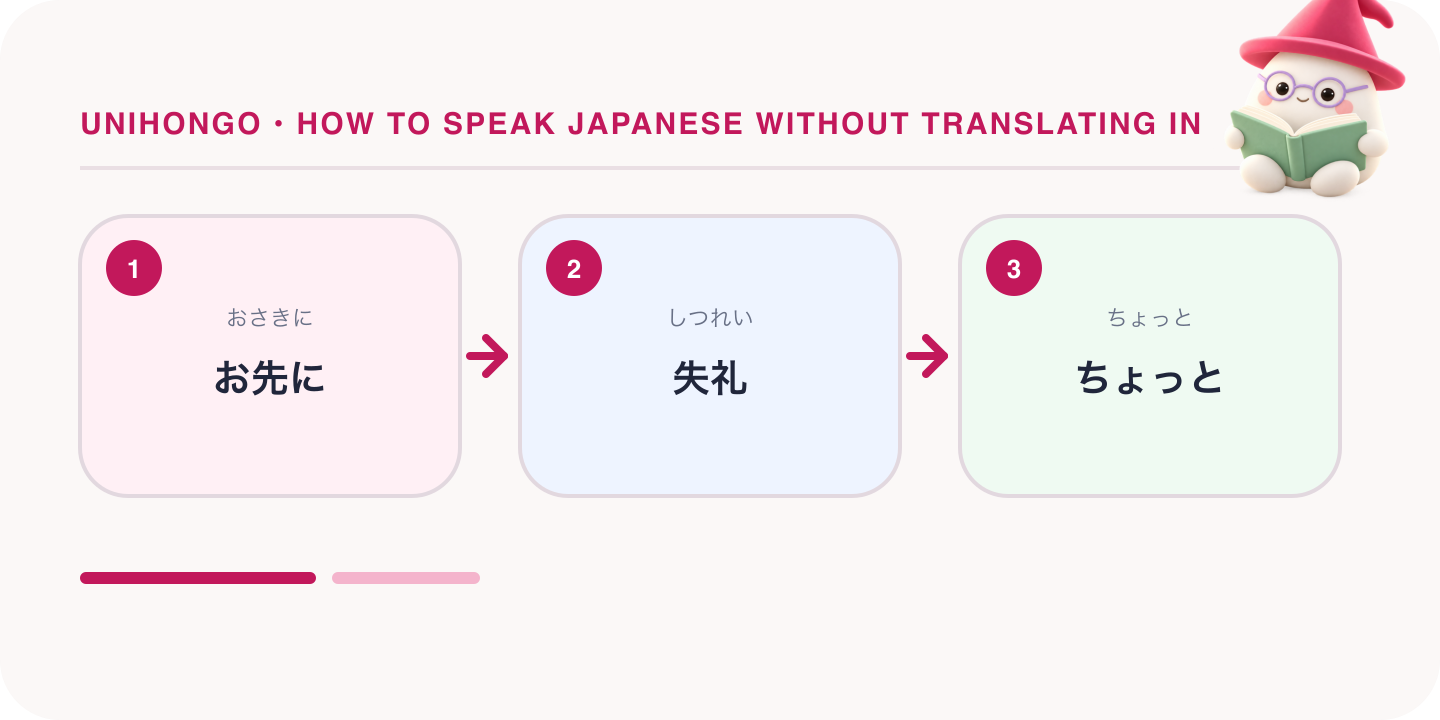
Learn whole chunks tied to a situation
A chunk is a fixed group of words retrieved as one unit, with its grammar and rhythm already attached. Because it is stored whole, it can be triggered by a situation rather than assembled from meaning, and that is the shortest possible route from wanting to say something to saying it. Every fluent speaker of any language runs on a large stock of these.
Learn them the way they are used: attached to the moment, not to an English gloss. Osaki ni shitsurei shimasu is not the translation of a sentence about leaving, it is what you say when you stand up before your colleagues do. Tie the phrase to the doorway and the bag on your shoulder, and it will arrive on its own the next time you are standing there.
| Japanese | Romaji | Meaning |
|---|---|---|
| お先に失礼します。 | Osaki ni shitsurei shimasu. | Excuse me for leaving before you. |
| お疲れさまです。 | Otsukaresama desu. | Thanks for your work. (a general workplace greeting) |
| ちょっといいですか? | Chotto ii desu ka? | Do you have a moment? |
| また今度お願いします。 | Mata kondo onegaishimasu. | Another time, then, if you do not mind. |
| よろしくお願いします。 | Yoroshiku onegaishimasu. | I look forward to working with you. |
| 助かりました。 | Tasukarimashita. | That really helped me out. |
A common reply to Chotto ii desu ka is Hai, dōzo or Sumimasen, ato de ii desu ka, so learn the likely answer alongside the chunk. A phrase you can say but cannot get a reply to is only half learned.
The translation habits and what to replace them with
| Habit | What it costs | Replacement drill |
|---|---|---|
| Building the English sentence, then converting it | Two processes fighting for the same seconds | Pattern-first drill: fix a frame, vary one slot |
| Looking up a word mid-sentence | The sentence dies while you search | Finish with a simpler word, look it up afterwards |
| Learning vocabulary as one-to-one English pairs | Every retrieval routes through English | Learn each word inside a situation and a full sentence |
| Silently rehearsing before you open your mouth | Pauses long enough to read as reluctance | Start aloud on the first four words and continue |
| Chasing the exact English nuance | Sentences you cannot finish | Downgrade to the meaning you can carry |
| Translating what you heard before answering | You miss the next sentence entirely | Answer the gist, use aizuchi to buy time |
| Studying only by reading English glosses | Recognition with no retrieval practice | Ten minutes of spoken narration every day |
Take one row a week rather than all seven. Each replacement is a small behaviour with a clear moment attached to it, which makes it possible to notice when you have failed to do it, and noticing is most of the work.
The pattern-first drill: one frame, one slot
In this drill you decide the grammatical frame before you decide the content. Fix the frame, then vary exactly one slot, five or six times in a row, aloud. Because the frame is not being chosen each time, the only thing your mind is doing is retrieving content, and that is the part you want to become automatic. Frames also stop the English structure from getting in, since the shape of the sentence was settled before meaning arrived.
Do it with real content about your own life rather than textbook nouns, because the sentences you will need again are the ones about your own week, your own job, and your own tiredness. Five variations of a single frame, said aloud at normal speed, is a two-minute drill you can run while waiting for a train, and it is worth more than twenty minutes of reading the same grammar point.
| Japanese | Romaji | Meaning |
|---|---|---|
| 高いと思います。 | Takai to omoimasu. | I think it is expensive. |
| 面白いと思います。 | Omoshiroi to omoimasu. | I think it is interesting. |
| 大丈夫だと思います。 | Daijōbu da to omoimasu. | I think it will be fine. |
| 少し早いと思います。 | Sukoshi hayai to omoimasu. | I think that is a little early. |
| 休みたいです。 | Yasumitai desu. | I want to take a rest. |
| 早く帰りたいです。 | Hayaku kaeritai desu. | I want to go home early. |
| 遅れるかもしれません。 | Okureru kamoshiremasen. | I might be late. |
| 毎日話すようにしています。 | Mainichi hanasu yō ni shite imasu. | I make a point of speaking every day. |
| 日本語で夢を見ることがあります。 | Nihongo de yume o miru koto ga arimasu. | Sometimes I dream in Japanese. |
| 少し疲れているので、今日は早く寝ます。 | Sukoshi tsukarete iru node, kyō wa hayaku nemasu. | I am a bit tired, so I will go to bed early today. |
| 来月から始めることにしました。 | Raigetsu kara hajimeru koto ni shimashita. | I have decided to start from next month. |
Notice that the last three frames carry a lot of meaning for very little choice. Yō ni shite imasu, koto ga arimasu, and koto ni shimashita each let you say something adult about your habits and decisions without inventing any structure at all, which is exactly why they are worth drilling until they are reflexive.
Narrate your day in Japanese
Self-talk is the cheapest volume of speaking you will ever get, and it removes the listener, so there is no social cost to being slow or wrong. The rule that makes it work is that you narrate at your real level. If the thought will not fit in the Japanese you have, shrink the thought rather than reaching for a dictionary, because reaching for the dictionary is the translating habit in another form.
| Japanese | Romaji | Meaning |
|---|---|---|
| 今からコーヒーを作ります。 | Ima kara kōhī o tsukurimasu. | I am going to make coffee now. |
| 電車が来るまで五分あります。 | Densha ga kuru made go-fun arimasu. | There are five minutes until the train comes. |
| 今日は昨日より人が多いです。 | Kyō wa kinō yori hito ga ōi desu. | There are more people today than yesterday. |
| あとでメールを書かないといけません。 | Ato de mēru o kakanai to ikemasen. | I have to write an email later. |
| 今日はよく話せました。 | Kyō wa yoku hanasemashita. | I managed to speak well today. |
| 明日はもう少しゆっくり話します。 | Ashita wa mō sukoshi yukkuri hanashimasu. | Tomorrow I will speak a little more slowly. |
| この単語は三回目です。 | Kono tango wa san-kai-me desu. | This is the third time for this word. |
- Pick one fixed twenty-minute window so it happens without a decision: commute, cooking, walking the dog.
- Narrate actions as you do them, in the present, rather than describing them afterwards.
- Say one comparison every session: today against yesterday, this against that.
- End with two past-tense sentences about the day and one plan for tomorrow.
- Keep a note of the three things you could not say, and look them up after the session, never during it.
Plan the pause in Japanese
Everyone pauses to think, in every language. The question is what you do during the pause. If you fill it with silence, your first language walks in and starts composing. If you fill it with Japanese, the planning itself happens inside Japanese and the sentence that follows tends to come out Japanese-shaped.
These are not filler for the sake of it. Sō desu ne and nan to ieba ii deshō ka are what a Japanese speaker says while thinking, and they buy you a real second or two while signalling that you are engaged rather than lost. Say them at normal speed, not slowly, or they sound like part of the struggle.
| Japanese | Romaji | Meaning |
|---|---|---|
| ええと、そうですね。 | Ēto, sō desu ne. | Um, let me see. |
| 何と言えばいいでしょうか。 | Nan to ieba ii deshō ka. | How should I put this? |
| ちょっと考えさせてください。 | Chotto kangaesasete kudasai. | Please let me think for a moment. |
| 一言で言うと、難しいです。 | Hitokoto de iu to, muzukashii desu. | In a word, it is difficult. |
| そうですね、いろいろありますが。 | Sō desu ne, iroiro arimasu ga. | Well, there are various things, but. |
Let go of the English sentence you wanted
The single most common cause of a stalled sentence is an English sentence you have already fallen in love with. You know the nuance you want, you know it needs a word you do not have, and you stand there trying to reverse-engineer it. Meanwhile the conversation is waiting. The professional move, and the one interpreters make constantly, is to say a smaller true thing quickly.
Downgrading is a skill worth drilling deliberately: take a thought you cannot express, and say it three ways with progressively simpler Japanese until one version is entirely within reach. The listener almost never notices the difference between your intended nuance and the version you delivered, because they never heard the intended one.
| Japanese | Romaji | Meaning |
|---|---|---|
| 説明するのが難しいので、簡単に言います。 | Setsumei suru no ga muzukashii node, kantan ni iimasu. | It is hard to explain, so I will say it simply. |
| うまく言えませんが、たぶんそうです。 | Umaku iemasen ga, tabun sō desu. | I cannot say it well, but I think that is right. |
| つまり、あまり好きじゃないということです。 | Tsumari, amari suki ja nai to iu koto desu. | In other words, I do not much like it. |
| 短く言うと、時間がなかったんです。 | Mijikaku iu to, jikan ga nakatta n desu. | To put it briefly, there was no time. |
A common reply is ああ、なるほど or そういうことですね, which confirms the gist landed. Take that as evidence that the simplified version worked, rather than as politeness covering for you.
Recovering when you freeze
A freeze is a moment where retrieval fails and nothing comes. Treat it as a normal event with a fixed procedure rather than as a verdict on your ability. The procedure is: make a sound in Japanese, name the problem in Japanese, and either request help or restart the sentence in a simpler shape. All three keep you inside the language, and the last one is what actually rescues the exchange.
| Japanese | Romaji | Meaning |
|---|---|---|
| すみません、もう一度お願いします。 | Sumimasen, mō ichido onegaishimasu. | Sorry, could you say that once more? |
| 日本語で何と言いますか? | Nihongo de nan to iimasu ka? | How do you say it in Japanese? |
| 言葉が出てこないです。 | Kotoba ga dete konai desu. | The word will not come to me. |
| ちょっと待ってください、今考えています。 | Chotto matte kudasai, ima kangaete imasu. | One moment please, I am thinking. |
| 別の言い方をします。 | Betsu no iikata o shimasu. | Let me put it another way. |
| あ、思い出しました。 | A, omoidashimashita. | Ah, I have remembered it. |
Expect replies such as ゆっくりで大丈夫ですよ or どうぞ, which are invitations to continue rather than judgements. The habit worth building is to keep the recovery line ready in advance, so the freeze costs you two seconds instead of thirty.
How listening volume feeds direct speech
Speaking without translating needs a stock of Japanese that arrives already assembled, and that stock comes mostly from listening. The useful kind is audio you understand well enough to follow without pausing, played at natural speed. Because it does not wait, translation is not available, and meaning has to bind directly to the sound. Difficult listening does the opposite: it teaches you to guess and then to check in English.
Volume matters more than variety here. Re-listening to material you have already understood is not wasted time, because the second and third passes are when phrases move from recognised to available. Aim for a daily amount you can sustain rather than an ambitious one, and pair every listening block with a short spoken block, since input alone builds recognition and only output builds retrieval.
Where translation is still the right tool
- First meeting with an abstract or technical word, where a clear gloss saves ten minutes of guessing.
- Checking a grammar contrast, such as why one particle changes the meaning of a whole sentence.
- Confirming something consequential: a contract line, a medical instruction, an official form.
- Reviewing your own recording afterwards, when there is no time pressure and precision is the point.
- Never during a live conversation, and never for language you have already known for months.
A two-week plan you can actually keep
| Days | Daily block | How you check it |
|---|---|---|
| 1-3 | Ten chunks tied to real moments in your day | You used three of them unprompted |
| 4-6 | Two frames, five slot variations each, aloud | The frame arrives before the content does |
| 7-9 | Twenty minutes of narration, no dictionary during it | Your unsaid list gets shorter each day |
| 10-11 | Pause fillers and freeze recovery lines only | You fill a hesitation in Japanese, not silence |
| 12-14 | Live conversation, one downgrade rule enforced | No sentence abandoned mid-way |
Repeat the fortnight with a new domain rather than a higher level. Direct speech spreads by situation, and each new domain starts with translation again for a few days before it settles, which is normal rather than a sign of backsliding.