
Courage, toughness, power and will
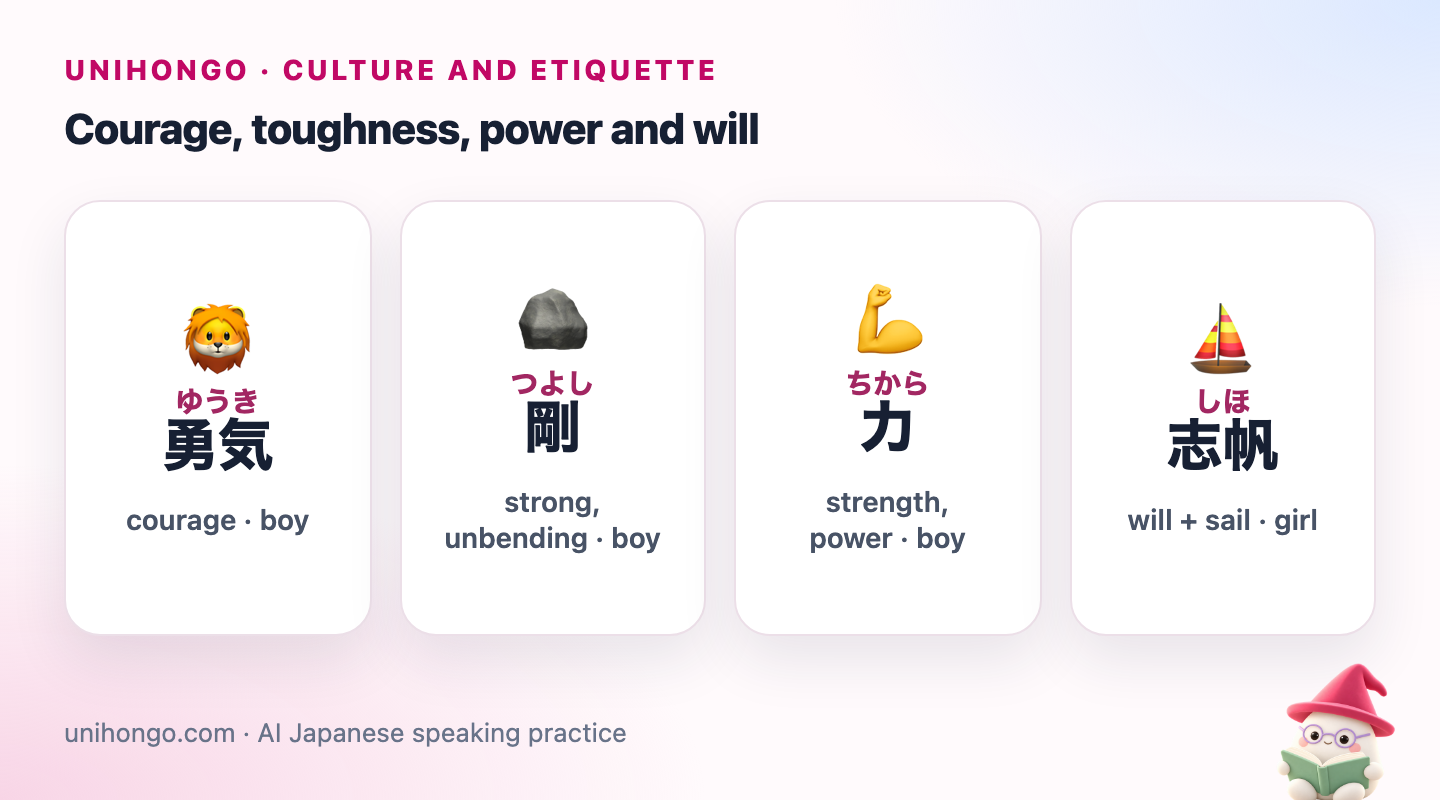
These four names show four different kinds of strength that Japanese parents wish for: the courage to act, a firm character that does not bend, plain physical power, and a strong will that carries you towards a goal.
| Japanese | Romaji | Meaning |
|---|---|---|
| 勇気 | Yūki | courage · boy |
| 剛 | Tsuyoshi | strong, unbending · boy |
| 力 | Chikara | strength, power · boy |
| 志帆 | Shiho | will + sail · girl |
志帆 shows how girls' names often express strength: 志 is will or ambition, and 帆 is the sail of a boat, so the name paints a picture of moving forward with purpose. 剛 can also be read Gō or Takeshi, and 力 as a name is short, direct and a little old-fashioned, which some families now find charming again.
勇: the kanji of courage
勇 is read yū in words like 勇気 (courage) and 勇敢 (brave), and isamu, from the verb 勇む, to be in high spirits. In names it can also be read haya, as in Hayato. The result is a whole family of names with one shared meaning.
| Japanese | Romaji | Meaning |
|---|---|---|
| 勇 | Isamu | brave, spirited · boy, classic |
| 勇人 | Hayato | brave person · boy |
| 勇太 | Yūta | brave + big · boy |
| 勇斗 | Yūto | brave + the Big Dipper · boy |
| 勇希 | Yūki | brave + hope · unisex |
Isamu was a common name in the first half of the twentieth century and now sounds classic. Hayato is more often written 隼人 (falcon person), so a Hayato with 勇 will usually explain it. Yūki is one of the most flexible names in Japanese: 勇気, 勇希, 優希, 悠希 and many other spellings exist, and only some of them mean courage.
Strong, firm and sturdy: choosing the right kanji
English uses strong for many things that Japanese splits into different kanji. If you are choosing a name for a character or a child, the nuance matters more than the dictionary translation.
| Japanese | Romaji | Meaning |
|---|---|---|
| 毅 | Takeshi | resolute, unshakeable · boy |
| 健 | Ken | healthy, sturdy · boy |
| 武 | Takeshi | martial, warrior · boy |
| 豪 | Gō | grand, powerful · boy |
| 力也 | Rikiya | power + emphasis · boy |
| Kanji | Core image | Name examples |
|---|---|---|
| 剛 | Hard, unbending, firm as metal | 剛 Tsuyoshi, 剛 Gō |
| 毅 | Resolute, unshakeable in spirit | 毅 Tsuyoshi, 毅 Takeshi |
| 健 | Healthy, sturdy, in good shape | 健 Ken, 健太 Kenta |
| 武 | Martial, warrior, military | 武 Takeshi, 武蔵 Musashi |
| 豪 | Grand, powerful, bold | 豪 Gō |
| 力 | Physical force, power | 力 Chikara, 力也 Rikiya |
健 is the gentlest of these, because it is mostly about health; parents choose it to wish for a child who grows up well. 武 and 豪 are the boldest. 武蔵 (Musashi) is also the name of an old province and has a strong historical flavour, so in modern life it is rare as a given name, but it is common in fiction.
Winning, overcoming and enduring
Another kind of strength is the ability to keep going. Japanese culture puts a high value on endurance and self-discipline, and several names express it directly. They feel steady rather than aggressive.
| Japanese | Romaji | Meaning |
|---|---|---|
| 勝 | Masaru | to win, to excel · boy |
| 克己 | Katsumi | overcoming oneself · boy |
| 忍 | Shinobu | endurance, patience · unisex |
| 貫太 | Kanta | to carry through + big · boy |
克己 is also a word, kokki, meaning self-control, so the name wishes for someone who masters their own weaknesses. 忍 means to endure, and it is also the first kanji of 忍者 (ninja), which gives the name a playful second image for some people. It has been used for both boys and girls. 貫 means to pierce or carry through, as in 貫く (tsuranuku), to stick to your principles to the end.
Strength in girls' names
Direct power kanji such as 剛 or 力 are rarely used for girls. When parents want a strong girl's name, they usually look for strength of mind, dignity or purpose, and pair it with a soft ending.
| Japanese | Romaji | Meaning |
|---|---|---|
| 志乃 | Shino | will + a soft classic ending · girl |
| 凛花 | Rinka | dignified + flower · girl |
| 志織 | Shiori | will + weave · girl |
凛 describes someone composed, clear and dignified, like cold, clean air; it has been a well-liked kanji for girls in recent years. Shiori is more often written 栞 (bookmark) or 詩織, so a Shiori with 志 will usually explain her kanji. A useful everyday phrase for this kind of strength is 芯が強い (shin ga tsuyoi), strong at the core, often said about someone who looks gentle but does not give up.
Modern parents also mix strength and softness inside one name. A first kanji such as 志 or 凛 carries the backbone of the name, and a second kanji such as 花 (flower), 乃 or 織 (weave) keeps it gentle. This balance is one reason these names feel natural for girls, while a name made only of power kanji would feel heavy.
Words for a strong personality
When people talk about why they chose a strong name, or whether a person lives up to it, these everyday words come up. They are useful far beyond names.
| Japanese | Romaji | Meaning |
|---|---|---|
| 勇気がある | yūki ga aru | brave, has courage |
| 芯が強い | shin ga tsuyoi | strong at the core |
| 粘り強い | nebarizuyoi | persistent, does not give up |
| 負けず嫌い | makezugirai | hates to lose, competitive |
| 頑張り屋 | ganbariya | a hard worker |
| 名前負け | namaemake | not living up to your name |
Makezugirai can be a compliment or a gentle tease, depending on tone. Ganbariya is almost always warm. Namaemake is something people say about themselves to be modest; saying it about another person to their face would be rude.
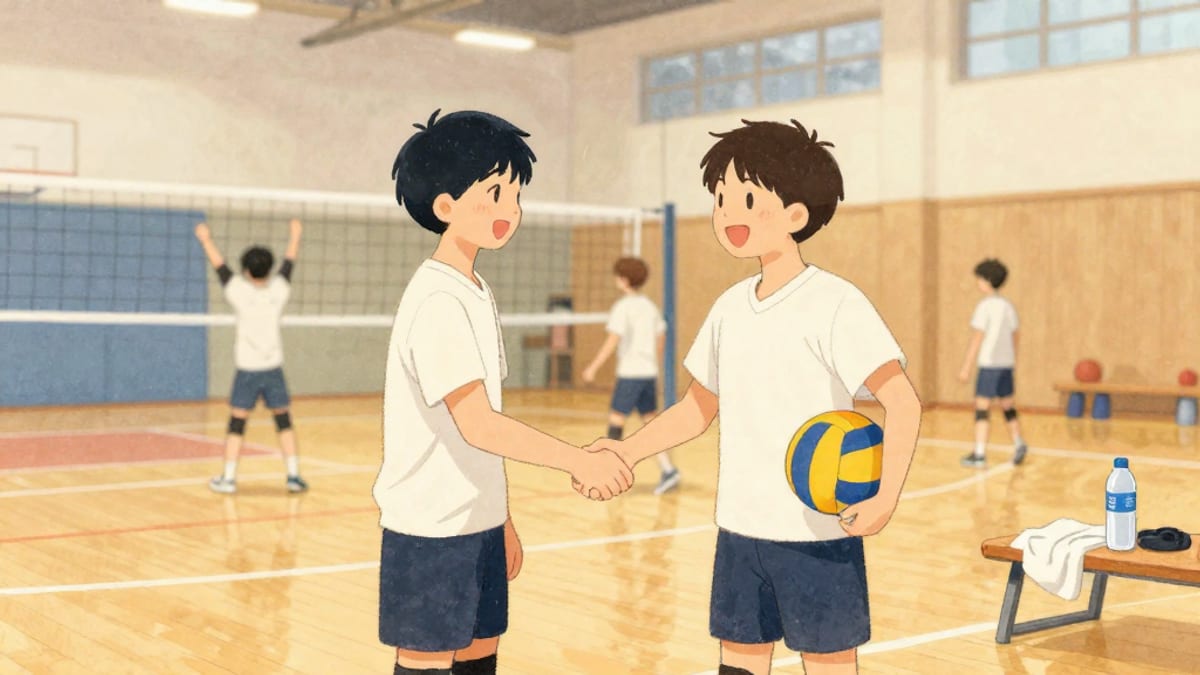
Mini dialogue: meeting Chikara at a volleyball club
You have joined a community volleyball club. A teammate introduces himself before practice. He uses polite speech because you have only just met.
| Japanese | Romaji | Meaning |
|---|---|---|
| はじめまして、山口力です。 | Hajimemashite, Yamaguchi Chikara desu. | Teammate: Nice to meet you, I'm Chikara Yamaguchi. |
| ちからさん。力持ちの力ですか。 | Chikara san. Chikaramochi no chikara desu ka. | You: Chikara. As in a strong person? |
| そうです。名前負けしてますけど。 | Sō desu. Namaemake shitemasu kedo. | Chikara: Yes. Though I don't live up to it. |
| そんなことないですよ。 | Sonna koto nai desu yo. | You: Oh, not at all. |
| じゃ、練習頑張りましょう。 | Ja, renshū ganbarimashō. | Chikara: Well, let's give practice our best. |
Sonna koto nai desu yo is the standard friendly reply when someone puts themselves down. 力持ち (chikaramochi) means a physically strong person, and it is the most natural reference word for explaining the name Chikara.
Say your strong name clearly: Mocchi, then the pronunciation coach
- Write a two-line self-introduction that explains a strength name, then send it to Mocchi with /correct. Mocchi fixes the Japanese, explains why, and remembers the mistakes so they appear in a later quiz.
- Ask Mocchi for a quick /quiz on the strength kanji in this post: 剛, 毅, 健, 武 and 勇. It will ask which nuance each one has, not just the reading.
- On the pronunciation coach, choose the long-vowel drills. Listen to the model, slow it down, record yourself and check the score and tip, so Yūki never turns into Yuki again.
When a strong name is too strong
- Translating strong word for word. 剛, 健 and 武 have different images, and a name with 武 sounds martial in a way that 健 never does.
- Giving a girl character a power name like 剛 without meaning to make a point. It can work in fiction, but Japanese readers will notice it as unusual.
- Shortening the long vowel in Yūki, Yūta or Yūto. It changes the name, and sometimes the meaning.
- Assuming Shinobu means ninja. The kanji 忍 means endurance, and the ninja image is a playful extra, not the reason parents choose it.
- Calling someone namaemake. People say it about themselves; saying it to others sounds like an insult.