
Four names for spring
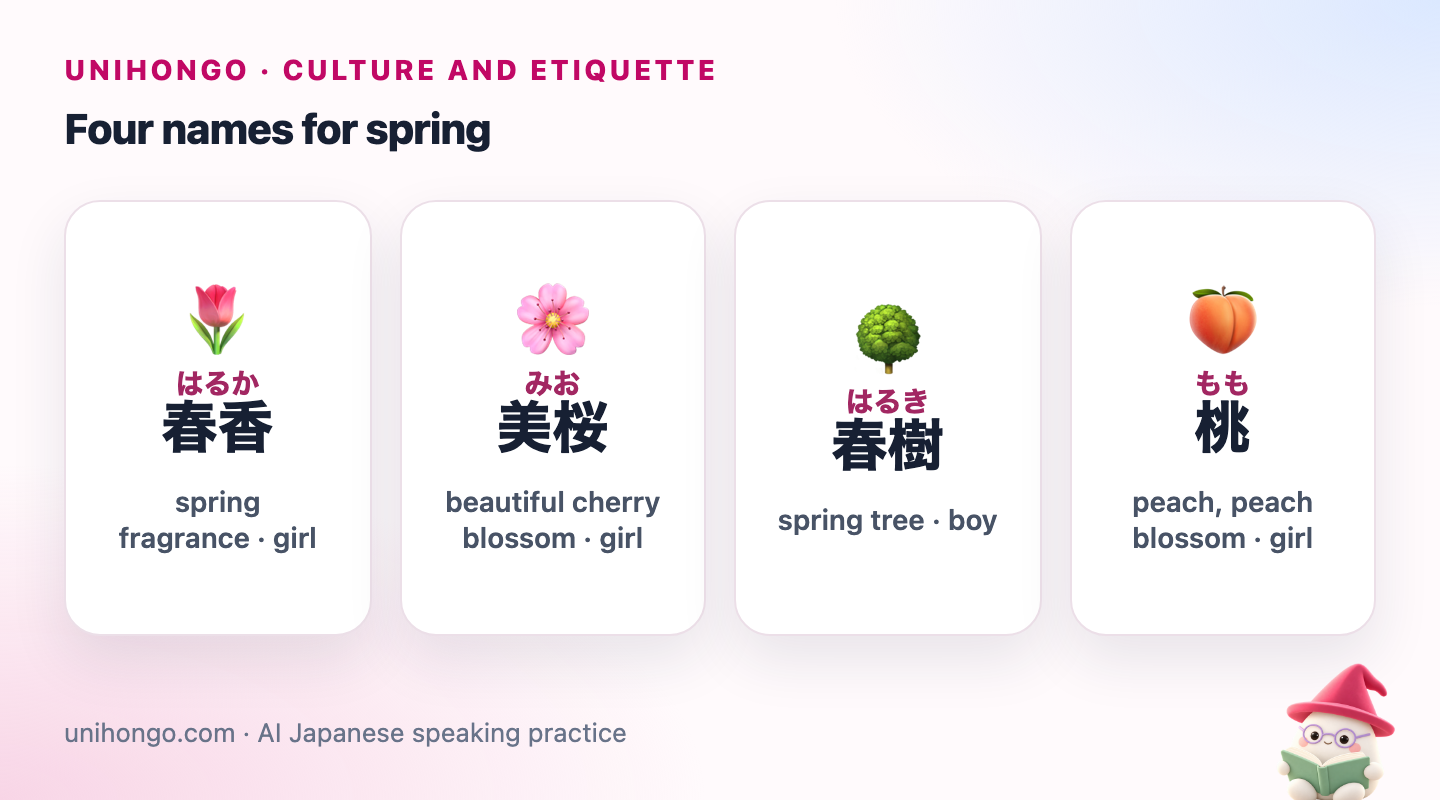
Each of these names brings spring in through a different image: a scent, a flower, a tree and a fruit blossom. Together they cover girls' and boys' names and show that spring names are not only about cherry trees.
| Japanese | Romaji | Meaning |
|---|---|---|
| 春香 | Haruka | spring fragrance · girl |
| 美桜 | Mio | beautiful cherry blossom · girl |
| 春樹 | Haruki | spring tree · boy |
| 桃 | Momo | peach, peach blossom · girl |
Haruka can also be written 遥 (far away) or 遥香, so not every Haruka is a spring name. 桃 is linked to early spring because peach blossoms open around March, and the Girls' Festival on 3 March is also called 桃の節句, the peach festival. That makes 桃, 桃子 (Momoko) and 桃花 (Momoka) gentle choices for girls born at that time of year.
Three ways to read 桜 in a name
As an everyday word, 桜 is read sakura. Its on'yomi, the reading taken from Chinese, is ō, which you hear in words like 桜花 (ōka, cherry blossoms in formal writing). In names, parents also use a shortened o, which lets 桜 fit into short, soft names. So the same kanji gives you three very different sounds.
| Japanese | Romaji | Meaning |
|---|---|---|
| 桜子 | Sakurako | cherry blossom child · girl |
| 桜介 | Ōsuke | cherry blossom + helper · boy, rare |
| 七桜 | Nao | seven + cherry blossom · girl |
| 桜 | Sakura | cherry blossom · girl |
| Reading | Name | Feel |
|---|---|---|
| sakura | 桜子 Sakurako | Classic and elegant, slightly formal |
| ō | 桜介 Ōsuke | Rare boy's name, strong sound |
| o | 美桜 Mio, 七桜 Nao | Short, soft and modern |
Readings like o for 桜 are name readings: you will not find them in ordinary words, and even Japanese speakers sometimes need to ask. If someone writes 美桜 and you are not sure, the polite question is Nan to oyomi suru n desu ka, how do you read it?
春 names, and the one that is really autumn
春 is read haru in almost every name. It sits at the start of names like Haruna and Haruki, and at the end in names like Chiharu. Many of these names were given by parents simply because the baby was born in spring, so the name works like a small birthday card.
| Japanese | Romaji | Meaning |
|---|---|---|
| 春菜 | Haruna | spring + greens · girl |
| 千春 | Chiharu | a thousand springs · girl |
| 春斗 | Haruto | spring + the Big Dipper · boy |
| 小春 | Koharu | little spring; late-autumn warmth · girl |
| 春 | Haru | spring · unisex |
The surprise is 小春. In the old calendar, 小春 was the tenth month, roughly November today, and 小春日和 means a warm, sunny day in late autumn or early winter, when the weather briefly feels like spring. The name still sounds springlike to most people, and nobody will think it odd for a baby born in April. It is just a lovely detail to know, and a nice thing to mention if you meet a Koharu.
千春 (Chiharu) wishes for a thousand springs, a long and happy life. Similar thousand names appear for other seasons too, such as 千秋 (Chiaki), a thousand autumns.
Buds, shoots and new leaves
Spring in Japanese is not only flowers. The fresh green of new leaves, the buds before the blossoms and the yellow fields of rapeseed are all part of the season, and they give names that feel lively and young.
| Japanese | Romaji | Meaning |
|---|---|---|
| 萌 | Moe | budding, sprouting · girl |
| 若葉 | Wakaba | fresh young leaves · girl |
| 菜々花 | Nanaka | rapeseed flowers · girl |
| つぼみ | Tsubomi | flower bud · girl, in hiragana |
| 新 | Arata | new, fresh · boy |
萌 shows a plant pushing up through the soil. In recent decades the reading moe has also become slang for a fond, almost protective feeling towards cute characters, so some parents think twice before choosing it, while others simply love its original meaning. 若葉 is also the image on the beginner driver's badge, a green and yellow leaf shape that new drivers display on their cars. つぼみ is often written in hiragana as a name because the kanji 蕾 is complicated.
Birth months and the spring calendar
Because the Japanese school year begins in April, spring means entrance ceremonies, new uniforms and new classmates, often under cherry trees. A child born in spring may later have a birthday close to these events, and parents sometimes mention it when they explain a name. These lines help you ask and answer in polite conversation.
| Japanese | Romaji | Meaning |
|---|---|---|
| 四月生まれなんです。 | Shigatsu umare na n desu. | I was born in April. |
| 桜が咲いていた日に生まれました。 | Sakura ga saite ita hi ni umaremashita. | I was born on a day the cherry trees were in bloom. |
| だから春の字が入っています。 | Dakara haru no ji ga haitte imasu. | That's why my name has the kanji for spring. |
| お誕生日はいつですか。 | Otanjōbi wa itsu desu ka. | When is your birthday? (polite) |
| 春らしい名前ですね。 | Haru rashii namae desu ne. | What a springlike name. |
Haru rashii means typical of spring, truly springlike. It is a gentle, natural compliment and works for names, clothes, food and weather alike.
Mini dialogue: meeting Mio at a hanami picnic
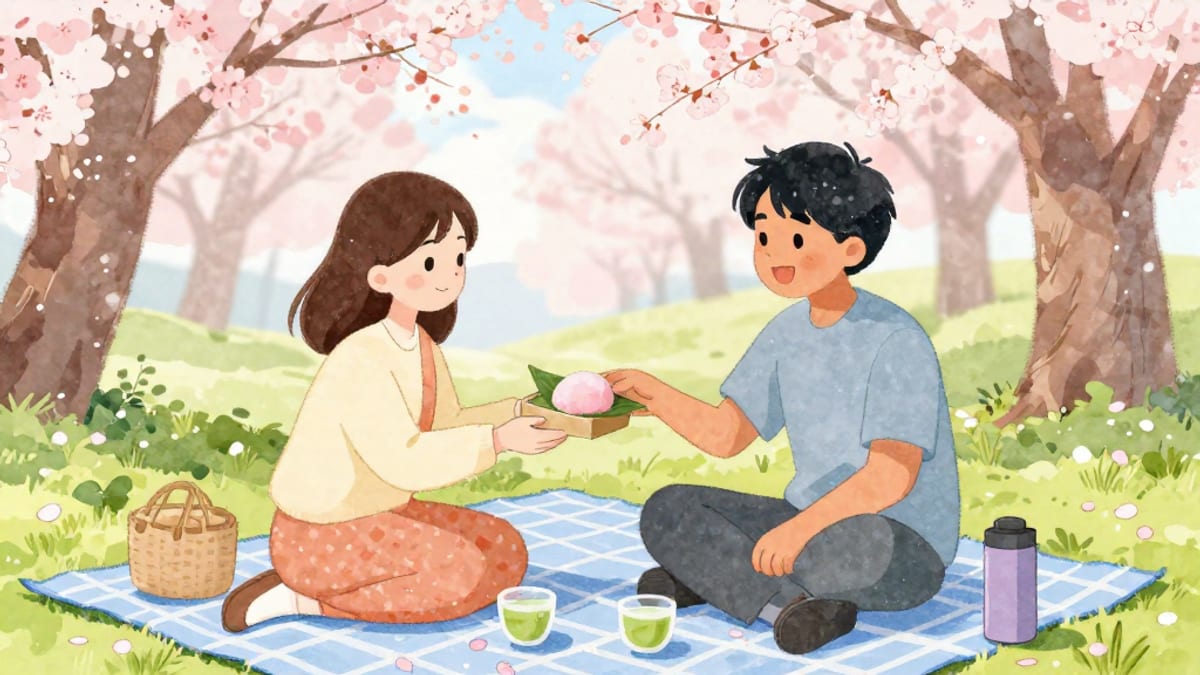
A coworker has invited you to a cherry blossom picnic in the park. Her friend Mio arrives with a box of sakura mochi. You are among friends, so the speech is casual but kind.
| Japanese | Romaji | Meaning |
|---|---|---|
| はじめまして、美桜です。 | Hajimemashite, Mio desu. | Mio: Nice to meet you, I'm Mio. |
| みおさん。どんな字? | Mio san. Donna ji? | You: Mio. Which kanji? |
| 美しいに、桜。 | Utsukushii ni, sakura. | Mio: Beautiful, and cherry blossom. |
| 今日にぴったりの名前だね。 | Kyō ni pittari no namae da ne. | You: A perfect name for today. |
| ありがとう。桜餅、食べる? | Arigatō. Sakuramochi, taberu? | Mio: Thanks. Want a sakura mochi? |
| うん、いただきます! | Un, itadakimasu! | You: Yes, thank you! |
Itadakimasu, said when you receive food you are about to eat, is natural here even in casual speech. If you want to sound a little more polite with someone you have only just met, add desu to the compliment: Kyō ni pittari no namae desu ne.
A spring-name warm-up with Mocchi and Sakura-sensei
Ask Mocchi something specific, for example: Quiz me on Japanese spring names, show the kanji and let me guess the reading. Mocchi asks one name at a time, explains each answer, and keeps a note of the readings you miss, such as Mio for 美桜 or Nao for 七桜, so they come back in your next review. If you are following a personal plan, Mocchi can fold the spring words from this post into the coming days.
Then take it out loud. In AI Sensei, choose Sakura-sensei, whose name fits the season, and ask the Sensei to play a friend at a hanami picnic. Introduce yourself, ask about the Sensei's name and compliment the blossoms; afterwards the session report lists your corrections and the new words you used.
Things learners get wrong with spring names
- Reading every 桜 as sakura. In names it can be ō or simply o, as in 美桜 (Mio). Ask before you say the name aloud.
- Assuming Haruka means spring. It can be written 遥 (far away) or 遥香, with no spring at all.
- Telling a Koharu that her name means little spring as if it were a fact. You can mention the autumn meaning of 小春日和 as an interesting detail, but her parents may simply have loved the sound.
- Pronouncing Haruki with stress on one syllable, as in English. Japanese keeps the syllables even, and the pitch pattern of names varies.
- Giving a boy a cherry blossom name in a story without knowing it reads as unusual. Spring names with 春 or 新 sound more natural for boys.