
Morijio at a glance
The word is made of moru (盛る, to heap up, to serve food in a pile) and shio (塩, salt), which usually becomes jio in the compound, although you will also hear morishio. Shops usually place one or two cones on small white or ceramic dishes at the sides of the entrance, often just outside the cloth curtain called noren. Some homes put morijio at the front door, and some offices place it discreetly in a corner.
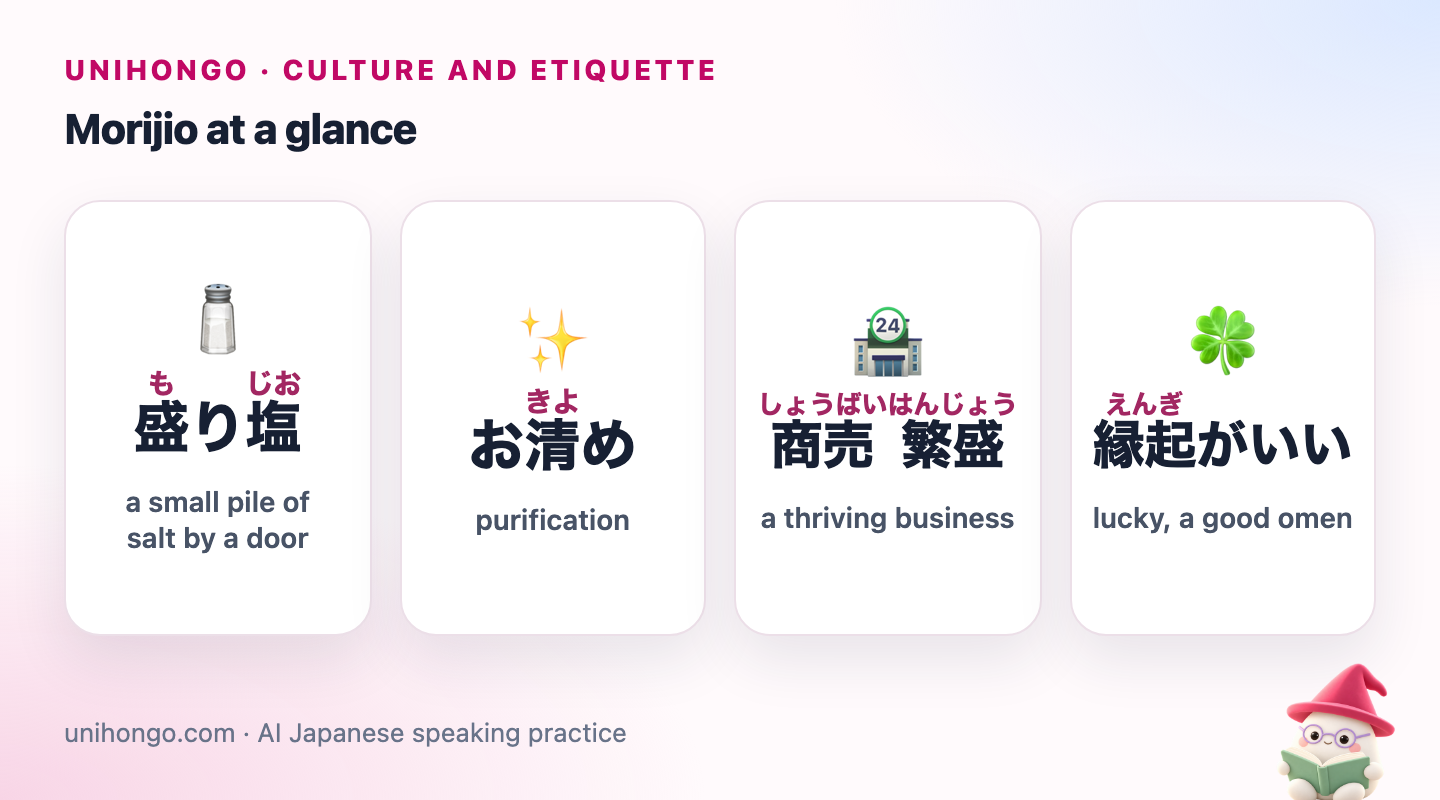
Ask Japanese people what it is for and you will hear two answers, often together. One is purification, keeping bad things away from the threshold. The other is engi, good luck, especially shōbai hanjō, a thriving business with plenty of customers.
| Japanese | Romaji | Meaning |
|---|---|---|
| 盛り塩 | morijio | a small pile of salt by a door |
| お清め | okiyome | purification |
| 商売繁盛 | shōbai hanjō | a thriving business |
| 縁起がいい | engi ga ii | lucky, a good omen |
| 入り口に盛り塩がある。 | Iriguchi ni morijio ga aru. | There's a salt pile at the entrance. (casual) |
The ox cart story and other origins
The story most often told is about an emperor in ancient China who had many consorts and rode around his palace in a cart pulled by an ox, visiting whoever's door the ox stopped at. One clever woman put salt outside her door. Oxen love salt, so the cart stopped there again and again, and her house prospered. The lesson is that salt at the door draws visitors, which is why it suits a business that wants customers.
Whether this story is the real origin is uncertain, and some people point instead, or as well, to the long use of salt for purification in Japan. Salt from the sea has been linked with cleansing for centuries: people purified themselves in the sea, and salt still appears in Shinto rituals and on household altars. Most people today do not think about history at all; they keep morijio because their parents did, or because it feels right.
| Japanese | Romaji | Meaning |
|---|---|---|
| 由来は諸説あります。 | Yurai wa shosetsu arimasu. | There are various theories about the origin. |
| 牛は塩が好きなんです。 | Ushi wa shio ga suki na n desu. | Oxen love salt, you see. |
| お客さんが来るように。 | Okyakusan ga kuru yō ni. | So that customers will come. |
| 昔からの習慣です。 | Mukashi kara no shūkan desu. | It's a custom from long ago. |
How morijio is made and looked after
The classic shape is a cone or a pyramid with sharp edges. Many people press slightly damp salt into a small mould, called a morijioki, and turn it out onto the dish, like a tiny sandcastle. Others shape it by hand. Natural sea salt is popular, but any salt works.
Practices vary, but many shops replace the salt regularly, often every morning, on the first of the month or whenever it gets damp, dirty or knocked over. Old salt is usually thrown away rather than eaten, since it has been sitting outside to absorb whatever it was meant to keep away.
| Japanese | Romaji | Meaning |
|---|---|---|
| 塩を盛る | shio o moru | to heap up salt |
| 小皿 | kozara | small dish |
| 盛り塩の型 | morijio no kata | a mould for salt piles |
| 毎朝、塩を取り替えます。 | Maiasa, shio o torikaemasu. | We change the salt every morning. |
| 崩れたら新しくします。 | Kuzuretara atarashiku shimasu. | If it collapses, we make a new one. |
Salt that purifies: sumo, funerals and dramas
Morijio is one small part of a bigger idea: salt cleanses. Sumo wrestlers throw a handful of salt into the ring before a bout to purify it, a gesture so famous that shio o maku, to scatter salt, instantly calls sumo to mind. After a funeral, many mourners are handed a small packet of kiyome jio, purifying salt, and some sprinkle a little on their chest, back and feet before they step into their house. Some Buddhist schools discourage this, so it depends on the family.
There is also a dramatic use you will see in television dramas: after an unwelcome visitor leaves, someone throws salt at the door and shouts shio maite oke! (go and throw salt!). It means good riddance, and it is a strong, emotional gesture, not something to copy at a friend's home.
| Japanese | Romaji | Meaning |
|---|---|---|
| 塩をまく | shio o maku | to scatter salt |
| 清め塩 | kiyome jio | purifying salt |
| 塩まいとけ! | Shio maitoke! | Throw salt! (good riddance, rough) |
| Where | What happens | Meaning |
|---|---|---|
| Shop or restaurant door | A small cone of salt on a dish | Purification and luck for business |
| Sumo ring | Wrestlers scatter salt before a bout | Purifying the ring |
| After a funeral | A packet of salt sprinkled on oneself | Purification, depending on the family |
| TV dramas | Salt thrown after a rude visitor | Good riddance (strong, emotional) |
Salt in everyday Japanese
Salt also gives Japanese some lively expressions. Shio taiō, a salty response, is modern slang for treating someone coldly or giving a curt, unfriendly reply; its opposite is kami taiō, a godlike response, meaning amazingly kind service. Teshio ni kakeru, to put salt on with your own hands, means to raise or care for something yourself, such as children or a project. Shio kagen is the amount of salt in a dish, and by extension the right balance.
| Japanese | Romaji | Meaning |
|---|---|---|
| 塩対応 | shio taiō | a cold, curt response (slang) |
| 神対応 | kami taiō | amazingly kind service (slang) |
| 手塩にかけて育てた。 | Teshio ni kakete sodateta. | I raised it with loving care. |
| 塩加減がちょうどいい。 | Shio kagen ga chōdo ii. | The saltiness is just right. |
| あの店員さん、塩対応だった。 | Ano ten'in san, shio taiō datta. | That clerk was really cold. (casual) |
What to do as a visitor
Treat morijio like any small object that belongs to the shop: give it space. Keep suitcases, bags and umbrellas away from the doorway corners, and watch children who might poke it. If you do knock one over, tell the staff and apologise at once; they will simply make a new one, and an honest apology matters more than the salt.
If you are curious, it is fine to ask. Shop owners are often pleased that a visitor noticed and are happy to explain what it means to them. Ask politely, at a quiet moment rather than at the busy lunchtime rush.

| Japanese | Romaji | Meaning |
|---|---|---|
| すみません、ちょっと伺ってもいいですか。 | Sumimasen, chotto ukagatte mo ii desu ka. | Excuse me, may I ask you something? |
| これにはどういう意味があるんですか。 | Kore ni wa dō iu imi ga aru n desu ka. | What does this mean? |
| すみません、盛り塩を崩してしまいました。 | Sumimasen, morijio o kuzushite shimaimashita. | I'm so sorry, I knocked over your salt pile. |
| 写真を撮ってもいいですか。 | Shashin o totte mo ii desu ka. | May I take a photo? |
Mini dialogue: asking at a little restaurant
| Japanese | Romaji | Meaning |
|---|---|---|
| すみません、入り口の塩は何ですか。 | Sumimasen, iriguchi no shio wa nan desu ka. | You: Excuse me, what is the salt at the entrance? |
| ああ、盛り塩ですよ。お清めと、商売繁盛のおまじないです。 | Ā, morijio desu yo. Okiyome to, shōbai hanjō no omajinai desu. | Owner: Oh, that's morijio. It's for purification and a charm for good business. |
| へえ、毎日作るんですか。 | Hē, mainichi tsukuru n desu ka. | You: Really? Do you make it every day? |
| ええ、毎朝お店を開ける前に。 | Ē, maiasa omise o akeru mae ni. | Owner: Yes, every morning before I open. |
| 知りませんでした。教えてくださって、ありがとうございます。 | Shirimasen deshita. Oshiete kudasatte, arigatō gozaimasu. | You: I didn't know that. Thank you for telling me. |
Common learner mistakes
- Being thrown by the reading. You will hear both morijio and morishio; morijio is very common, and either is understood.
- Thinking the salt is for customers to use, or a seasoning display. It is not for eating.
- Calling it a superstition to the owner's face. Saying it is an interesting custom is kinder and just as true.
- Saying shio o maku about your own visit to someone. It sounds like you are describing them chasing you away.
- Using shio taiō in a polite complaint. It is slang; in a formal setting say taiō ga tsumetakatta desu.
A five-minute Mocchi session on salt and luck
- Type /kanji 塩 and then /kanji 盛 to see readings and everyday words, and notice how shio turns into jio in compounds.
- Ask Mocchi to quiz you on shio taiō, kami taiō, teshio ni kakeru and engi ga ii. Mocchi keeps track of the ones you mix up and brings them back in your next /review.
- Write your own two-sentence explanation of morijio and send it with /correct; Mocchi fixes the grammar and explains each change.
- Finish with a round of Sentence Builder, putting the chunks of the dialogue lines in the right order.