

Tanoshimi: the everyday way to say you're excited
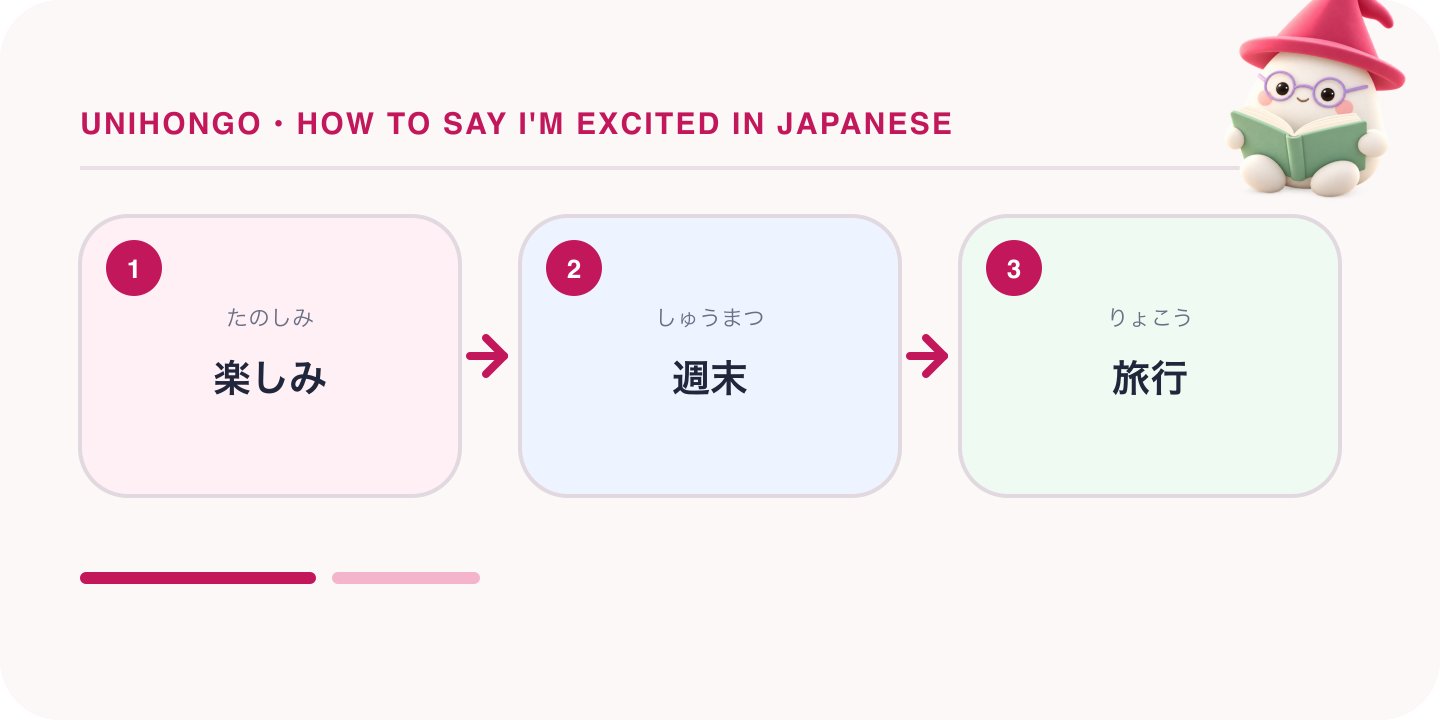
楽しみ (tanoshimi) means something you look forward to, and it is how most Japanese speakers express excitement about a future event. Tanoshimi! alone means "I can't wait!" or "I'm so excited!". Add the event with ga: ryokō ga tanoshimi, I'm excited about the trip.
In polite speech, say tanoshimi desu. 楽しみにしています (tanoshimi ni shite imasu) means "I'm looking forward to it" and is the standard phrase for plans with teachers, acquaintances and colleagues. Its humble version, tanoshimi ni shite orimasu, suits emails and clients.
| Japanese | Romaji | Meaning |
|---|---|---|
| 楽しみ! | Tanoshimi! | I can't wait! |
| 週末の旅行がすごく楽しみ。 | Shūmatsu no ryokō ga sugoku tanoshimi. | I'm really excited about the weekend trip. |
| 楽しみです。 | Tanoshimi desu. | I'm looking forward to it. |
| お会いできるのを楽しみにしています。 | O-ai dekiru no o tanoshimi ni shite imasu. | I'm looking forward to meeting you. |
| 来週のイベント、楽しみにしてるね。 | Raishū no ibento, tanoshimi ni shiteru ne. | Looking forward to next week's event. |
| 楽しみにしております。 | Tanoshimi ni shite orimasu. | I am looking forward to it. (humble) |
Wakuwaku suru: that bubbling, can't-wait feeling
わくわく (wakuwaku) is onomatopoeia for eager, happy excitement, the feeling of a child the night before a school trip. Wakuwaku suru means "I'm excited", and wakuwaku shite kita means "I'm starting to get excited". It is bright and friendly, and works with friends and in light polite speech.
Wakuwaku can describe things as well as people. Wakuwaku suru eiga is an exciting film, and a new project can be wakuwaku suru too. It always carries a positive, anticipating feel.
| Japanese | Romaji | Meaning |
|---|---|---|
| わくわくする! | Wakuwaku suru! | I'm so excited! |
| だんだんわくわくしてきた。 | Dandan wakuwaku shite kita. | I'm getting more and more excited. |
| 明日のことを考えるとわくわくします。 | Ashita no koto o kangaeru to wakuwaku shimasu. | Thinking about tomorrow makes me excited. |
| わくわくする新しいプロジェクトです。 | Wakuwaku suru atarashii purojekuto desu. | It's an exciting new project. |
| わくわくして眠れない。 | Wakuwaku shite nemurenai. | I'm too excited to sleep. |
Tension ga agaru and moriagaru: energy and atmosphere
テンションが上がる (tenshon ga agaru) uses the English loanword tension, but in Japanese it means your energy or mood, not stress. Tenshon ga agaru means your spirits lift and you get hyped up; tenshon takai describes someone who is very energetic. It is casual and very common among younger speakers.
盛り上がる (moriagaru) means to liven up, and usually describes a group, a party, a conversation or a crowd rather than one person. Kinō no nomikai, moriagatta ne means "last night's drinks were a blast". Moriageru, the transitive form, means to liven something up yourself.
| Japanese | Romaji | Meaning |
|---|---|---|
| テンション上がる! | Tenshon agaru! | I'm so hyped! |
| 雪を見てテンションが上がった。 | Yuki o mite tenshon ga agatta. | Seeing the snow got me excited. |
| 今日はテンション高いね。 | Kyō wa tenshon takai ne. | You're full of energy today. |
| 昨日の飲み会、盛り上がったね。 | Kinō no nomikai, moriagatta ne. | Last night's drinks were lively. |
| 会場がすごく盛り上がっています。 | Kaijō ga sugoku moriagatte imasu. | The venue is buzzing. |
| みんなで盛り上げよう! | Minna de moriageyō! | Let's liven things up together! |
Kōfun suru and its nuance trap
興奮する (kōfun suru) is the word dictionaries give for excited, and it means being worked up, stirred or stimulated. It is natural after a thrilling moment: a last-minute goal, a great concert, a close finish. Shiai, sugoi kōfun shita! is fine.
The trap is using kōfun for plans or everyday enthusiasm. Ryokō ni kōfun shite imasu, "I'm excited about the trip", sounds overwrought at best, and because kōfun also covers physical and sexual arousal, a bare kōfun shite imasu can make listeners smile or feel awkward. It can also describe being agitated or angry: kōfun shinaide, calm down. For anticipation, use tanoshimi or wakuwaku.
| Situation | Natural | Avoid |
|---|---|---|
| Trip next week | 楽しみ / わくわくする | 興奮している |
| Watching a close match | 興奮した / 盛り上がった | 楽しみ |
| Meeting a client next week | 楽しみにしております | わくわくします |
| Party atmosphere | 盛り上がっている | 興奮している |
| Someone angry or agitated | 興奮している / 落ち着いて | わくわくしている |
Excited or nervous: dokidoki and kinchō
English "excited" sometimes includes nerves, as in excited about a first date. Japanese separates these. ドキドキ (dokidoki) is the sound of a pounding heart, and fits nerves, fear, suspense or romantic excitement. 緊張する (kinchō suru) means to be nervous or tense, as before an exam or a speech.
You can combine the feelings: dokidoki to wakuwaku ga majitte iru, a mix of nerves and excitement. For a date or a confession, dokidoki is the classic word. Our guide to saying you are scared covers the more fearful side.
| Japanese | Romaji | Meaning |
|---|---|---|
| ドキドキする。 | Dokidoki suru. | My heart is pounding. |
| 面接の前で緊張しています。 | Mensetsu no mae de kinchō shite imasu. | I'm nervous before the interview. |
| 初デートでドキドキした。 | Hatsu dēto de dokidoki shita. | My heart was racing on the first date. |
| 緊張するけど、楽しみでもある。 | Kinchō suru kedo, tanoshimi de mo aru. | I'm nervous, but I'm excited too. |
| ハラハラする試合だった。 | Harahara suru shiai datta. | It was a nail-biting match. |
Saying it at work and in business
In a professional setting, excitement is usually expressed as looking forward to something, and wakuwaku or tenshon would sound too casual with clients. Tanoshimi ni shite orimasu and 期待しています (kitai shite imasu), "I have high hopes", are the standard options.
Kitai shite imasu is also what a manager might say to you: kitai shite iru yo, we're counting on you. Replying with kitai ni kotaerareru yō ganbarimasu, "I'll work hard to live up to it", is the classic response.
| Japanese | Romaji | Meaning |
|---|---|---|
| 来週の打ち合わせを楽しみにしております。 | Raishū no uchiawase o tanoshimi ni shite orimasu. | I look forward to next week's meeting. |
| 新しいプロジェクトに期待しています。 | Atarashii purojekuto ni kitai shite imasu. | I have high hopes for the new project. |
| ご一緒できるのを楽しみにしています。 | Go-issho dekiru no o tanoshimi ni shite imasu. | I'm looking forward to working with you. |
| 期待に応えられるよう頑張ります。 | Kitai ni kotaerareru yō ganbarimasu. | I'll do my best to meet your expectations. |
What people say back, and tone
When someone tells you they are excited, share it. Watashi mo tanoshimi!, I'm excited too, or ii ne!, sounds great, keeps the energy up. If it is their event, such as a trip, ask about it: doko ni iku no? Where are you going?
Tone is part of the meaning. Tanoshimi! with a rising, bright voice and a smile sounds genuinely excited; the same word said flatly can sound polite but lukewarm. Japanese speakers, especially in formal settings, often show excitement more quietly than English speakers, with a smile and a slightly faster pace rather than loud exclamations. Jumping or shouting is fine at a concert or festival, less so in an office.
| Japanese | Romaji | Meaning |
|---|---|---|
| 私も楽しみ! | Watashi mo tanoshimi! | I'm excited too! |
| いいね! | Ii ne! | Sounds great! |
| 楽しんできてね。 | Tanoshinde kite ne. | Have a great time. |
| 楽しみですね。 | Tanoshimi desu ne. | That's something to look forward to. (polite) |
| どうだったか、また教えてね。 | Dō datta ka, mata oshiete ne. | Tell me how it went. |
Common mistakes
- Using kōfun shite imasu for plans. Say tanoshimi desu or wakuwaku shimasu.
- Using tanoshii for the future. Tanoshii is fun now; tanoshimi is looking forward.
- Saying tenshon ga agaru to a client. It is casual; use tanoshimi ni shite orimasu.
- Using moriagaru about yourself alone. It usually describes a group or atmosphere.
- Using dokidoki for happy anticipation. Dokidoki is a racing heart, often nerves; use wakuwaku.
- Reading tension as stress. In Japanese, tenshon means mood or energy.