
A snowy commute in four lines
These are the lines you will say or hear on any snowy morning. The first goes to your workplace, the second comes over the station speakers, the third describes the pavement and the fourth describes what your neighbours are doing outside.
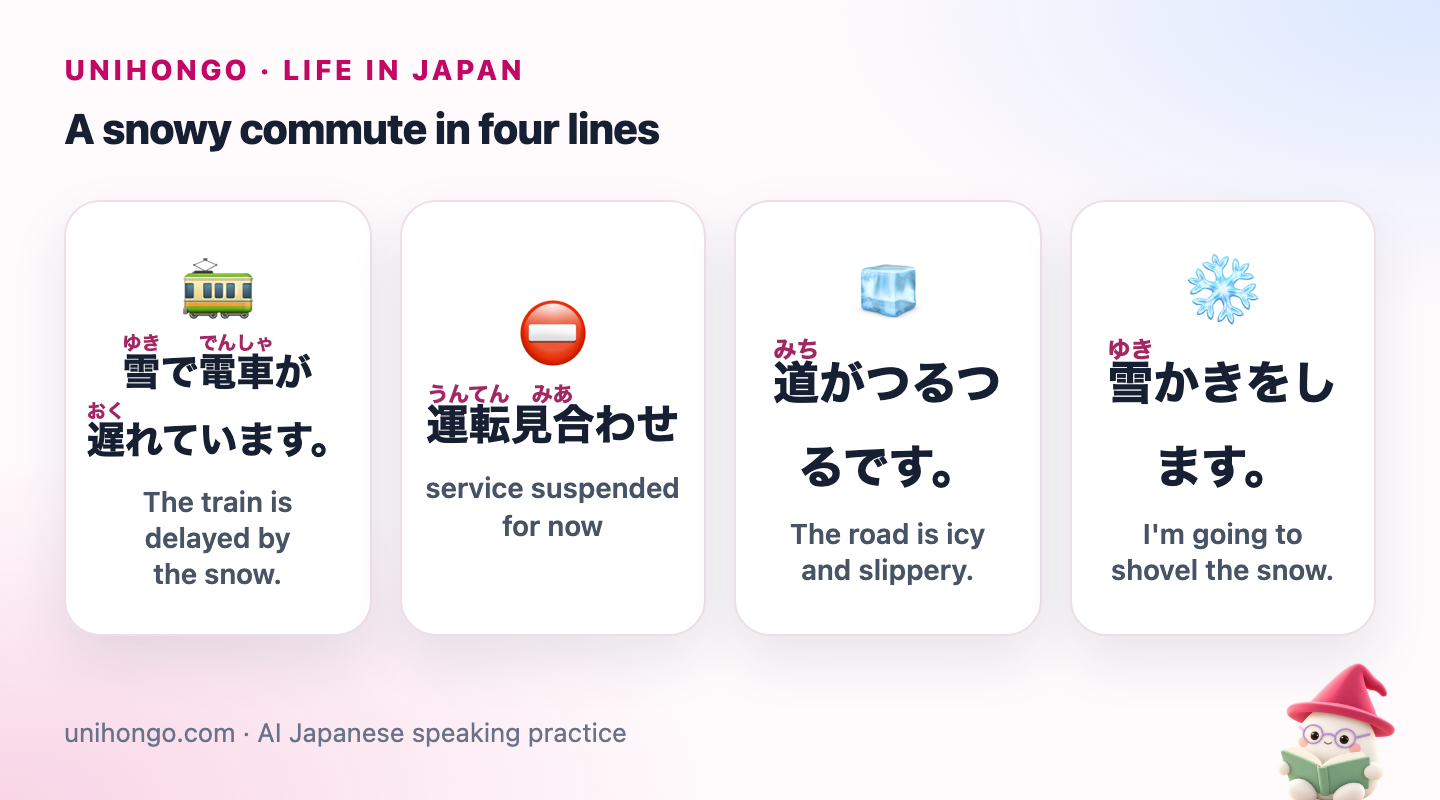
| Japanese | Romaji | Meaning |
|---|---|---|
| 雪で電車が遅れています。 | Yuki de densha ga okurete imasu. | The train is delayed by the snow. |
| 運転見合わせ | unten miawase | service suspended for now |
| 道がつるつるです。 | Michi ga tsurutsuru desu. | The road is icy and slippery. |
| 雪かきをします。 | Yukikaki o shimasu. | I'm going to shovel the snow. |
Announcement vocabulary: what the speakers are saying
Station and train announcements use very polite, fixed language, with orimasu instead of imasu and ~ te orimasu everywhere. You do not need to understand every word: catch the line name, the cause (eikyō de, because of) and the status word. On heavy-snow days, railway companies also post updates on their websites and apps, and announcements on the platform are often repeated in English on major lines, but local lines may only announce in Japanese.
| Japanese | Romaji | Meaning |
|---|---|---|
| ただいま、大雪の影響で運転を見合わせております。 | Tadaima, ōyuki no eikyō de unten o miawasete orimasu. | Announcement: Service is currently suspended due to heavy snow. |
| 運転再開は未定です。 | Unten saikai wa mitei desu. | Announcement: The restart time is not yet decided. |
| お急ぎのところ、ご迷惑をおかけしております。 | Oisogi no tokoro, gomeiwaku o okake shite orimasu. | Announcement: We apologise for the inconvenience. |
| 振替輸送を実施しております。 | Furikae yusō o jisshi shite orimasu. | Announcement: Alternative transport is available on other lines. |
| Word | Meaning | What to do |
|---|---|---|
| 遅延 chien | Delay | Expect late trains; message work |
| 運転見合わせ unten miawase | Service suspended for now | Wait, or look for another route |
| 運休 unkyū | Specific trains cancelled | Check which trains still run |
| 間引き運転 mabiki unten | Reduced service, fewer trains | Expect crowding and longer waits |
| 振替輸送 furikae yusō | Your ticket is valid on another line or bus | Ask staff which routes accept it |
| 計画運休 keikaku unkyū | Planned suspension announced in advance | Change plans the night before |
Asking station staff what is happening
Station staff in winter are busy and patient. Short, polite questions work best. Start with sumimasen and get straight to the point. If you need a delay certificate, it may be handed out at the ticket gates or available on the railway company's website.
| Japanese | Romaji | Meaning |
|---|---|---|
| すみません、いつごろ再開しますか。 | Sumimasen, itsu goro saikai shimasu ka. | Excuse me, when will it restart, roughly? |
| ほかの行き方はありますか。 | Hoka no ikikata wa arimasu ka. | Is there another way to get there? |
| 振替輸送は使えますか。 | Furikae yusō wa tsukaemasu ka. | Can I use alternative transport with this ticket? |
| 遅延証明書はどこでもらえますか。 | Chien shōmeisho wa doko de moraemasu ka. | Where can I get a delay certificate? |
| この電車は渋谷に止まりますか。 | Kono densha wa Shibuya ni tomarimasu ka. | Does this train stop at Shibuya? |
Messaging work about a delay
Japanese workplaces expect you to report a delay as soon as you know, even if it is not your fault. A good message has three parts: the reason, your expected arrival time, and an apology. In the mornings many teams use chat apps, but for a manager or a client, the polite form below is safe. Tōchaku (到着) is arrival; shukkin (出勤) is coming in to work.
| Japanese | Romaji | Meaning |
|---|---|---|
| 雪の影響で電車が遅れており、到着が三十分ほど遅れます。 | Yuki no eikyō de densha ga okurete ori, tōchaku ga sanjuppun hodo okuremasu. | The train is delayed by the snow, so I'll arrive about 30 minutes late. |
| 申し訳ありません。 | Mōshiwake arimasen. | I'm very sorry. (polite) |
| 運転再開の見込みが立っていません。 | Unten saikai no mikomi ga tatte imasen. | There is no estimate yet for the restart. |
| 本日は在宅勤務にしてもよろしいでしょうか。 | Honjitsu wa zaitaku kinmu ni shite mo yoroshii deshō ka. | Would it be all right for me to work from home today? |
| 遅延証明書をもらいました。 | Chien shōmeisho o moraimashita. | I got a delay certificate. |
Okurete ori is the formal written version of okurete ite. In a spoken call, okurete ite is fine. Notice also hodo, about: it makes your estimate sound honest rather than like a promise.
Mini dialogue: calling your manager from the platform
When you phone instead of messaging, the call is short. Your manager will usually ask for your expected arrival time and whether you are safe. Here is how it sounds in polite office Japanese.
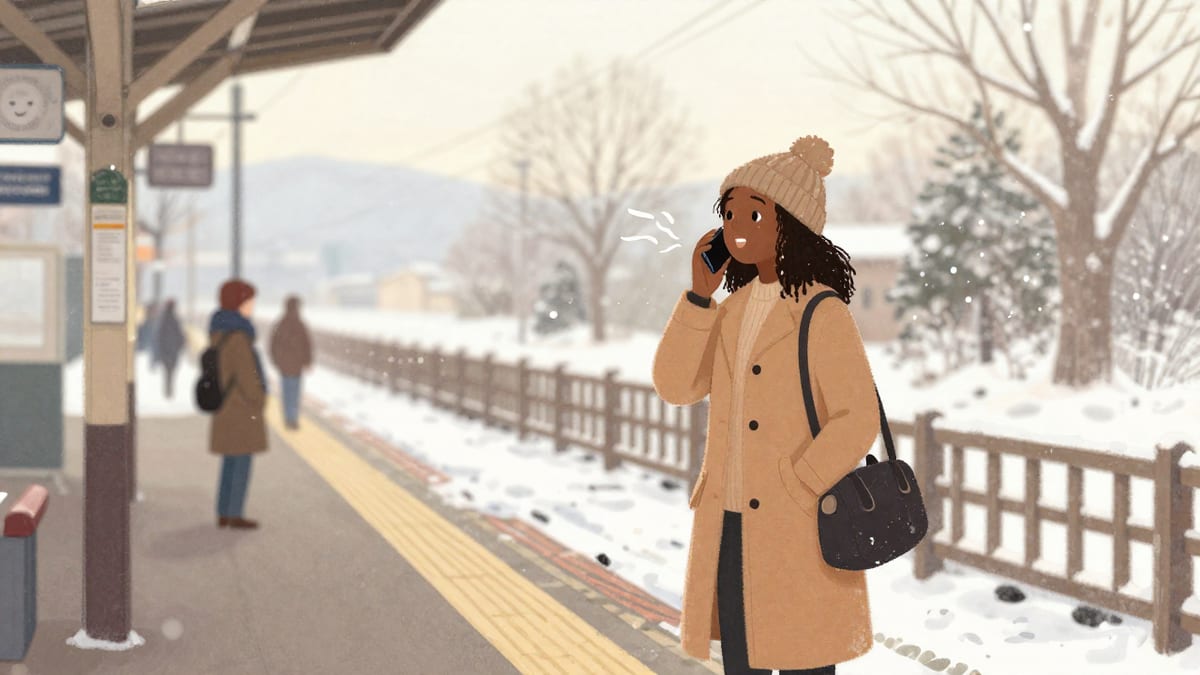
| Japanese | Romaji | Meaning |
|---|---|---|
| おはようございます。マリアです。 | Ohayō gozaimasu. Maria desu. | You: Good morning. It's Maria. |
| 実は、雪で電車が止まっていまして。 | Jitsu wa, yuki de densha ga tomatte imashite. | You: Actually, the trains have stopped because of the snow. |
| そうですか。何時ごろになりそうですか。 | Sō desu ka. Nanji goro ni narisō desu ka. | Manager: I see. Around what time do you think you'll arrive? |
| 十時ごろになると思います。申し訳ありません。 | Jūji goro ni naru to omoimasu. Mōshiwake arimasen. | You: Around ten, I think. I'm very sorry. |
| 気をつけて来てください。 | Ki o tsukete kite kudasai. | Manager: Come carefully. |
Icy roads, snow tyres and shovelling
Packed snow turns to ice overnight, and pavements become tsurutsuru (つるつる), the onomatopoeia for slick and slippery. In snowy regions people take small steps with their weight forward, and some shops sell clip-on spikes for shoes. Romen tōketsu (路面凍結) is the weather warning for icy roads.
Drivers in snowy regions fit studless tyres from late autumn. Residents usually shovel the snow in front of their own homes, and in some neighbourhoods people help each other clear shared paths; ask your neighbours how it works where you live. In heavy-snow areas, snow ploughs, josetsusha (除雪車), clear the roads early in the morning.
| Japanese | Romaji | Meaning |
|---|---|---|
| 足元に気をつけてください。 | Ashimoto ni ki o tsukete kudasai. | Watch your step. |
| 転びそうになりました。 | Korobisō ni narimashita. | I almost fell over. |
| もうスタッドレスに替えましたか。 | Mō sutaddoresu ni kaemashita ka. | Have you switched to winter tyres yet? |
| 雪かき、手伝いましょうか。 | Yukikaki, tetsudaimashō ka. | Shall I help with the shovelling? |
| 今夜は路面が凍結しそうです。 | Kon'ya wa romen ga tōketsu shisō desu. | The roads look likely to freeze tonight. |
Snow-day small talk at work
When you finally arrive, the snow is the topic of the morning. Coworkers swap stories about their commute, compare how long it took, and remind each other to leave early. It is an easy, friendly moment to join the conversation, and the language is simple. Taihen deshita ne, that must have been rough, is the all-purpose sympathetic reply.
In the afternoon, managers may tell staff to go home early if more snow is forecast. Listen for hayame ni kaette kudasai, please head home early, and kitaku konnan, difficulty getting home, a phrase that appears in the news on heavy-snow days.
| Japanese | Romaji | Meaning |
|---|---|---|
| 今朝は大変でしたね。 | Kesa wa taihen deshita ne. | This morning was rough, wasn't it? |
| 駅まで歩くのに三十分かかりました。 | Eki made aruku no ni sanjuppun kakarimashita. | It took me 30 minutes just to walk to the station. |
| 電車がぎゅうぎゅうでした。 | Densha ga gyūgyū deshita. | The train was packed. |
| 今日は早めに帰ってください。 | Kyō wa hayame ni kaette kudasai. | Manager: Please head home early today. |
| 明日も降るみたいですよ。 | Ashita mo furu mitai desu yo. | It looks like it'll snow tomorrow too. |
Common learner mistakes
- Saying densha wa osoi desu for a delay. Osoi means slow; for a late train say densha ga okurete imasu.
- Messaging work only after you arrive. Report the delay as soon as you know.
- Promising an exact time. Add goro or hodo, about, because the trains may change again.
- Confusing unkyū and unten miawase. Unkyū is specific trains cancelled; unten miawase is the whole line stopped for now.
- Walking normally on tsurutsuru pavement. Slow down, take small steps and hold the handrail on station stairs.