
Yakiimo in four lines
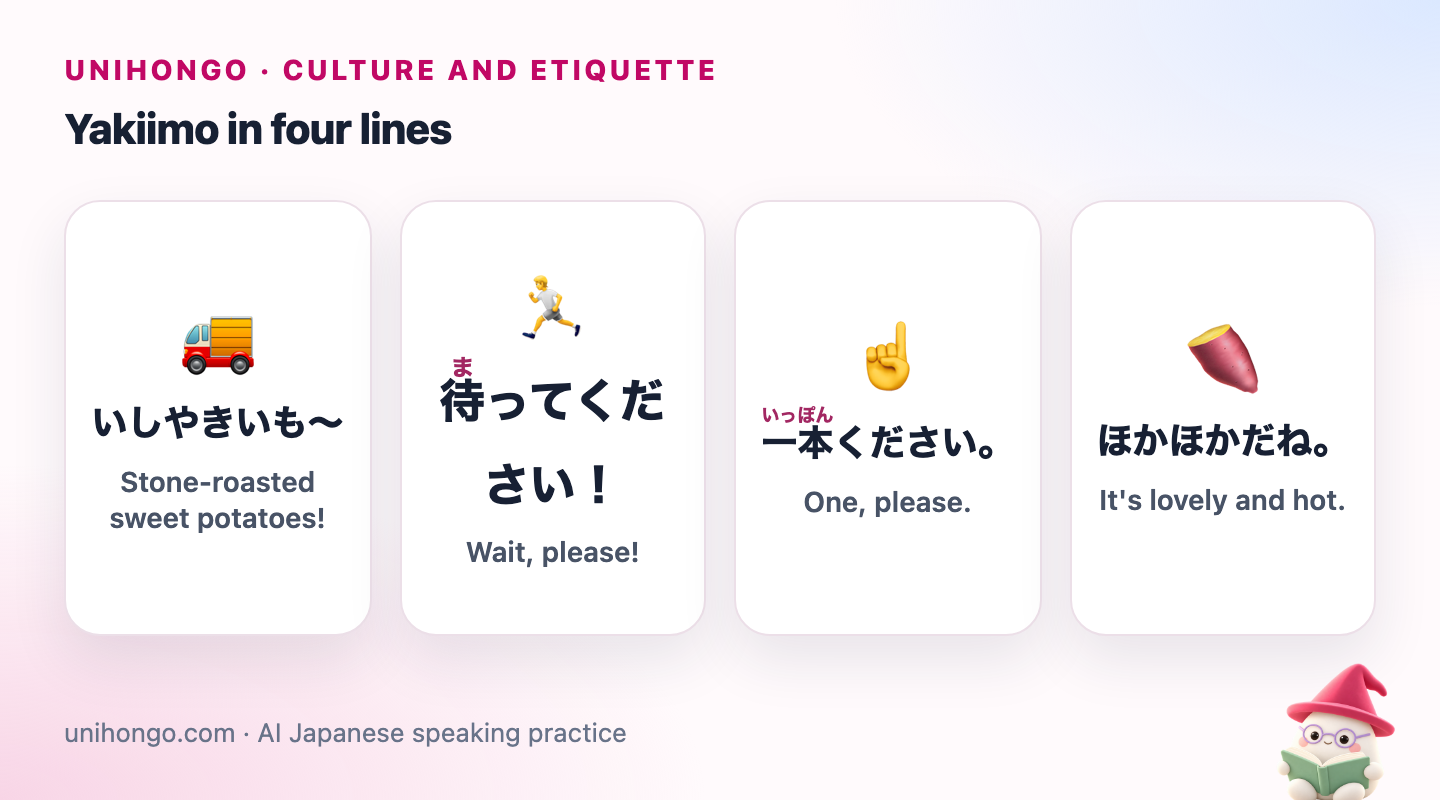
Four lines tell the whole story of buying from the truck: the call you hear from the street, the shout as you run after it, the request, and the word for the hot potato in your hands. Hokahoka, the last one, is a sound-symbolic word for food or a body that is pleasantly, steamingly warm. Vendors and parents both use it.
| Japanese | Romaji | Meaning |
|---|---|---|
| いしやきいも〜 | Ishiyakiimo | Stone-roasted sweet potatoes! |
| 待ってください! | Matte kudasai! | Wait, please! |
| 一本ください。 | Ippon kudasai. | One, please. |
| ほかほかだね。 | Hokahoka da ne. | It's lovely and hot. |
What yakiimo is, and why stones
The potato is satsumaimo (さつまいも), the Japanese sweet potato, with purple-red skin and pale yellow flesh. Yakiimo simply means roasted potato, and ishiyakiimo (石焼き芋) is the version roasted on hot pebbles. The stones spread the heat gently and evenly, so the potato cooks slowly. Slow cooking gives the potato's own enzymes time to turn starch into sugar, which is why a good yakiimo tastes almost like a dessert with nothing added.
Yakiimo is eaten as it is, often standing in the street, by peeling back the skin. Some people eat the skin too. It is a snack of autumn and winter, when the new crop has been stored for a while and has become sweeter.
| Japanese | Romaji | Meaning |
|---|---|---|
| さつまいも | satsumaimo | Japanese sweet potato |
| 焼き芋 | yakiimo | roasted sweet potato |
| 石焼き芋 | ishiyakiimo | sweet potato roasted on hot stones |
| 皮ごと食べる | kawa goto taberu | to eat it skin and all |
| 甘い! | Amai! | So sweet! |
The truck and its call
The classic yakiimo seller drives a small pickup truck with a wood-fired or gas-fired stone oven on the back, often with a little chimney. The truck moves at walking pace through residential streets in the late afternoon and evening, playing its call over a loudspeaker so people have time to come out. The call is slow and sung, with long vowels: ishi-yaaaki-imo, oimo. Some vendors add a line about the potatoes being hot or sweet. Each vendor has their own version.
Trucks are less common than they once were, and many people now meet the call as a nostalgic sound. If you hear one, it is worth going out: it is a small, very local winter experience.
| Japanese | Romaji | Meaning |
|---|---|---|
| 焼き芋屋さん | yakiimoya san | the sweet potato seller |
| 焼き芋屋さんが来た! | Yakiimoya san ga kita! | The sweet potato man is here! |
| ほかほかのおいもだよ。 | Hokahoka no oimo da yo. | Vendor's call: Lovely hot potatoes! |
| あ、行っちゃう! | A, itchau! | Oh, it's leaving! |
| すみません!一つください! | Sumimasen! Hitotsu kudasai! | Excuse me! One, please! |
Buying one: size, price and what the vendor says
Pricing varies. Some vendors sell by size, small, medium and large, and some weigh the potato and price it by weight. Asking is normal, so do not be shy about ikura desu ka. The vendor usually picks a potato from the oven with tongs, wraps it in paper or puts it in a paper bag, and warns you that it is hot. Occasionally a friendly vendor adds a small extra potato, omake, especially near closing time.
If you are buying for a group, say how many and the sizes in one sentence, and the vendor will help you choose.
| Japanese | Romaji | Meaning |
|---|---|---|
| いくらですか。 | Ikura desu ka. | How much is it? |
| 小さいのを一つください。 | Chiisai no o hitotsu kudasai. | A small one, please. |
| 大きいのと小さいの、一本ずつください。 | Ōkii no to chiisai no, ippon zutsu kudasai. | One large and one small, please. |
| 量り売りですか。 | Hakariuri desu ka. | Is it priced by weight? |
| 熱いから気をつけてね。 | Atsui kara ki o tsukete ne. | Vendor: It's hot, so be careful. |
| おまけしとくよ。 | Omake shitoku yo. | Vendor: I'll throw in a little extra. |
Mini dialogue: at the truck on a cold evening
Here is the whole purchase, from the moment the truck pulls over. The vendor speaks in a casual, friendly style, which is normal for street sellers; you can answer politely. Notice how short each line is. Nobody expects a long conversation in the cold.

| Japanese | Romaji | Meaning |
|---|---|---|
| はい、いらっしゃい。 | Hai, irasshai. | Vendor: Hello there, welcome. |
| 焼き芋、二つください。 | Yakiimo, futatsu kudasai. | You: Two sweet potatoes, please. |
| 大きさはどうする? | Ōkisa wa dō suru? | Vendor: What size would you like? |
| 中くらいのをお願いします。 | Chūkurai no o onegai shimasu. | You: Medium ones, please. |
| はい、熱いよ。今日のは甘いよ。 | Hai, atsui yo. Kyō no wa amai yo. | Vendor: Here you go, they're hot. Today's are sweet. |
| ありがとうございます。いい匂い! | Arigatō gozaimasu. Ii nioi! | You: Thank you. It smells wonderful! |
Hokuhoku, nettori and the varieties on the label
Japanese has precise words for the texture of a sweet potato, and people have strong preferences. Hokuhoku is the traditional fluffy, floury texture that breaks apart. Nettori is dense, moist and sticky, almost like custard, and very sweet. Shittori sits between them: moist but not sticky. Supermarket labels and shop signs often use these words, so they are worth knowing.
You will also see variety names. Beni haruka and An'noimo are widely known for a sweet, moist result, and silk sweet for a smooth one, while some older varieties give the classic fluffy texture. Availability depends on the region and the season.
| Japanese | Romaji | Meaning |
|---|---|---|
| ほくほく | hokuhoku | fluffy and floury |
| ねっとり | nettori | dense, moist and sticky |
| しっとり | shittori | moist and smooth |
| ねっとりしたのが好きです。 | Nettori shita no ga suki desu. | I like the moist, sticky kind. |
| どれが一番甘いですか。 | Dore ga ichiban amai desu ka. | Which one is the sweetest? |
| 紅はるか | beni haruka | Beni Haruka (a sweet variety) |
Yakiimo beyond the truck
If no truck passes your street, you can still find yakiimo. Many supermarkets keep a heated case of potatoes near the entrance or the vegetable section in the colder months, sold individually in paper bags, and some convenience stores do the same. Specialist yakiimo shops and autumn festivals sell it too, sometimes with butter or as desserts.
At home, people bake sweet potatoes slowly in an oven or a toaster oven, wrapped in foil. An old image of yakiimo is roasting potatoes in a bonfire of fallen leaves, ochiba-taki, but open fires are restricted in many areas today, so this is mostly a memory or a supervised community event. In recent years, chilled yakiimo has also become a popular summer snack in some shops.
| Japanese | Romaji | Meaning |
|---|---|---|
| スーパーで焼き芋を売ってるよ。 | Sūpā de yakiimo o utteru yo. | They sell yakiimo at the supermarket. |
| オーブンでゆっくり焼くと甘くなる。 | Ōbun de yukkuri yaku to amaku naru. | Bake it slowly in the oven and it gets sweet. |
| 冷やし焼き芋 | hiyashi yakiimo | chilled roasted sweet potato |
Words that confuse learners
- Imo (芋) is not only sweet potato. It covers tubers in general: jagaimo is potato and satoimo is taro. Say satsumaimo when you need to be clear.
- Imoppoi or imo kusai is casual slang for unsophisticated or countrified, about clothes or style. It is teasing at best and rude at worst; do not say it about people you do not know well.
- Yakiimo has two i sounds in a row, yaki-imo. Saying yakimo with one i sounds like a different word. Hold the second i.
- Yaki means grilled or roasted, as in yakitori and yakisoba, but yakiimo is always the whole roasted sweet potato, not slices.
- Long things are counted with hon: ippon, nihon, sanbon. Hitotsu, futatsu also works and is easier when you are in a hurry.
Make a warm little word deck
- Ask Mocchi: /create-flashcards for the yakiimo words in this post, and pick a photo for each card, the truck, a steaming potato, a paper bag.
- Review them with /review-flashcards over the next few days. Mocchi brings back the ones you hesitate on, like hakariuri or nettori, sooner.
- Play Vocabulary Dash with your own flashcards to hear and grab the words at speed.
- Ask Mocchi for a short /quiz on hokuhoku, nettori and shittori. Mocchi remembers which texture word you mix up and brings it back in a later chat.