
Why the bins are a language problem
Most newcomers describe the same experience: the rules are not hard, but they arrive entirely in Japanese, all at once, in the first week. A leaflet appears in the postbox, a laminated notice hangs at the collection point, and the bag in the supermarket has four lines of small print on it. None of it is complicated language. It is a closed set of maybe forty words that repeat on every surface, which makes it one of the most efficient pieces of vocabulary you can learn early.
The second thing to understand is that there is no single national system. Rubbish collection is run locally, so the categories, the names given to them, the collection days, the bag requirement and the treatment of specific items are decided by your city, ward, town or village. A friend two train stops away may sort differently and be equally correct. Everything below is written to help you read your own local guide, not to replace it.
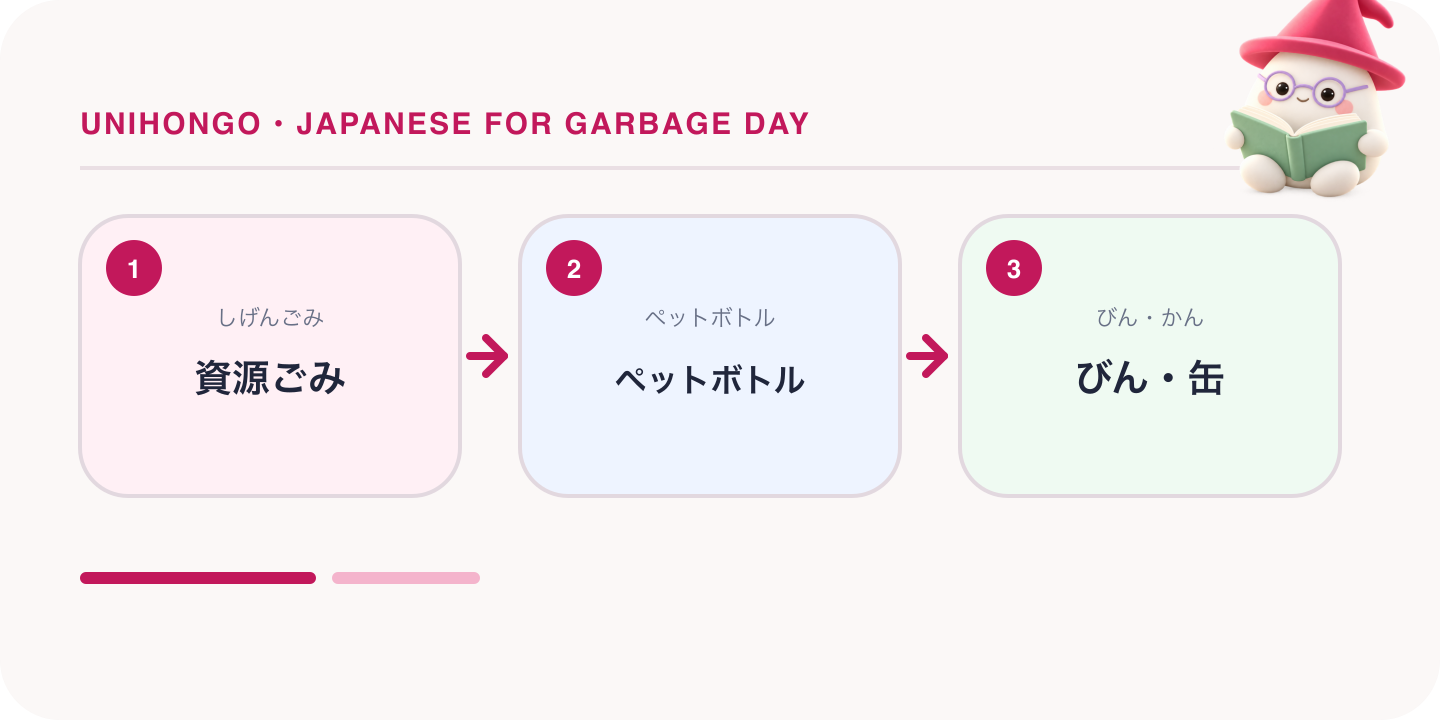
The category names you will see
| Category | Romaji | Typically includes |
|---|---|---|
| 燃えるごみ / 可燃ごみ | Moeru gomi / kanen gomi | Food waste, tissues, small soiled paper, often plastic in some areas |
| 燃えないごみ / 不燃ごみ | Moenai gomi / funen gomi | Small metal items, ceramics, broken glass, some small appliances |
| 資源ごみ | Shigen gomi | The umbrella term for recyclables, split further in most places |
| プラスチック製容器包装 | Purasuchikku-sei yōki hōsō | Plastic packaging: trays, wrappers, bottle caps and film |
| ペットボトル | Petto botoru | PET drink bottles, usually rinsed with cap and label removed |
| びん・缶 | Bin, kan | Glass bottles and metal cans, sometimes collected separately |
| 古紙 / 雑がみ | Koshi / zatsugami | Newspaper, cardboard, magazines, mixed clean paper |
| 電池 | Denchi | Batteries, often a separate small container at the collection point |
| 有害ごみ / 危険ごみ | Yūgai gomi / kiken gomi | Fluorescent tubes, lighters, spray cans, thermometers |
| 小型家電 | Kogata kaden | Small electronics, frequently a drop-off box rather than a collection |
| 粗大ごみ | Sodai gomi | Large items above a size threshold set locally, booked in advance |
Read this as a menu of names you may meet, not as your own list. Some municipalities burn plastic and put it in the burnable category, others collect it separately. Some merge glass and cans, others split them. Some use kanen and funen on the calendar while the bags say moeru and moenai. Match the words on the page to the words in your hand and you will be reading your local system rather than a generic one.
Reading the collection calendar
The calendar is usually a single sheet, colour coded by category, with the days of the week across the top and the months down the side. The two things you must find are the day of the week for each category and the deadline time in the morning. The deadline exists because trucks run early, and in many areas you are asked to put rubbish out on the morning of collection rather than the night before, partly because of crows and cats.
Look for 収集日 shūshū-bi for the collection day, 午前八時まで gozen hachi-ji made for a morning deadline, and 年末年始 nenmatsu nenshi for the changed schedule around the new-year period, when collection often pauses for several days. If you cannot read the sheet, most offices publish a version in other languages or an app; asking for one is a normal request.
| Japanese | Romaji | Meaning |
|---|---|---|
| 燃えるごみは何曜日ですか。 | Moeru gomi wa nan-yōbi desu ka. | Which day is burnable rubbish collected? |
| 火曜日と金曜日です。 | Kayōbi to kin'yōbi desu. | Tuesdays and Fridays. (their reply) |
| 何時までに出せばいいですか。 | Nan-ji made ni daseba ii desu ka. | By what time should I put it out? |
| 朝八時までにお願いします。 | Asa hachi-ji made ni onegai shimasu. | By eight in the morning, please. (their reply) |
| 前の日の夜に出してもいいですか。 | Mae no hi no yoru ni dashite mo ii desu ka. | Is it all right to put it out the night before? |
| いいえ、当日の朝に出してください。 | Iie, tōjitsu no asa ni dashite kudasai. | No, please put it out on the morning itself. (their reply) |
| ごみカレンダーはどこでもらえますか。 | Gomi karendā wa doko de moraemasu ka. | Where can I get a rubbish calendar? |
| 英語版もありますか。 | Eigo-ban mo arimasu ka. | Is there an English version as well? |
Note nan-yōbi for which day of the week, as opposed to nan-nichi for which date. The calendar answer is nearly always a weekday, and a follow-up question about the deadline time is the single most useful thing you can ask, because it is the rule people most often break by accident.
The designated bag question
Whether you need a specific bag is one of the clearest differences between municipalities. Some require an official designated bag, often printed with the city name and the category, sold at supermarkets and convenience stores in the area. Others simply ask for a transparent or semi-transparent bag so that the crew can see the contents. A few apply the designated bag to some categories only. Because this varies so much, buying a large pack before you have checked is a common and expensive mistake when you move.
The word to look for is 指定袋 shitei-bukuro, a designated bag. You may also see a request to write your name or apartment number on the bag, which some blocks use and many do not. Follow whatever the notice at your own collection point says, and if two sources disagree, the municipality's guide wins.
| Japanese | Romaji | Meaning |
|---|---|---|
| 指定のごみ袋はありますか。 | Shitei no gomi-bukuro wa arimasu ka. | Is there a designated rubbish bag here? |
| この地域は指定袋です。 | Kono chiiki wa shitei-bukuro desu. | This area uses designated bags. (their reply) |
| 袋はどこで買えますか。 | Fukuro wa doko de kaemasu ka. | Where can I buy the bags? |
| スーパーやコンビニで売っています。 | Sūpā ya konbini de utte imasu. | They are sold at supermarkets and convenience stores. (their reply) |
| 透明の袋でもいいですか。 | Tōmei no fukuro demo ii desu ka. | Is a clear bag acceptable? |
| 袋に名前を書きますか。 | Fukuro ni namae o kakimasu ka. | Do I write my name on the bag? |
At the collection point
Rubbish is not usually collected from your door. Instead there is a shared collection point, ごみ集積所 gomi shūsekijo, for a group of houses or a whole building, often a marked square of pavement with a folded net beside it. The net goes over the bags to stop crows opening them, and putting it back over your bag after you add it is part of the routine that neighbours notice. Weighting the edges down with the bricks or weights provided is the other half of the job.
The social side of the collection point is covered in the neighbourhood life post, so here it is enough to say that this is the place where a quiet greeting and a correctly stacked bag do most of your reputation work. Everything else is timing.
| Japanese | Romaji | Meaning |
|---|---|---|
| ごみ集積所はどこですか。 | Gomi shūsekijo wa doko desu ka. | Where is the rubbish collection point? |
| マンションの裏です。 | Manshon no ura desu. | Behind the building. (their reply) |
| ネットはどうすればいいですか。 | Netto wa dō sureba ii desu ka. | What should I do with the net? |
| ごみの上にネットをかけてください。 | Gomi no ue ni netto o kakete kudasai. | Please put the net over the rubbish. (their reply) |
| カラス除けのネットです。 | Karasu-yoke no netto desu. | It is a net to keep the crows off. |
| 出し方が合っているか、見ていただけますか。 | Dashikata ga atte iru ka, mite itadakemasu ka. | Could you check whether I have put it out correctly? |
The marks printed on packaging
| Mark | Romaji | What it tells you |
|---|---|---|
| プラ | Pura | Plastic container or wrapping, for the plastic packaging category where one exists |
| 紙 | Kami | Paper packaging, usually with clean mixed paper |
| PET | Petto | A PET bottle, almost always collected on its own |
| アルミ | Arumi | Aluminium can |
| スチール | Suchīru | Steel can |
| ダンボール | Danbōru | Corrugated cardboard, flattened and tied |
These small marks are the fastest sorting tool you have, because manufacturers print them on almost everything. A yoghurt pot may carry a paper mark on its sleeve and a plastic mark on the tub, which is the point: the label refers to that part of the package, so the item comes apart before it goes in the bag. Whether your area actually collects a plastic packaging category separately is, again, local.
Two habits travel everywhere. Rinse food residue off before recycling, and empty and dry containers rather than putting liquid in a bag. Beyond that, follow the local instruction about caps, labels and whether trays go back to the supermarket collection box instead of your bin.
Oversized waste and the booking system
Anything above a size limit set locally, typically furniture, futons, bicycles and suitcases, is usually not collected on a normal day. Instead it goes through 粗大ごみ sodai gomi, which works by appointment: you contact the collection centre by phone or through a website, describe the item, receive a reference number and a collection date, and put the item out at the arranged spot on the morning. In many places you must also buy a disposal ticket in advance from a convenience store or shop and stick it on the item with your name or number written on it.
The size threshold, the booking route, the ticket system and the treatment of specific items all vary, and certain large appliances and electronics are typically handled through separate schemes rather than sodai gomi. Confirm the route with your own municipality before you plan a move-out day around it.
| Japanese | Romaji | Meaning |
|---|---|---|
| 粗大ごみを出したいのですが。 | Sodai gomi o dashitai no desu ga. | I would like to put out a large item. |
| 予約が必要ですか。 | Yoyaku ga hitsuyō desu ka. | Do I need to book? |
| インターネットか電話で申し込めます。 | Intānetto ka denwa de mōshikomemasu. | You can apply online or by phone. (their reply) |
| 品目は本棚です。大きさは百二十センチくらいです。 | Hinmoku wa hondana desu. Ōkisa wa hyaku-nijū-senchi kurai desu. | The item is a bookshelf, about a hundred and twenty centimetres. |
| 収集日はいつになりますか。 | Shūshū-bi wa itsu ni narimasu ka. | When will the collection day be? |
| 当日の朝、家の前に出しておいてください。 | Tōjitsu no asa, ie no mae ni dashite oite kudasai. | Please put it out in front of your house on the morning. (their reply) |
| 受付番号を教えていただけますか。 | Uketsuke bangō o oshiete itadakemasu ka. | Could you give me the reference number? |
| シールはどこで買えますか。 | Shīru wa doko de kaemasu ka. | Where can I buy the sticker? |
The phone call follows a predictable order: your name and address, the item and roughly its size, then the date and the number they read back to you. Write the number down while they are still speaking, and repeat it back with a rising kakunin: uketsuke bangō wa ni-san-yon-go desu ne. Confirming a number aloud is the single most useful telephone habit in Japanese.
When you cannot classify something
| Japanese | Romaji | Meaning |
|---|---|---|
| これは何ごみになりますか。 | Kore wa nani-gomi ni narimasu ka. | Which rubbish category does this go in? |
| これは燃えるごみですか、燃えないごみですか。 | Kore wa moeru gomi desu ka, moenai gomi desu ka. | Is this burnable or non-burnable? |
| 電池はどうやって捨てますか。 | Denchi wa dō yatte sutemasu ka. | How do I dispose of batteries? |
| スプレー缶は中身を使い切ってから出してください。 | Supurē-kan wa nakami o tsukaikitte kara dashite kudasai. | Please use up spray cans completely before putting them out. (their reply) |
| 洗ってから出したほうがいいですか。 | Aratte kara dashita hō ga ii desu ka. | Is it better to rinse it first? |
| ラベルははがしますか。 | Raberu wa hagashimasu ka. | Do I peel the label off? |
| キャップは別ですか。 | Kyappu wa betsu desu ka. | Do the caps go separately? |
- Take the item apart in your mind: metal lid, plastic pump, paper sleeve, and sort each piece.
- Look for the printed mark before you look for a rule; it answers most cases in a second.
- Search your municipality's item index, which lists everyday objects alphabetically by kana.
- Set aside anything genuinely unclear until the next collection instead of guessing.
- Never put a lighter, a spray can with contents, or a battery into a normal bag.
- Photograph the item and show it at the office counter if the words fail you.
Asking a neighbour or the ward office
Two people can solve almost any rubbish question: a neighbour who has lived there longer, and the environment or cleaning section at the city or ward office. Neighbours are the faster route for the local habits nobody writes down, such as which corner the net is stored in. The office is the right route for anything that could be wrong in an official way, and counters usually have leaflets in several languages.
Frame the question as a beginner's question rather than a challenge to the rule. Bunbetsu no rūru ga yoku wakaranakute, said with a slightly trailing ending, invites help rather than a lecture, and it is a much softer opening than a bare demand for the rule.
| Japanese | Romaji | Meaning |
|---|---|---|
| すみません、ごみの出し方を教えていただけますか。 | Sumimasen, gomi no dashikata o oshiete itadakemasu ka. | Excuse me, could you tell me how to put the rubbish out? |
| 最近引っ越してきました。よろしくお願いします。 | Saikin hikkoshite kimashita. Yoroshiku onegai shimasu. | I moved in recently. Pleased to meet you. |
| 分別のルールがよく分からなくて。 | Bunbetsu no rūru ga yoku wakaranakute. | I am not really sure about the sorting rules. |
| 区役所の環境課に聞いてみてください。 | Kuyakusho no kankyō-ka ni kiite mite kudasai. | Try asking the environment section at the ward office. (their reply) |
| 外国語のごみ分別アプリはありますか。 | Gaikokugo no gomi bunbetsu apuri wa arimasu ka. | Is there a sorting app in other languages? |
| 間違えてしまいました。すみません。 | Machigaete shimaimashita. Sumimasen. | I got it wrong. I am sorry. |
| 次回から気をつけます。 | Jikai kara ki o tsukemasu. | I will be careful from next time. |
| ゆっくり話していただけますか。 | Yukkuri hanashite itadakemasu ka. | Could you speak a little more slowly? |
A first-week routine that works
- Pin the calendar where you see it while making breakfast, not inside a drawer.
- Set two alarms the evening before each collection day and one at seven in the morning.
- Keep three labelled containers at home so sorting happens as you throw things away.
- Rinse and dry recyclables immediately; a dry bin never smells and never leaks.
- Walk past the collection point on a collection morning and simply look at what others did.
- Save the office phone number and the item index page on your phone before you need them.
The routine matters more than the vocabulary in the end, because the categories become automatic within a month while the timing stays a decision every week. Once the habit is in place, the only Japanese you still need is the question you ask about the one strange object nobody has a rule for.