
The four things parents weigh
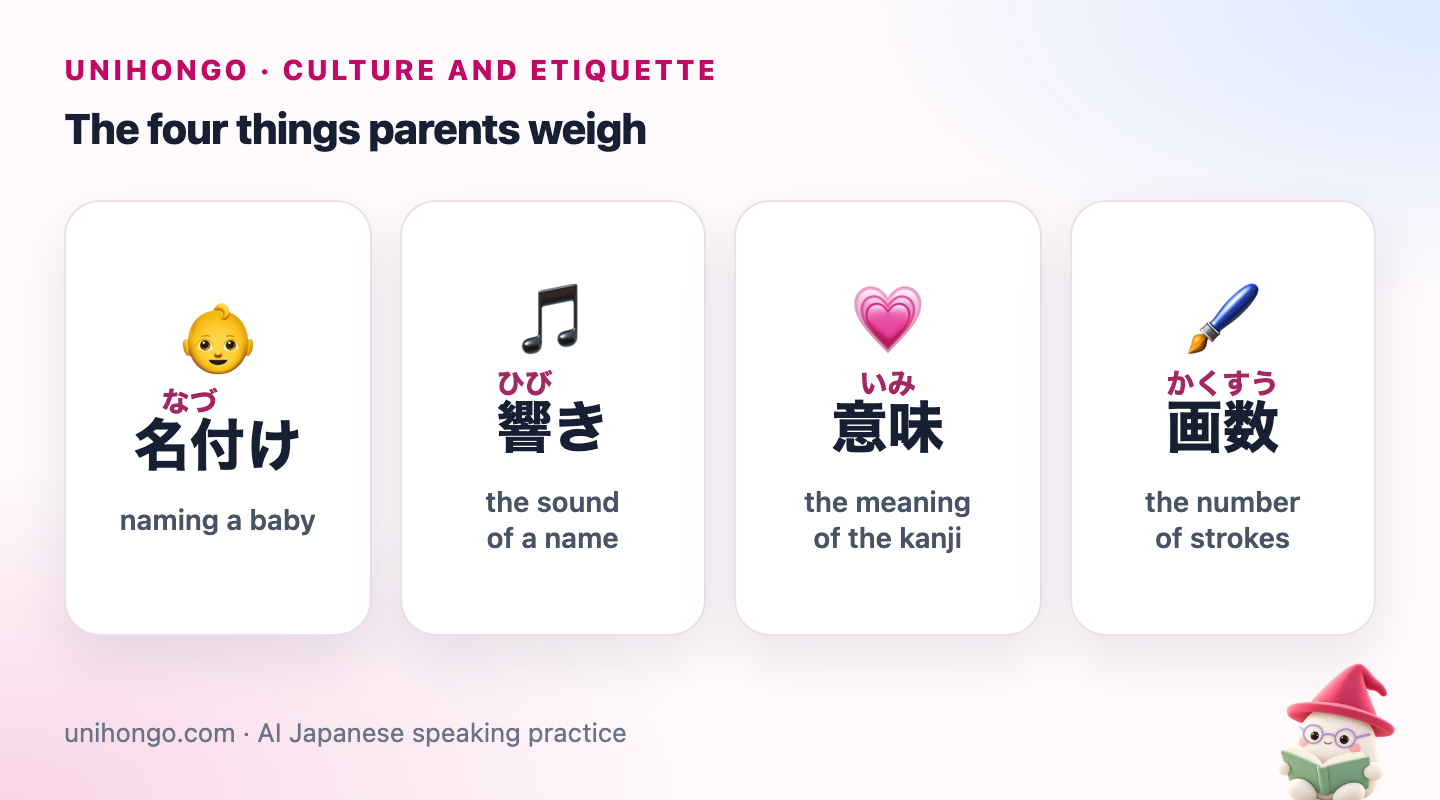
Ask Japanese parents how they chose their child's name and you will hear the same handful of words. Hibiki is the sound and feel of the name when you say it. Imi is the meaning of the kanji. Kakusū is the number of strokes, which matters to families who check naming fortune. Most parents juggle these until one name ticks enough boxes.
| Japanese | Romaji | Meaning |
|---|---|---|
| 名付け | nazuke | naming a baby |
| 響き | hibiki | the sound of a name |
| 意味 | imi | the meaning of the kanji |
| 画数 | kakusū | the number of strokes |
| 字面 | jizura | how the name looks written |
| 名前の由来 | namae no yurai | the story behind a name |
Jizura, the look of the name, is the fourth check people often mention. A name can sound lovely but look heavy if all its kanji are dense, or look unbalanced next to a long surname. Parents often write candidate names out by hand, together with the surname, to see how they sit on the page.
Sound first or kanji first
There are two common starting points. Some parents fall in love with a sound, such as Haru or Yui, and then pick kanji that carry a meaning they like. Others start with a kanji, such as 陽 (sun) or 結 (to tie), and then look for a reading that suits it. Either way, the sound is checked against the surname: said in one breath, does it flow? Does it repeat the same syllable awkwardly, or make an unfortunate word?
| Japanese | Romaji | Meaning |
|---|---|---|
| 音から決めました。 | Oto kara kimemashita. | We chose the sound first. |
| 先に漢字を決めました。 | Saki ni kanji o kimemashita. | We chose the kanji first. |
| 苗字と合わせて呼んでみて。 | Myōji to awasete yonde mite. | Say it together with the surname. |
| 呼びやすい名前がいいね。 | Yobi yasui namae ga ii ne. | An easy name to call out is best. (casual) |
| 読みやすさも大事です。 | Yomi yasusa mo daiji desu. | Being easy to read matters too. |
Readability has become a bigger part of the conversation in recent years, partly because of the debate about unusual readings. Many parents ask themselves whether a teacher could read the name on a class list without help. Others accept a less common reading if the meaning matters more to them. There is no single right answer, and families vary a lot.
The characters a name may use
Japanese law limits the characters in a given name. Parents may use kanji from two official lists: the jōyō kanji, the characters for general use, and the jinmeiyō kanji, an extra list allowed specifically for names. Together they come to roughly 3,000 kanji. Names can also be written in hiragana or katakana, and may include the long-vowel mark ー and the repeat mark 々. Roman letters and numerals cannot be used.
Since the revised Family Register Act took effect on 26 May 2025, the reading of the name is recorded in katakana as well, and it must be a reading generally accepted for those kanji. In practice that leaves plenty of room for choice, but very far-fetched readings may be questioned at the office.
| Japanese | Romaji | Meaning |
|---|---|---|
| 常用漢字 | jōyō kanji | kanji for general use |
| 人名用漢字 | jinmeiyō kanji | extra kanji allowed in names |
| この漢字は名前に使えますか。 | Kono kanji wa namae ni tsukaemasu ka. | Can this kanji be used in a name? |
| ひらがなの名前にしました。 | Hiragana no namae ni shimashita. | We gave her a name in hiragana. |
Hiragana names, such as さくら or ひなた, are chosen for their soft look and because nobody will misread them. Katakana names are less common for Japanese children but are often used by children with one non-Japanese parent, for example a name that works in two languages.
Stroke-count fortune: seimei handan
Seimei handan (姓名判断) is a fortune method based on the number of strokes in a full name. The strokes are added up in five combinations, and each total is matched to a meaning, lucky or unlucky, in a naming book, a website or an app. Some parents take it seriously and change their shortlist if a total looks unlucky; many check it out of curiosity; some ignore it entirely. Grandparents are sometimes keener on it than the parents.
| Japanese | Romaji | Meaning |
|---|---|---|
| 画数を調べてみた? | Kakusū o shirabete mita? | Did you look up the strokes? (casual) |
| 姓名判断では大吉でした。 | Seimei handan de wa daikichi deshita. | It came out very lucky in seimei handan. |
| 画数はあまり気にしませんでした。 | Kakusū wa amari ki ni shimasen deshita. | We didn't worry much about strokes. |
| Total | What is added | Said to relate to |
|---|---|---|
| Tenkaku (天格) | All strokes of the surname | Family line; often treated as less important |
| Jinkaku (人格) | Last kanji of the surname + first kanji of the given name | Personality, the core of the name |
| Chikaku (地格) | All strokes of the given name | Childhood and youth |
| Gaikaku (外格) | Total minus jinkaku | Relationships with others |
| Sōkaku (総格) | All strokes of the full name | The whole life |
Schools of seimei handan disagree on details, such as whether to count a kanji's modern or traditional form, or how many strokes a radical has. The same name can therefore look lucky in one book and unlucky in another. If a friend tells you they checked the strokes, it is fine to show interest; there is no need to share your own opinion about fortune-telling.
Family, season and wishes
Beyond the four checks, ideas come from many places. A grandparent's or parent's kanji is sometimes passed on, so a father called 健一 might give his son a name with 健. The season of birth inspires names with spring, summer, autumn or winter kanji, or seasonal flowers. Many names express a wish, negai, for the child: to be kind, healthy, bright or free.
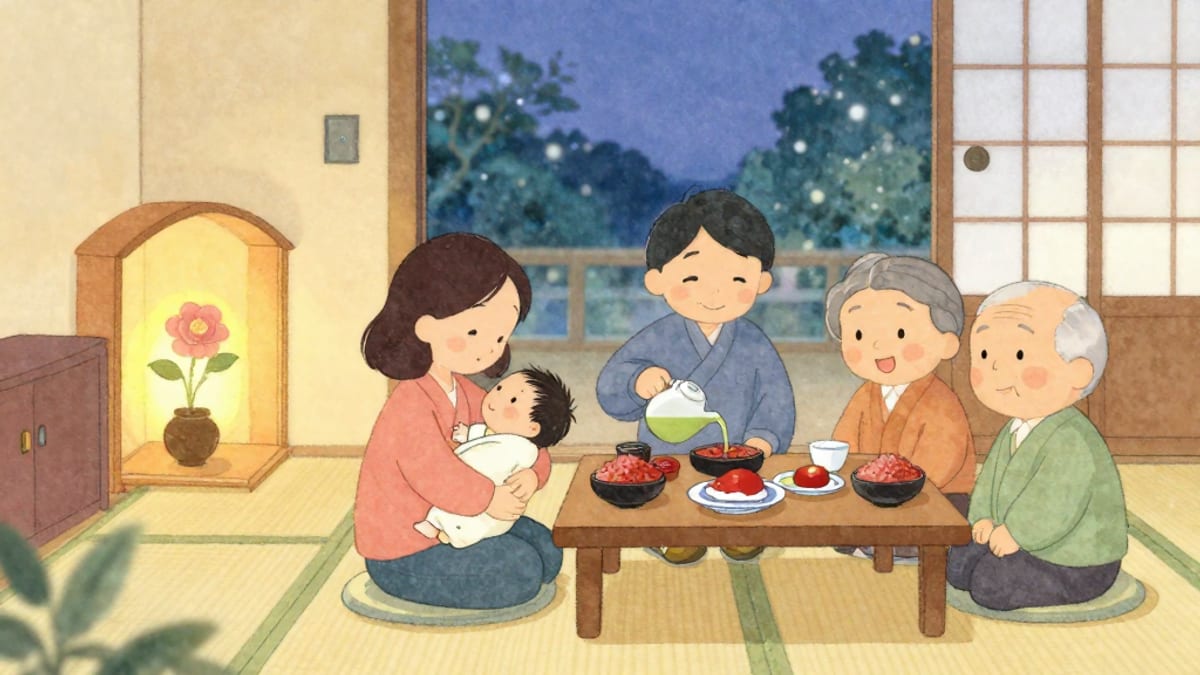
In some families the name is announced at oshichiya (お七夜), a small celebration on the seventh night after birth, when the name may be written on a sheet called a meimeisho (命名書) and displayed at home. Customs vary a lot, and plenty of families simply share the news in a message to relatives.
| Japanese | Romaji | Meaning |
|---|---|---|
| 父の名前から一字もらいました。 | Chichi no namae kara ichiji moraimashita. | We took one kanji from my father's name. |
| 春生まれなので「春」を入れました。 | Haru umare na node "haru" o iremashita. | She's a spring baby, so we put 春 in. |
| 優しい子に育ってほしいです。 | Yasashii ko ni sodatte hoshii desu. | We want him to grow up kind. |
| お七夜に名前を発表しました。 | Oshichiya ni namae o happyō shimashita. | We announced the name on the seventh night. |
The birth registration and the 14-day deadline
For a baby born in Japan, the birth registration, shusshō todoke (出生届), must be submitted to a municipal office within 14 days, counting the day of birth. The form includes the child's name, so this deadline is what gives many families their real decision date. For Japanese nationals born abroad, the period is three months. If you are a foreign resident having a baby in Japan, the municipal office can explain what applies to your family, including steps with your own country's embassy.
| Japanese | Romaji | Meaning |
|---|---|---|
| 出生届 | shusshō todoke | birth registration form |
| 出生届を出しに来ました。 | Shusshō todoke o dashi ni kimashita. | I've come to submit a birth registration. |
| 名前はもう決まりましたか。 | Namae wa mō kimarimashita ka. | Have you decided on the name yet? |
| まだ二つで迷っています。 | Mada futatsu de mayotte imasu. | We're still torn between two. |
Mini dialogue: two parents, one shortlist
Two new parents compare the last two names on their list, in casual Japanese.
| Japanese | Romaji | Meaning |
|---|---|---|
| 「ゆい」と「はるか」、どっちがいいと思う? | "Yui" to "Haruka", dotchi ga ii to omou? | Mother: Yui or Haruka, which do you think? |
| 響きは「ゆい」が好きだな。 | Hibiki wa "Yui" ga suki da na. | Father: I like the sound of Yui. |
| 漢字は「結衣」かな。人と結ばれるように。 | Kanji wa "Yui" ka na. Hito to musubareru yō ni. | Mother: Maybe 結衣 for the kanji. So she connects with people. |
| いいね。苗字と合わせても呼びやすいし。 | Ii ne. Myōji to awasete mo yobi yasui shi. | Father: Nice. It's easy to say with our surname too. |
| じゃあ、お母さんに画数だけ見てもらおう。 | Jā, okāsan ni kakusū dake mite moraō. | Mother: Then let's just have my mum check the strokes. |
Tell a name's story with Mocchi and Hana-sensei
Write three sentences explaining a baby's name, real or invented, and send them to Mocchi with /correct. Mocchi fixes the Japanese, explains each change, and keeps track of the grammar you stumbled on, such as yō ni or te hoshii, so it can come back in a later quiz.
Then say the corrected story out loud: in AI Sensei, choose Hana-sensei and ask her to play a friend visiting with a gift for the new baby, asking about the name and what it means.
Etiquette when someone shares a baby's name
- Congratulate first: go-shussan omedetō gozaimasu. Ask about the name after.
- Never say a name is hard to read or strange. Ask the reading, then say something about its sound or meaning.
- Do not offer your own stroke-count verdict, even as a joke. The family may have checked carefully.
- Asking for the story behind the name, namae no yurai, is warm and welcome.
- If you plan a gift with the name on it, confirm the kanji and reading in writing first.