
Count Japanese Timing Units With Mocchi Before Speaking Faster

Before trying to speak Japanese faster, notice the timing units inside familiar words. Ask Mocchi to help count morae in examples with long vowels, small っ, ん, or small-kana combinations, then return the word to a natural short phrase.

Mocchi separates a Japanese word into timing units and then reconnects it into a short phrase
What you need to know

Count Japanese Timing Units With Mocchi Before Speaking Faster

An English-style syllable count may not make Japanese timing features visible. A learner can miss the time carried by a long vowel or small っ while treating every kana-like shape as a separate full sound. Use a few familiar written words and compare their timing structure. Counting can help you notice a contrast, but it is not a complete model of natural rhythm, pitch, or phrasing. Keep the final goal a clear word inside an understandable sentence.

Use familiar words when learning the count.

Notice long vowels, small っ, and ん.

Treat small-kana combinations carefully.

Return from counting to a complete phrase.

Use counting to reveal a specific timing feature

Tell Mocchi which word feels difficult and what you tend to omit or lengthen. A count can help reveal the feature, but it should serve a real listening or speaking problem. You do not need to turn every sentence into an analysis exercise before saying anything. Start with one familiar word and a clear contrast.

Keep meaning available while counting. A word you know is easier to reconnect to natural speech after the analysis. If the vocabulary is new, learn its meaning first so the count does not become a sequence of symbols detached from a message.

Compare school with today

がっこう can be counted as が・っ・こ・う, four morae. きょう can be counted as きょ・う, two. The small ょ combines with the preceding kana in this example, while the long-vowel element still matters. Ask Mocchi to check your explanation and then compare another familiar word rather than relying on a mechanical count of printed characters.
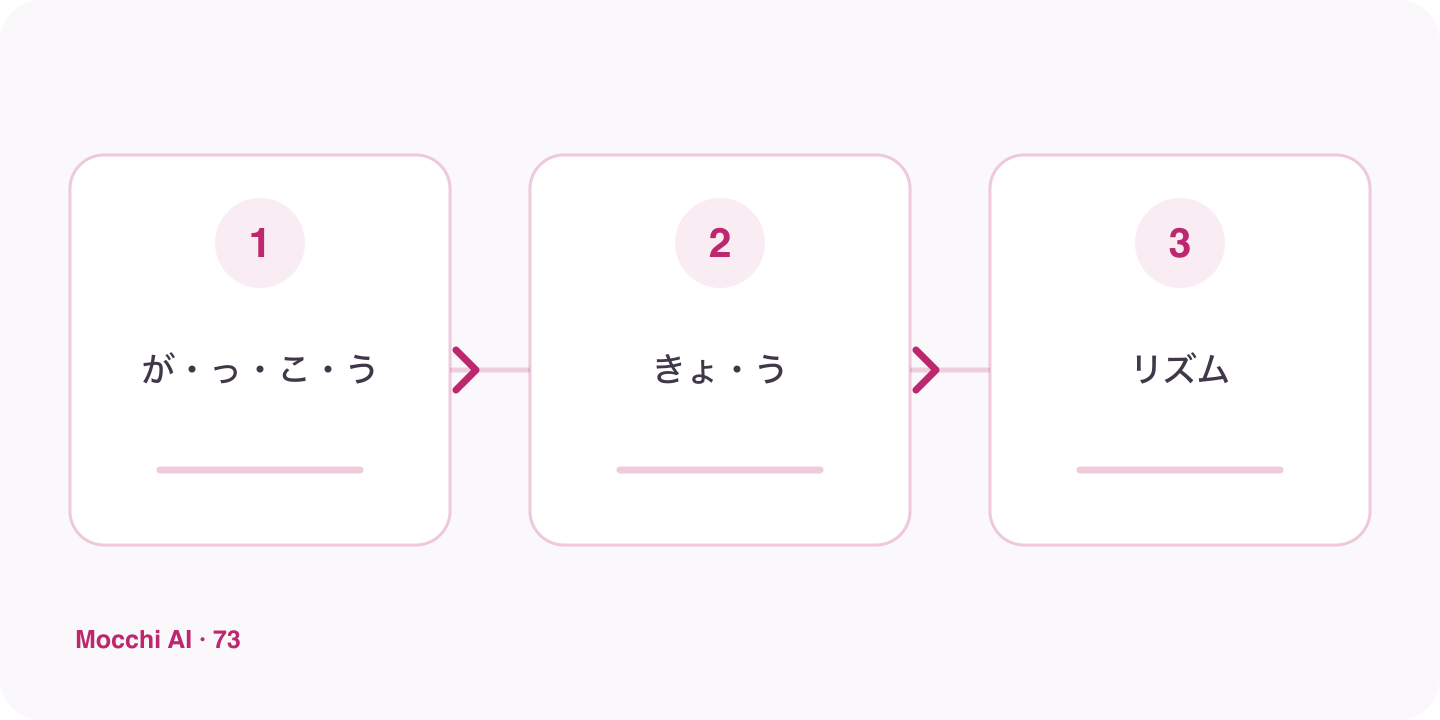
がっこう is shown as four timing units before the word is practiced in a complete sentence
Counting is a learning aid for noticing timing, not a demand to pronounce natural speech as equal isolated beats.
JapaneseRomajiMeaning
学校に行きます。Gakkō ni ikimasu.I go to school.
今日は休みです。Kyō wa yasumi desu.Today is a day off.

Move from the count to listening

Listen to a clear model after identifying the timing structure. Notice whether the feature you counted is actually present in what you hear. Then attempt the word yourself without exaggerating every unit equally. The comparison connects the analysis to perception instead of treating a correct written count as proof that you can hear or produce the distinction.

Choose one sound target for coached practice

If the difficulty is a shortened long vowel, missing small っ, or compressed ん, tell Mocchi that specific target. A focused pronunciation activity can make the next attempt more purposeful than a general request to sound natural. Use the supplied practice and actual feedback, and avoid inventing a score or conclusion when the activity did not provide one.

Keep the feature inside a meaningful phrase

Say a short familiar sentence containing the word and check whether the timing survives when attention moves to the message. If not, reduce the phrase and rebuild gradually. Later, try another word with the same feature. Mocchi can help choose the next focus, while the new phrase checks whether the learning aid has contributed to speech beyond the original counted example.

Key points

A practical way to improve

Ask Mocchi to compare the timing units in がっこう and きょう. Explain which parts contribute a unit and which small-kana combination belongs together. Listen to a model and say a short phrase containing one word. If a particular feature causes difficulty, request a pronunciation activity focused on that sound rather than trying to make every word faster at once.

  1. 1

    Choose one clear goal

    Focus each session on a situation or skill you can actually use.

  2. 2

    Practice actively

    Say complete answers aloud instead of only reading or recognizing Japanese.

  3. 3

    Review and repeat

    Keep useful corrections and revisit the same skill until it feels natural.

FAQ

Frequently asked questions

Is a mora exactly the same as an English syllable?

No. Japanese timing units can make distinctions that a familiar English syllable count does not represent in the same way. Learn the count through clear Japanese examples rather than assuming one system maps directly onto the other.

Should I pronounce every unit with identical force?

No. Counting is a teaching aid. Natural speech also has pitch, phrasing, and timing variation. Use the count to notice important features, then listen to how the whole word and phrase are actually spoken.

Does small ゃ, ゅ, or ょ always add another full unit?

In common combinations such as きょ, the small kana participates in one combined unit. Compare the actual spelling and a clear model instead of counting every visible character mechanically.

Notice the timing before increasing the speed

Use Mocchi to connect a simple count to a focused listening and speaking attempt.