
The three expressions and what they actually carry
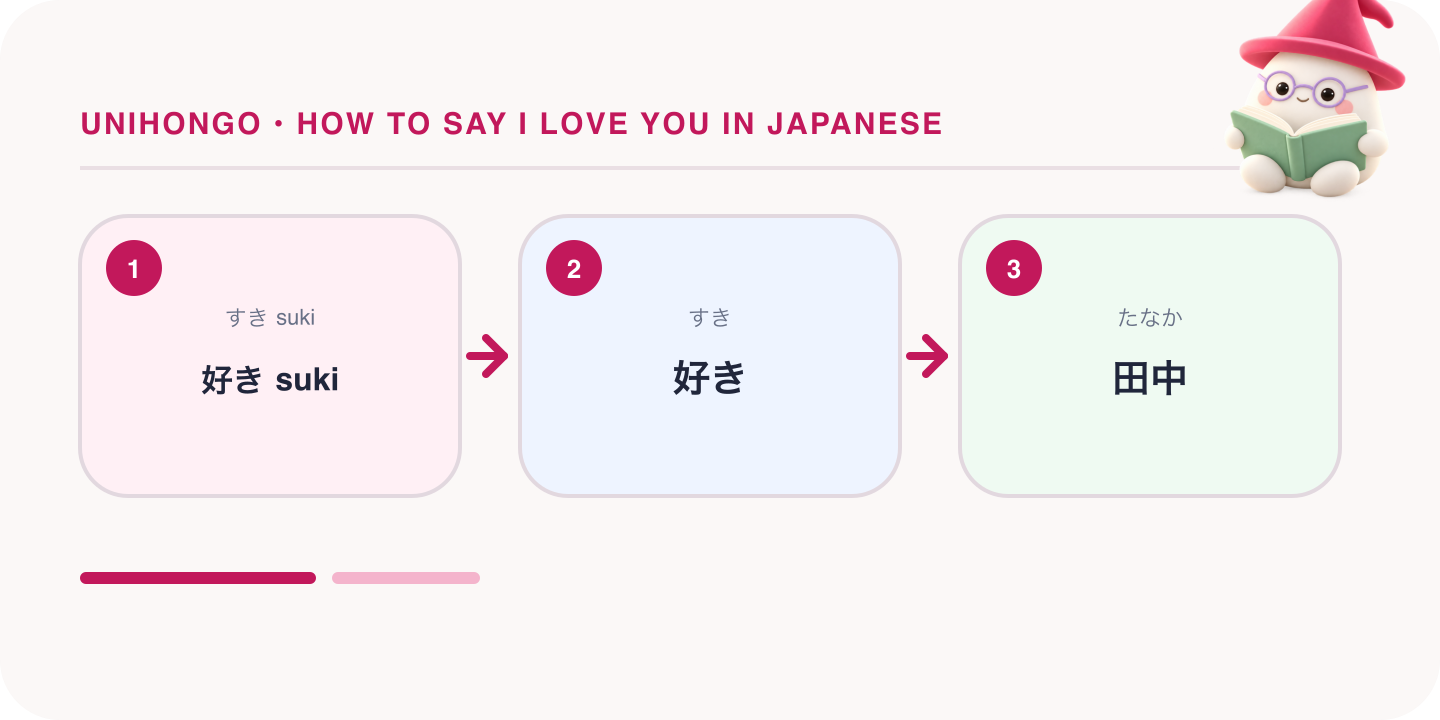
| Expression | Weight | Register | Typical use |
|---|---|---|---|
| 好き suki | Like, up to and including romantic love depending on delivery | Everyday, works in polite and casual form | Confessing feelings, saying what you enjoy |
| 大好き daisuki | Strong, warm, affectionate, not necessarily romantic | Everyday and slightly childlike or emotional | Partners, family, close friends, food, music, places |
| 愛してる aishiteru | Very heavy, whole-life commitment | Literary, dramatic, rare in speech | Long marriages, farewells, songs and fiction |
| 恋してる koi shiteru | Being in love, the falling feeling itself | Descriptive, said about yourself to a third person | Talking about your own state, not addressing the person |
Read that table as a warning about direction of error. Learners usually overestimate suki and underestimate its power, so they either avoid it as too weak or drop aishiteru into a first date because a dictionary told them it was the real translation. In practice the ordinary romantic sentence in Japan is suki desu, said with care and a pause. Daisuki is the affectionate everyday word a couple uses for years. Aishiteru sits far away, kept for moments that genuinely deserve it.
The grammar: suki takes ga, aisuru takes o
Suki and daisuki are na-adjectives, not verbs, so the person or thing you like is marked with ga rather than with o. The full polite frame is watashi wa X ga suki desu, though in real speech the watashi wa is usually dropped because the topic is obvious. Adding no koto after a person's name softens the sentence and widens it from a surface preference to the whole person, which is why anata no koto ga suki desu sounds more sincere than the bare version.
Aisuru behaves as a normal verb and takes o, and it is almost always used in the continuous form aishite iru, shortened to aishiteru in speech. Note also that anata sounds distant or oddly formal for most couples in Japan, so use the person's name plus san or the name alone once you are close, rather than repeating anata like an English you.
| Japanese | Romaji | Meaning |
|---|---|---|
| 日本語が好きです。 | Nihongo ga suki desu. | I like Japanese. |
| 田中さんのことが好きです。 | Tanaka-san no koto ga suki desu. | I have feelings for you, Tanaka. |
| 猫が大好きです。 | Neko ga daisuki desu. | I really love cats. |
| あなたを愛しています。 | Anata o aishite imasu. | I love you. (heavy, formal) |
| 君のことを愛してる。 | Kimi no koto o aishiteru. | I love you. (casual, very heavy) |
| 好きになりました。 | Suki ni narimashita. | I have come to like you. / I fell for you. |
Suki desu is the line that starts a relationship
Japan has a recognisable confession moment, kokuhaku, in which one person states their feelings and asks to date. Before it, two people may go out repeatedly without either treating the relationship as official; after it, they are a couple. That is why suki desu carries so much freight. It is not a compliment thrown into conversation, it is a proposal to change the status of the relationship, and it is normally followed by tsukiatte kudasai, please go out with me.
The delivery matters as much as the words. It is said in a quiet place, usually one to one, with a short pause before the phrase. Keep it simple: a long speech reads as rehearsed. The dedicated dating post covers arranging the meeting itself, so here we stay with the sentence and the answer.
| Japanese | Romaji | Meaning |
|---|---|---|
| ちょっと話したいことがあるんだけど。 | Chotto hanashitai koto ga aru n da kedo. | There is something I want to talk to you about. (casual opener) |
| 前から気になっていました。 | Mae kara ki ni natte imashita. | I have had my eye on you for a while. |
| 好きです。付き合ってください。 | Suki desu. Tsukiatte kudasai. | I like you. Please go out with me. |
| ずっと好きでした。 | Zutto suki deshita. | I have liked you for a long time. |
| よかったら、付き合ってもらえませんか。 | Yokattara, tsukiatte moraemasen ka. | If you are willing, would you go out with me? |
| 返事は今すぐじゃなくて大丈夫です。 | Henji wa ima sugu ja nakute daijōbu desu. | You do not have to answer right away. |
The replies you should be ready to hear
Half of this situation is listening, and the answer usually arrives faster than you can process it. Learn the three shapes: acceptance, a request for time, and a refusal. A refusal in Japanese is rarely a flat no. It arrives as gratitude plus a reason plus a softener, and if you only listen for the word iie you will miss it entirely. Treat gomennasai, ima wa, and tomodachi as the words that carry the answer.
| Japanese | Romaji | Meaning |
|---|---|---|
| 私もです。 | Watashi mo desu. | Reply: I feel the same. |
| 嬉しいです。こちらこそよろしくお願いします。 | Ureshii desu. Kochira koso yoroshiku onegai shimasu. | Reply: I am happy. I look forward to being with you too. |
| 私でよければ。 | Watashi de yokereba. | Reply: If I am all right for you, then yes. |
| 少し考えさせてください。 | Sukoshi kangaesasete kudasai. | Reply: Please let me think about it a little. |
| ありがとう。でも、お友達でいたいです。 | Arigatō. Demo, o-tomodachi de itai desu. | Reply: Thank you, but I would like to stay friends. |
| ごめんなさい。気持ちには応えられません。 | Gomen nasai. Kimochi ni wa kotaeraremasen. | Reply: I am sorry. I cannot return your feelings. |
| 今は仕事に集中したいので。 | Ima wa shigoto ni shūchū shitai node. | Reply: Right now I want to focus on work. (soft refusal) |
If the answer is no, the graceful close is short: wakarimashita, hanashite kurete arigatō, and then let the subject drop. Pushing after a refusal is as unwelcome in Japanese as anywhere else, and the language gives you a clean exit line so that neither person loses face.
Daisuki: the word couples actually live in
Once you are together, daisuki does most of the daily work. It is warmer than suki, it is emotionally open without being solemn, and it is safe to repeat. Couples use it constantly, parents use it with children, friends use it with each other, and everyone uses it about food and music. Because it stretches that far, daisuki alone does not prove romance: dare ga daisuki is answered as happily with ramen as with a person.
The everyday romantic vocabulary around it is smaller than English learners expect. Aitai, I want to see you, does an enormous amount of affectionate work in messages, and so does a simple issho ni iru to tanoshii. These are the lines a Japanese partner is far more likely to send than any translation of I love you.
| Japanese | Romaji | Meaning |
|---|---|---|
| 大好きだよ。 | Daisuki da yo. | I really like you. (casual, warm) |
| 大好きです。 | Daisuki desu. | I really like you. (polite) |
| 会いたいな。 | Aitai na. | I want to see you. |
| 一緒にいると楽しいです。 | Issho ni iru to tanoshii desu. | I enjoy being with you. |
| 世界で一番好き。 | Sekai de ichiban suki. | I like you more than anyone in the world. |
| 大事にするね。 | Daiji ni suru ne. | I will treasure you. |
| そばにいてくれてありがとう。 | Soba ni ite kurete arigatō. | Thank you for being by my side. |
Aishiteru and why it stays in the drawer
Aishiteru is not forbidden, it is simply expensive. It carries a sense of lifelong, unconditional devotion, and because song lyrics and television dramas use it constantly it also carries a faint theatrical echo. Said by a partner of many years at a serious moment it lands with real force. Said on a third date it sounds like a line from a script, and a Japanese listener may laugh from embarrassment rather than take it as intended.
There is also a gender pattern many people describe, though it varies by couple and generation: men in particular often report never having said it aloud, while daisuki flows easily. Take it as a word to recognise and understand rather than one to deploy. If you want to escalate beyond daisuki, escalating the specificity of what you say is usually more moving than escalating the vocabulary.
| Japanese | Romaji | Meaning |
|---|---|---|
| 愛してる。 | Aishiteru. | I love you. (casual, very heavy) |
| 愛してます。 | Aishitemasu. | I love you. (slightly softened polite form) |
| これからもずっと一緒にいたいです。 | Kore kara mo zutto issho ni itai desu. | I want to stay with you from now on as well. |
| 君がいてくれてよかった。 | Kimi ga ite kurete yokatta. | I am glad you are here with me. |
| 家族になってください。 | Kazoku ni natte kudasai. | Please become my family. (a proposal) |
Saying you like someone without confessing
Sometimes you want to signal interest without triggering the whole kokuhaku machinery. Japanese has a useful middle layer for this. Ki ni naru describes someone who is on your mind, typically read as interest that has not yet resolved into a declaration. Suki kamo hedges with maybe. Tsukiatte kudasai is the part that makes it official, so leaving it off keeps the sentence as information rather than a request.
Compliments do similar work at a lower temperature. Issho ni ite raku, easy to be around, and hanashi ga au, we click when we talk, are warm without committing you, and they give the other person room to respond in kind or to leave it alone.
| Japanese | Romaji | Meaning |
|---|---|---|
| ちょっと気になってるんだ。 | Chotto ki ni natteru n da. | I have been thinking about you a bit. (casual) |
| 好きかも。 | Suki kamo. | I might like you. |
| 話が合いますね。 | Hanashi ga aimasu ne. | We really click when we talk. |
| 一緒にいると楽です。 | Issho ni iru to raku desu. | You are easy to be around. |
| 今度、二人で会いませんか。 | Kondo, futari de aimasen ka. | Would you like to meet, just the two of us, next time? |
| また誘ってもいいですか。 | Mata sasotte mo ii desu ka. | May I invite you out again? |
Family and friends: what Japanese says instead
An English speaker ends a phone call to a parent with I love you. A Japanese speaker usually does not, and the absence is not coldness. The equivalent affection is carried by gratitude and by concern for the other person's body and schedule. Itsumo arigatō, thank you as always, does the emotional work, and karada ni ki o tsukete ne, take care of yourself, is close to a declaration of love from an adult child to a parent.
Daisuki is genuinely usable inside a family, especially toward small children and between a parent and child, and friends say daisuki to each other without any romantic reading. What almost never happens is aishiteru inside a family in ordinary speech. If you want a formula for phone calls home, pair gratitude with a specific memory: that combination sounds native and it is easy to say.
| Japanese | Romaji | Meaning |
|---|---|---|
| お母さん、いつもありがとう。 | Okāsan, itsumo arigatō. | Mum, thank you for everything, always. |
| 体に気をつけてね。 | Karada ni ki o tsukete ne. | Take care of yourself. |
| 無理しないでね。 | Muri shinaide ne. | Do not push yourself too hard. |
| 家族が大好きです。 | Kazoku ga daisuki desu. | I love my family. |
| みんなに会いたいな。 | Minna ni aitai na. | I miss everyone. |
| 元気でいてくれれば、それでいいよ。 | Genki de ite kurereba, sore de ii yo. | As long as you are well, that is enough for me. |
| 友達として大好きだよ。 | Tomodachi to shite daisuki da yo. | I love you as a friend. |
Loving things rather than people
| Japanese | Romaji | Meaning |
|---|---|---|
| 寿司が大好きです。 | Sushi ga daisuki desu. | I love sushi. |
| この曲、めっちゃ好き。 | Kono kyoku, meccha suki. | I really love this song. (casual) |
| 京都が好きになりました。 | Kyōto ga suki ni narimashita. | I have grown to love Kyoto. |
| 写真を撮るのが好きです。 | Shashin o toru no ga suki desu. | I like taking photographs. |
| 歩くのはちょっと苦手です。 | Aruku no wa chotto nigate desu. | Walking is not really my thing. |
| どんな音楽が好きですか。 | Donna ongaku ga suki desu ka. | What kind of music do you like? |
Two grammar notes make this whole group work. To like doing something, turn the verb into a noun with no and mark it with ga: shashin o toru no ga suki desu. And the natural opposite of suki in polite conversation is not kirai, which is strong enough to sound hostile, but amari suki ja nai desu or nigate desu, both of which mean not really my thing without insulting whatever is in front of you.
Choosing the register
| Situation | What to say | Why |
|---|---|---|
| Confessing to someone you address politely | 好きです suki desu | Polite form keeps the distance you already had, and sincerity carries it |
| Confessing to a close friend | 好きだ suki da / 好きなんだ suki na n da | Plain form matches the relationship; na n da adds explanation and softness |
| Established partner, daily | 大好き daisuki | Warm, repeatable, no ceremony |
| A serious moment after years together | 愛してる aishiteru | The weight is the point, so it must be rare |
| Family member | いつもありがとう itsumo arigatō | Gratitude is the usual channel for family affection |
| Friend | 友達として大好き tomodachi to shite daisuki | The framing prevents a romantic reading |
Mistakes learners make
- Translating suki as only like, then being surprised that saying it changed the relationship.
- Using o with suki. The person or thing you like takes ga.
- Reaching for aishiteru because a dictionary called it the real word for love.
- Repeating anata instead of the person's name, which sounds distant or oddly formal.
- Missing a soft refusal because it contained no clear no; listen for gomennasai, ima wa and tomodachi.
- Answering aishiteru with a bigger phrase instead of a quiet watashi mo.
- Using kirai to say you dislike something ordinary, when amari suki ja nai desu is what a Japanese speaker would say.