
The counter and the machine do different jobs
Almost everything you will ever do at a Japanese bank happens in one of two places. The madoguchi, the staffed counter, deals with anything that creates or changes a contract: opening an account, replacing a lost card, registering a new address, closing an account before you leave the country. It is slower, it involves forms, and it is where the polite language is thickest.
The ATM handles the daily traffic. Withdrawals, deposits, transfers, balance checks, and printing entries into a passbook are all machine work, and many branches keep the machines available longer than the counter. Deciding which of the two you need before you walk in saves you from queueing twice, and it also tells you which vocabulary set to rehearse on the way there.
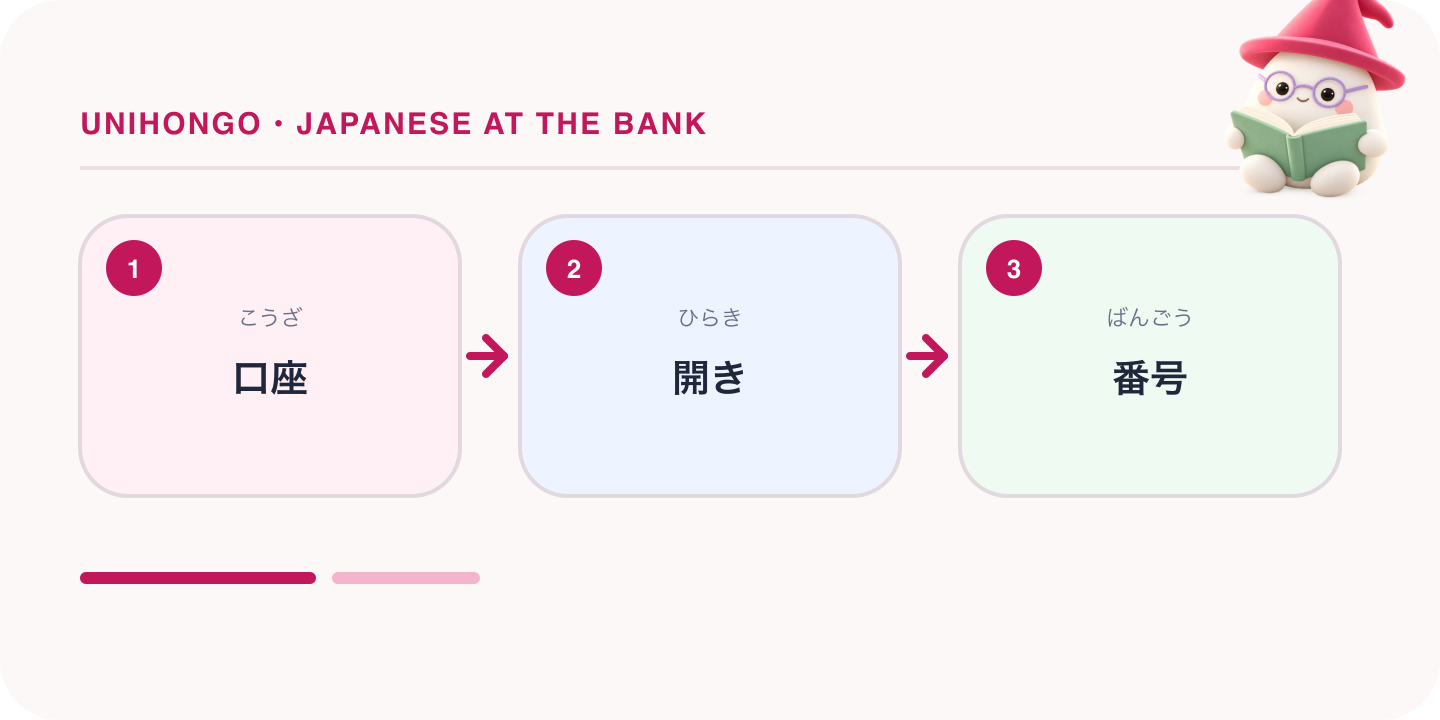
Taking a ticket and reaching the window
Most branches start you at a ticket machine or a reception desk. You either press a button for the type of business you have or tell a floor member of staff, who then hands you a numbered ticket. The number is called over a speaker and shown on a board, usually with the window number attached, so listening for your own number in Japanese is the first small test of the visit.
| Japanese | Romaji | Meaning |
|---|---|---|
| すみません、口座を開きたいのですが。 | Sumimasen, kōza o hirakitai no desu ga. | Excuse me, I would like to open an account. |
| 番号札はどこで取りますか? | Bangōfuda wa doko de torimasu ka? | Where do I take a numbered ticket? |
| こちらでお待ちください。 | Kochira de omachi kudasai. | Please wait over here. (staff) |
| 三十二番のお客様、二番窓口へどうぞ。 | Sanjūni-ban no okyakusama, niban madoguchi e dōzo. | Customer number thirty-two, please come to window two. (staff) |
| はい、三十二番です。 | Hai, sanjūni-ban desu. | Yes, that is number thirty-two. |
Opening an account
Account opening is a form-filling procedure with an identity check attached. Expect to be asked for a residence card, sometimes a second document such as a student card or a work ID, an address that matches your official record, and a phone number that reaches you in Japan. Requirements differ between banks and between branches, so treat anything you read online as a starting point and confirm with the branch you plan to use.
The clerk will normally hand you a form, mark the boxes you need to complete, and take the paperwork away for a few minutes. Your job at that point is small: fill in the fields, answer the seal question, and ask when the card arrives. Saying the procedure clearly at the start is what makes the rest of the exchange easy to follow.
| Japanese | Romaji | Meaning |
|---|---|---|
| 普通預金の口座をお願いします。 | Futsū yokin no kōza o onegai shimasu. | An ordinary savings account, please. |
| 必要な書類は何ですか? | Hitsuyō na shorui wa nan desu ka? | What documents do you need? |
| 在留カードと学生証を持ってきました。 | Zairyū kādo to gakuseishō o motte kimashita. | I have brought my residence card and my student ID. |
| 住所は在留カードの裏と同じです。 | Jūsho wa zairyū kādo no ura to onaji desu. | My address is the same as the one on the back of my residence card. |
| 名前はカタカナで書きますか? | Namae wa katakana de kakimasu ka? | Should I write my name in katakana? |
| キャッシュカードはいつ届きますか? | Kyasshu kādo wa itsu todokimasu ka? | When will the cash card arrive? |
The seal or signature question
At some point the clerk will ask about an inkan, the personal seal also called a hanko. Many banks now accept a signature from foreign residents, and some accept either, but the practice is not uniform and it can differ by product. The safest approach is to ask before you queue rather than after you have filled in half a form, and to note which seal you registered if you do use one.
| Japanese | Romaji | Meaning |
|---|---|---|
| 印鑑は必要ですか? | Inkan wa hitsuyō desu ka? | Is a seal required? |
| 印鑑を持っていないので、サインでもいいですか? | Inkan o motte inai node, sain demo ii desu ka? | I do not have a seal, so would a signature be all right? |
| どこに押せばいいですか? | Doko ni oseba ii desu ka? | Where should I stamp it? |
| 朱肉はありますか? | Shuniku wa arimasu ka? | Do you have a red ink pad? |
| 押し直してもいいですか? | Oshinaoshite mo ii desu ka? | May I stamp it again? |
Reading the ATM screen
| On screen | Romaji | What it does |
|---|---|---|
| お引き出し | O-hikidashi | Withdraw cash |
| お預け入れ | O-azukeire | Deposit cash |
| お振込 | O-furikomi | Transfer to someone else's account |
| お振替 | O-furikae | Move money between your own accounts |
| 残高照会 | Zandaka shōkai | Check the balance |
| 通帳記入 | Tsūchō kinyū | Print recent entries into your passbook |
| 暗証番号 | Anshō bangō | Your PIN |
| 金額 | Kingaku | The amount |
| 万 | Man | The ten-thousand key used to build amounts |
| 円 | En | Yen |
| 訂正 | Teisei | Correct the last entry |
| 取消 | Torikeshi | Cancel the whole transaction |
| 確認 | Kakunin | Confirm and continue |
| 金融機関 | Kin'yū kikan | The financial institution, meaning the bank name |
| 支店名 | Shitenmei | Branch name |
| 口座番号 | Kōza bangō | Account number |
| 受取人 | Uketorinin | The person receiving the transfer |
| 手数料 | Tesūryō | Fee |
| お客様控え | Okyakusama hikae | Your receipt copy |
These words repeat on every machine in the country, so learning them once pays for itself. The two that cause the most trouble are man, because amounts are built in units of ten thousand rather than thousand, and the pair teisei and torikeshi, which look similar but do very different things. Teisei clears the field you just typed, while torikeshi ends the transaction and returns your card.
Machines almost always offer an English mode, and using it is sensible when money is involved. Read the Japanese screen first, then switch, and you get the vocabulary practice without the risk of sending a payment to the wrong place.
Making a domestic transfer
A furikomi is a transfer to another person or a company, and it is the standard way to pay rent, a deposit, or an invoice. The screen asks for the financial institution, the branch, the account type, the account number, and the recipient name in katakana, then shows you a confirmation page with the fee. Check the katakana name character by character before confirming, because a mismatch between the name and the account number can stop the payment.
| Japanese | Romaji | Meaning |
|---|---|---|
| 振込をしたいのですが。 | Furikomi o shitai no desu ga. | I would like to make a transfer. |
| ATMで振込できますか? | ATM de furikomi dekimasu ka? | Can I make a transfer at the ATM? |
| 相手の銀行名と支店名はこれです。 | Aite no ginkōmei to shitenmei wa kore desu. | Here are the recipient's bank name and branch name. |
| 受取人の名前はカタカナでいいですか? | Uketorinin no namae wa katakana de ii desu ka? | Should the recipient's name be in katakana? |
| 振込手数料はいくらですか? | Furikomi tesūryō wa ikura desu ka? | How much is the transfer fee? |
| 今日中に届きますか? | Kyōjū ni todokimasu ka? | Will it arrive today? |
The passbook and checking your balance
A tsūchō is a small printed book that records your transactions. You feed it into the machine, it prints the entries added since your last visit, and it doubles as a paper statement that some offices still ask to see. Not every account comes with one, and many banks now offer an app-based record instead, so ask when you open the account rather than assuming.
| Japanese | Romaji | Meaning |
|---|---|---|
| 通帳も作れますか? | Tsūchō mo tsukuremasu ka? | Can I also have a passbook? |
| 通帳記入をお願いします。 | Tsūchō kinyū o onegai shimasu. | I would like to update my passbook, please. |
| 残高を確認したいです。 | Zandaka o kakunin shitai desu. | I would like to check my balance. |
| この機械で記帳できますか? | Kono kikai de kichō dekimasu ka? | Can I update the passbook at this machine? |
| 通帳がいっぱいになりました。 | Tsūchō ga ippai ni narimashita. | My passbook is full. |
When the keigo goes too fast
Bank staff speak in dense honorific language, and they speak it quickly because they say the same sentences hundreds of times a day. You will hear o-azukari itashimasu instead of a plain verb, go-kinyū itadakemasu deshō ka instead of a simple request, and osoreirimasu ga in front of anything that inconveniences you. None of it is meant to exclude you, but the extra syllables genuinely make the sentence longer and harder to parse.
The fix is not to learn all of the keigo before your visit. It is to carry two or three repair phrases that reset the pace, and to use them early rather than after three failed attempts. Saying that your Japanese is still developing at the start of the exchange usually produces slower, plainer speech for the rest of it.
| Japanese | Romaji | Meaning |
|---|---|---|
| 恐れ入りますが、ご本人様確認をさせていただきます。 | Osoreirimasu ga, go-honnin-sama kakunin o sasete itadakimasu. | Excuse me, we need to verify your identity. (staff) |
| こちらにご記入いただけますでしょうか。 | Kochira ni go-kinyū itadakemasu deshō ka. | Could you please fill this in? (staff) |
| すみません、日本語がまだ上手ではありません。 | Sumimasen, nihongo ga mada jōzu de wa arimasen. | Sorry, my Japanese is not very good yet. |
| もう少しゆっくりお願いできますか? | Mō sukoshi yukkuri onegai dekimasu ka? | Could you speak a little more slowly, please? |
| 今のは、どういう意味ですか? | Ima no wa, dō iu imi desu ka? | What does what you just said mean? |
| 紙に書いていただけますか? | Kami ni kaite itadakemasu ka? | Could you write it down for me? |
Reporting a lost or swallowed card
Losing a card is the one bank errand where speed matters more than polish. Say what happened, ask for the card to be stopped, then ask about a replacement. If a machine keeps your card, look for the intercom on the ATM itself, because the machine's own support line can often release it during branch hours, and outside those hours it is a counter job the next day.
| Japanese | Romaji | Meaning |
|---|---|---|
| キャッシュカードをなくしました。 | Kyasshu kādo o nakushimashita. | I have lost my cash card. |
| すぐに止めてください。 | Sugu ni tomete kudasai. | Please stop it immediately. |
| カードが機械から出てきません。 | Kādo ga kikai kara dete kimasen. | The machine has not returned my card. |
| 再発行をお願いします。 | Saihakkō o onegai shimasu. | I would like a replacement issued, please. |
| 新しいカードはいつ届きますか? | Atarashii kādo wa itsu todokimasu ka? | When will the new card arrive? |
| 暗証番号を忘れてしまいました。 | Anshō bangō o wasurete shimaimashita. | I have forgotten my PIN. |
A replacement is usually posted to your registered address rather than handed over on the spot, which is one more reason to keep that address up to date after a move. Bring identification, and be ready to answer questions about recent transactions.
Asking about fees without guessing
Fees in Japan depend on the bank, the type of transaction, the time of day, and whether you are using your own bank's machine. Because of that, the useful skill is not memorising figures but asking cleanly and understanding the answer. Ask before you confirm a transfer rather than after, and ask specifically about the case you are in.
| Japanese | Romaji | Meaning |
|---|---|---|
| 手数料はかかりますか? | Tesūryō wa kakarimasu ka? | Is there a fee? |
| 時間外の手数料はいくらですか? | Jikangai no tesūryō wa ikura desu ka? | How much is the out-of-hours fee? |
| 他の銀行のATMでも使えますか? | Hoka no ginkō no ATM demo tsukaemasu ka? | Can I use it at another bank's ATM as well? |
| コンビニでも引き出せますか? | Konbini demo hikidasemasu ka? | Can I withdraw at a convenience store too? |
| 合計はいくらになりますか? | Gōkei wa ikura ni narimasu ka? | What will the total be? |
How to rehearse a bank visit
- Choose one procedure and say the whole visit aloud in order, from the ticket machine to the goodbye.
- Practise your own account number and phone number as spoken Japanese digits until they come out without pauses.
- Drill amounts in units of man: ichi-man, san-man, jū-man, jūgo-man, until the ATM keypad stops surprising you.
- Record yourself saying the three repair phrases, then play them back and cut any hesitation before sumimasen.
- Write the recipient details for a real transfer on a card and read them aloud in screen order: bank, branch, number, name.
- After the visit, note the one sentence the clerk said that you did not catch, and look it up the same evening.