
The scripted part and the unscripted part
Learners preparing for a networking event concentrate on the card exchange, because it has visible rules and getting it wrong feels conspicuous. It is worth knowing, and it is also the easiest part: it is short, fixed, and the other person is doing the same thing.
What follows is the difficult half. Two people now stand facing each other with no shared context, no fixed topic and a conversation that must be started and, more awkwardly, ended. That is what is worth preparing.
Fortunately the unscripted half has predictable shapes. The opening comes from the card, the middle from three general questions, and the exit from a set phrase.
Opening from the card
The card you have just been handed is a list of conversation openings: a company, a location, a department, a job title. Using one is the expected next move and removes the problem of inventing a topic from nothing.
This works particularly well for a learner, because commenting on something concrete is much easier than opening with small talk.
| Japanese | Romaji | Meaning |
|---|---|---|
| 大阪のご出身ですか。 | Ōsaka no goshusshin desu ka. | Are you from Osaka? |
| 御社のお名前は伺っております。 | Onsha no onamae wa ukagatte orimasu. | I have heard of your company. |
| どういったお仕事をされているんですか。 | Dō itta oshigoto o sarete iru n desu ka. | What sort of work do you do? |
| この業界は長いんですか。 | Kono gyōkai wa nagai n desu ka. | Have you been in this industry long? |
| 今日はどちらから。 | Kyō wa dochira kara. | Where have you come from today? |
| このイベントにはよく来られるんですか。 | Kono ibento ni wa yoku koraeru n desu ka. | Do you come to this event often? |
The last two work with anyone, require no information at all, and are the ones to fall back on when the card gives you nothing.
One sentence about what you do
The standard mistake is a full self-introduction where one sentence was wanted. At an event, people are deciding within seconds whether there is a reason to keep talking, and a long introduction delays that and is harder to follow.
Prepare one sentence that says what you do and why it might matter to them, and keep the rest for if they ask. This is genuinely difficult to write and worth the effort, because you will use it constantly.
| Japanese | Romaji | Meaning |
|---|---|---|
| 物流のシステムを作っています。 | Butsuryū no shisutemu o tsukutte imasu. | I build logistics systems. |
| 主に海外のお客様を担当しています。 | Omo ni kaigai no okyakusama o tantō shite imasu. | I mainly handle overseas clients. |
| 採用の仕事をしています。 | Saiyō no shigoto o shite imasu. | I work in recruitment. |
| 御社と近い分野かもしれません。 | Onsha to chikai bun'ya kamo shiremasen. | It may be close to your field. |
| 最近この分野に移ったばかりです。 | Saikin kono bun'ya ni utsutta bakari desu. | I moved into this field recently. |
| 詳しくは、また改めて。 | Kuwashiku wa, mata aratamete. | I will explain properly another time. |
Leaving without ending it badly
The exit is what learners handle worst, usually by staying too long because they do not know how to leave. At a networking event both people expect to circulate, and a clean exit is a courtesy rather than a rejection.
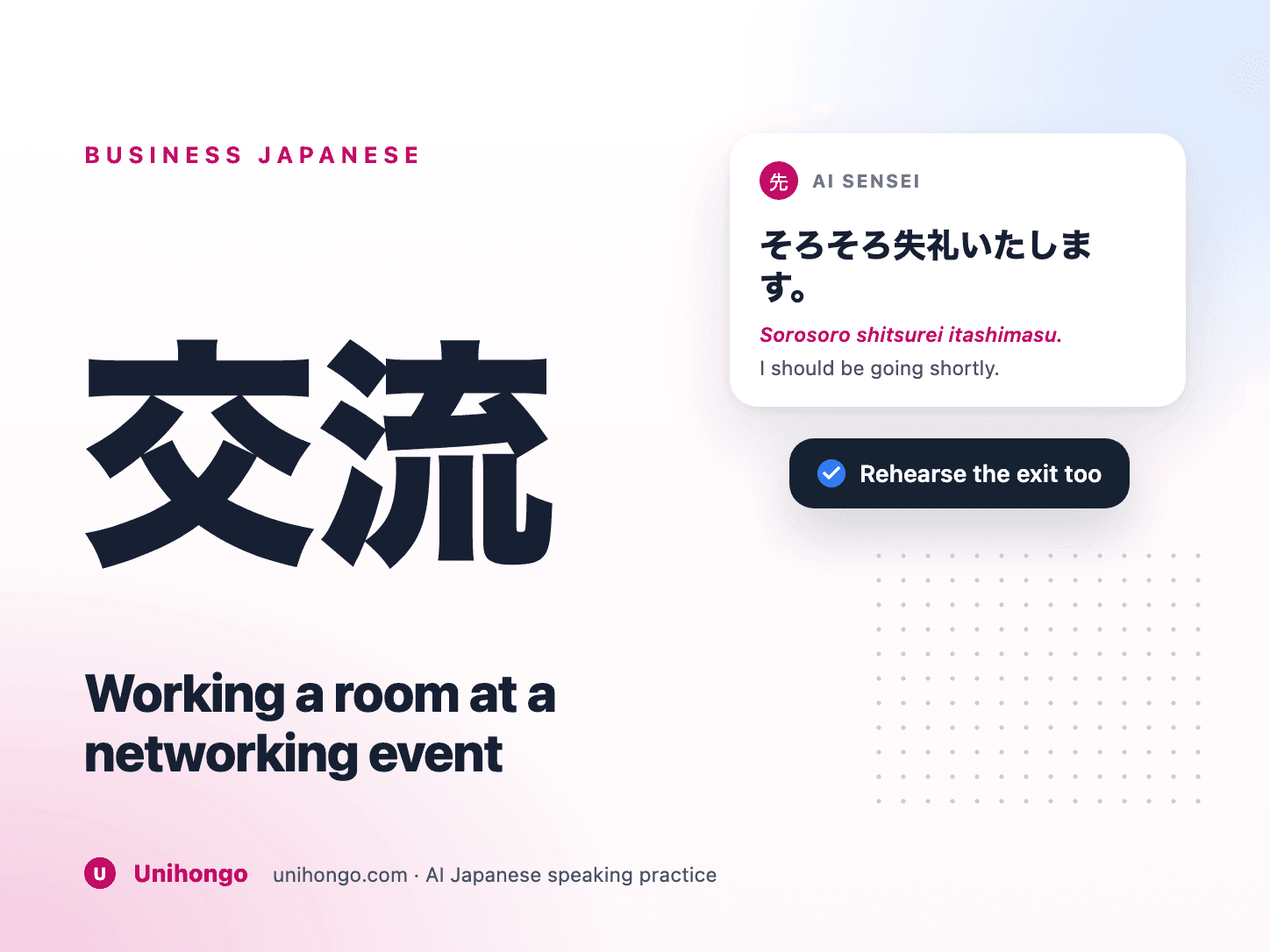
The convention is to signal before you go rather than leaving abruptly. Sorosoro, meaning it is about that time, does most of the work.
| Japanese | Romaji | Meaning |
|---|---|---|
| そろそろ失礼いたします。 | Sorosoro shitsurei itashimasu. | I should be going shortly. |
| お話しできてよかったです。 | Ohanashi dekite yokatta desu. | It was good to talk with you. |
| またぜひお願いいたします。 | Mata zehi onegai itashimasu. | I hope we can speak again. |
| ほかの方にもご挨拶してきます。 | Hoka no kata ni mo goaisatsu shite kimasu. | I will go and greet some others. |
| 後日、ご連絡させていただきます。 | Gojitsu, gorenraku sasete itadakimasu. | I will be in touch at a later date. |
| 失礼いたします。 | Shitsurei itashimasu. | Excuse me. |
Saying that you will go and greet others is honest, expected and gives an unambiguous reason. Nobody takes it as a slight.
The two minutes that are always the same
Networking conversations have a shape, and knowing it means you are never wondering what comes next. Roughly: card, comment on the card, what you each do, one shared point, and an exit with a follow-up promise.
Five moves, of which three can be prepared word for word. That is a much smaller preparation task than it feels like standing in the room.
| Move | Prepared? | Roughly |
|---|---|---|
| Card exchange | Fully | 20 seconds |
| Comment on the card | Yes | 30 seconds |
| What you each do | Yes, one sentence | 1 minute |
| Find a shared point | No | 2-5 minutes |
| Exit and follow-up | Fully | 20 seconds |
Only the fourth row is genuinely unscripted, and it is the shortest thing to prepare for, because it only requires three general questions.
The follow-up that makes it count
An event produces cards, and cards produce nothing without a follow-up. Sending a short message within a day or two, referring to something specific you discussed, is what converts a two-minute conversation into a contact.
Specificity is the whole thing. A generic message of thanks is indistinguishable from every other one they received; a sentence about the thing you actually talked about is not.
Because a networking conversation is short, unscripted and unforgiving of pauses, it repays rehearsal more than most. Running one as a roleplay with your AI Sensei in Unihongo's immersive 3D classroom exposes the gaps while nothing is at stake, and the session report will show whether the register held, which at a business event is the part most likely to slip.
Write the follow-up the same evening, while you still remember which person said what. By the third day the cards are indistinguishable.