
The two numbers and who answers
Japan splits emergencies between two numbers. 110, read hyakutōban, reaches the police and covers crime, traffic accidents and anything threatening. 119, read hyakujūkyū-ban, reaches the fire service, which also dispatches ambulances, so one number serves both a fire and a medical emergency. Both are free from any phone, including the grey and green payphones that still stand in stations and which work without coins in a disaster.
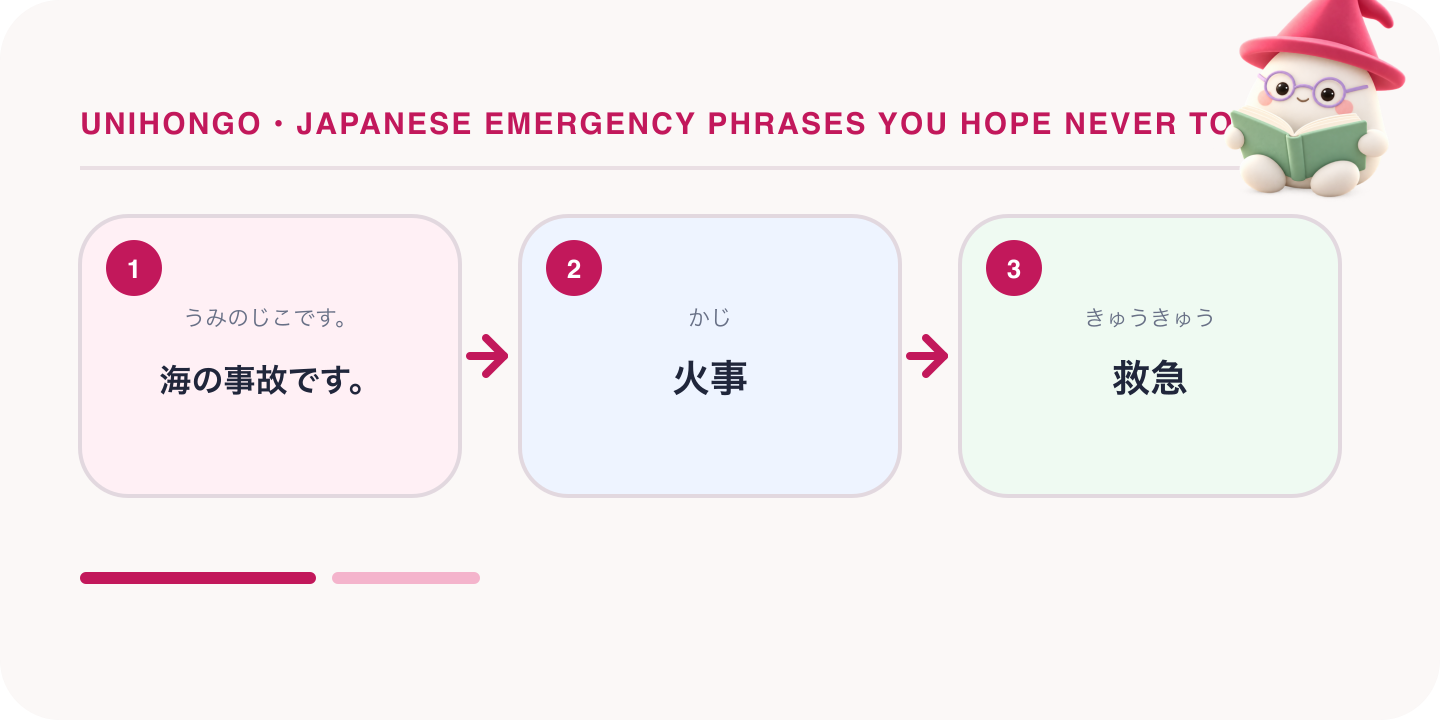
| Number | Who answers | Open with |
|---|---|---|
| 110 | 警察 keisatsu, the police | 泥棒です。 or 事故です。 |
| 119 | 消防 shōbō, fire and ambulance | 火事です。 or 救急です。 |
| 118 | 海上保安庁 kaijō hoanchō, the coast guard | 海の事故です。 |
| #7119 | Medical advice line, available in many areas | Ask whether you need an ambulance |
The #7119 advice line does not exist everywhere and is not for a real emergency; it exists for the case where you are unsure whether a symptom warrants an ambulance. Look up whether your prefecture runs it before you need it, and save the answer in your phone next to the address of your building written in Japanese.
Say what kind of emergency first
The single most useful habit is to lead with the category, not with an apology or an introduction. The operator's first question is kaji desu ka, kyūkyū desu ka, meaning is it a fire or a medical emergency, and answering it before it is asked saves several seconds. One noun plus desu is a complete, correct sentence here. Everything else follows once the dispatcher knows which service to send.
| Japanese | Romaji | Meaning |
|---|---|---|
| 火事です。 | Kaji desu. | There is a fire. |
| 救急です。 | Kyūkyū desu. | This is a medical emergency. |
| 救急車をお願いします。 | Kyūkyūsha o onegai shimasu. | I need an ambulance, please. |
| 交通事故です。 | Kōtsū jiko desu. | There has been a traffic accident. |
| 人が倒れています。 | Hito ga taorete imasu. | Someone has collapsed. |
| けが人がいます。 | Keganin ga imasu. | There is an injured person. |
| 泥棒に入られました。 | Dorobō ni hairaremashita. | Someone has broken into my home. |
The questions the operator will ask
| The operator asks | Romaji | Answer with |
|---|---|---|
| 火事ですか、救急ですか? | Kaji desu ka, kyūkyū desu ka? | One word: 救急です。 |
| 場所はどこですか? | Basho wa doko desu ka? | A ward and a landmark: 渋谷区、駅の近くです。 |
| 住所を教えてください。 | Jūsho o oshiete kudasai. | 住所が分かりません。目印を言います。 |
| どうしましたか? | Dō shimashita ka? | 男の人が倒れました。 |
| けが人は何人ですか? | Keganin wa nan-nin desu ka? | 一人です。 |
| 意識はありますか? | Ishiki wa arimasu ka? | あります。 or ありません。 |
| 息はしていますか? | Iki wa shite imasu ka? | しています。 or していません。 |
| 年齢は分かりますか? | Nenrei wa wakarimasu ka? | 六十歳くらいです。 |
| お名前と電話番号をお願いします。 | O-namae to denwa bangō o onegai shimasu. | Your name, then the number digit by digit |
| 電話を切らないでください。 | Denwa o kiranaide kudasai. | はい、分かりました。 |
Notice how many answers are a single word or a number. That is deliberate on the operator's side: the questions are built so that a frightened caller can answer them. Give the location before the story, because dispatch begins as soon as the address is confirmed and the rest of the call happens while a vehicle is already moving. If you are asked to stay on the line, stay on it.
Giving your location without an address
Japanese streets mostly have no names, and addresses run from ward to district to block to building number, which is hard to read off a sign in a hurry. Three things fix this. Utility poles carry a small plate with the district and block numbers printed on it. Vending machines often have an address sticker on the side. Convenience stores are named after their branch, so reading the sign gives a location by itself. Say what you can see and let the operator do the rest.
| Japanese | Romaji | Meaning |
|---|---|---|
| 住所が分かりません。 | Jūsho ga wakarimasen. | I do not know the address. |
| 電柱に住所が書いてあります。読みます。 | Denchū ni jūsho ga kaite arimasu. Yomimasu. | The address is written on the utility pole. I will read it out. |
| 自動販売機に住所が書いてあります。 | Jidōhanbaiki ni jūsho ga kaite arimasu. | There is an address on the vending machine. |
| 近くにコンビニがあります。看板を読みます。 | Chikaku ni konbini ga arimasu. Kanban o yomimasu. | There is a convenience store nearby. I will read the sign. |
| 新宿駅の南口の近くです。 | Shinjuku-eki no minamiguchi no chikaku desu. | I am near the south exit of Shinjuku Station. |
| 大きな公園の前です。 | Ōkina kōen no mae desu. | I am in front of a large park. |
| マンションの三階、301号室です。 | Manshon no san-gai, san-maru-ichi-gōshitsu desu. | It is flat 301 on the third floor of the block. |
Describing the person who needs help
The dispatcher will ask about consciousness and breathing before anything else, because those two answers change what is sent and what you will be told to do while you wait. Learn ishiki, consciousness, and iki, breath, as a pair. Use the te imasu form for a state you can see right now, as in taorete imasu for someone lying collapsed, and add anything you know about medication or a chronic condition at the end.
| Japanese | Romaji | Meaning |
|---|---|---|
| 意識がありません。 | Ishiki ga arimasen. | He is unconscious. |
| 息をしていません。 | Iki o shite imasen. | She is not breathing. |
| 血がたくさん出ています。 | Chi ga takusan dete imasu. | There is a lot of bleeding. |
| 胸が苦しいと言っています。 | Mune ga kurushii to itte imasu. | He says his chest feels tight. |
| 階段から落ちました。 | Kaidan kara ochimashita. | She fell down the stairs. |
| 持病があります。心臓の薬を飲んでいます。 | Jibyō ga arimasu. Shinzō no kusuri o nonde imasu. | He has a chronic condition and takes heart medicine. |
Getting a bystander to act
A general appeal to a crowd produces hesitation everywhere in the world, so the trick is the same in Japanese as in English: choose one person, look at them, and give them one task. Anata wa, meaning as for you, sounds blunt in ordinary conversation, which is exactly why it works here. Follow it with a single te kudasai instruction and then turn to the next person with a different task.
| Japanese | Romaji | Meaning |
|---|---|---|
| すみません、助けてください。 | Sumimasen, tasukete kudasai. | Excuse me, please help. |
| 誰か来てください。 | Dareka kite kudasai. | Somebody come, please. |
| あなたは119番に電話してください。 | Anata wa hyakujūkyū-ban ni denwa shite kudasai. | You, please call 119. |
| AEDを持ってきてください。 | AED o motte kite kudasai. | Please bring an AED. |
| 警察を呼んでください。 | Keisatsu o yonde kudasai. | Please call the police. |
| 動かないでください。 | Ugokanaide kudasai. | Please do not move. |
Asking for language help on the line
Emergency lines in Japan have some interpreter support, usually as a three-way call brought in after the operator understands what service is needed. That means the fastest route to an interpreter is still to give the category and the location in Japanese first. Say your language plainly, keep your sentences to one clause, and repeat rather than rephrase, because a repeated sentence is easier to catch than a new one.
| Japanese | Romaji | Meaning |
|---|---|---|
| 日本語が少ししか話せません。 | Nihongo ga sukoshi shika hanasemasen. | I can only speak a little Japanese. |
| 英語をお願いします。 | Eigo o onegai shimasu. | English, please. |
| 通訳をお願いできますか? | Tsūyaku o onegai dekimasu ka? | Could I have an interpreter? |
| ゆっくり話してください。 | Yukkuri hanashite kudasai. | Please speak slowly. |
| もう一度お願いします。 | Mō ichido onegai shimasu. | Once more, please. |
Reporting a lost wallet or a theft
Lost property and crime are different reports, and the word you choose decides which one you get. Otoshimashita means you dropped it and leads to an ishitsubutsu todoke, a lost property report. Nusumaremashita means it was stolen and leads to a higai todoke, a criminal report, which is the document an insurer will ask for. Go to the nearest kōban, the small police box on a corner, rather than to a police station.
| Japanese | Romaji | Meaning |
|---|---|---|
| 財布を落としました。 | Saifu o otoshimashita. | I dropped my wallet. |
| 電車の中に忘れました。 | Densha no naka ni wasuremashita. | I left it on the train. |
| 遺失物届を出したいです。 | Ishitsubutsu todoke o dashitai desu. | I would like to file a lost property report. |
| 中に現金とカードが入っています。 | Naka ni genkin to kādo ga haitte imasu. | There is cash and there are cards inside. |
| 盗まれたと思います。 | Nusumareta to omoimasu. | I think it was stolen. |
| 被害届を出したいです。 | Higai todoke o dashitai desu. | I would like to file a criminal report. |
| パスポートをなくしました。 | Pasupōto o nakushimashita. | I have lost my passport. |
The officer will ask doko de nakushimashita ka, where you lost it, nan-ji goro desu ka, roughly what time, and donna saifu desu ka, what the wallet looks like. Prepare a colour, a material and one distinguishing detail. You will also be asked for your residence card or passport, so having a photo of it on your phone speeds the report up considerably.
Earthquake words and what the announcements say
| Japanese | Romaji | Meaning |
|---|---|---|
| 地震 | Jishin | Earthquake |
| 震度 | Shindo | Local shaking intensity, on a scale up to 7 |
| 余震 | Yoshin | Aftershock |
| 津波 | Tsunami | Tsunami |
| 緊急地震速報 | Kinkyū jishin sokuhō | The early warning that sounds on every phone |
| 落ち着いてください。 | Ochitsuite kudasai. | Please stay calm |
| 机の下に入ってください。 | Tsukue no shita ni haitte kudasai. | Get under a desk |
| 火を消してください。 | Hi o keshite kudasai. | Turn off any flames |
| エレベーターは使わないでください。 | Erebētā wa tsukawanaide kudasai. | Do not use the lift |
| 高台に避難してください。 | Takadai ni hinan shite kudasai. | Evacuate to high ground |
| 避難所 | Hinanjo | Evacuation shelter |
| 安否確認 | Anpi kakunin | Checking whether people are safe |
The early warning arrives as a loud two-tone alert and a short line of text naming the region and the expected intensity. It gives seconds, not minutes, so the only useful response is the one you have already rehearsed. Afterwards, station and shop announcements repeat hinan, avoid the lifts, and name the nearest hinanjo, which is usually a local school. Learn the location of yours in advance and note the disaster message dial, 171, which lets you record and retrieve a short safety message when phone lines are congested.
Typhoons and the three grades of warning
| Japanese | Romaji | What it means |
|---|---|---|
| 台風 | Taifū | Typhoon |
| 注意報 | Chūihō | Advisory, the lowest grade, be aware |
| 警報 | Keihō | Warning, take precautions now |
| 特別警報 | Tokubetsu keihō | Emergency warning, the highest grade |
| 大雨 | Ōame | Heavy rain |
| 暴風 | Bōfū | Violent wind |
| 洪水 | Kōzui | Flooding |
| 土砂災害 | Dosha saigai | Landslide |
| 高齢者等避難 | Kōreisha-tō hinan | Older and less mobile residents should leave now |
| 避難指示 | Hinan shiji | Evacuation order for everyone in the area |
| 計画運休 | Keikaku unkyū | Planned suspension of train services |
| 停電 | Teiden | Power cut |
| 断水 | Dansui | Water supply cut |
The grade is the part to read first. Chūihō, keihō and tokubetsu keihō rise in severity, and the noun in front of them tells you what kind: ōame keihō is a heavy rain warning. Keikaku unkyū matters even if the storm passes you by, because railways announce the suspension the day before and simply stop running at the stated hour. Check it in the evening rather than at the station in the morning.
Ill or injured in a hotel
Hotel front desks are the easiest emergency help to reach in Japan, and staff will make the call for you if you give them the room number and one clear sentence. Start with your room number, because that is what they need to send someone up. If you are asking about a clinic rather than an ambulance, say when you need to be seen, since night and weekend cover is limited and reception will know which hospital takes walk-ins.
| Japanese | Romaji | Meaning |
|---|---|---|
| フロントですか。部屋で気分が悪くなりました。 | Furonto desu ka. Heya de kibun ga waruku narimashita. | Is this the front desk? I have become unwell in my room. |
| 部屋は502号室です。 | Heya wa go-maru-ni-gōshitsu desu. | I am in room 502. |
| 救急車を呼んでいただけますか? | Kyūkyūsha o yonde itadakemasu ka? | Could you call an ambulance for me? |
| 近くの病院を教えてください。 | Chikaku no byōin o oshiete kudasai. | Please tell me where the nearest hospital is. |
| 夜間でも診てくれる病院はありますか? | Yakan demo mite kureru byōin wa arimasu ka? | Is there a hospital that sees patients at night? |
| 薬局はまだ開いていますか? | Yakkyoku wa mada aite imasu ka? | Is the pharmacy still open? |
| タクシーを呼んでください。 | Takushī o yonde kudasai. | Please call a taxi. |
If an ambulance does come, take your passport or residence card, your insurance card if you have one, and any medicine you are already taking. The clinic vocabulary on this blog covers what happens once you arrive, from the reception counter to the pharmacy afterwards, and the two sets of phrases are worth learning together.