
The meaning, word by word
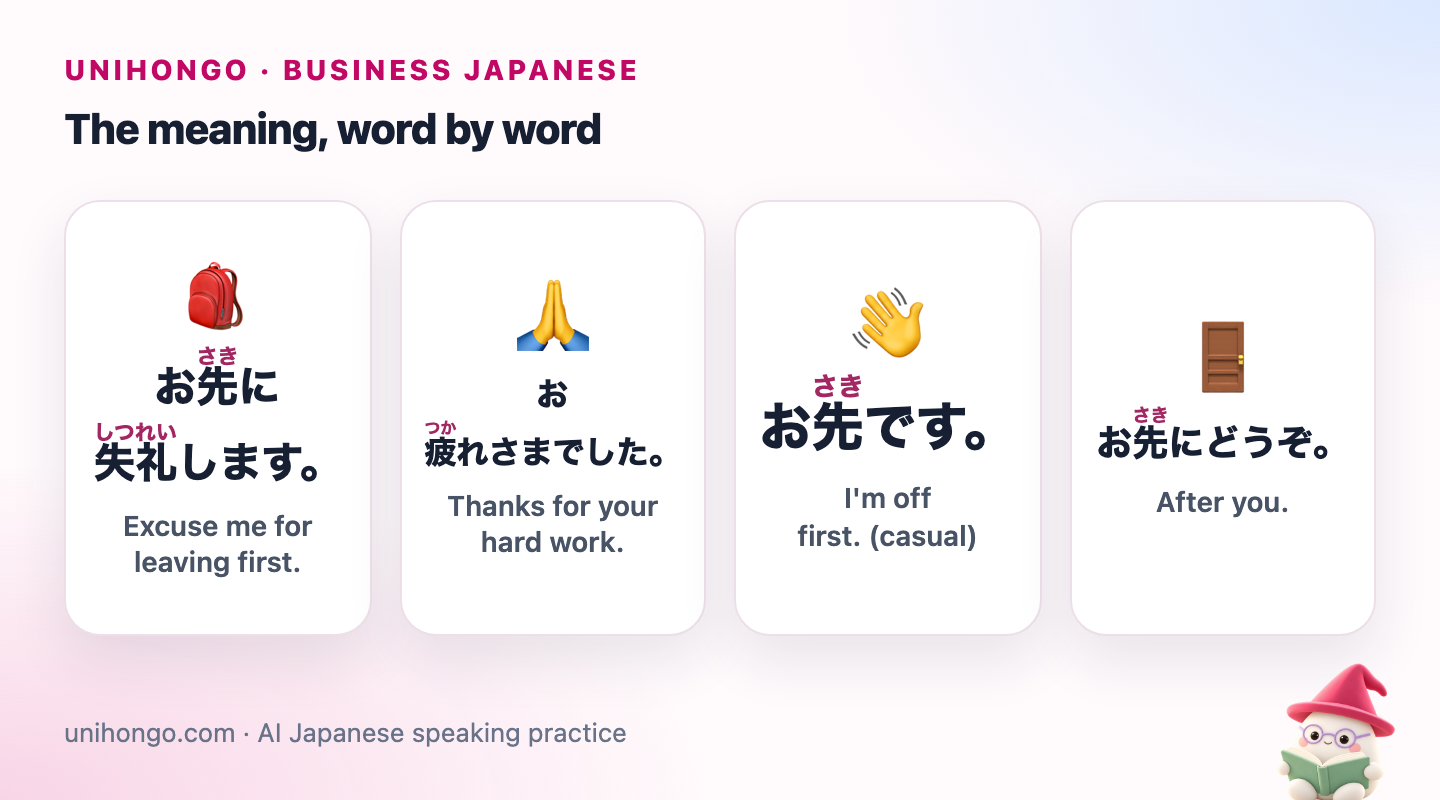
Saki (先) means ahead or first; with the polite o- and the particle ni it becomes osaki ni, ahead of others, before you. Shitsurei (失礼) is written with the kanji for lose and courtesy: a lapse in manners. Shitsurei shimasu, I commit a rudeness, is a general excuse me used when entering and leaving rooms. Put them together and you get excuse me for going ahead of you.
In practice no one hears it as a real apology. It is a ritual that marks your departure and acknowledges that others are still working. The colleague's reply, otsukaresama deshita, thanks you for the work you did today. The two lines together close the working day politely.
| Japanese | Romaji | Meaning |
|---|---|---|
| お先に失礼します。 | Osaki ni shitsurei shimasu. | Excuse me for leaving first. |
| お疲れさまでした。 | Otsukaresama deshita. | Thanks for your hard work. |
| お先です。 | Osaki desu. | I'm off first. (casual) |
| お先にどうぞ。 | Osaki ni dōzo. | After you. |
The full exchange at the end of the day
The typical sequence is short. You finish your work, tidy your desk, maybe check whether anyone needs help, then stand up and say osaki ni shitsurei shimasu loud enough for the people near you. Whoever hears it answers otsukaresama deshita, often without looking up from the screen. Some people add otsukaresama desu themselves before or after the leaving line, especially to a team that is still busy.
If you are leaving early for a reason, a short explanation is courteous but not required. If a deadline is close and others are clearly working late, offering help before you go is a kind touch.
| Japanese | Romaji | Meaning |
|---|---|---|
| 何か手伝えることはありますか。 | Nanika tetsudaeru koto wa arimasu ka. | Is there anything I can help with? |
| 大丈夫、ありがとう。 | Daijōbu, arigatō. | Colleague: We're fine, thanks. |
| では、お先に失礼します。 | Dewa, osaki ni shitsurei shimasu. | Well then, excuse me for leaving first. |
| お疲れさまでした。 | Otsukaresama deshita. | Colleague: Thanks for your hard work. |
| 今日は病院があるので、お先に失礼します。 | Kyō wa byōin ga aru node, osaki ni shitsurei shimasu. | I have a hospital appointment, so I'll leave first today. |
| お大事に。 | Odaiji ni. | Colleague: Take care of yourself. |
Casual, polite and humble versions
The full phrase is safe with everyone. Among colleagues of your own age, or in a relaxed team, people shorten it. With clients or very senior people, the humble itashimasu version adds formality.
| Japanese | Romaji | Meaning |
|---|---|---|
| お先に失礼いたします。 | Osaki ni shitsurei itashimasu. | Excuse me for leaving first. (humble, formal) |
| お先に。 | Osaki ni. | I'm heading off. (casual) |
| お疲れ! | Otsukare! | Good work today! (casual reply) |
| お疲れさま。気をつけてね。 | Otsukaresama. Ki o tsukete ne. | Good work. Get home safe. (to a junior or peer) |
| Version | Who says it to whom | Typical reply |
|---|---|---|
| Osaki ni shitsurei itashimasu | To clients, executives, very formal settings | Otsukaresama deshita |
| Osaki ni shitsurei shimasu | Standard; fine with anyone at work | Otsukaresama deshita |
| Osaki desu / osaki ni | To friendly colleagues, part-time staff, peers | Otsukaresama / otsukare |
| Osaki! | Very casual, close coworkers and friends | Otsukare! |
In shops and restaurants, part-time staff use the same phrases with their coworkers when their shift ends, often in the quick osaki desu form.
Who replies what: otsukaresama vs gokurōsama
Otsukaresama deshita works in every direction: up to the boss, across to peers, down to juniors. Gokurōsama (ご苦労さま) also thanks someone for their effort, but it carries a top-down feeling, as if an employer is thanking a worker. Many people consider it rude when said to a superior, and many managers now avoid it altogether and simply say otsukaresama.
So the safe rule for learners is easy: whenever someone says osaki ni shitsurei shimasu to you, answer otsukaresama deshita.
| Japanese | Romaji | Meaning |
|---|---|---|
| お疲れさまでした。 | Otsukaresama deshita. | Thanks for your work. (safe in every direction) |
| ご苦労さま。 | Gokurōsama. | Thanks for your trouble. (top-down only) |
| また明日。 | Mata ashita. | See you tomorrow. (casual) |
| 失礼します。 | Shitsurei shimasu. | Excuse me. (leaving a room or ending a call) |
Osaki ni in everyday life: after you
Outside the office, osaki ni appears whenever someone goes first. Osaki ni dōzo, please go ahead, is what you say when you hold a door, let someone into the lift, or wave a person with fewer items ahead of you at the supermarket. When someone offers you the turn, osaki ni (or sumimasen, osaki ni) is the polite thanks as you go.
At meals, osaki ni itadakimasu means I'll start eating before you, useful when your food arrives first. And at the end of a party, someone leaving early says osaki ni shitsurei shimasu to the table, which usually gets a chorus of otsukaresama or ki o tsukete.
| Japanese | Romaji | Meaning |
|---|---|---|
| お先にどうぞ。 | Osaki ni dōzo. | Please go ahead. (after you) |
| すみません、お先に。 | Sumimasen, osaki ni. | Thanks, I'll go ahead. |
| お先にいただきます。 | Osaki ni itadakimasu. | I'll start eating before you. |
| 明日早いので、お先に失礼します。 | Ashita hayai node, osaki ni shitsurei shimasu. | I have an early start, so I'll head off first. |
Leaving the office: a short scene
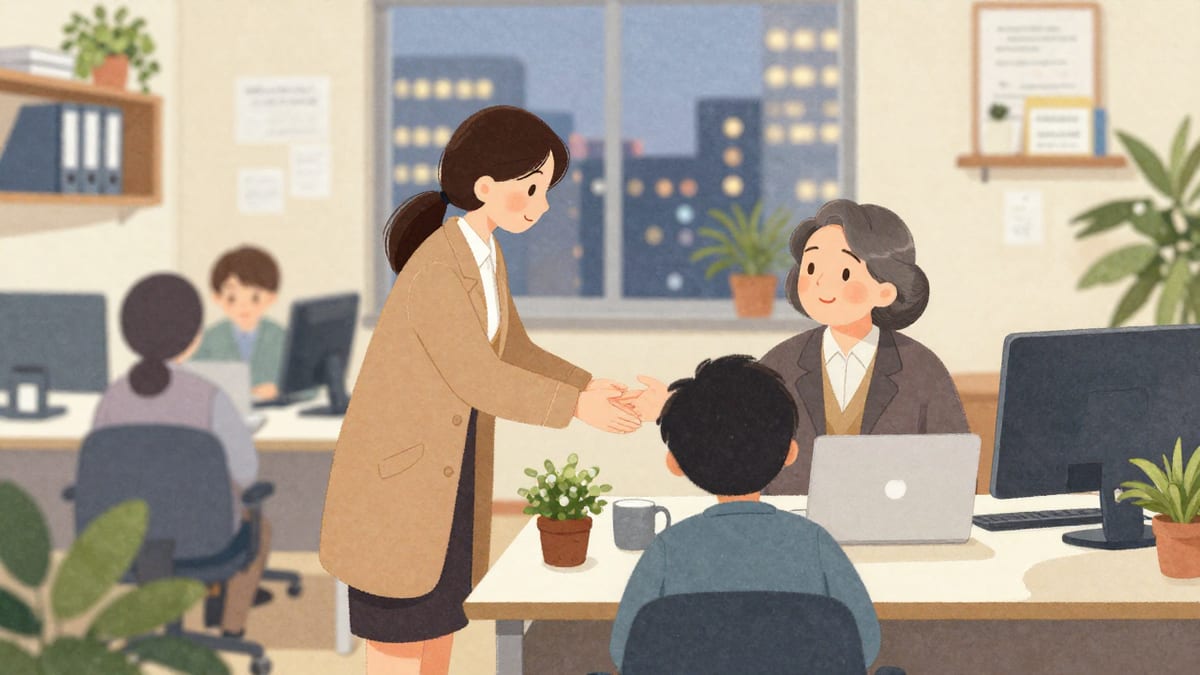
Here is a realistic end-of-day exchange. A new team member finishes at six while her manager and a colleague are still working on a presentation.
| Japanese | Romaji | Meaning |
|---|---|---|
| 資料の準備、手伝いましょうか。 | Shiryō no junbi, tetsudaimashō ka. | New member: Shall I help prepare the materials? |
| ありがとう。もうすぐ終わるから大丈夫。 | Arigatō. Mōsugu owaru kara daijōbu. | Manager: Thanks, we're almost done, so it's fine. |
| では、お先に失礼します。 | Dewa, osaki ni shitsurei shimasu. | New member: Then excuse me for leaving first. |
| お疲れさまでした。 | Otsukaresama deshita. | Manager: Thanks for your hard work. |
| お疲れさま。また明日ね。 | Otsukaresama. Mata ashita ne. | Colleague: Good work. See you tomorrow. |
Common mistakes
Most mistakes with this phrase are not grammar mistakes but timing and pairing mistakes. The words are easy; knowing when to say them, and which reply goes with which line, is what makes you sound at home in a Japanese workplace. If you are new, watch what your colleagues do for the first week: some teams say the line loudly to the whole floor, others only to the people nearby, and in large open offices people sometimes just bow to their own group.
Part-time workplaces have their own rhythm too. In a café or a convenience store, the person finishing a shift often says osaki ni shitsurei shimasu to the staff still working and otsukaresama desu to the person taking over, and the replies come back just as fast.
| Japanese | Romaji | Meaning |
|---|---|---|
| 昨日はお先に失礼しました。 | Kinō wa osaki ni shitsurei shimashita. | Sorry for leaving before you yesterday. |
| お疲れさまです。 | Otsukaresama desu. | Hello, thanks for your work. (during the day) |
- Leaving silently. Even in a quiet office, a short osaki ni shitsurei shimasu is expected.
- Saying sayōnara to the team. It sounds distant or school-like.
- Replying gokurōsama to your boss. Use otsukaresama deshita.
- Saying osaki ni shitsurei shimashita as you leave. The present form is standard at the door; the past form is used later, for example the next morning: kinō wa osaki ni shitsurei shimashita.
- Using it when everyone leaves together. If nobody is staying, just say otsukaresama deshita to each other.