
Four names from the moon
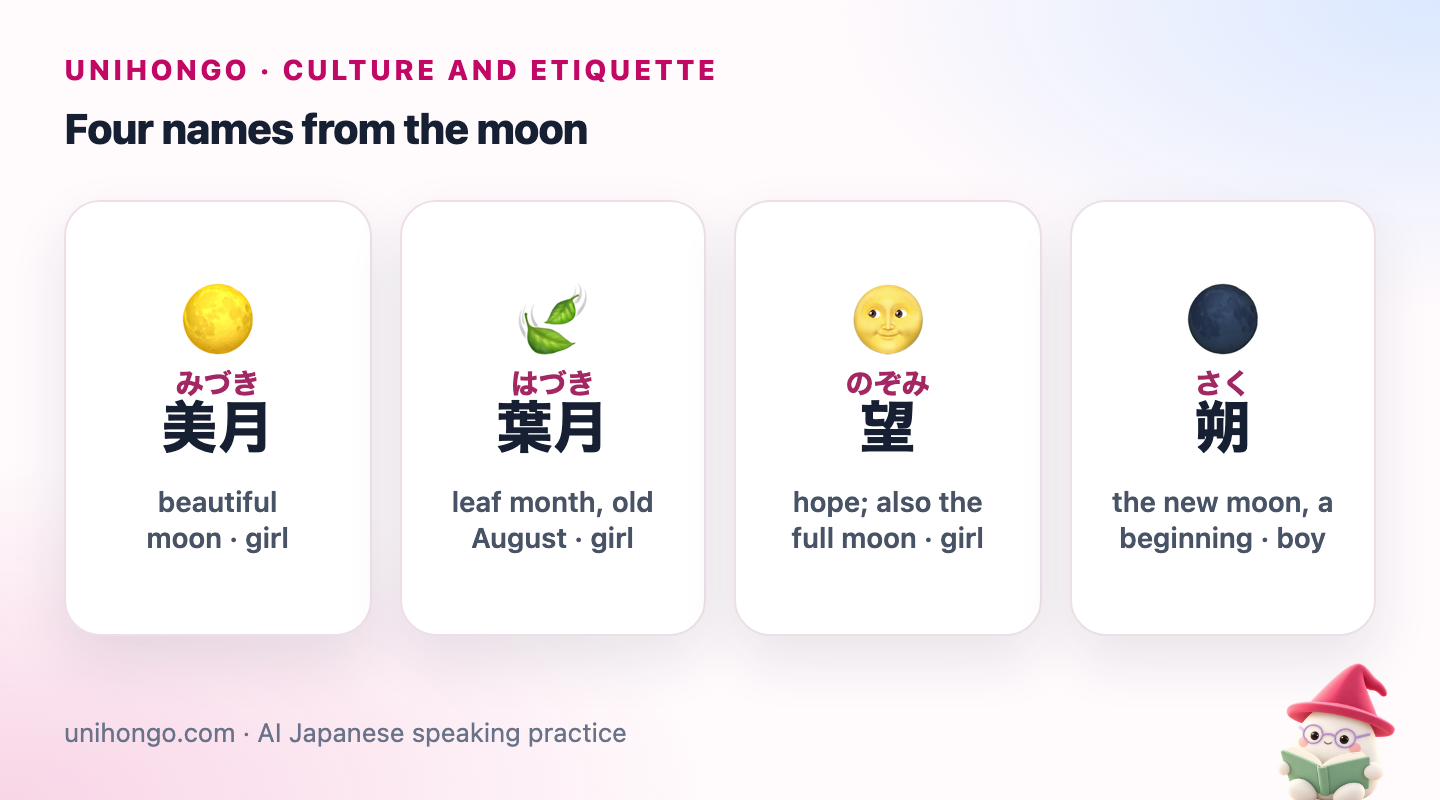
These four names show the main ways the moon enters a name: the kanji 月 itself, an old month name, and moon-related kanji with a second meaning.
| Japanese | Romaji | Meaning |
|---|---|---|
| 美月 | Mizuki | beautiful moon · girl |
| 葉月 | Hazuki | leaf month, old August · girl |
| 望 | Nozomi | hope; also the full moon · girl |
| 朔 | Saku | the new moon, a beginning · boy |
朔 is the first day of a month in the old lunar calendar, when the moon is dark and new. Parents who choose it like the image of a fresh start. 望 means hope in everyday words like 希望, kibō, and in the old calendar it is also the night of the full moon, which gives the name a double meaning.
How 月 is read in names
In everyday words 月 has several readings: tsuki on its own, getsu in 月曜日 (getsuyōbi, Monday), gatsu in month names such as 一月 (ichigatsu, January). In names, the usual readings are tsuki and zuki; the sound change from tsuki to zuki in the middle of a name is the same one you hear in 三日月, mikazuki, crescent moon.
This means the same spelling can give different names. 美月 can be Mizuki or Mitsuki, and parents decide which.
| Japanese | Romaji | Meaning |
|---|---|---|
| 美月 | Mitsuki | beautiful moon · girl |
| 結月 | Yuzuki | tie + moon · girl |
| 菜月 | Natsuki | greens + moon · girl |
| 紗月 | Satsuki | fine silk gauze + moon · girl |
| 優月 | Yuzuki | gentle + moon · girl |
Natsuki is often heard as natsu, summer, and some parents write it 夏月, summer moon. Satsuki written 紗月 sounds like the old month name 皐月 but uses a different first kanji, chosen for its soft look.
The old month names
Before Japan adopted the Western calendar, each month had a poetic name, the wafū getsumei (和風月名). They are still printed on calendars and used in letters, and several are lovely names. They belonged to the lunar calendar, so their seasons sit about a month later than the modern months they are matched with today.
| Japanese | Romaji | Meaning |
|---|---|---|
| 睦月 | Mutsuki | harmony month, January · unisex (rare) |
| 弥生 | Yayoi | growing, March · girl |
| 皐月 | Satsuki | rice-planting month, May · girl |
| 卯月 | Uzuki | deutzia month, April · girl (rare) |
| Month | Old name | Reading and common explanation |
|---|---|---|
| January | 睦月 | Mutsuki: the month of getting along, family gatherings |
| March | 弥生 | Yayoi: plants growing more and more |
| April | 卯月 | Uzuki: the month of the deutzia flower |
| May | 皐月 | Satsuki: rice-planting time |
| August | 葉月 | Hazuki: the month of leaves |
| November | 霜月 | Shimotsuki: the frost month |
The explanations of these names are traditional and some are debated, so treat them as the usual stories rather than certain origins. Yayoi has no 月 in it but is one of the best-known month names for girls. If a person is called Satsuki or Hazuki, people may guess they were born in May or August; often that is true.
Moon words behind the names
Knowing a few moon words helps you understand names and gives you good small talk. These words also appear in songs, poems and seasonal greetings.
| Japanese | Romaji | Meaning |
|---|---|---|
| 満月 | mangetsu | full moon |
| 三日月 | mikazuki | crescent moon |
| 新月 | shingetsu | new moon |
| 月明かり | tsukiakari | moonlight |
| お月見 | otsukimi | moon viewing |
| 十五夜 | jūgoya | the harvest moon night |
Jūgoya, the fifteenth night, is the night of the harvest moon in the old calendar. It falls in September or early October and changes every year. Families may set out round dumplings and pampas grass and look at the moon, and children hear that the shapes on the moon are a rabbit making mochi. A popular story also says that a famous novelist once suggested Tsuki ga kirei desu ne, the moon is beautiful, as a Japanese way to say I love you; it is probably a legend, but everyone knows it.
Talking about a moon name
If someone has a moon name, they have probably explained it many times, and most people like being asked. Ask about the kanji, then about the story: were they born on a full moon, in a particular month, on a clear autumn night?
| Japanese | Romaji | Meaning |
|---|---|---|
| 月が綺麗ですね。 | Tsuki ga kirei desu ne. | The moon is beautiful tonight. |
| 「みづき」は美しい月と書きます。 | "Mizuki" wa utsukushii tsuki to kakimasu. | Mizuki is written beautiful moon. |
| 満月の夜に生まれたそうです。 | Mangetsu no yoru ni umareta sō desu. | I was born on a full-moon night, I'm told. |
| 八月生まれなので、葉月です。 | Hachigatsu umare na node, Hazuki desu. | I was born in August, so I'm Hazuki. |
Note sō desu in the third line: you were a baby, so you report what you heard. It is the natural way to tell any story about your own birth.
Mini dialogue: moon viewing with a friend
| Japanese | Romaji | Meaning |
|---|---|---|
| 今日は十五夜だね。 | Kyō wa jūgoya da ne. | Friend: Tonight is the harvest moon, isn't it. |
| そういえば、名前に月が入ってるよね。 | Sō ieba, namae ni tsuki ga haitteru yo ne. | You: Come to think of it, your name has moon in it. |
| うん、結月。結ぶに月。 | Un, Yuzuki. Musubu ni tsuki. | Friend: Yeah, Yuzuki. Musubu, to tie, plus moon. |
| 人とつながる月、みたいな? | Hito to tsunagaru tsuki, mitai na? | You: Like a moon that connects people? |
| そうそう、母がつけてくれたんだ。 | Sō sō, haha ga tsukete kureta n da. | Friend: Exactly, my mum chose it. |
Choosing a moon name for a baby, a pet or a character
If you are choosing a moon name yourself, think the way Japanese parents do. First, the meaning: 月 is beautiful, but combined with another kanji it changes; 美月 is graceful, 結月 suggests connection, 葉月 points to August. Second, the sound with the family name: say the full name aloud many times and check that it flows and that it does not repeat the same sounds awkwardly. Third, readability: a name like Mizuki is easy, while a creative reading of 月 as Runa will need explaining every time.
Moon names also suit pets and fictional characters, and Japanese people often give cats and dogs gentle nature names. For a character in a story or a game, a moon name can hint at a calm or mysterious personality. In every case, ask a native speaker to read the name back to you: if they hesitate over the reading, others will too.
| Japanese | Romaji | Meaning |
|---|---|---|
| 呼びやすい名前ですね。 | Yobiyasui namae desu ne. | It's an easy name to say. |
| 読みやすいですか。 | Yomiyasui desu ka. | Is it easy to read? |
| 苗字と合っていますか。 | Myōji to atte imasu ka. | Does it go well with the family name? |
| この漢字、名前に使えますか。 | Kono kanji, namae ni tsukaemasu ka. | Can this kanji be used in a name? |
The last question is worth asking for real baby names: only kanji from the official lists can be registered, and a native speaker or the town office can tell you. For a character or a pet, any kanji is possible, but natural is still better than clever.
Learn the moon months with Mocchi
Ask Mocchi: /kanji 月, and you get its meanings, its readings and everyday words such as 月曜日 and 満月. Follow up with: Quiz me on the old Japanese month names, one at a time, Japanese to English. Mocchi keeps track of the months you miss, so Uzuki and Shimotsuki come back in your next review instead of the ones you already know.
If you want them in your daily plan, say so: Add the old month names to my plan this week. Plan steps run right in the chat, so each day's task is a short, focused quiz.
Mistakes to avoid with moon names
- Mixing up Mizuki and Mitsuki. Both can be 美月; ask which one, and say the small difference clearly: zu versus tsu.
- Thinking 月 in a name always means moon. In month names it means month, and in 月曜日 it means Monday.
- Reading every month name with gatsu. Old names use tsuki or zuki: Hazuki, not Hagatsu.
- Assuming a moon name is old-fashioned. Mizuki, Yuzuki and Natsuki are common modern names.
- Guessing a creative reading. If you see 月 alone, it might be read Runa, Tsuki or another reading; ask before you say it.