
Family words before family names
Before the names, learn the words for the family itself. Japanese distinguishes older and younger siblings, and the polite words for other people's family members are different from the plain words for your own. Osoroi, matching, is the word parents use for names that go together.
| Japanese | Romaji | Meaning |
|---|---|---|
| おそろいの漢字 | osoroi no kanji | a matching kanji |
| 兄弟 | kyōdai | siblings, brothers |
| 姉妹 | shimai | sisters |
| 双子 | futago | twins |
| 末っ子 | suekko | the youngest child |
| 一人っ子 | hitorikko | an only child |
Kyōdai is written with the kanji for older and younger brother, but people use it for any mix of siblings: san nin kyōdai desu, there are three of us, can include sisters. To be specific about a brother and sister, you can say ani to imōto, or kyōdai again with a short explanation.
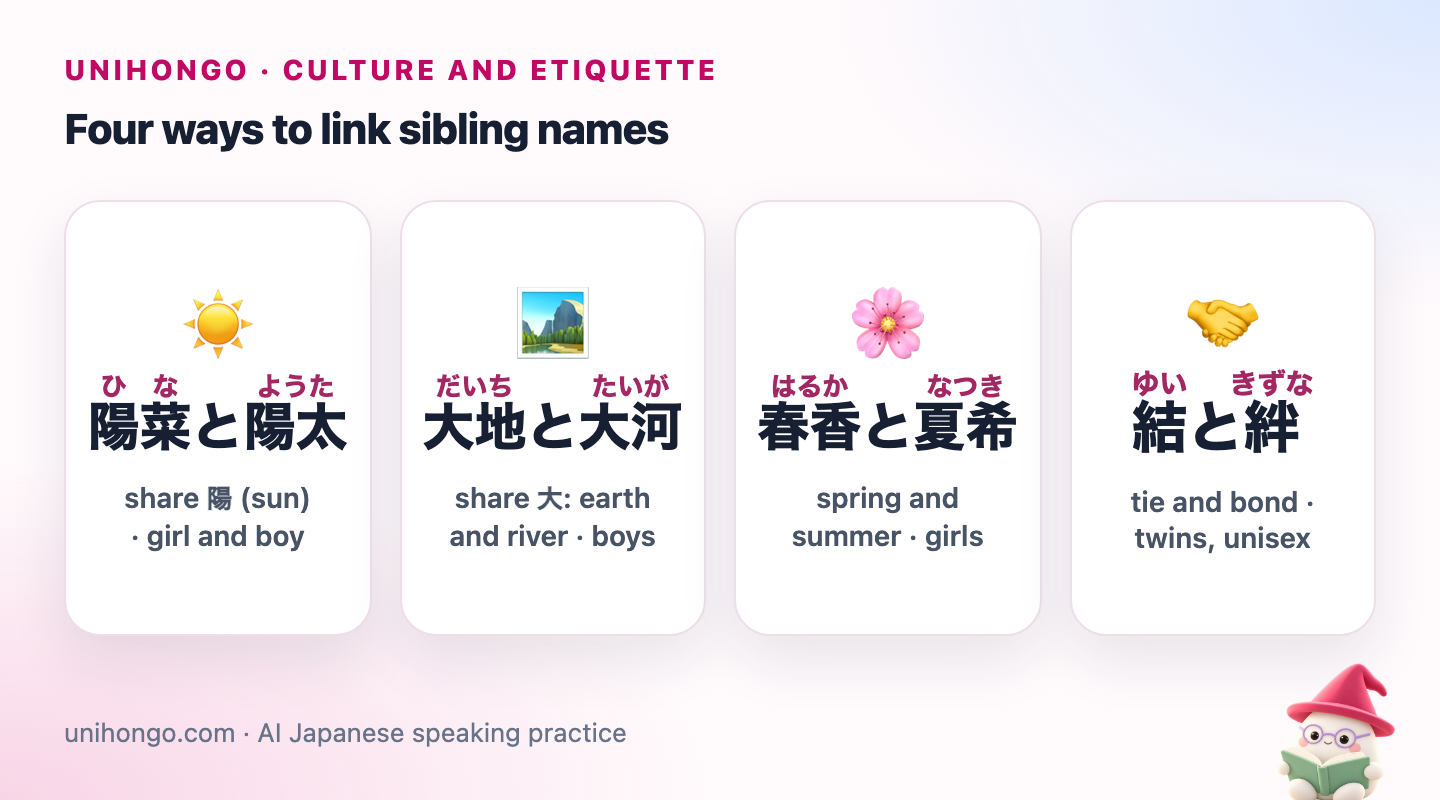
Four ways to link sibling names
These four pairs show the main patterns. The first two share a kanji, the third shares a theme, and the fourth makes a pair of meanings. Each pattern can be used for brothers, sisters or a mix.
| Japanese | Romaji | Meaning |
|---|---|---|
| 陽菜と陽太 | Hina to Yōta | share 陽 (sun) · girl and boy |
| 大地と大河 | Daichi to Taiga | share 大: earth and river · boys |
| 春香と夏希 | Haruka to Natsuki | spring and summer · girls |
| 結と絆 | Yui to Kizuna | tie and bond · twins, unisex |
Notice that 陽 is read hi in Hina and yō in Yōta. Sharing a kanji does not mean sharing a sound, and that is part of the charm: the link is visible on paper and invisible in speech.
Sharing a kanji
The most common link is a shared kanji. When it is the first kanji, everyone sees the connection immediately. When it is the ending, the link is softer and the names can sound very different. Some families go further and keep one kanji across generations: this is called tsūji (通字), a tradition of samurai and noble houses that some families still follow, especially for sons.
| Japanese | Romaji | Meaning |
|---|---|---|
| 健一と健二 | Ken'ichi to Kenji | share 健 (health) · first and second son |
| 美咲と美優 | Misaki to Miyu | share 美 (beauty) · sisters |
| 翔太と颯太 | Shōta to Sōta | share 太 ending · brothers |
| 彩花と萌花 | Ayaka to Moeka | share 花 ending · sisters |
| 通字 | tsūji | a kanji passed down the generations |
Ken'ichi and Kenji follow an older pattern, a shared kanji plus a number for birth order: one, two. It sounds classic now. Modern parents more often share a kanji with a meaning they love and let the rest of each name be individual.
Sharing a theme
A theme links names without repeating a kanji. Parents choose a family of ideas, seasons, the natural world, colours, flowers, and give each child one piece. These names often have a story the family enjoys telling: we named the first after the sky, and the second after the sea.
| Japanese | Romaji | Meaning |
|---|---|---|
| 空 | Sora | sky · unisex |
| 陸 | Riku | land · boy |
| 海 | Kai | sea · boy |
| 椿 | Tsubaki | camellia · girl |
| Theme | Pair | Readings and meanings |
|---|---|---|
| Seasons | 春香 / 夏希 | Haruka (spring fragrance), Natsuki (summer hope) |
| Sky and sea | 空 / 海 | Sora (sky), Umi (sea) |
| Land and sea | 陸 / 海 | Riku (land), Kai (sea) |
| Flowers | 桜 / 椿 | Sakura (cherry blossom), Tsubaki (camellia) |
| Colours | 茜 / 葵 | Akane (deep red), Aoi (hollyhock, sounds like blue) |
The same kanji can be read differently in a theme pair: 海 is Umi for a girl and Kai for a boy, depending on the family. As always, ask how each name is read before you write it.
Naming twins
Twins are the moment many parents enjoy designing a pair. Some choose two halves of one idea, such as tie and bond, or light and hope. Some share a kanji. Many think hard about how the names sound side by side, because twins spend years being called together.
A common worry is names that are too similar, such as Yūto and Yūta, which differ by one vowel. Teachers and friends mix them up, and the twins may dislike it. Many parents therefore keep a visible link in the kanji and make the sounds clearly different. Others prefer completely independent names, so each twin feels like an individual, and some choose names that start with different sounds so that the twins can be told apart at a glance on a class list.
| Japanese | Romaji | Meaning |
|---|---|---|
| 一卵性の双子 | ichiransei no futago | identical twins |
| 二卵性の双子 | niransei no futago | fraternal twins |
| 男女の双子 | danjo no futago | boy-girl twins |
| 光と希 | Hikari to Nozomi | light and hope · twin girls |
| 名前が似ていて、よく間違えられます。 | Namae ga nite ite, yoku machigaeraremasu. | Our names are similar, so people mix us up. |
Twins in Japan are usually described as older and younger, ane and imōto or ani and otōto, with the first-born treated as the elder. Families often refer to them by name rather than by order, which is one more reason the names matter.
Talking about brothers and sisters
Questions about siblings come up early in any friendship or workplace in Japan. Use the plain words for your own family and the polite words for someone else's. These phrases cover the usual questions and answers.
| Japanese | Romaji | Meaning |
|---|---|---|
| ご兄弟はいますか。 | Gokyōdai wa imasu ka. | Do you have any siblings? (polite) |
| 三人兄弟の真ん中です。 | Sannin kyōdai no mannaka desu. | I'm the middle of three. |
| 姉が一人と弟が一人います。 | Ane ga hitori to otōto ga hitori imasu. | I have an older sister and a younger brother. |
| お姉さんは何歳ですか。 | Onēsan wa nansai desu ka. | How old is your older sister? |
| 名前に同じ漢字が入っているんです。 | Namae ni onaji kanji ga haitte iru n desu. | Our names have the same kanji. |
Ane and otōto are for your own siblings; onēsan and otōtosan are for someone else's. Mixing them up is one of the most common family mistakes, and Japanese people will understand, but switching correctly sounds much more natural.
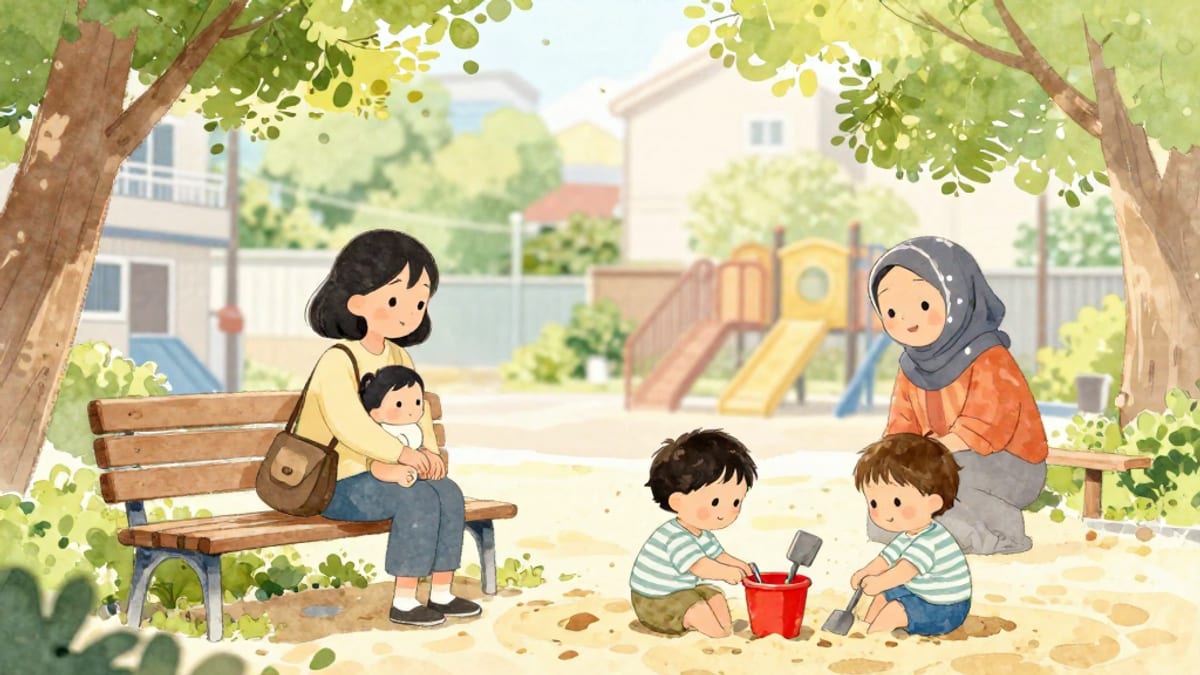
Mini dialogue: twins at the park
| Japanese | Romaji | Meaning |
|---|---|---|
| 双子ちゃんですか。かわいいですね。 | Futago chan desu ka. Kawaii desu ne. | You: Are they twins? How sweet. |
| はい、二歳です。結と絆っていいます。 | Hai, nisai desu. Yui to Kizuna tte iimasu. | Parent: Yes, they're two. They're Yui and Kizuna. |
| 素敵な名前ですね。何か意味があるんですか。 | Suteki na namae desu ne. Nanika imi ga aru n desu ka. | You: Lovely names. Do they have a meaning? |
| 二人でずっとつながっていてほしくて。 | Futari de zutto tsunagatte ite hoshikute. | Parent: We want them to stay connected, always. |
| どっちがお姉ちゃんですか。 | Dotchi ga onēchan desu ka. | You: Which one is the big sister? |
| 結です。五分だけ早く生まれました。 | Yui desu. Gofun dake hayaku umaremashita. | Parent: Yui. She was born just five minutes earlier. |
Your family vocabulary plan with Mocchi
- Ask Mocchi to "add a week of family vocabulary to my plan, including sibling and twin words." Mocchi adjusts your personal plan with small daily tasks, and the finished ones tick themselves off.
- Type /grammar to onaji and Mocchi explains how to say same as, with examples like namae ni onaji kanji ga aru.
- Turn the words into flashcards and run them in Vocabulary Dash, the 3D word runner, with your own deck.
- When you are ready to talk, ask Haru-sensei in AI Sensei to play a parent of twins at a park and tell you their story.
Mistakes to avoid when talking about siblings
- Using ani or ane for someone else's brother or sister. Use oniisan and onēsan for other people's family.
- Assuming kyōdai means only brothers. It is used for siblings of any gender.
- Commenting that twins' names are too similar. Parents have heard it before; ask about the meaning instead.
- Reading a shared kanji the same way in both names. 陽 can be hi in one name and yō in another.
- Asking which twin is better at something. Comparisons between siblings can feel unkind; praise both.