

Nemui: the basic way to say I'm sleepy
眠い (nemui) is an i-adjective meaning sleepy. Because it is an adjective, the present form describes how you feel now: nemui, "I'm sleepy". In polite speech add desu: nemui desu. The past, nemukatta, means you were sleepy earlier, and the negative is nemukunai.
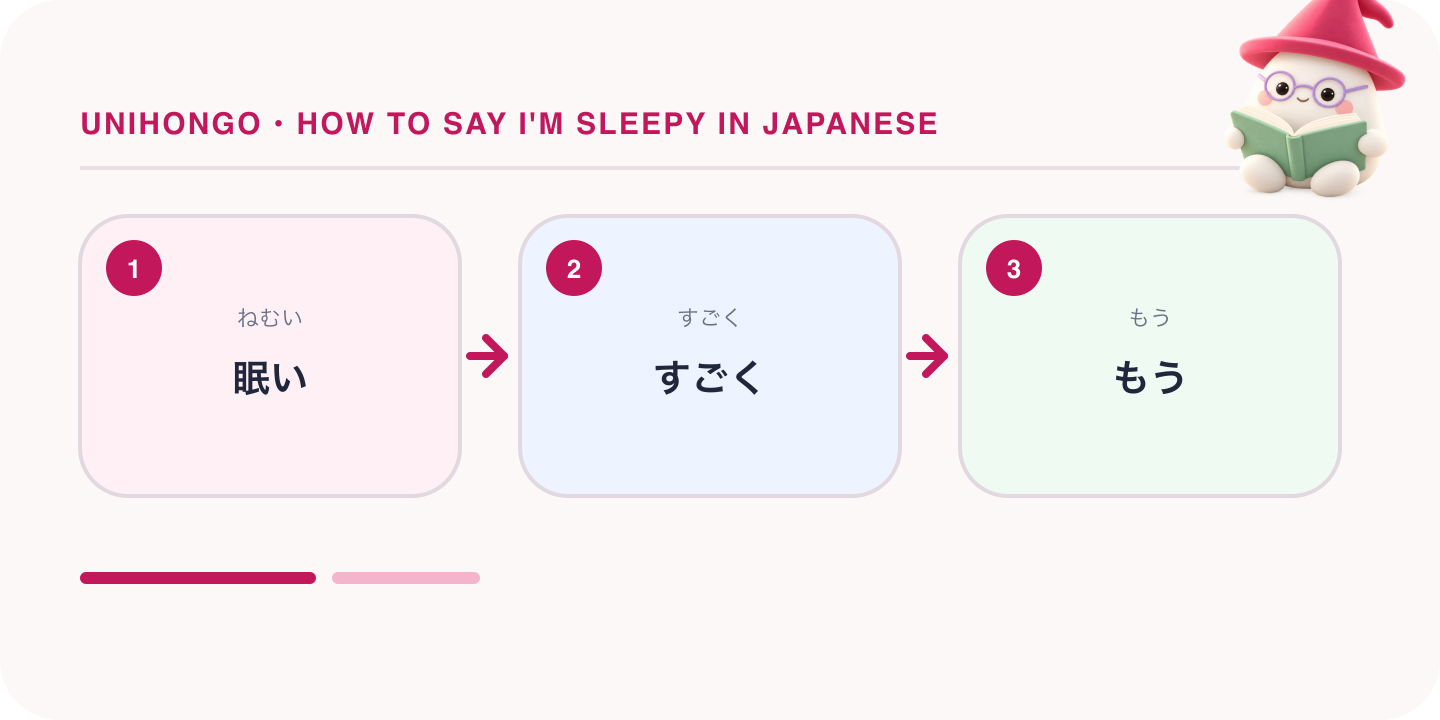
Casually, the vowel is often stretched or the ending changed: nemūi, or the slangier nemu, clipped short. With friends, a yawning ā, nemui is about as natural as Japanese gets. Sugoku, really, or mō, already, add emphasis.
| Japanese | Romaji | Meaning |
|---|---|---|
| あー、眠い。 | Ā, nemui. | Ah, I'm sleepy. |
| 眠いです。 | Nemui desu. | I'm sleepy. (polite) |
| すごく眠い。 | Sugoku nemui. | I'm really sleepy. |
| もう眠くなってきた。 | Mō nemuku natte kita. | I'm starting to get sleepy. |
| 昨日は眠かった。 | Kinō wa nemukatta. | I was sleepy yesterday. |
| 眠くない? | Nemukunai? | Aren't you sleepy? |
Nemutai, nemuke and sleepy word families
眠たい (nemutai) means the same as nemui but sounds softer and a little more drawn out. Children use it a lot, and it is common in some regions, including Kansai. Adults use it casually too, often to sound less blunt.
眠気 (nemuke) is the noun: drowsiness. Nemuke ga suru means "I feel drowsy", and nemuke ni osowareru, "to be attacked by drowsiness", is a common expression for a wave of sleepiness you cannot fight. Nemuke-zamashi is something that wakes you up, such as coffee or cold water on your face.
| Japanese | Romaji | Meaning |
|---|---|---|
| 眠たい。 | Nemutai. | I'm sleepy. (softer) |
| なんだか眠気がする。 | Nandaka nemuke ga suru. | I feel kind of drowsy. |
| 昼ご飯の後、眠気に襲われた。 | Hirugohan no ato, nemuke ni osowareta. | After lunch a wave of sleepiness hit me. |
| 眠気覚ましにコーヒーを飲もう。 | Nemuke-zamashi ni kōhī o nomō. | Let's have a coffee to wake up. |
| 眠気が取れない。 | Nemuke ga torenai. | I can't shake off the sleepiness. |
Uto uto, neboke and other sleepy sounds
Japanese sound words describe sleepiness in detail. うとうと (uto uto) is lightly dozing, drifting in and out, typically on a train, in a warm room or in front of a film. Kokkuri kokkuri describes the head nodding forward as you fall asleep sitting up.
寝ぼけ (neboke) is the groggy, confused state right after waking. Nebokete iru means "I'm still half asleep", and nebokete is often used to explain a silly mistake first thing in the morning. 居眠り (inemuri) is dozing off where you should be awake, such as in a meeting or a class; inemuri unten is falling asleep at the wheel.
| Japanese | Romaji | Meaning |
|---|---|---|
| 電車でうとうとしてしまった。 | Densha de uto uto shite shimatta. | I dozed off on the train. |
| ごめん、まだ寝ぼけてる。 | Gomen, mada neboketeru. | Sorry, I'm still half asleep. |
| 寝ぼけて間違えた。 | Nebokete machigaeta. | I made a mistake because I was half asleep. |
| 会議中に居眠りしそうになった。 | Kaigi-chū ni inemuri shisō ni natta. | I nearly nodded off in the meeting. |
| こっくりこっくりしている。 | Kokkuri kokkuri shite iru. | He's nodding off. |
| 寝落ちしちゃった。 | Neochi shichatta. | I fell asleep mid-chat. (slang) |
Nemui vs tsukareta: sleepy or tired
English speakers often say "I'm tired" when they mean sleepy, and translate it as tsukareta. In Japanese the two feelings are clearly separate. Nemui is about wanting to sleep; tsukareta is about energy being used up. After a big lunch in a warm office you are nemui. After moving house you are tsukareta, and possibly nemui as well.
When you are short of sleep, the key word is 寝不足 (nebusoku). It explains both feelings at once and gives the listener a reason, which Japanese speakers generally appreciate.
| Word | Meaning | Typical situation |
|---|---|---|
| 眠い | Sleepy | After lunch, late at night |
| 疲れた | Tired, worn out | After work, exercise, travel |
| 寝不足 | Short of sleep | After a late night |
| だるい | Heavy, sluggish | Coming down with a cold |
| 寝ぼけている | Half awake, groggy | Just after waking up |
| 時差ボケ | Jet-lagged | After a long flight |
Jisaboke, jet lag, combines jisa, time difference, with boke, fuzziness. It is a handy word for the first few days of a trip to Japan: jisaboke de nemui desu.
Saying why you're sleepy
A reason turns a bare nemui into a conversation. Use node, kara or the te-form to explain, and Japanese listeners will respond with sympathy rather than wondering if you are bored.
| Japanese | Romaji | Meaning |
|---|---|---|
| 昨日遅くまで起きてたから、眠い。 | Kinō osoku made okiteta kara, nemui. | I stayed up late last night, so I'm sleepy. |
| 寝不足で眠いです。 | Nebusoku de nemui desu. | I'm sleepy from lack of sleep. |
| 時差ボケで眠くて。 | Jisaboke de nemukute. | I'm sleepy because of jet lag. |
| お腹いっぱいで眠くなってきた。 | Onaka ippai de nemuku natte kita. | I'm full and getting sleepy. |
| 薬のせいで眠いです。 | Kusuri no sei de nemui desu. | I'm sleepy because of the medicine. |
Excusing yourself and saying good night
When you want to leave a gathering or end a late conversation, Japanese speakers usually hint first with sorosoro, "it's about time", then give a reason and a closing phrase. With friends, sorosoro neru wa, oyasumi is enough. With hosts or colleagues, o-saki ni shitsurei shimasu, "excuse me for leaving before you", is the standard formal line.
For going to bed, yasumu, to rest, sounds gentler and more polite than neru. Oyasumi nasai is good night; the shorter oyasumi is for family and friends. Our guide to saying good night covers the variations in more depth.
| Japanese | Romaji | Meaning |
|---|---|---|
| そろそろ寝るね。おやすみ。 | Sorosoro neru ne. Oyasumi. | I'm going to bed now. Night. |
| 眠くなってきたので、そろそろ休みます。 | Nemuku natte kita node, sorosoro yasumimasu. | I'm getting sleepy, so I'll turn in. |
| 明日早いので、お先に失礼します。 | Ashita hayai node, o-saki ni shitsurei shimasu. | I have an early start, so I'll excuse myself. |
| おやすみなさい。 | Oyasumi nasai. | Good night. |
| 今日は楽しかったです。おやすみなさい。 | Kyō wa tanoshikatta desu. Oyasumi nasai. | I had a great time today. Good night. |
What people say back
When someone says they are sleepy, the natural replies either encourage rest or tease a little. At night, oyasumi and a wish for good sleep close the conversation. During the day, people often suggest coffee or a short nap, hirune.
| Japanese | Romaji | Meaning |
|---|---|---|
| 眠そうだね。 | Nemusō da ne. | You look sleepy. |
| 早く寝たほうがいいよ。 | Hayaku neta hō ga ii yo. | You should get to bed early. |
| ちょっと昼寝したら? | Chotto hirune shitara? | Why not have a quick nap? |
| ゆっくり休んでね。 | Yukkuri yasunde ne. | Get a good rest. |
| おやすみ、また明日。 | Oyasumi, mata ashita. | Night, see you tomorrow. |
| ぐっすり眠れた? | Gussuri nemureta? | Did you sleep well? |
Common mistakes when saying you're sleepy
- Saying tsukareta when you mean sleepy: Japanese keeps the two separate. If you want to sleep, say nemui.
- Putting nemui in the past to mean "I'm sleepy": nemukatta means you were sleepy before. Use nemui for now.
- Saying nemui desu flatly to a manager or teacher: it can sound like boredom or a lack of effort. Add a reason or keep it to yourself.
- Confusing nemui and nemuru: nemuru is the verb to sleep, and nemurenai means "I can't sleep".
- Using oyasumi nasai to leave the office in the evening: it belongs to bedtime or parting late at night, so at work use o-saki ni shitsurei shimasu instead.
- Using neochi or nemu in formal situations: they are casual slang for friends only.