
The real task in responding to an opinion you do not share
The moment to practice is not all of Japanese; it is one conversational job: responding to an opinion you do not share. The common trap is that direct contradiction can close a friendly discussion. If you wait until you know every word, the practice never begins. Decide on one response you can produce now, and let the next sentence carry the extra detail.
The goal is to show you understood first, then soften your alternative. Keep your first attempt deliberately simple. A short, complete sentence gives the other person something to react to, which is more useful than a complicated sentence that stays in your head.
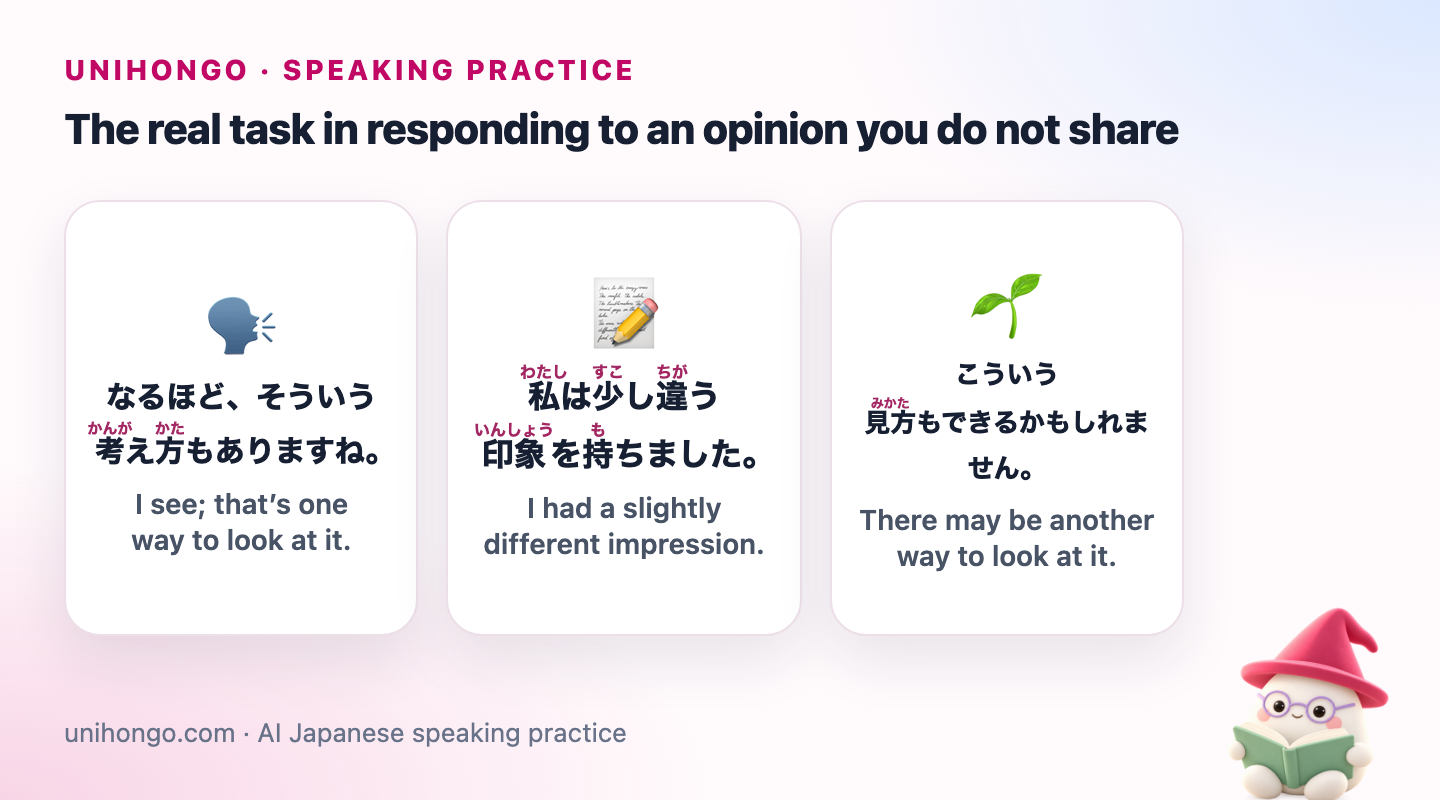
| Japanese | Romaji | Meaning |
|---|---|---|
| なるほど、そういう考え方もありますね。 | Naruhodo, sō iu kangaekata mo arimasu ne. | I see; that’s one way to look at it. |
| 私は少し違う印象を持ちました。 | Watashi wa sukoshi chigau inshō o mochimashita. | I had a slightly different impression. |
| こういう見方もできるかもしれません。 | Kō iu mikata mo dekiru kamo shiremasen. | There may be another way to look at it. |
Make the first sentence easy to retrieve
Treat the examples as flexible chunks rather than lines to memorize. Say each one once while reading, once while looking away, and once with a changed detail. This moves practice from recognition toward retrieval—the difference between understanding a phrase and being able to say it when someone is waiting.
If you lose a word, keep the sentence moving with a simpler description. A usable phrase is a bridge into the conversation, not a test of whether you remembered the exact textbook wording.
- Read one phrase aloud at a comfortable pace.
- Cover the text and recreate the meaning from memory.
- Change one detail so the sentence becomes true for you.
Add one natural second turn
A conversation becomes easier when you stop treating your answer as the finish line. After your first sentence, add a reason, a small example, or a question. For this situation, show you understood first, then soften your alternative. That gives the other person a clear opening and gives you another useful turn of Japanese.
Listen for one concrete word in the reply. Reuse it in your follow-up rather than jumping to a question from a memorized list. That small connection is what makes the exchange feel like a conversation instead of a worksheet.
| Turn | Your job | Keep it manageable |
|---|---|---|
| Start | Answer the immediate question | One complete sentence |
| Extend | Give a reason or a real detail | One extra clause |
| Return | Invite the other person in | One related question |
Practice with a small amount of pressure
Use the same prompt three times. On the first round, take your time. On the second, start within five seconds. On the third, respond to a changed detail—for example, a different time, preference, or unexpected follow-up. This is enough variation to make the skill flexible without overwhelming a learner.
If you practice with an AI Sensei, ask for one follow-up question and save corrections until you have finished your answer. If practicing alone, record the final round and listen only for whether you continued after the first sentence.
A weekly way to notice progress
Repeat this task on three different days, using the same basic prompt but changing the details. At the end of the week, compare the first and last recording. Listen for one measurable change: a shorter pause, a more specific detail, or a follow-up you could not produce at the start.
The point is not to collect a perfect performance. It is to make speaking a normal part of study. Once this scenario feels easier, carry the same pattern into a less familiar conversation and let real questions stretch it.
Your next step: show you understood first, then soften your alternative. Then say the result aloud once without looking at the page.