

Genki dashite: the direct cheer up
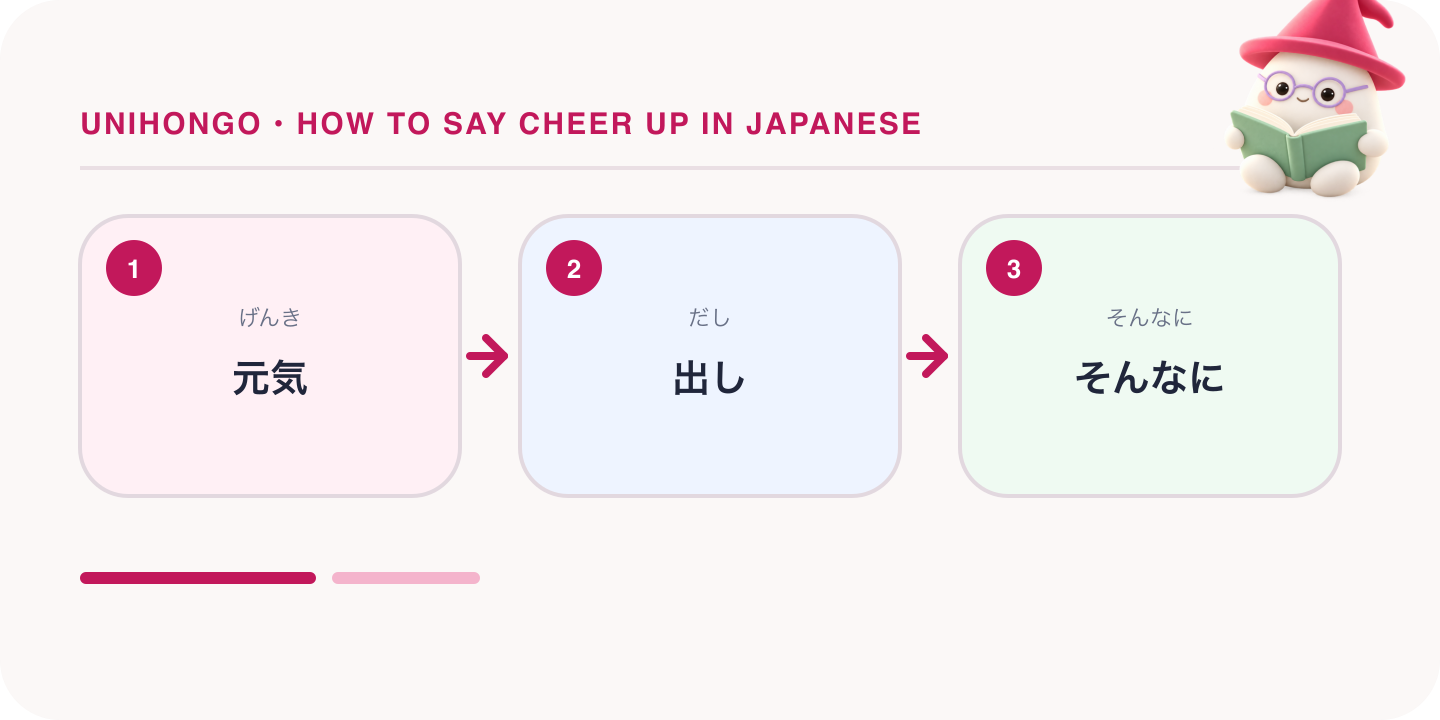
Genki is the everyday word for energy, health and good spirits, and dasu means to put out or bring out. Genki dashite, the te form used as a gentle request, asks someone to bring their spirits back out. It is bright, casual and affectionate, and it is what you say to a friend who is sulking after a lost match, a bad date or a scolding at work.
The politeness scale runs from genki dase, a rough command a coach might use, through genki dashite for friends, to genki o dashite kudasai for people you speak to politely, and genki dashite ne, which adds a soft ne and is the version you will hear most from friends. Between very close people, genki dashi na or genki dashinayo also appear.
The limit of genki dashite is that it presumes the sadness is small and temporary. Used for a real loss, it can sound as if you want the person to hurry up and stop being sad. For those moments, the phrases in the next sections do more with less.
| Japanese | Romaji | Meaning |
|---|---|---|
| 元気出して。 | Genki dashite. | Cheer up. |
| 元気出してね。 | Genki dashite ne. | Cheer up, okay? |
| 元気を出してください。 | Genki o dashite kudasai. | Please cheer up. (polite) |
| そんなに落ち込まないで。 | Sonna ni ochikomanaide. | Don't be so down. |
| 明日はきっといい日になるよ。 | Ashita wa kitto ii hi ni naru yo. | Tomorrow will surely be a better day. |
| 元気ない?どうしたの? | Genki nai? Dō shita no? | You seem down. What happened? |
Daijōbu da yo and nan to ka naru yo: reassurance
When someone is worried rather than sad, they need reassurance, and Japanese has two workhorses. Daijōbu da yo, it is all right, is the plain-form phrase you say to a friend, with yo adding conviction; the polite version is daijōbu desu yo. It fits fear about an exam, a presentation, a medical test, a first day at work. Kitto daijōbu, it will surely be fine, adds hope without promising anything specific.
Nan to ka naru yo, it will work out somehow, is looser and more philosophical. Nan to ka means somehow or one way or another, and naru means to become. Japanese people say it about money worries, visa paperwork, a broken plan, anything that feels tangled. It is comforting precisely because it does not pretend to know how the problem will be solved. With a colleague, nan to ka narimasu yo is fine.
Both phrases work best with a reason or an offer attached. Daijōbu da yo, junbi shita n dakara, it is fine, you prepared, is stronger than the bare phrase. Nan to ka naru yo, issho ni kangaeyō, it will work out, let us think about it together, turns reassurance into support.
| Japanese | Romaji | Meaning |
|---|---|---|
| 大丈夫だよ。 | Daijōbu da yo. | It's all right. |
| きっと大丈夫。 | Kitto daijōbu. | It'll surely be fine. |
| 何とかなるよ。 | Nan to ka naru yo. | It'll work out somehow. |
| 何とかなりますよ。 | Nan to ka narimasu yo. | It will work out. (polite) |
| 準備したんだから、大丈夫。 | Junbi shita n dakara, daijōbu. | You prepared, so it's fine. |
| 一緒に考えよう。 | Issho ni kangaeyō. | Let's think about it together. |
Ki ni shinai de and muri shinaide: forgiving and easing off
Ki ni shinai de is for a friend who is beating themselves up. Ki ni suru means to mind or worry about something, so the negative request means do not let it bother you. It is the right phrase after a spilt drink, a forgotten name, an awkward comment or a small failure at work. Ki ni shinaide kudasai is the polite form, and if the mistake affected you, dare demo aru yo, it happens to everyone, softens it further.
Muri shinaide is different. Muri means something unreasonable or beyond one's limits, and muri suru means to overdo it. Muri shinaide tells someone to stop pushing, and it is what you say to a friend who is working through illness, studying all night or holding a family together. It contains care without demanding cheerfulness, which makes it one of the kindest phrases in the language. Polite forms are muri shinaide kudasai and, in keigo, muri nasaranaide kudasai.
Related phrases in the same spirit are yasunde ne, get some rest, and jibun o semenaide, do not blame yourself. Ochitsuite, calm down, belongs here too, but use it gently; said sharply it sounds like an order.
| Japanese | Romaji | Meaning |
|---|---|---|
| 気にしないで。 | Ki ni shinai de. | Don't worry about it. |
| 誰でもあるよ。 | Dare demo aru yo. | It happens to everyone. |
| 無理しないでね。 | Muri shinaide ne. | Don't push yourself too hard. |
| 無理なさらないでください。 | Muri nasaranaide kudasai. | Please don't overdo it. (respectful) |
| 自分を責めないで。 | Jibun o semenaide. | Don't blame yourself. |
| 今日はもう休んで。 | Kyō wa mō yasunde. | Rest for today. |
Listening phrases that comfort more than advice
Japanese conversation leans heavily on aizuchi, the small responses that show you are listening, and when someone is upset these do more than any cheer-up phrase. Sō datta n da, so that is what happened, told as a soft statement, shows you have taken it in. Taihen datta ne, that must have been hard, and tsurakatta ne, that must have hurt, name the feeling without fixing it.
Offers of presence matter too. Hanashi, kiku yo, I will listen, and itsu demo renraku shite, contact me any time, are the Japanese equivalents of I am here for you. They are usually said plainly, without drama. Between friends, a simple soba ni iru yo, I am right here, is strong and rare, so save it for real trouble.
The rhythm is: listen and echo first, name the feeling, offer presence, and only then, if it fits, add a cheering phrase like genki dashite ne. Learners often skip straight to the last step, and it is the step that matters least.
- Sō datta n da: so that's what happened
- Taihen datta ne: that must have been hard
- Tsurakatta ne: that must have been painful
- Hanashi, kiku yo: I'll listen
- Itsu demo renraku shite: get in touch any time
- Soba ni iru yo: I'm right here with you
- Nani ka dekiru koto aru?: is there anything I can do
Un and sō ka, said quietly while the other person talks, are also part of comforting. Silence is not awkward here; it is respectful.
Friend or colleague: the same care in different words
The feeling behind cheer up does not change at work, but the words do. Plain-form phrases with yo and ne, like daijōbu da yo and genki dashite ne, belong to friends and family. With a colleague, especially a senior one, you switch to polite forms and to phrases that acknowledge effort rather than emotion. The table matches common moments to a friend version and a workplace version.
| Moment | Reading | To a friend, then to a colleague |
|---|---|---|
| 失敗した | shippai shita | Ki ni shinai de. / Dare ni demo aru koto desu yo. |
| 疲れている | tsukarete iru | Muri shinaide ne. / Muri nasaranaide kudasai. |
| 落ち込んでいる | ochikonde iru | Genki dashite. / O-tsukare-sama desu. Nani ka areba itte kudasai. |
| 不安 | fuan | Daijōbu da yo. / Kitto daijōbu desu yo. |
| 残業続き | zangyō tsuzuki | Yasunde ne. / Sukoshi yasumareta hō ga ii desu yo. |
| 企画が通らなかった | kikaku ga tōranakatta | Nan to ka naru yo. / Tsugi ga arimasu yo. |
| 試験に落ちた | shiken ni ochita | Tsugi ga aru yo. / Tsugi no kikai ga arimasu yo. |
| 別れた | wakareta | Hanashi, kiku yo. / Itsu demo sōdan shite kudasai. |
| 病気 | byōki | O-daiji ni ne. / O-daiji ni nasatte kudasai. |
The colleague column avoids telling anyone how to feel. It acknowledges effort, points at the next chance and offers a door, which is how support is usually expressed in a Japanese office.
Ganbatte as a contrast
Ganbatte, do your best, is not a cheer-up phrase, although learners use it as one. It points at future effort. To someone about to sit an exam, run a race or give a speech, it is perfect. To someone who has just failed, is burnt out or is grieving, it can land as keep trying harder, which is the opposite of comfort. A separate post explores ganbatte in depth; here the rule of thumb is simple.
If the difficult thing is still ahead, ganbatte. If it has already happened, genki dashite or the listening phrases. If the person is exhausted, muri shinaide. When you are unsure, taihen da ne, that is tough, fits nearly everything and commits you to nothing.
| Japanese | Romaji | Meaning |
|---|---|---|
| 明日の面接、頑張ってね。 | Ashita no mensetsu, ganbatte ne. | Good luck at tomorrow's interview. |
| 頑張ったね。 | Ganbatta ne. | You did your best. (after the fact) |
| もう十分頑張ったよ。 | Mō jūbun ganbatta yo. | You've already done more than enough. |
| 大変だね。 | Taihen da ne. | That's tough. |
What not to say, and how to recover
A few well-meant phrases backfire. Wakaru, I understand, said about a situation you have not lived, can annoy; wakaru ki ga suru, I think I can imagine, is safer. Genki dashite to someone in grief can feel dismissive. Comparing troubles, watashi mo mae ni, I once also, pulls attention to yourself. And a bright kitto daijōbu about a serious diagnosis promises what you cannot know.
If a phrase lands badly, you will usually see it: a pause, a flat un. Repair with honesty rather than more cheering. Gomen, umaku ienakute, sorry, I am not saying this well, followed by demo, shinpai shiteru, but I am worried about you, resets the conversation. In polite speech, sumimasen, kotoba ga mitsukaranakute, sorry, I cannot find the words, is respectful and true.
Finally, remember that in Japan, comfort is often shown by action: bringing food, walking someone to the station, sending a short message the next day. A message that just says dō? kyō wa daijōbu?, how are you, okay today?, is as much a cheer up as any phrase in this guide.
| Japanese | Romaji | Meaning |
|---|---|---|
| 分かる気がする。 | Wakaru ki ga suru. | I think I can imagine how that feels. |
| ごめん、うまく言えなくて。 | Gomen, umaku ienakute. | Sorry, I'm not saying this well. |
| でも、心配してる。 | Demo, shinpai shiteru. | But I'm worried about you. |
| すみません、言葉が見つからなくて。 | Sumimasen, kotoba ga mitsukaranakute. | Sorry, I can't find the words. |
| 今日は大丈夫? | Kyō wa daijōbu? | Are you okay today? |