
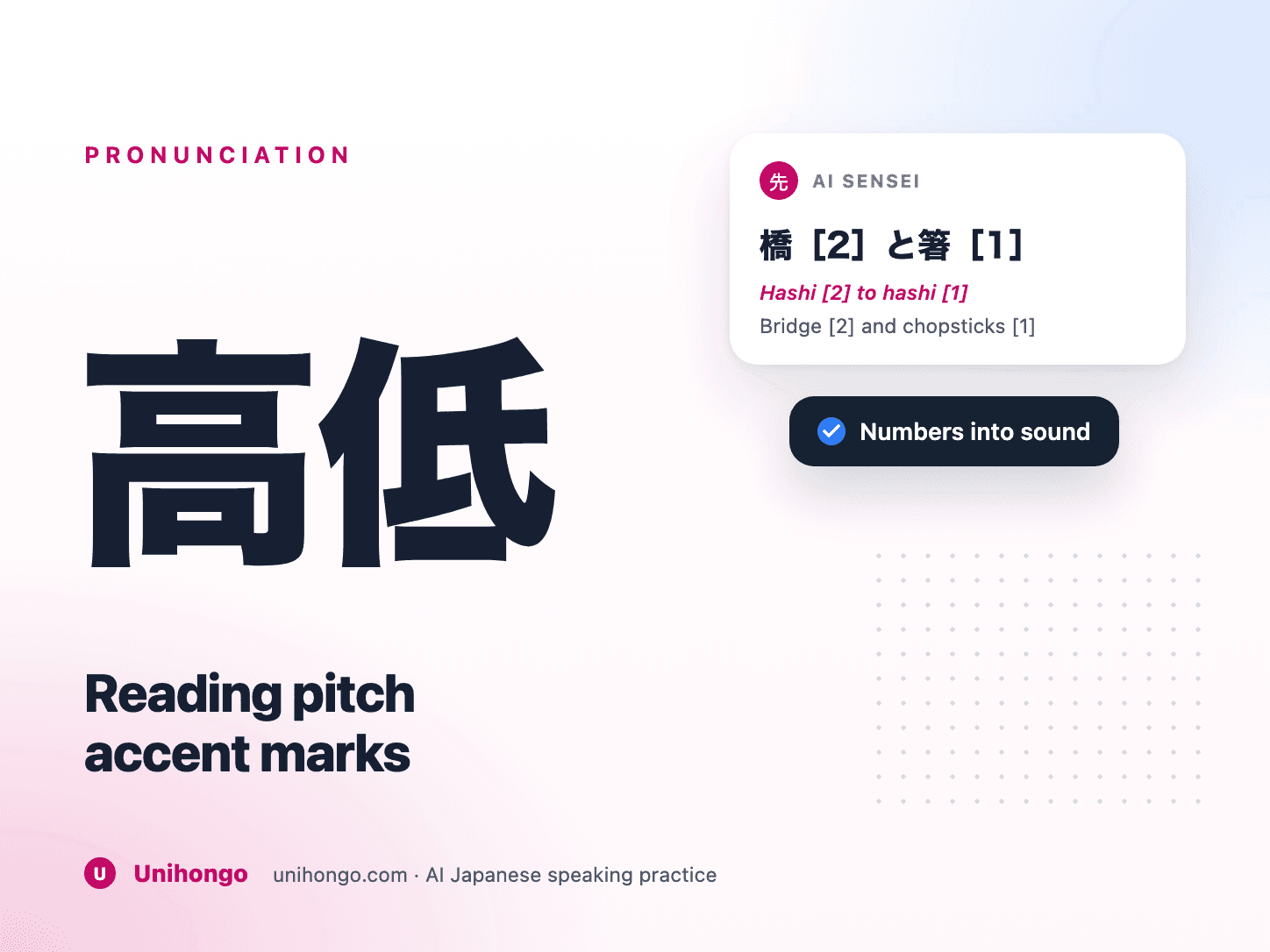
Why the notation is worth learning
Pitch accent is hard to learn by ear alone, especially for words you do not hear often. A dictionary mark gives you a reliable answer you can check at the moment you learn a word, when it costs almost nothing to add.
You do not need to memorise the accent of every word. Knowing how to read the notation means you can look it up whenever a word matters, such as a name, a word you use at work, or a pair you keep confusing.
What the number means
In the common numbering system, the number is the mora after which the pitch falls. In standard Tokyo Japanese the first and second morae always differ in height: low then high, or high then low when the accent falls on the first mora.
| Number | Pattern name | What happens to the pitch |
|---|---|---|
| Zero | Heiban, flat | Low first mora, then high to the end and on a following particle |
| One | Atamadaka, head-high | High first mora, then low from the second mora |
| Between one and the last mora | Nakadaka, middle-high | Rises, then drops after the numbered mora inside the word |
| Same as the number of morae | Odaka, tail-high | High to the end of the word, then drops onto the particle |
The difference between zero and odaka is invisible in the word alone and only appears on the particle, which is why dictionaries need the number.
The four patterns in dictionary terms
| Japanese | Romaji | Meaning |
|---|---|---|
| 端 | hashi | Edge: [0] heiban, no drop |
| 箸 | hashi | Chopsticks: [1] atamadaka, drop after the first mora |
| お菓子 | okashi | Sweets: [2] nakadaka, drop after the second mora |
| 橋 | hashi | Bridge: [2] odaka, drop onto the following particle |
| 飴 | ame | Candy: [0] heiban |
| 雨 | ame | Rain: [1] atamadaka |
The particle test
To confirm a pattern, say the word with ga after it. For heiban words the particle stays high; for odaka words it drops. This is the simplest way to hear what the number is telling you.
| Japanese | Romaji | Meaning |
|---|---|---|
| 端が | hashi ga | Edge + ga: the particle stays high |
| 橋が | hashi ga | Bridge + ga: the particle drops |
| 箸が | hashi ga | Chopsticks + ga: high first mora, then low |
| 鼻が | hana ga | Nose + ga: [0], the particle stays high |
| 花が | hana ga | Flower + ga: [2], the particle drops |
Other ways accent is shown
- A line over the high kana, with a small hook where the pitch drops.
- A downstep mark after the mora where the pitch falls.
- Coloured lines or dots marking high and low morae in learner apps.
- A pitch graph drawn from a recording, rising and falling with the voice.
- Words with no mark at all in many general dictionaries, which simply do not record accent.
Whatever the system, translate it into the same question: after which mora does it drop, or does it not drop at all?
Verbs, adjectives and compounds
Dictionaries usually give the accent of the dictionary form. Conjugated forms follow their own regularities, and compound words often take a new accent rather than combining the two originals. The patterns guide covers the most useful rules, including polite masu forms.
For learners, the practical approach is to check the dictionary form, then listen to the phrase you actually use and copy that. Accent in real speech is heard in phrases, not isolated words.
| Japanese | Romaji | Meaning |
|---|---|---|
| 食べる | taberu | To eat: [2], drop after be |
| 日本 | Nihon | Japan: [2], drop after ho |
| 二本 | nihon | Two long objects: [1], drop after ni |
Building accent into your vocabulary habit
Add the accent number to a word only when you first learn it, then say the word with ga three times. That takes seconds and slowly builds an ear for patterns you have not looked up.
Unihongo's pronunciation lab has a pitch accent focus that generates minimal pairs and words where pitch changes meaning, and scores your recording on pitch as well as sounds and mora timing. It is a quick check that the number you read is the pattern you actually say.