

The core phrase and how it is built
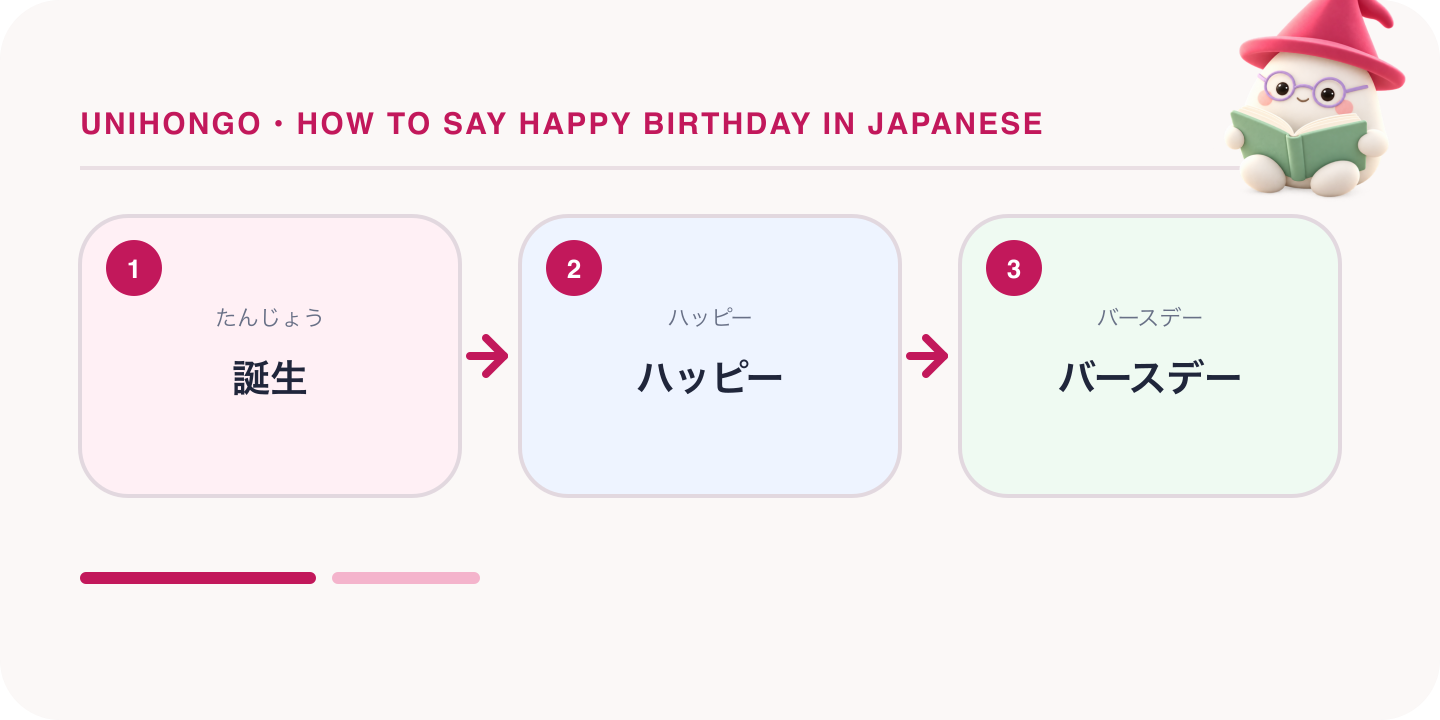
The word for birthday is tanjōbi, written 誕生日, and the word for congratulations is omedetō. Put together with nothing between them, tanjōbi omedetō is the plainest way to wish someone a happy birthday. There is no verb, no subject and no article, which is why learners often feel the phrase is too short to be a sentence. It is not; Japanese greetings are routinely this compact.
Two additions raise the politeness. The prefix o- in front of tanjōbi shows respect for the other person's birthday rather than your own, and the ending gozaimasu turns omedetō into its polite form. You can add either or both, and the fully polite o-tanjōbi omedetō gozaimasu is what you hear from shop staff, in offices and from anyone speaking to someone senior. A middle version, tanjōbi omedetō gozaimasu without the o-, is common in speech and perfectly fine.
| Japanese | Romaji | Meaning |
|---|---|---|
| 誕生日おめでとう。 | Tanjōbi omedetō. | Happy birthday. (casual) |
| 誕生日おめでとうございます。 | Tanjōbi omedetō gozaimasu. | Happy birthday. (polite) |
| お誕生日おめでとうございます。 | O-tanjōbi omedetō gozaimasu. | Happy birthday. (fully polite) |
| ハッピーバースデー! | Happī bāsudē! | Happy birthday! (playful) |
| 今日、誕生日だよね。おめでとう。 | Kyō, tanjōbi da yo ne. Omedetō. | It's your birthday today, right? Congratulations. |
To a friend, a partner or a child
With people you are close to, the short form is enough, but the particles that follow it do the emotional work. Tanjōbi omedetō ne is warm and slightly soft, tanjōbi omedetō yo is a little more emphatic, and a stretched omedetō with a rising tone is how excited friends greet each other. It is normal to add the number of years, though only with friends who will not mind.
To a child, the phrase is the same, but the tone is brighter and you can add the child's name with chan or kun. Ask how old they are now, nansai ni natta no, because a child will almost always want to tell you. Adults asking each other the same question is another matter, and we return to that below.
| Japanese | Romaji | Meaning |
|---|---|---|
| 誕生日おめでとう!今日は何かするの? | Tanjōbi omedetō! Kyō wa nani ka suru no? | Happy birthday! Are you doing anything today? |
| おめでとう。いい一年になるといいね。 | Omedetō. Ii ichinen ni naru to ii ne. | Congratulations. I hope it's a good year. |
| ゆいちゃん、お誕生日おめでとう。何歳になったの? | Yui-chan, o-tanjōbi omedetō. Nansai ni natta no? | Happy birthday, Yui. How old are you now? |
| 三十歳おめでとう! | Sanjussai omedetō! | Happy thirtieth! |
| 誕生日おめでとう。あとでケーキ買ってくるね。 | Tanjōbi omedetō. Ato de kēki katte kuru ne. | Happy birthday. I'll pick up a cake later. |
To a colleague, a boss or a customer
In an office, a birthday is usually mentioned briefly rather than celebrated loudly. To a colleague of the same rank, tanjōbi omedetō gozaimasu with a smile is the standard, and among people who are friendly with each other the plain form is fine. To a boss, a client or anyone senior, use the fully polite o-tanjōbi omedetō gozaimasu and pair it with a small bow of the head.
The follow-up sentence changes too. Instead of asking about plans, senior people are wished good health or a good year in more formal words: subarashii ichinen ni narimasu yō ni, may it be a wonderful year, or o-karada ni ki o tsukete, please take care of your health, which is heard when the birthday is a round number. If several people are speaking together, one person says the wish and the others add omedetō gozaimasu in chorus.
| Japanese | Romaji | Meaning |
|---|---|---|
| 部長、お誕生日おめでとうございます。 | Buchō, o-tanjōbi omedetō gozaimasu. | Happy birthday, chief. (to a department head) |
| 素晴らしい一年になりますように。 | Subarashii ichinen ni narimasu yō ni. | May it be a wonderful year. |
| これからもお体に気をつけてください。 | Kore kara mo o-karada ni ki o tsukete kudasai. | Please keep looking after your health. |
| 田中さん、今日誕生日なんですよね。おめでとうございます。 | Tanaka-san, kyō tanjōbi nan desu yo ne. Omedetō gozaimasu. | Tanaka, it's your birthday today, isn't it? Congratulations. |
| 皆でお祝いさせてください。 | Minna de o-iwai sasete kudasai. | Please let us all celebrate with you. |
Singing happy birthday in Japanese
At parties, restaurants and school events, the birthday song is the English one with the familiar melody. The words are sung as happī bāsudē tsū yū, repeated, then happī bāsudē dia followed by the person's name with san, chan or kun, and a final happī bāsudē tsū yū. Everyone claps on the last note and the person blows out the candles.
The name line is the only part you must prepare. For a friend called Kenta you sing happī bāsudē dia Kenta-kun, for a colleague happī bāsudē dia Satō-san, and for a small child the chan form. There is also an older Japanese version, o-tanjōbi omedetō sung to the same tune, that some kindergartens use, but if you join a birthday dinner in Japan, the English words are what you will hear.
| Japanese | Romaji | Meaning |
|---|---|---|
| じゃあ、歌いましょう。せーの! | Jā, utaimashō. Sēno! | Right, let's sing. One, two! |
| ハッピーバースデー、ディア、けんたくん。 | Happī bāsudē, dia, Kenta-kun. | Happy birthday, dear Kenta. |
| ろうそく、吹き消して! | Rōsoku, fukikeshite! | Blow out the candles! |
| 願い事した? | Negaigoto shita? | Did you make a wish? |
Replying when someone wishes you a happy birthday
The reply is short. Arigatō to a friend, arigatō gozaimasu to anyone else, and that is genuinely enough. Learners sometimes try to be modest, because Japanese often deflects compliments, but a birthday wish is not a compliment and denying it sounds odd. Accept it, thank the person and, if you like, add one line.
The natural second line depends on the person. To a friend, oboetete kureta n da, you remembered, is warm. To a colleague, wazawaza arigatō gozaimasu, thank you for going to the trouble, acknowledges that they took a moment to say it. If the person is older, or if they gave you a present, add these lines with a slightly deeper nod.
If it is the other person's birthday too, mo does the work: Tanaka-san mo omedetō gozaimasu, congratulations to you as well.
| Japanese | Romaji | Meaning |
|---|---|---|
| ありがとう!覚えててくれたんだ。 | Arigatō! Oboetete kureta n da. | Thanks! You remembered. |
| ありがとうございます。嬉しいです。 | Arigatō gozaimasu. Ureshii desu. | Thank you. I'm really pleased. |
| わざわざありがとうございます。 | Wazawaza arigatō gozaimasu. | Thank you for taking the trouble. |
| 田中さんもおめでとうございます。 | Tanaka-san mo omedetō gozaimasu. | Congratulations to you too, Tanaka. |
| おかげさまで、いい誕生日になりました。 | Okagesama de, ii tanjōbi ni narimashita. | Thanks to you, it's been a good birthday. |
Belated wishes and asking someone's birthday
Japanese has no single word for belated. Instead you add a short clause admitting that you are late, then say the usual wish. To a friend, osoku natta kedo, tanjōbi omedetō, it's late but happy birthday, is the everyday version. To someone senior, osoku narimashita ga, o-tanjōbi omedetō gozaimasu. If you missed it by more than a few days, add a light apology such as ki ga tsukanakute gomen, sorry I didn't notice, rather than a heavy one.
Asking a birthday is friendly and normal. O-tanjōbi wa itsu desu ka is the polite question, tanjōbi itsu with a rising tone is the casual one. People answer with the month and day using gatsu and nichi, so listen for the day counters that change shape: tsuitachi for the first, futsuka for the second, mikka for the third, and so on up to tōka for the tenth, then hatsuka for the twentieth.
What you should not ask casually is a person's age. Nansai desu ka is fine with children and close friends, but adults often find it intrusive from someone they do not know well. If you want to know, wait for them to say it, or ask instead what year they were born in a joking tone among friends.
| Japanese | Romaji | Meaning |
|---|---|---|
| 遅くなったけど、誕生日おめでとう。 | Osoku natta kedo, tanjōbi omedetō. | It's late, but happy birthday. |
| 遅くなりましたが、お誕生日おめでとうございます。 | Osoku narimashita ga, o-tanjōbi omedetō gozaimasu. | Belatedly, happy birthday. (polite) |
| 気がつかなくてごめん。 | Ki ga tsukanakute gomen. | Sorry I didn't notice. |
| お誕生日はいつですか。 | O-tanjōbi wa itsu desu ka. | When is your birthday? |
| 誕生日いつ? | Tanjōbi itsu? | When's your birthday? (casual) |
| 三月二十日です。 | Sangatsu hatsuka desu. | It's the twentieth of March. |
Which version for whom
The table below pulls the choices together. Read down the Say column and notice that the wish itself barely changes; what changes is the frame around it.
| Listener | Say | Reading | Add |
|---|---|---|---|
| Close friend | 誕生日おめでとう | tanjōbi omedetō | ne, yo or a question about plans |
| Partner | 誕生日おめでとう | tanjōbi omedetō | kotoshi mo yoroshiku ne |
| Child | お誕生日おめでとう | o-tanjōbi omedetō | name with chan or kun, nansai ni natta no |
| Younger sibling or junior | 誕生日おめでとう | tanjōbi omedetō | ii ichinen ni shite ne |
| Colleague, same rank | 誕生日おめでとうございます | tanjōbi omedetō gozaimasu | a smile, kyō wa hayaku kaerimasu ka |
| Boss or senior | お誕生日おめでとうございます | o-tanjōbi omedetō gozaimasu | small bow, subarashii ichinen ni narimasu yō ni |
| Client or customer | お誕生日おめでとうございます | o-tanjōbi omedetō gozaimasu | nothing else unless they continue |
| Teacher | 先生、お誕生日おめでとうございます | sensei, o-tanjōbi omedetō gozaimasu | itsumo arigatō gozaimasu |
| Parent-in-law | お誕生日おめでとうございます | o-tanjōbi omedetō gozaimasu | o-karada ni ki o tsukete kudasai |
| Belated, casual | 遅くなったけど、おめでとう | osoku natta kedo, omedetō | ki ga tsukanakute gomen |
If a row seems too formal for the person in front of you, that is usually a sign that you are closer than you thought, and the shorter form is fine. The reverse mistake, being too casual with a senior person, is the one to avoid.
Mistakes that make the wish land badly
Most birthday mistakes come from mixing registers. Omedetō to a client sounds like you are talking to a friend; o-tanjōbi omedetō gozaimasu to your best friend sounds like a joke, unless you mean it as one. Decide who the person is to you before you open your mouth, and the rest follows.
A few other habits are worth dropping. Do not translate many happy returns or have a great one word by word; the Japanese follow-ups above do that job. Do not ask an adult's age as part of the wish. And do not go quiet after saying it: a wish followed by a question about plans, a comment about the cake or a simple ureshii desu in reply keeps the moment natural.
- Using plain omedetō with a boss, client or someone's parents
- Clipping the long vowels: omedeto and gozaimas sound rushed
- Asking nansai desu ka of an adult you do not know well
- Denying the wish with a modest iie instead of a thank-you
- Forgetting the name line in the song, so everyone waits for you
- Saying happī bāsudē to a senior person as the main greeting
If you do slip, a quick shitsurei shimashita, excuse me, and a repeat in the right form fixes it. Japanese speakers correct their own register mid-sentence all the time, and nobody minds.