
Four words for when something goes wrong
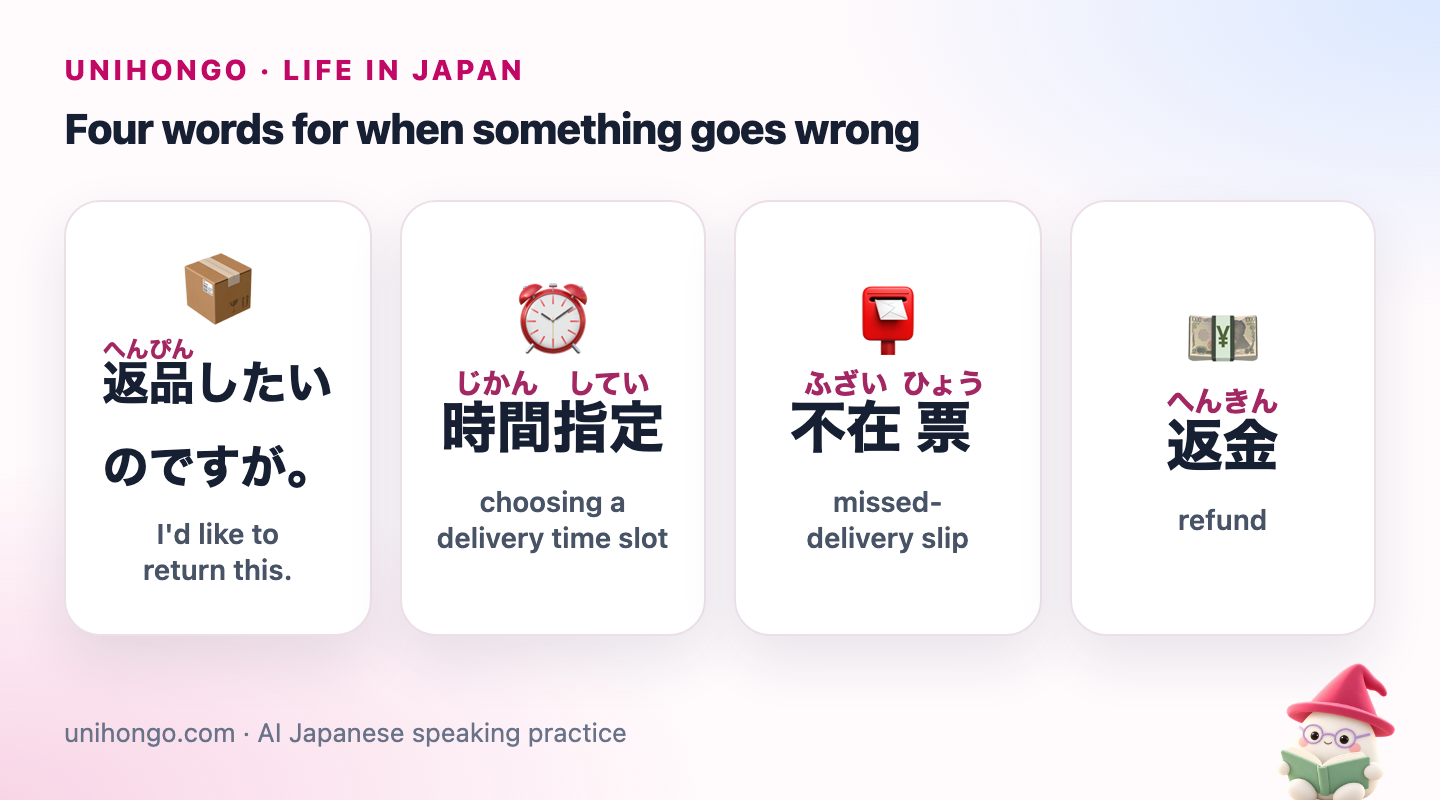
Henpin shitai no desu ga, I would like to return this, is the sentence that opens most support conversations; the trailing ga softens it and invites the agent to take over. Jikan shitei (時間指定) is choosing a delivery time slot at checkout. A fuzaihyō (不在票) is the slip left when you were out. Henkin (返金) is the refund. Behind them sit chūmon (注文), an order; sōryō muryō (送料無料), free shipping; and kōkan (交換), an exchange.
| Japanese | Romaji | Meaning |
|---|---|---|
| 返品したいのですが。 | Henpin shitai no desu ga. | I'd like to return this. |
| 時間指定 | jikan shitei | choosing a delivery time slot |
| 不在票 | fuzaihyō | missed-delivery slip |
| 返金 | henkin | refund |
| 注文 | chūmon | order |
| 送料無料 | sōryō muryō | free shipping |
| 交換 | kōkan | exchange |
Ordering: stock, shipping and payment
Zaiko (在庫) is stock, and zaiko ari or zaiko nashi tells you whether an item is available; nyūka (入荷) is the next arrival of stock. Sōryō (送料) is shipping, often free above a threshold. Payment options are wider than in many countries: credit card, daibiki (代引き), paying the driver in cash on delivery, konbini barai (コンビニ払い), paying at a convenience store with a code, and bank transfer. If you need a receipt for work, ask for a ryōshūsho (領収書); many shops issue one from the order page.
| Japanese | Romaji | Meaning |
|---|---|---|
| 在庫はありますか。 | Zaiko wa arimasu ka. | Is it in stock? |
| 送料はいくらですか。 | Sōryō wa ikura desu ka. | How much is shipping? |
| 入荷はいつですか。 | Nyūka wa itsu desu ka. | When will it be back in stock? |
| コンビニ払いはできますか。 | Konbini barai wa dekimasu ka. | Can I pay at a convenience store? |
| 領収書を発行してもらえますか。 | Ryōshūsho o hakkō shite moraemasu ka. | Could you issue a receipt? |
| Payment option | Reading | How it works |
|---|---|---|
| クレジットカード | kurejitto kādo | Card online; the most common option |
| 代引き | daibiki | Cash to the driver on delivery, usually with a small fee |
| コンビニ払い | konbini barai | Pay at a convenience store with a payment code |
| 銀行振込 | ginkō furikomi | Bank transfer; shipping starts after payment arrives |
| 後払い | atobarai | Pay after delivery by invoice, through a payment service |
Address, time slot and the parcel at the door
A Japanese address runs from large to small: postcode, prefecture, city, district, block numbers, then building name and room number. Fill in the tatemono mei (建物名), building name, and heya bangō (部屋番号), room number, or the driver cannot find you. At checkout you can usually choose a time slot, gozenchū for the morning or evening windows, and increasingly okihai (置き配), leaving the parcel at the door, or delivery to a takuhai bokkusu (宅配ボックス), the locker in many apartment buildings.
If you miss the driver, a fuzaihyō appears in your letterbox with the slip number and the courier's contact details. Redelivery is free and can be booked by phone, by automated line or online.
| Japanese | Romaji | Meaning |
|---|---|---|
| 午前中にお願いします。 | Gozenchū ni onegai shimasu. | Please deliver in the morning. |
| 置き配でお願いします。 | Okihai de onegai shimasu. | Please leave it at the door. |
| 宅配ボックスに入れてください。 | Takuhai bokkusu ni irete kudasai. | Please put it in the delivery locker. |
| 不在票が入っていました。 | Fuzaihyō ga haitte imashita. | There was a missed-delivery slip. |
| 再配達をお願いします。 | Saihaitatsu o onegai shimasu. | Please redeliver. |
| 今日の夜7時から9時でお願いします。 | Kyō no yoru shichiji kara kuji de onegai shimasu. | Tonight between 7 and 9, please. |
Cancelling an order
Cancelling is simple before shipping, hassō mae (発送前), and often impossible after, hassō go. Many shops let you cancel from the order page within a short window; after that you need support. State the order number and the reason in plain terms. If you got the address wrong, ask whether it can be changed rather than cancelling, since a redirected parcel is faster than a new order. Sudeni hassō zumi desu, it has already been shipped, is the answer that means you will be looking at a return instead.
| Japanese | Romaji | Meaning |
|---|---|---|
| 注文をキャンセルしたいです。 | Chūmon o kyanseru shitai desu. | I'd like to cancel my order. |
| 発送前ならキャンセルできますか。 | Hassō mae nara kyanseru dekimasu ka. | Can I cancel if it hasn't shipped yet? |
| 間違えて二つ注文してしまいました。 | Machigaete futatsu chūmon shite shimaimashita. | I ordered two by mistake. |
| 住所を間違えました。変更できますか。 | Jūsho o machigaemashita. Henkō dekimasu ka. | I got the address wrong. Can I change it? |
| すでに発送済みです。 | Sudeni hassō zumi desu. | Support: It has already been shipped. |
Returns, exchanges and refunds
Henpin (返品) is sending an item back, kōkan (交換) is swapping it for another size or colour, and henkin is the refund. Shops distinguish between a defect, shoki furyō (初期不良), and a change of mind. For defects and wrong items, the shop normally pays the return shipping, hensōryō, and may send a prepaid label or ask you to ship chakubarai (着払い), with the receiver paying. For a change of mind, policies vary from full acceptance to none, and the deadline, henpin kigen, is often a week or so from delivery.
Describe the problem with the state of the item: kowarete imashita, it was broken, not kowashimashita, which means you broke it.
| Japanese | Romaji | Meaning |
|---|---|---|
| サイズが合わなかったので交換したいです。 | Saizu ga awanakatta node kōkan shitai desu. | It didn't fit, so I'd like to exchange it. |
| 届いた商品が壊れていました。 | Todoita shōhin ga kowarete imashita. | The item arrived broken. |
| 注文したものと違う商品が届きました。 | Chūmon shita mono to chigau shōhin ga todokimashita. | I received a different item from the one I ordered. |
| 返送料はどちらが負担しますか。 | Hensōryō wa dochira ga futan shimasu ka. | Who pays the return shipping? |
| 返金はいつごろになりますか。 | Henkin wa itsu goro ni narimasu ka. | When will the refund arrive? |
| 返品期限は過ぎていますか。 | Henpin kigen wa sugite imasu ka. | Has the return deadline passed? |
Chatting with support
Support agents write in careful keigo: gofuben o okake shite mōshiwake gozaimasen, we apologise for the inconvenience, and kakunin shite ohenji itashimasu, I will check and reply. You do not need to answer in kind. Plain masu forms are polite enough, and clarity helps the agent more than flourish. Lead with the problem, add your order number, and ask one thing. If you cannot read a reply, paste it into a dictionary; the humble verbs are the same every time, so they become easy quickly.
| Japanese | Romaji | Meaning |
|---|---|---|
| 注文について問い合わせたいです。 | Chūmon ni tsuite toiawasetai desu. | You: I have a question about my order. |
| まだ商品が届いていません。 | Mada shōhin ga todoite imasen. | You: The item hasn't arrived yet. |
| 追跡番号を教えてください。 | Tsuiseki bangō o oshiete kudasai. | You: Please tell me the tracking number. |
| ご不便をおかけして申し訳ございません。 | Gofuben o okake shite mōshiwake gozaimasen. | Support: We apologise for the inconvenience. |
| 確認してお返事いたします。 | Kakunin shite ohenji itashimasu. | Support: I'll check and reply. |
| ご対応ありがとうございます。 | Gotaiō arigatō gozaimasu. | You: Thank you for your help. |
Phoning the courier
Courier phone lines are mostly automated, and the human operators speak quickly but ask predictable questions: the denpyō bangō (伝票番号), the slip number, your name, and the time you want. Numbers are the hard part, so read them slowly, digit by digit, and repeat them back. If you cannot be home, ask whether you can collect from the eigyōsho (営業所), the local depot, or redirect to a convenience store.
On the automated line, jidō onsei (自動音声), you key in the slip number and a code for the time slot, which is easier than speaking and worth trying first. Many couriers also let you redirect a parcel to a nearby convenience store or a locker, konbini uketori (コンビニ受け取り), which suits anyone who is rarely home in the day. If the parcel is being held at the depot, there is a time limit before it is returned to the sender, usually about a week, so act on the slip quickly.
| Japanese | Romaji | Meaning |
|---|---|---|
| 伝票番号を読み上げます。 | Denpyō bangō o yomiagemasu. | I'll read out the slip number. |
| 本日の夜間でお願いします。 | Honjitsu no yakan de onegai shimasu. | This evening, please. |
| 明日の午前中は家にいます。 | Asu no gozenchū wa ie ni imasu. | I'll be home tomorrow morning. |
| 営業所で受け取れますか。 | Eigyōsho de uketoremasu ka. | Can I collect it from the depot? |
Common mistakes
- Saying kowashimashita for a broken delivery. That is I broke it; the item was broken on arrival is kowarete imashita.
- Leaving out the building name and room number. Drivers rely on them, and a missing room number is the most common cause of a fuzaihyō.
- Trying to match the agent's keigo. Plain polite forms are fine; a clear sentence beats an awkward humble one.
- Confusing henpin and henkin. Henpin is sending the item back; henkin is the money coming back.
- Assuming change-of-mind returns are accepted. Many shops accept only defects; read the henpin ni tsuite section before you buy.