
Why abstract talk is a genuine step up
Concrete conversation is supported by the world. The objects are present or recently experienced, the tenses are simple, and the vocabulary repeats. If a word is missing, you can point at the thing or describe its shape.
Abstract conversation removes all of that support. There is nothing to point at, the vocabulary is broader and less frequent, and the grammar has to express relationships rather than events: because, unless, in general, it depends. The jump is real, and treating it as a separate skill to be trained is more productive than treating it as evidence that your Japanese is bad.
The reassuring part is that the required grammar is small. Most of the difficulty is in the habit of building an argument in a second language, and that improves quickly with practice.
The tools that carry an opinion
An opinion in Japanese conversation is usually built from three parts: a softened position, a reason, and an acknowledgement that other views exist. All three have standard forms, and once those forms are automatic you can put almost any content through them.
The softening is not optional politeness decoration. An unhedged assertion carries more force in Japanese than its English translation suggests, so the hedge is what makes the sentence sound like conversation rather than a pronouncement.
| Japanese | Romaji | Meaning |
|---|---|---|
| 個人的には、そう思います。 | Kojinteki ni wa, sō omoimasu. | Personally, I think so. |
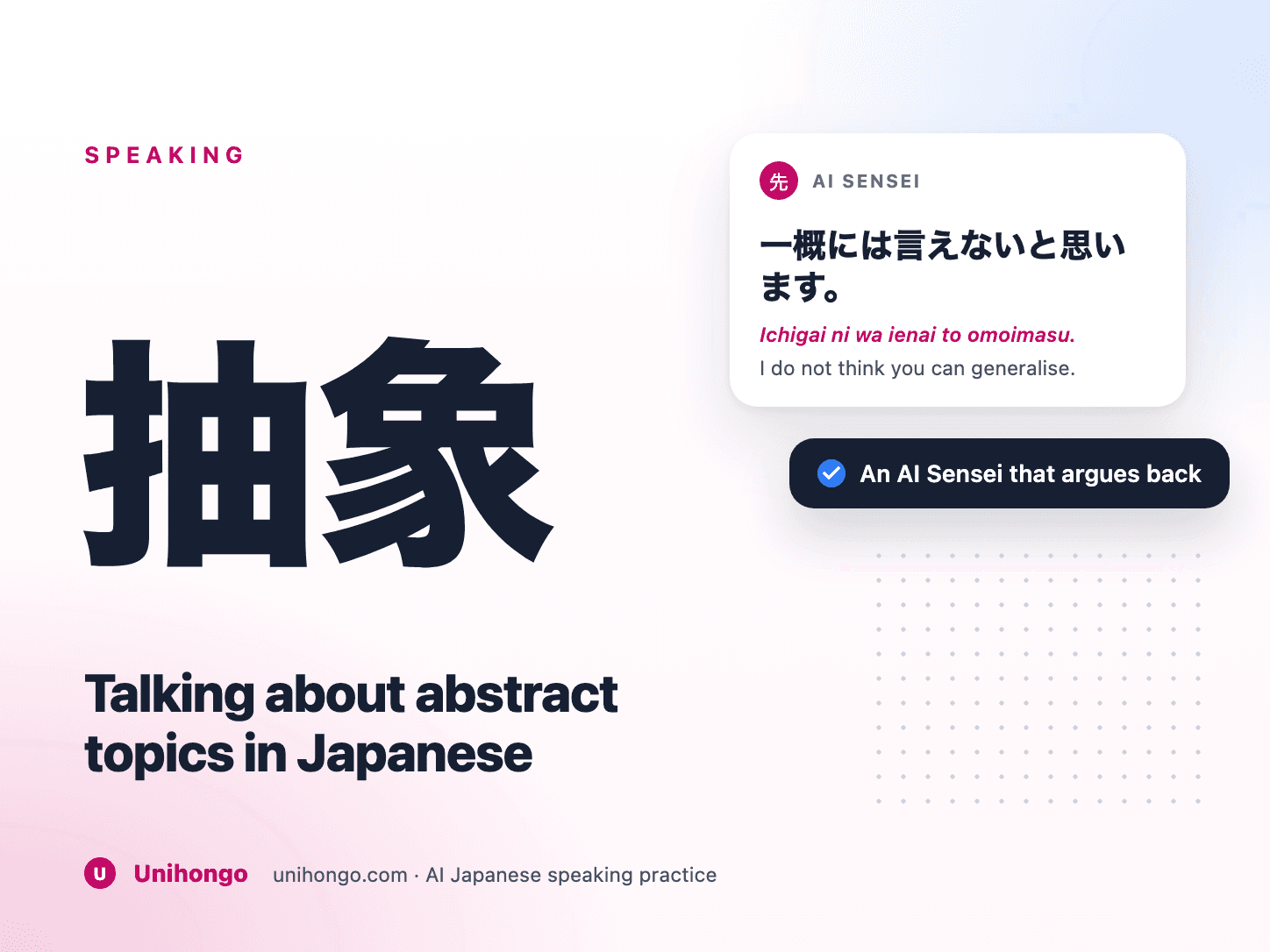
| 一概には言えないと思います。 | Ichigai ni wa ienai to omoimasu. | I do not think you can generalise. |
| 場合によると思うんですが。 | Baai ni yoru to omou n desu ga. | I think it depends on the case. |
| そういう見方もありますね。 | Sō iu mikata mo arimasu ne. | That is one way of seeing it. |
| 確かにそうかもしれません。 | Tashika ni sō kamo shiremasen. | That may well be true. |
| 逆の意見もよく聞きます。 | Gyaku no iken mo yoku kikimasu. | I often hear the opposite view too. |
The last two let you disagree without conflict, which is what most abstract conversation needs. Neither concedes the point.
Words that let you generalise
Abstract talk needs words that refer to categories, tendencies and degrees rather than to specific things. This is a small, high-value vocabulary set, and learning thirty of these words does more for discussion than three hundred concrete nouns.
They are worth drilling as production vocabulary rather than recognition vocabulary, because they are exactly the words that vanish under pressure.
| Japanese | Romaji | Meaning |
|---|---|---|
| だいたい | daitai | Roughly, generally |
| ほとんど | hotondo | Almost all, hardly any |
| 傾向がある | keikō ga aru | There is a tendency |
| 場合によって | baai ni yotte | Depending on the case |
| 一般的に | ippanteki ni | Generally speaking |
| そのかわり | sono kawari | In exchange, on the other hand |
Drill these as production vocabulary, aloud. They are the words that vanish first under pressure, and recognising them is not the same as reaching for them.
Causes, conditions and consequences
Most abstract discussion is about relationships between things: this causes that, if this then that, this is better than that in these circumstances. Japanese expresses all of these with grammar you probably already have, and the difficulty is producing it quickly rather than knowing it.
Pick one relationship type per week and force it into conversation until it is automatic. Reason first, then condition, then comparison, is a sensible order.
| Japanese | Romaji | Meaning |
|---|---|---|
| 理由は二つあると思います。 | Riyū wa futatsu aru to omoimasu. | I think there are two reasons. |
| もしそうなったら、大変ですね。 | Moshi sō nattara, taihen desu ne. | If that happened, it would be difficult. |
| その結果、こうなったんだと思います。 | Sono kekka, kō natta n da to omoimasu. | As a result, I think it turned out this way. |
| 長い目で見れば、いいと思います。 | Nagai me de mireba, ii to omoimasu. | In the long run, I think it is good. |
| メリットもデメリットもあります。 | Meritto mo demeritto mo arimasu. | There are both advantages and disadvantages. |
| どちらが正しいかは分かりません。 | Dochira ga tadashii ka wa wakarimasen. | I do not know which is right. |
Saying the simple version first
The most common failure in abstract conversation is trying to produce, in Japanese, the sophisticated argument you would make in your first language. The sentence is too complex, it collapses, and the conclusion is that you cannot discuss ideas.
The fix is to state the simple version first and add nuance in following sentences. A position in one clause, then a reason, then a qualification, communicates the same argument in three easy sentences instead of one impossible one.
- Sentence one: the position, hedged, in under ten words.
- Sentence two: one reason, introduced with kara or node.
- Sentence three: the qualification, the exception or the counterview.
- Stop there and hand the turn over; the rest can come from their reply.
- Never begin with the qualification; it is the hardest sentence to build.
Practising with something that argues back
Abstract conversation cannot be rehearsed alone in any useful way, because the whole difficulty is responding to a position you did not anticipate. Preparing an opinion is easy; defending it against a follow-up is the skill.
This is what makes a spoken practice partner valuable at this stage. An AI Sensei in Unihongo's immersive 3D classroom will ask why, offer the opposite view, and stay on the topic instead of moving on politely, which is exactly the pressure that develops the skill. Because you answer aloud rather than typing, the hedges have to arrive in real time, which is where they are actually needed.
The session report afterwards makes a good vocabulary list: the abstract words you reached for and could not find are precisely the ones worth saving as flashcards before the next discussion.
Expect the first several abstract conversations to be uncomfortable. The discomfort is the step up, and it flattens out faster than the concrete stage did.