
Teasing in four lines
These four lines cover the whole game: the comeback, the role, the protest, and the teaser backing off. Notice that they are all casual. Teasing happens between people who are already close, and the language reflects that.
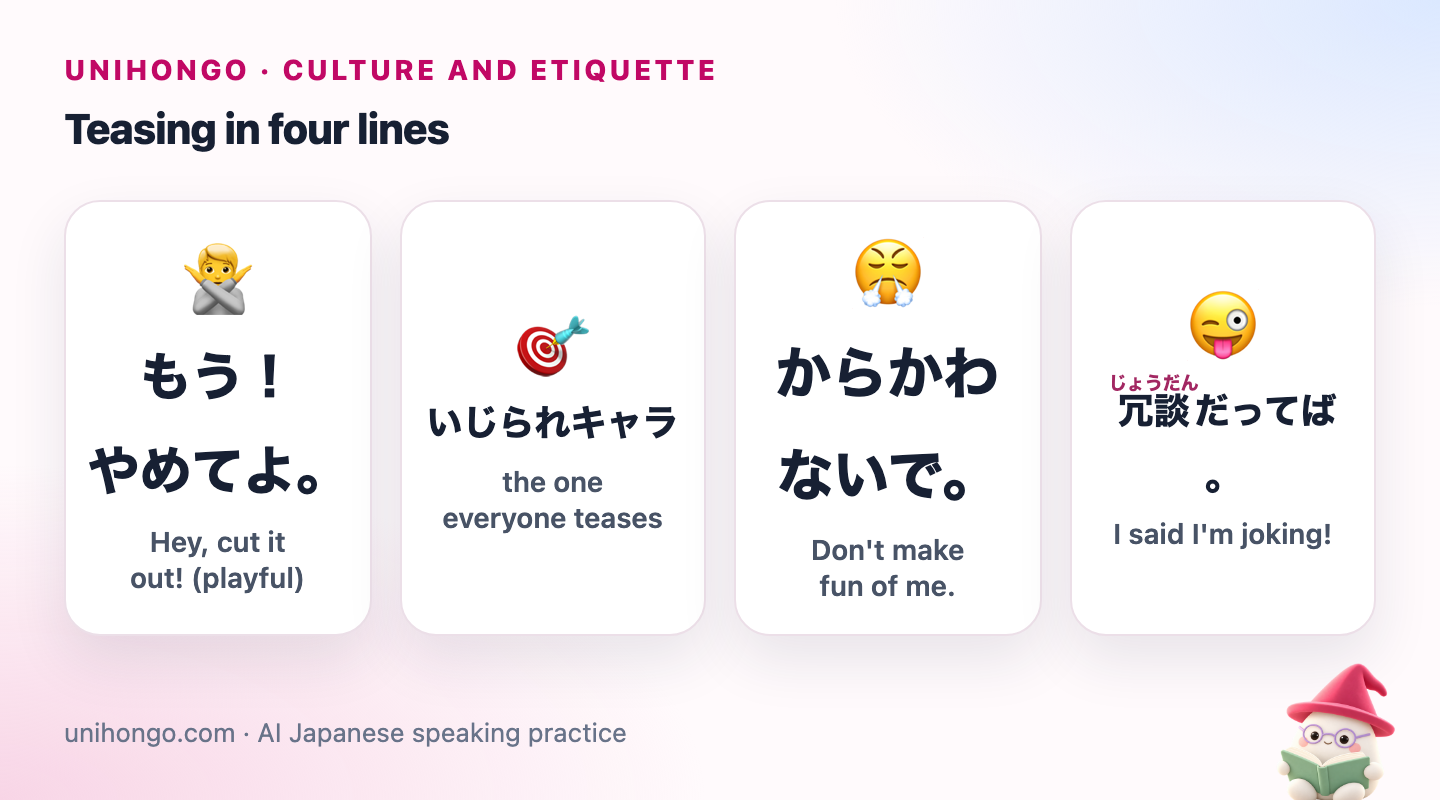
| Japanese | Romaji | Meaning |
|---|---|---|
| もう!やめてよ。 | Mō! Yamete yo. | Hey, cut it out! (playful) |
| いじられキャラ | ijirare kyara | the one everyone teases |
| からかわないで。 | Karakawanaide. | Don't make fun of me. |
| 冗談だってば。 | Jōdan da tte ba. | I said I'm joking! |
Ijiru: teasing that includes you
Ijiru's everyday meaning is to fiddle with something, such as your phone or your hair. Applied to people, it means to poke at someone's quirks for laughs: their accent, their clumsiness, their terrible taste in songs at karaoke. The idea is strongly shaped by Japanese comedy, where one performer plays the fool and the others react. In a friend group, being ijirareru, teased, often means you are noticed and accepted.
That does not mean all teasing is welcome. The spirit of ijiri is that the target laughs too and can push back. If that stops being true, the same words can feel very different.
| Japanese | Romaji | Meaning |
|---|---|---|
| またいじられてる。 | Mata ijirareteru. | They're teasing him again. |
| 私、すぐいじられるんだ。 | Watashi, sugu ijirareru n da. | I get teased all the time. |
| いじるのやめてよ。 | Ijiru no yamete yo. | Stop picking on me. (playful) |
| スマホいじってないで。 | Sumaho ijittenaide. | Stop fiddling with your phone. |
Karakau: making fun and pulling legs
Karakau is the more general verb. It covers a parent teasing a child, classmates making fun of a boy with a crush, and a friend telling you a ridiculous story to see whether you believe it. Karakawanaide, don't tease me, is what you say when you suspect someone is not serious, including when someone praises you too much.
Because karakau can also describe mean teasing, people tend to use ijiru for the affectionate group version and karakau when they want to complain about being made fun of.
| Japanese | Romaji | Meaning |
|---|---|---|
| からかわないでよ。 | Karakawanaide yo. | Stop pulling my leg. |
| またからかってるでしょ。 | Mata karakatteru desho. | You're teasing me again, aren't you? |
| またまた。 | Mata mata. | Oh, come on. (brushing off praise) |
| 子供の頃、よくからかわれた。 | Kodomo no koro, yoku karakawareta. | I was often teased as a child. |
Comebacks from soft to rough
The best response to friendly teasing is usually a quick, exaggerated protest with a smile. The words matter less than the timing and the grin. Here is a range, from safe with anyone you joke with to rough, for close friends only.
| Japanese | Romaji | Meaning |
|---|---|---|
| ひどい! | Hidoi! | That's so mean! (playful) |
| それ言う? | Sore iu? | You're really going to say that? |
| そっちこそ! | Socchi koso! | Look who's talking! |
| ケンには言われたくないな。 | Ken ni wa iwaretakunai na. | That's rich coming from you, Ken. |
| Comeback | Meaning | Tone |
|---|---|---|
| mō! | Hey! / Honestly! | Soft, works almost anywhere |
| yamete yo | Cut it out | Playful, casual |
| hidoi! | That's so mean! | Mock-hurt, playful |
| sore iu? | You're really going to say that? | Laughing disbelief |
| urusai nā | Oh, be quiet | Casual, teasing back |
| urusē | Shut up | Rough; close male friends |
With a senpai or someone older who teases you, keep the protest polite: kanben shite kudasai yo, give me a break, said with a laugh, is a classic.
Teasing lines you are likely to hear
Learners in Japan tend to be teased about the same few things: small slips in Japanese, an unexpectedly strong love of something very Japanese, and quirks of personality. Tennen (天然), literally natural, is a teasing label for someone who is charmingly spacey and says odd things without meaning to. It is usually affectionate.
A compliment can also be teasing in disguise. Nihonjin yori nihonjin ppoi, more Japanese than the Japanese, is said laughingly to a foreigner who loves natto or bows to the phone. Take it as a sign of warmth, and reply with a smile or a joke of your own.
The teasing often lands on the way you say things rather than what you say. Friends may repeat a word exactly as you pronounced it. This can feel uncomfortable at first, but it is usually an invitation to laugh together, and it is also free pronunciation feedback.
| Japanese | Romaji | Meaning |
|---|---|---|
| 天然だね。 | Tennen da ne. | You're such a space cadet. |
| またやってる。 | Mata yatteru. | You're doing it again. |
| 日本人より日本人っぽい。 | Nihonjin yori nihonjin ppoi. | More Japanese than the Japanese. |
| その言い方、かわいい。 | Sono iikata, kawaii. | The way you said that is cute. |
Scenario: when friends tease your accent
You are at an izakaya with friends. You order a beer, but you say biru (ビル, building) instead of bīru (ビール, beer), with the long vowel too short. The table bursts out laughing. It is the perfect moment to take the joke and send it back.
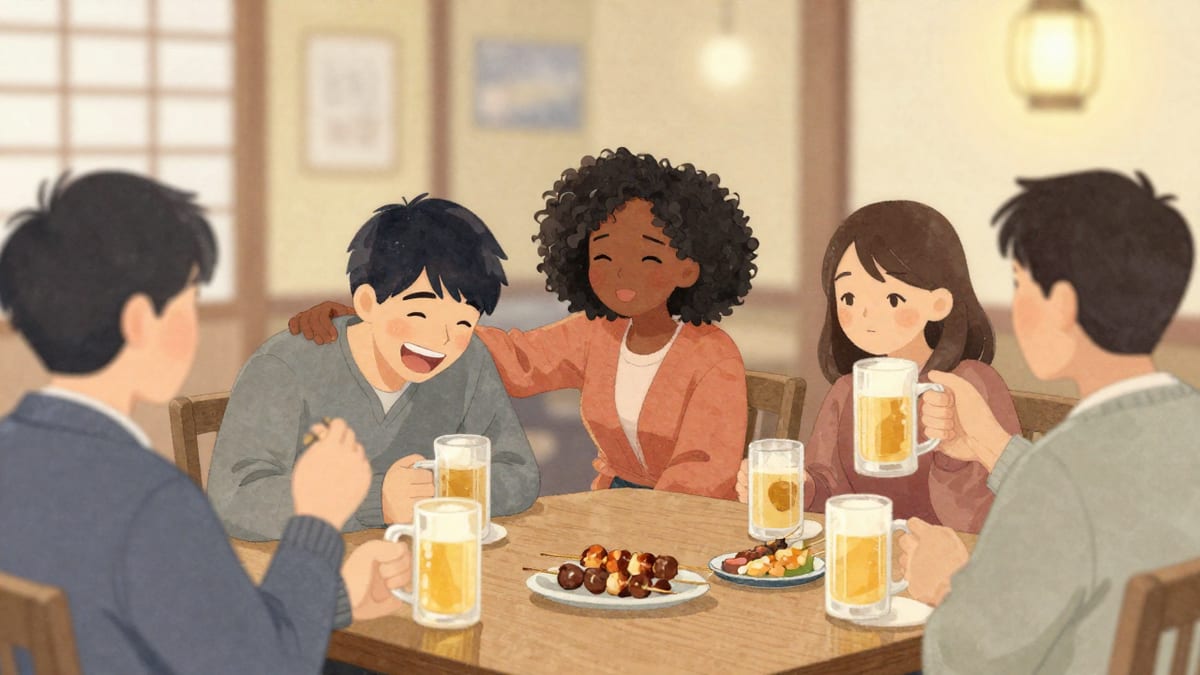
| Japanese | Romaji | Meaning |
|---|---|---|
| すみません、ビルください。 | Sumimasen, biru kudasai. | You: Excuse me, a building, please. |
| ビル?建物買うの? | Biru? Tatemono kau no? | Friend: A building? You're buying a building? |
| もう!いじらないでよ。 | Mō! Ijiranaide yo. | You: Hey! Stop teasing me. |
| ごめんごめん、冗談だよ。 | Gomen gomen, jōdan da yo. | Friend: Sorry, sorry, just kidding. |
| じゃあ、ビール!長く言ったよ! | Jā, bīru! Nagaku itta yo! | You: Then, beer! I said it long this time! |
Turning the mistake into the punchline is the most Japanese way out. You have taken the joke, shown you can laugh at yourself, and practised your long vowels at the same time.
When it stops being fun
Ijiri can slide into ijime (いじめ), bullying, when it becomes one-sided, repetitive, or aimed at something a person cannot change or is hurt by, such as appearance, family or nationality. Where exactly the line lies is a frequent topic of discussion in Japan, and people disagree. A simple test is whether the person being teased is still laughing and still free to tease back.
If teasing bothers you, it is fine to say so, and the clearer you are, the better. Japanese often softens refusals, so a gentle line said with a serious face is usually understood. If it continues, be direct.
| Japanese | Romaji | Meaning |
|---|---|---|
| それはちょっと嫌かな。 | Sore wa chotto iya ka na. | I'm not really okay with that one. |
| それ、あんまり好きじゃない。 | Sore, anmari suki ja nai. | I don't really like that. |
| 本当にやめて。 | Hontō ni yamete. | Seriously, stop. |
| ごめん、言いすぎた。 | Gomen, iisugita. | Sorry, I went too far. |
Teasing back without going too far
| Japanese | Romaji | Meaning |
|---|---|---|
| 勘弁してくださいよ。 | Kanben shite kudasai yo. | Give me a break. (to a senpai, laughing) |
| 冗談、冗談。 | Jōdan, jōdan. | Just kidding, just kidding. |
- Tease the moment, not the person: a funny slip is fair game, someone's body or family is not.
- Tease sideways and downwards with care, and upwards almost never: a senpai or a boss may tease you, but the reverse is risky until you are very close.
- Watch for the laugh. If the target goes quiet, stop and say gomen, iisugita.
- Do not copy rough comebacks such as urusē with people you have just met.
- Remember that a stiff, serious reaction to light ijiri can feel cold to the group. Laughing first, then protesting, keeps everyone comfortable.