

What konbanwa means and how to write it
Konbanwa is made of konban, this evening, and the particle wa, so the literal sense is as for this evening, with the rest of the sentence left unsaid, much like konnichiwa. Because the last syllable is the topic particle, it is written with は and pronounced wa. Writing こんばんわ is a common slip in casual messages, but it is an error in anything formal.
There is no polite and casual version to choose between: you say the same konbanwa to a shop assistant and to a neighbour's child. The politeness comes from your tone, a small bow and how you follow it up, not from the word.
Pronounce it with the two n sounds held rather than swallowed; said too quickly it turns into kobanwa.
| Japanese | Romaji | Meaning |
|---|---|---|
| こんばんは。 | Konbanwa. | Good evening. |
| こんばんは、田中です。 | Konbanwa, Tanaka desu. | Good evening, this is Tanaka. |
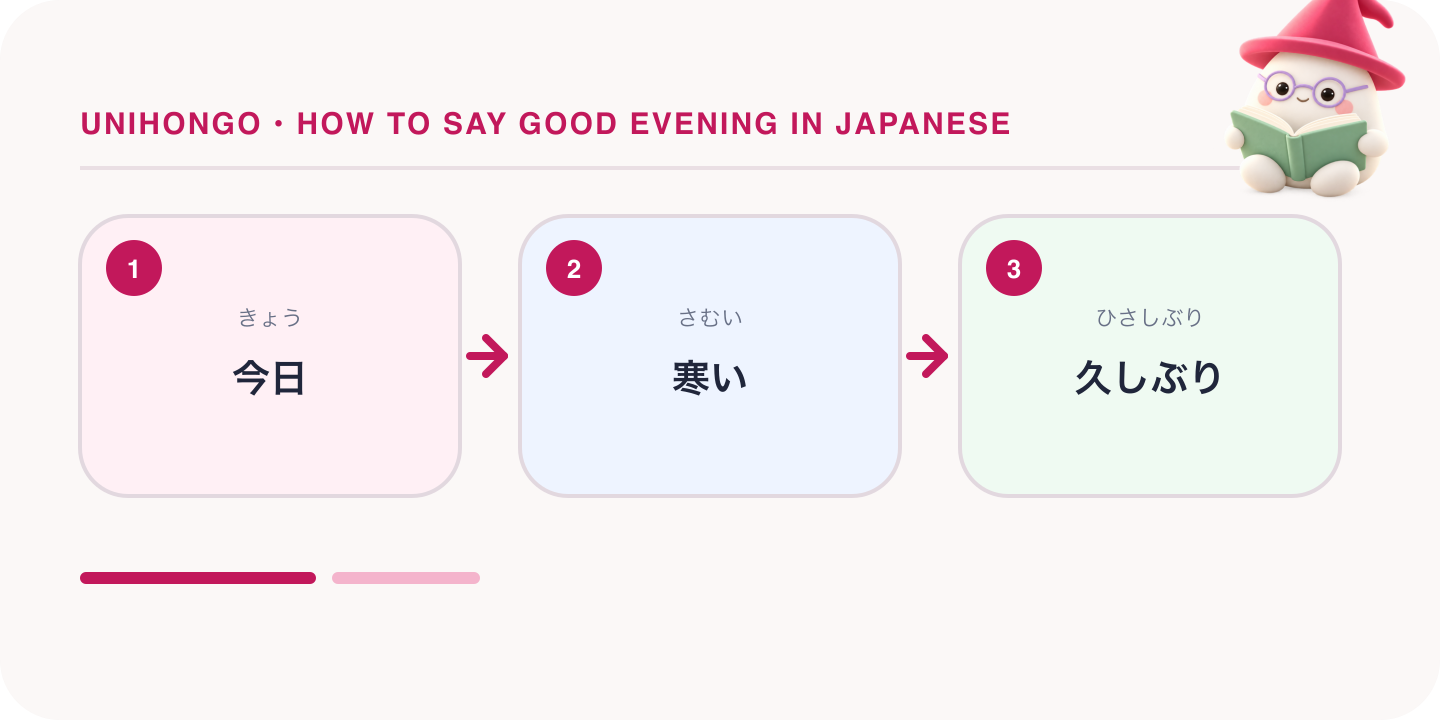
| こんばんは。今日は寒いですね。 | Konbanwa. Kyō wa samui desu ne. | Good evening. It's cold today, isn't it? |
| あ、こんばんは。お久しぶりです。 | A, konbanwa. O-hisashiburi desu. | Oh, good evening. It's been a while. |
| こんばんは。遅くにすみません。 | Konbanwa. Osoku ni sumimasen. | Good evening. Sorry for the late hour. |
When evening starts: the switch from konnichiwa
Japanese has no clock rule for the change from konnichiwa to konbanwa. The switch follows the light, so it moves with the seasons: from about five in midwinter, but well after six in midsummer. The practical test is simple: if it is dark enough that lights are on, konbanwa is right.
The grey zone is late afternoon in spring and autumn. Nobody will think you rude for using either greeting between five and six, and the easiest solution is to listen first and mirror whatever the other person chose. If you speak first and the sky is still bright, konnichiwa is safer, because konbanwa in daylight sounds odd while konnichiwa at dusk sounds merely a little late.
| Japanese | Romaji | Meaning |
|---|---|---|
| もう暗いから、こんばんはですね。 | Mō kurai kara, konbanwa desu ne. | It's already dark, so it's konbanwa now. |
| まだ明るいから、こんにちはでいい。 | Mada akarui kara, konnichiwa de ii. | It's still light, so konnichiwa is fine. |
| こんにちは。あ、もうこんばんはかな。 | Konnichiwa. A, mō konbanwa ka na. | Good afternoon. Oh, maybe it's good evening already. |
| 夕方五時ごろから「こんばんは」と言います。 | Yūgata goji goro kara konbanwa to iimasu. | People say konbanwa from around five in the evening. |
Who says konbanwa: neighbours yes, family no
The rule that surprises learners most is that konbanwa is a greeting for people outside your inner circle. It carries a hint of formality, the same feeling as saying good evening in English to someone you live with. A husband coming home does not say konbanwa to his wife; he says tadaima and hears okaeri. Close friends who meet at night say osoku natte gomen, or simply start talking.
Konbanwa lives instead in the spaces between households and teams. You say it to the neighbour you pass in the corridor, the landlord who comes to fix a tap, the parents of a friend, the staff at a restaurant, the teacher at an evening class, and anyone you meet for the first time after dark. It is also the standard opener for radio hosts and speakers at evening events.
The line is about relationship, not status. A student greeting a professor at an evening seminar says konbanwa; the same student meeting a housemate in the kitchen asks what they are cooking. Konbanwa to an intimate does not offend, but it creates a small, noticeable distance, which is why native speakers avoid it at home.
| Japanese | Romaji | Meaning |
|---|---|---|
| ただいま。 | Tadaima. | I'm home. |
| おかえり。ご飯できてるよ。 | Okaeri. Gohan dekiteru yo. | Welcome back. Dinner's ready. |
| こんばんは。いつもお世話になっています。 | Konbanwa. Itsumo o-sewa ni natte imasu. | Good evening. Thank you for always looking after us. |
| こんばんは、佐藤の母です。 | Konbanwa, Satō no haha desu. | Good evening, I'm Satō's mother. |
| 皆さん、こんばんは。 | Minasan, konbanwa. | Good evening, everyone. |
At work: why colleagues say otsukaresama instead
Greetings in Japanese workplaces mark the first meeting of the day, and after that the working relationship takes over. If you saw a colleague at nine in the morning, you do not greet them again at six; you say otsukaresama desu when you pass, which acknowledges the shared effort of the day. Konbanwa to a colleague you have worked beside since morning sounds as though you had forgotten you already met.
Konbanwa does appear at work in two cases: a client arriving for an evening meeting, and a call or email to another company after business hours, where it is a neutral start before the usual itsumo o-sewa ni natte orimasu. For insiders, even a night-shift colleague you meet as you leave, otsukaresama desu is preferred.
If you work evenings, the same principle applies in reverse: the first time you see a colleague in the shift, the greeting is ohayō gozaimasu, however dark it is. It marks the start of work rather than the morning, which is why night-shift staff say good morning at ten at night.
| Japanese | Romaji | Meaning |
|---|---|---|
| お疲れ様です。 | Otsukaresama desu. | Good work today. (evening greeting between colleagues) |
| お先に失礼します。 | O-saki ni shitsurei shimasu. | Excuse me for leaving before you. |
| おはようございます。今日もよろしくお願いします。 | Ohayō gozaimasu. Kyō mo yoroshiku onegai shimasu. | Good morning (at the start of a shift). Let's work well together today. |
| こんばんは。夜分に失礼します。 | Konbanwa. Yabun ni shitsurei shimasu. | Good evening. Apologies for contacting you at night. |
| こんばんは。本日はお越しいただきありがとうございます。 | Konbanwa. Honjitsu wa o-koshi itadaki arigatō gozaimasu. | Good evening. Thank you for coming today. |
Konbanwa versus oyasumi
Learners sometimes mix up konbanwa and oyasumi late in the evening. They do opposite jobs. Konbanwa is an arrival greeting: you say it when you meet, enter or call. Oyasumi nasai is a parting greeting: for someone going to bed, for leaving a friend's house late, or as the last message before sleep. Nobody says oyasumi on arriving, and nobody says konbanwa on leaving.
The audience also differs. Oyasumi is warm and used with everyone, most of all family and close friends, which is exactly where konbanwa is avoided. So the evening of a family often contains tadaima, okaeri and oyasumi, but never konbanwa. An evening with a neighbour contains konbanwa on meeting and a polite shitsurei shimasu or oyasumi nasai on parting.
Konbanwa has no leaving form of its own. To end a late encounter with an acquaintance, use shitsurei shimasu, or oyasumi nasai if they are clearly heading to bed. The guide on saying good night covers those parting forms in detail.
| Japanese | Romaji | Meaning |
|---|---|---|
| こんばんは。お邪魔します。 | Konbanwa. O-jama shimasu. | Good evening. Excuse me for coming in. |
| では、おやすみなさい。 | Dewa, oyasumi nasai. | Well then, good night. |
| 遅くまでありがとうございました。おやすみなさい。 | Osoku made arigatō gozaimashita. Oyasumi nasai. | Thank you for staying so late. Good night. |
| こんばんは。今日はありがとうございました。 | Konbanwa. Kyō wa arigatō gozaimashita. | Good evening. Thank you for today. |
| 失礼します。おやすみなさい。 | Shitsurei shimasu. Oyasumi nasai. | Excuse me, I'll be off. Good night. |
Evening greetings by situation
The table below puts the common evening situations side by side, so you can see where konbanwa fits and where another expression takes its place.
| Situation | Reading | What to say and why |
|---|---|---|
| 近所の人に会う | kinjo no hito ni au | Konbanwa, a neighbour is outside your household |
| 家に帰る | ie ni kaeru | Tadaima, and the family answers okaeri |
| 同僚とすれ違う | dōryō to surechigau | Otsukaresama desu, you already met that day |
| 夜勤の同僚に初めて会う | yakin no dōryō ni hajimete au | Ohayō gozaimasu, the start of the shift |
| 店に入る | mise ni hairu | Staff say irasshaimase, you may reply konbanwa |
| 夜に取引先に電話する | yoru ni torihikisaki ni denwa suru | Konbanwa, then yabun ni shitsurei shimasu |
| 友達の家に着く | tomodachi no ie ni tsuku | Konbanwa to the parents, o-jama shimasu at the door |
| 親しい友達と会う | shitashii tomodachi to au | Osoku natte gomen or just start talking |
| 寝る前に別れる | neru mae ni wakareru | Oyasumi nasai, the parting form |
| 配信やゲームに入る | haishin ya gēmu ni hairu | Konbanwa in the chat to greet the room |
Notice that in most rows the choice depends on relationship and on whether you are arriving or leaving, not on the clock. Once you hold those two questions in mind, the greeting almost chooses itself.
Shops, phones and messages
In shops and restaurants the staff greet first with irasshaimase. A nod is enough in reply, but konbanwa is a friendly, natural answer after dark, and a regular at a small restaurant or bar will often say konbanwa as they walk in. Staff may return it, or say irasshaimase again.
On the phone, konbanwa is a polite opener when you call someone outside your circle after dark: a restaurant, a landlord, a friend's parents. Follow it with your name and, if it is late, a short apology for the hour, yabun ni sumimasen. When the call is to a company in business hours, even in winter darkness, itsumo o-sewa ni natte orimasu replaces the greeting.
In text messages, konbanwa signals politeness and a little distance, just as in speech. It is right in a message to a teacher, a landlord or a colleague at another company. Between friends it is normally skipped, and opening with konbanwa can make a friend wonder what is wrong.
| Japanese | Romaji | Meaning |
|---|---|---|
| こんばんは。予約をお願いしたいのですが。 | Konbanwa. Yoyaku o onegai shitai no desu ga. | Good evening. I'd like to make a reservation. |
| こんばんは、二人です。 | Konbanwa, futari desu. | Good evening, a table for two. |
| 夜分にすみません。山田と申します。 | Yabun ni sumimasen. Yamada to mōshimasu. | Sorry to call at night. My name is Yamada. |
| こんばんは。明日の授業の件でご連絡しました。 | Konbanwa. Ashita no jugyō no ken de go-renraku shimashita. | Good evening. I'm writing about tomorrow's class. |
| こんばんは!今日も配信ありがとう。 | Konbanwa! Kyō mo haishin arigatō. | Good evening! Thanks for streaming again today. |
| こんばんは、初見です。 | Konbanwa, shoken desu. | Good evening, first time watching. |
Konbanwa online and the mistakes to avoid
Online, konbanwa is used more freely. Viewers joining a live stream type konbanwa into the chat to greet the streamer and the room, and streamers greet newcomers back by name. In online games a quick konbanwa when you join a party is normal even among regulars, because the room mixes strangers and acquaintances. Some communities shorten it to ばんわ, which is fine in chat but nowhere formal.
The mistakes that mark a learner are consistent, and each has an easy fix.
- Write こんばんは with は; save こんばんわ for casual chat at most
- Skip konbanwa with family and housemates; use tadaima and okaeri
- Use otsukaresama desu for colleagues you have already seen that day
- Never use konbanwa to leave; that is oyasumi nasai or shitsurei shimasu
- Follow the light, not the clock, when switching from konnichiwa
- In chats and streams, konbanwa on joining is normal and friendly
If you use the wrong greeting, there is no need to apologise. Japanese people rarely comment on a learner's greetings, and getting the next one right is all the repair needed.