

Mō ichido: the standard phrase
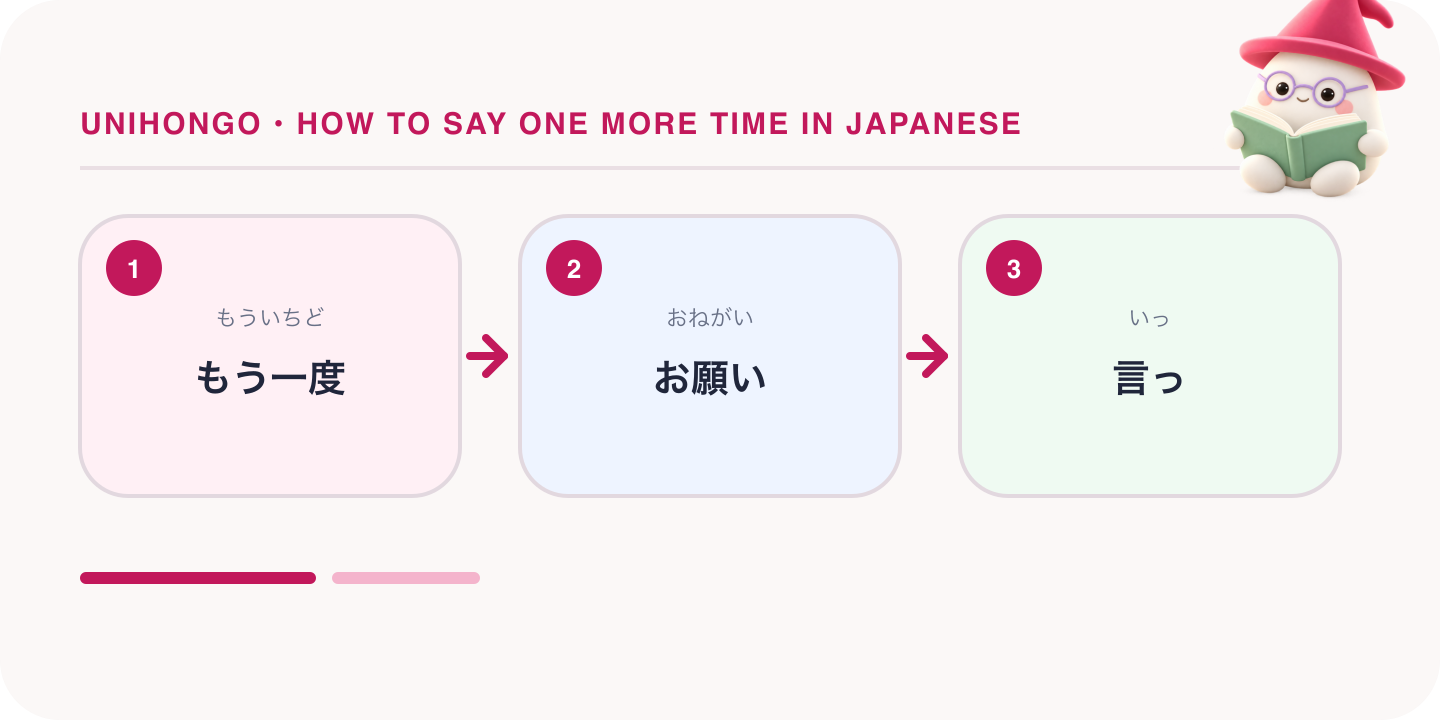
もう一度 (mō ichido) combines mō, more or again, with ichido, one time. On its own it means once more, and with o-negai shimasu it becomes a polite request: mō ichido o-negai shimasu, one more time, please. Adding sumimasen, excuse me, at the start makes it even smoother and is what most people do when they miss something at a counter or on the phone.
Mō ichido is neutral enough for almost any situation: a shop, a station, a classroom, a job interview. If you learn only one phrase from this guide, make it this one.
| Japanese | Romaji | Meaning |
|---|---|---|
| もう一度お願いします。 | Mō ichido o-negai shimasu. | One more time, please. |
| すみません、もう一度お願いします。 | Sumimasen, mō ichido o-negai shimasu. | Sorry, could you say that again? |
| もう一度言ってください。 | Mō ichido itte kudasai. | Please say it again. |
| もう一度言っていただけますか。 | Mō ichido itte itadakemasu ka. | Could you say that again, please? |
| もう一度言っていただけませんか。 | Mō ichido itte itadakemasen ka. | Would you mind saying that once more? (very polite) |
Mō ikkai and casual ways to ask
もう一回 (mō ikkai) means the same as mō ichido but feels more everyday. Friends say mō ikkai itte, say it again, or just mō ikkai? with a rising tone. It is also what people shout at concerts for an encore and what children say when they want to play a game again.
When you simply did not catch something, casual Japanese often skips the phrase altogether. A surprised え? (e?) or なに? (nani?) is how friends ask each other to repeat. Nante?, what did you say?, is also common. These are fine with friends and family, but too blunt for strangers.
| Japanese | Romaji | Meaning |
|---|---|---|
| もう一回言って。 | Mō ikkai itte. | Say it again. |
| え? | E? | Huh? / Sorry? |
| なに? | Nani? | What? |
| 今なんて言った? | Ima nante itta? | What did you just say? |
| ごめん、聞こえなかった。 | Gomen, kikoenakatta. | Sorry, I didn't hear you. |
Asking someone to slow down
Often the problem is speed, not volume. ゆっくり (yukkuri) means slowly, and mō sukoshi yukkuri o-negai shimasu, a little more slowly, please, is a very natural request. Most people are glad to help once they know you are learning.
If you want to explain why, say nihongo ga mada heta nanode, because my Japanese is still weak. Heta is modest here; nobody will think less of you. Alternatively, ask for key information in writing: kaite itadakemasu ka, could you write it down?
| Japanese | Romaji | Meaning |
|---|---|---|
| もう少しゆっくりお願いします。 | Mō sukoshi yukkuri o-negai shimasu. | A little more slowly, please. |
| ゆっくり話していただけますか。 | Yukkuri hanashite itadakemasu ka. | Could you speak slowly? |
| 日本語がまだ下手なので、ゆっくりお願いします。 | Nihongo ga mada heta nanode, yukkuri o-negai shimasu. | My Japanese isn't very good yet, so slowly, please. |
| もう少し大きい声でお願いします。 | Mō sukoshi ōkii koe de o-negai shimasu. | A little louder, please. |
| 書いていただけますか。 | Kaite itadakemasu ka. | Could you write it down? |
| 簡単な日本語でお願いします。 | Kantan na nihongo de o-negai shimasu. | In simple Japanese, please. |
Asking about a word you didn't understand
Sometimes you heard every sound but one word is unfamiliar. Repeat the word and add tte nan desu ka, what does ... mean? For example, jūsho tte nan desu ka, what is jūsho? This tells the speaker exactly where the problem is, which is more helpful than asking for the whole sentence again.
You can also ask about a part of the sentence: ___ no ato wa?, what came after ___? This is especially useful for addresses, times and directions.
| Japanese | Romaji | Meaning |
|---|---|---|
| すみません、「じゅうしょ」って何ですか。 | Sumimasen, "jūsho" tte nan desu ka. | Sorry, what does jūsho mean? |
| それはどういう意味ですか。 | Sore wa dō iu imi desu ka. | What does that mean? |
| 「右」の後は何ですか。 | "Migi" no ato wa nan desu ka. | What came after right? |
| 別の言い方で言っていただけますか。 | Betsu no iikata de itte itadakemasu ka. | Could you put it another way? |
| 漢字で書くとどうなりますか。 | Kanji de kaku to dō narimasu ka. | How is it written in kanji? |
Confirming what you heard
Japanese speakers confirm details constantly, especially on the phone and at counters. The easiest method is to repeat the key information and add desu ne, with a slight rise: sanji desu ne?, three o'clock, right? Staff do this too, so you will hear it as often as you say it.
For something longer, use to iu koto desu ka, so you mean that...? It shows you understood and gives the other person a chance to correct you. Kakunin shimasu, let me confirm, is a polite way to introduce a summary.
| Japanese | Romaji | Meaning |
|---|---|---|
| 三時ですね。 | Sanji desu ne. | Three o'clock, right? |
| 二番線ですね。 | Niban-sen desu ne. | Platform two, right? |
| 確認します。明日の十時ですね。 | Kakunin shimasu. Ashita no jūji desu ne. | Let me confirm. Tomorrow at ten, correct? |
| つまり、今日は無理ということですか。 | Tsumari, kyō wa muri to iu koto desu ka. | So you mean today isn't possible? |
| これで合っていますか。 | Kore de atte imasu ka. | Is this right? |
What people say back
When you ask for a repeat, people usually say hai, of course, and repeat more slowly. Shop and station staff may rephrase with simpler words or point to a sign. When you confirm something, the replies are short: hai, sō desu, yes, that's right, or iie, correcting you.
| Japanese | Romaji | Meaning |
|---|---|---|
| はい、もちろんです。 | Hai, mochiron desu. | Yes, of course. |
| はい、そうです。 | Hai, sō desu. | Yes, that's right. |
| いえ、四時です。 | Ie, yoji desu. | No, it's four o'clock. |
| 失礼しました。 | Shitsurei shimashita. | Sorry about that. |
| もう一度申し上げます。 | Mō ichido mōshiagemasu. | I'll say it once more. (formal) |
| 大丈夫ですよ。 | Daijōbu desu yo. | No problem. |
Mō ichido beyond repeating words
Mō ichido and mō ikkai are not only about speech. They mean once more for any action: trying again, visiting again, playing again or ordering another round. The pattern is the same, followed by a verb.
| Japanese | Romaji | Meaning |
|---|---|---|
| もう一回やってみよう。 | Mō ikkai yatte miyō. | Let's try once more. |
| もう一度挑戦します。 | Mō ichido chōsen shimasu. | I'll try again. |
| もう一度行きたいです。 | Mō ichido ikitai desu. | I want to go again. |
| もう一杯お願いします。 | Mō ippai o-negai shimasu. | One more drink, please. |
| もう一回! | Mō ikkai! | Encore! / Again! |
Common mistakes when asking for a repeat
- Saying nani? or e? to strangers. Among friends it is fine, but at a counter it sounds abrupt; use sumimasen, mō ichido o-negai shimasu.
- Saying wakarimasen, I don't understand, when you only missed one word. It can sound like you understood nothing. Ask about the specific word instead.
- Pretending to understand. Nodding and saying hai can lead to the wrong train or wrong appointment time. Asking once more is normal and expected.
- Asking for a repeat three times with the same phrase. After the second time, ask them to slow down, write it down or put it another way.
- Using mō ichido when you want more of something. Mō ichido means once more; for a bit more food or time, say mō sukoshi, and for one more item, mō hitotsu.
- Forgetting to thank them afterwards. A quick arigatō gozaimasu or wakarimashita, arigatō gozaimasu closes the exchange politely.